Exclusive
Kashkuli
324 × 250 cm
9.750 €

Bold Tribal Designs with Modern Appeal
Lori and Gabbeh rugs come from the nomadic and village weaving of south-western Iran, above all the province of Fars around Shiraz and the Zagros mountains, where Qashqai and Lori (Luri) families have woven for generations. "Gabbeh" means roughly "raw" or "unclipped" in Persian and describes the long, barely trimmed pile; "Loribaft" simply means "Lori weave". Both began as rugs made for the weaver's own household, and both are still knotted entirely by hand.
The two share a region but not a structure. A Gabbeh is coarse and thick: traditionally a wool foundation, several weft passes between each row of knots and a long pile. The Gabbehs in this collection are knotted on wool warps at typically 72,000 to 90,000 knots per square metre. The result is a soft, heavy, almost cushioned rug. A Loribaft is the finer relative, knotted far more densely, with a shorter, firm pile that holds sharper drawing; the Iranian Loribaft rugs in this collection mostly have a wool warp and typically 200,000 to 250,000 knots per square metre.
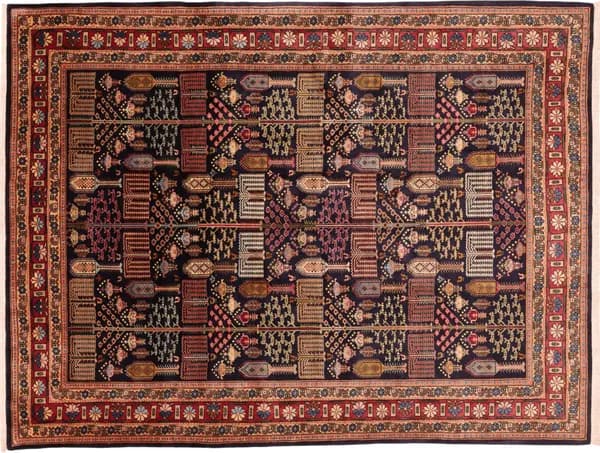
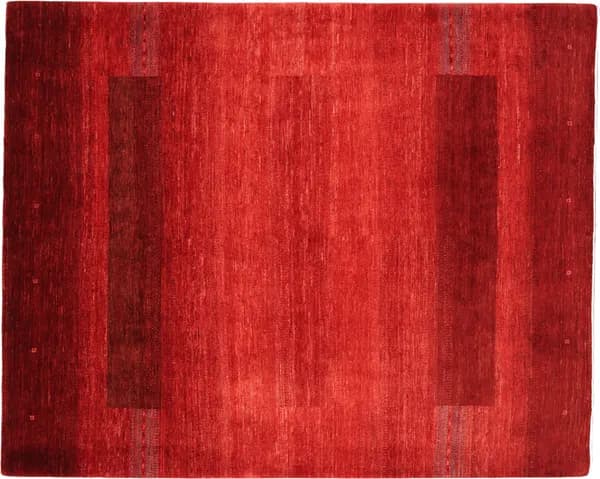
A Gabbeh is easy to recognise by its open field: large areas of one colour, often with visible shading (abrash) from small batches of wool, and a few simple motifs set into it, such as animals, trees, figures or a small stepped medallion. The design is woven from memory rather than from a drawn cartoon, so proportions are free and every piece differs. Loribaft designs are more ordered: stepped geometric medallions, compartments, stripes and borders, still bold and graphic but laid out with more symmetry. Both suit contemporary rooms because their patterns are spare and their colours strong.
When choosing, look at the wool: hand-spun wool has a slightly irregular thread and a natural sheen that gives the colour its depth. Shading within one colour is normal and part of the character. Check that the pile is evenly clipped, that the rug lies flat and that the sides run straight. On a Gabbeh, the thickness and weight of the pile are the point, so feel it; on a Loribaft, the crispness of the motif edges shows how densely it was knotted. Rugs in the Loribaft style are also woven in India, on a cotton warp; for those pieces the rug's own page names India as the country of origin.
Read the guide: What is a Lori-Pars rug?
See Lori & Gabbeh rugs in Hamburg: our Speicherstadt showroom
Also known as
Gabbeh, Loribaft, Luribaft, Luri
Gabbeh Shouli · Kashkuli · Ghaschghai · Bakhtiar · Nimbaft
More to Explore