Gabbeh
327 × 236 cm
3.600 €






2.805 €
Incl. VAT
In Stock · Ready to Ship
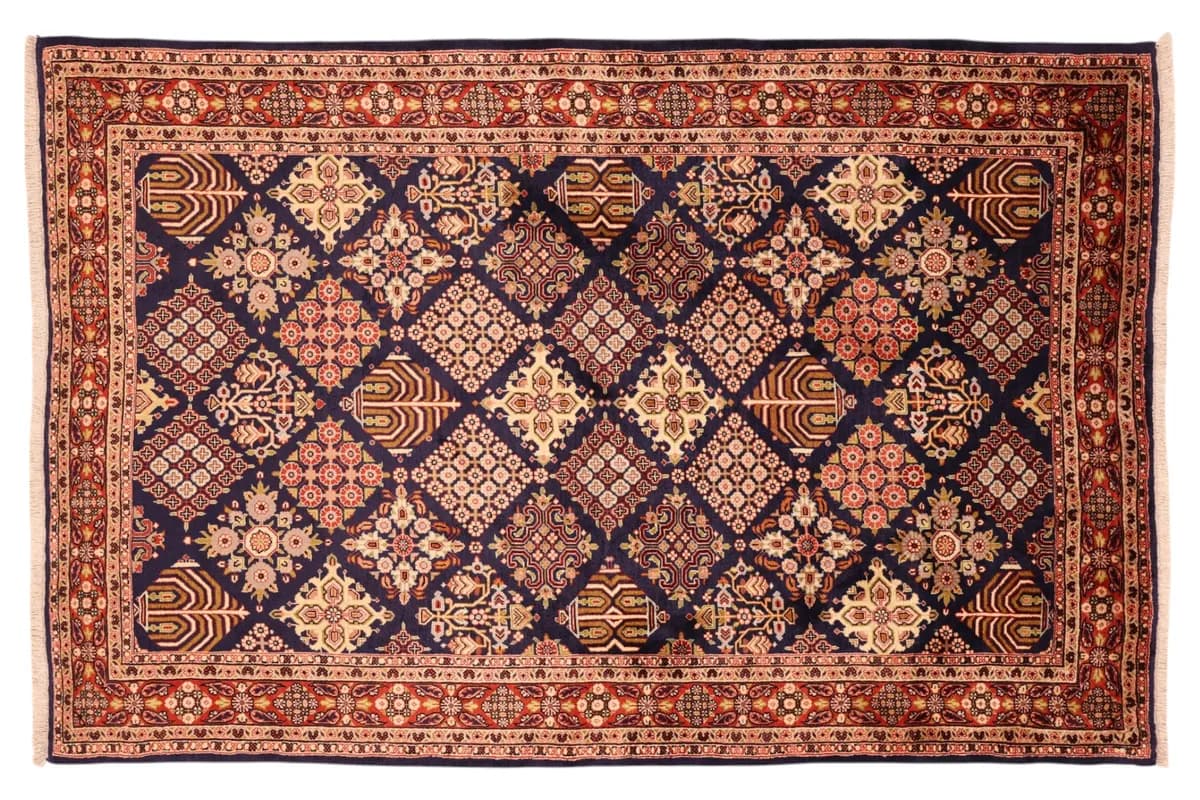
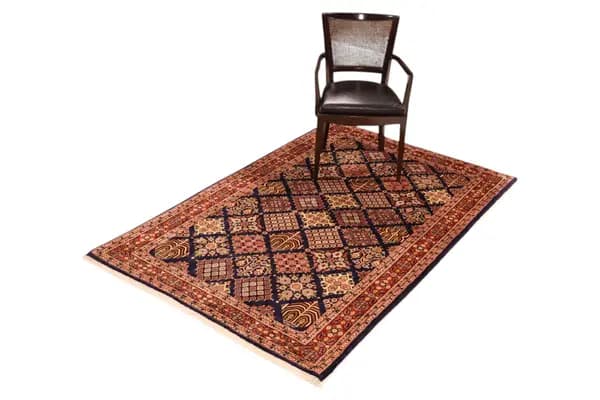
This is a Meymeh, also written Meimeh, a village rug from the highlands between Isfahan and Kashan, 213 x 140 cm (7'0" x 4'7"). The town wove for the Safavid court and kept its habit of precise, architectural drawing even once weaving moved out into the surrounding villages. Meymeh rugs are known for diamond medallions nested one inside another, a layered structure said to echo the valley's own marble and iron hills.
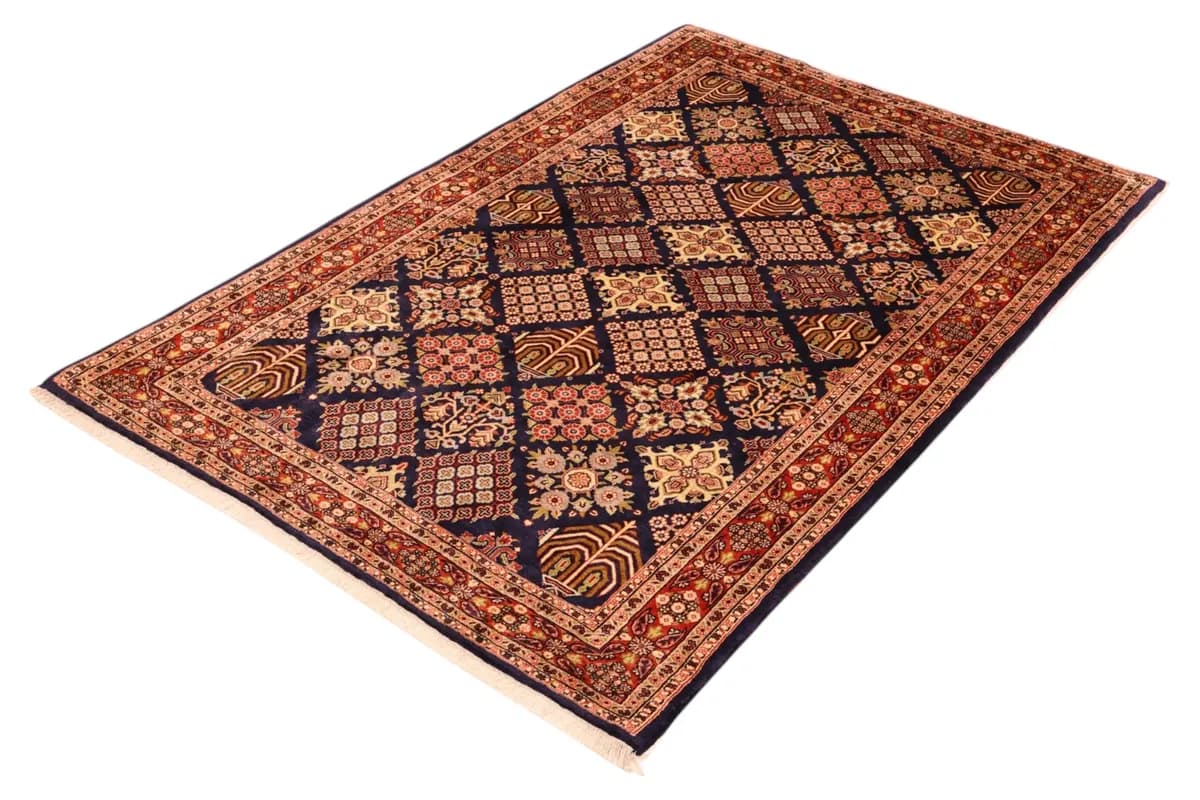
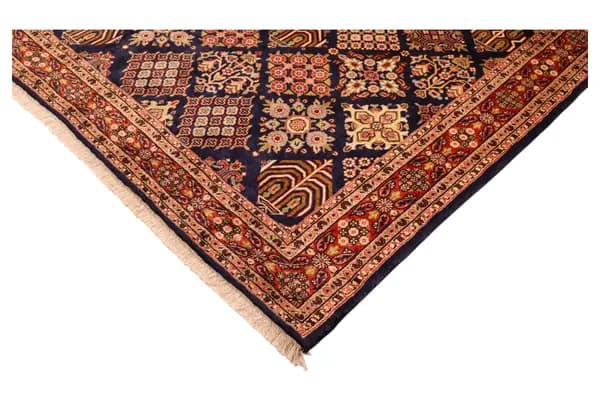
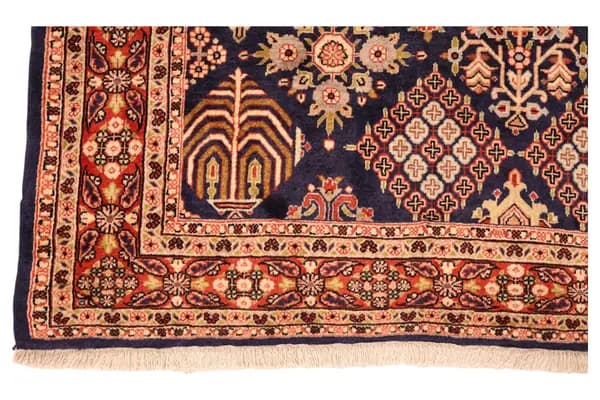
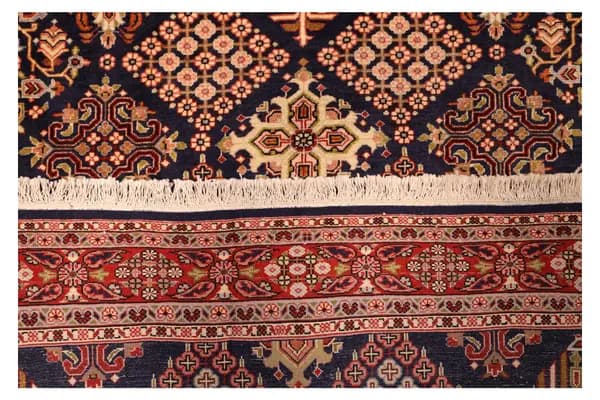
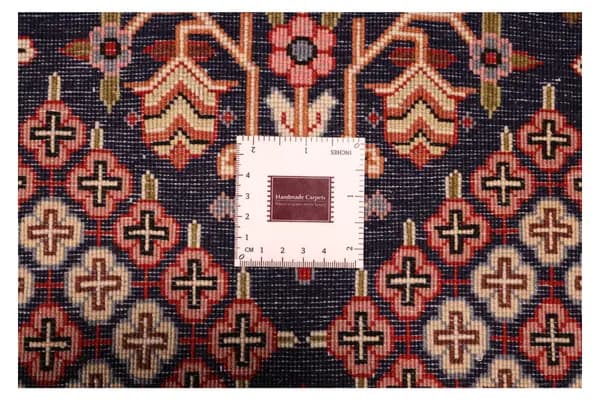
A deep navy field carries the eye first, crossed by a fine diamond lattice in the Mahi manner. Each compartment holds its own small pattern — a rosette, a stepped cross, a striped geometric — rather than one repeating motif, so the field reads like a collection of pieces rather than a single uniform repeat. A wide brick-red border of floral scrollwork closes the composition, framed by narrow cream and dark guard lines, making up close to a fifth of the whole rug.
That variation is a village habit rather than a workshop one: the lattice was drawn freehand, compartment by compartment, each motif worked from memory rather than from a fixed cartoon. The wool is hand-spun and knotted onto a cotton foundation at 321,000 to 380,000 knots per square metre, enough to keep each small motif crisp and distinct from its neighbour. A twelve-millimetre pile gives the surface a soft, matte depth, wool rather than silk, so the light draws out warmth rather than sheen.
A rug this size suits a bedroom, or a quiet corner of a study, somewhere it can be looked at as much as walked across. The navy grounds a pale floor and holds its own against dark furniture, while the brick red and mustard keep the room from turning cold. Underfoot the pile is soft and dense, made for daily use rather than for display, and the sampler of small patterns keeps offering something new to notice as the light moves across it through the day.
Meymeh rugs come from the small town of Meymeh, about 100 km north of Isfahan in central Iran. Part of the historic Josheghan weaving trio, they are knotted on cotton foundations with wool pile dyed using natural plant colours. Meymeh pieces occupy the fine quality tier within this group, with a Safavid-era weaving heritage dating back to the 16th century.
The distinctive hexagonal medallion designs combine floral and geometric elements in an unusual harmony, a pairing rarely seen in other Persian rug types. Rich burgundy red dominates, complemented by blue, green, and ivory. The drawing appears rustic at first glance but reveals surprising precision.
Superior craftsmanship
At 213 × 140 cm (2.98 m²) this is a medium rug. It works in front of a sofa, in front of a bed or in a study. It is too small for a dining table — there you want about 80 cm of clearance so a chair does not tip over the edge when pushed back.
Yes, knotted by hand — knot by knot on a loom, not machine-made. The density is 321,000 to 380,000 knots per square metre; across 2.98 m² that is roughly 1.0 to 1.1 million individual knots, every one of them tied by hand.
Hand-spun wool still carries its own lanolin, which keeps liquid sitting on the surface for a moment: blot quickly, with clear water and a light cloth, working inwards and without rubbing. Otherwise regular vacuuming along the pile is enough. Turn the rug once or twice a year so light and footfall reach it evenly.
We are in the Hamburg Speicherstadt. Come and see this rug in daylight, or write to us — a person answers.
Certificate included verifying origin, materials, and craftsmanship.
Ref: 346775