Signed
Kashan | Signed
250 × 202 cm
5.700 €








2.850 €
Incl. VAT
In Stock · Ready to Ship
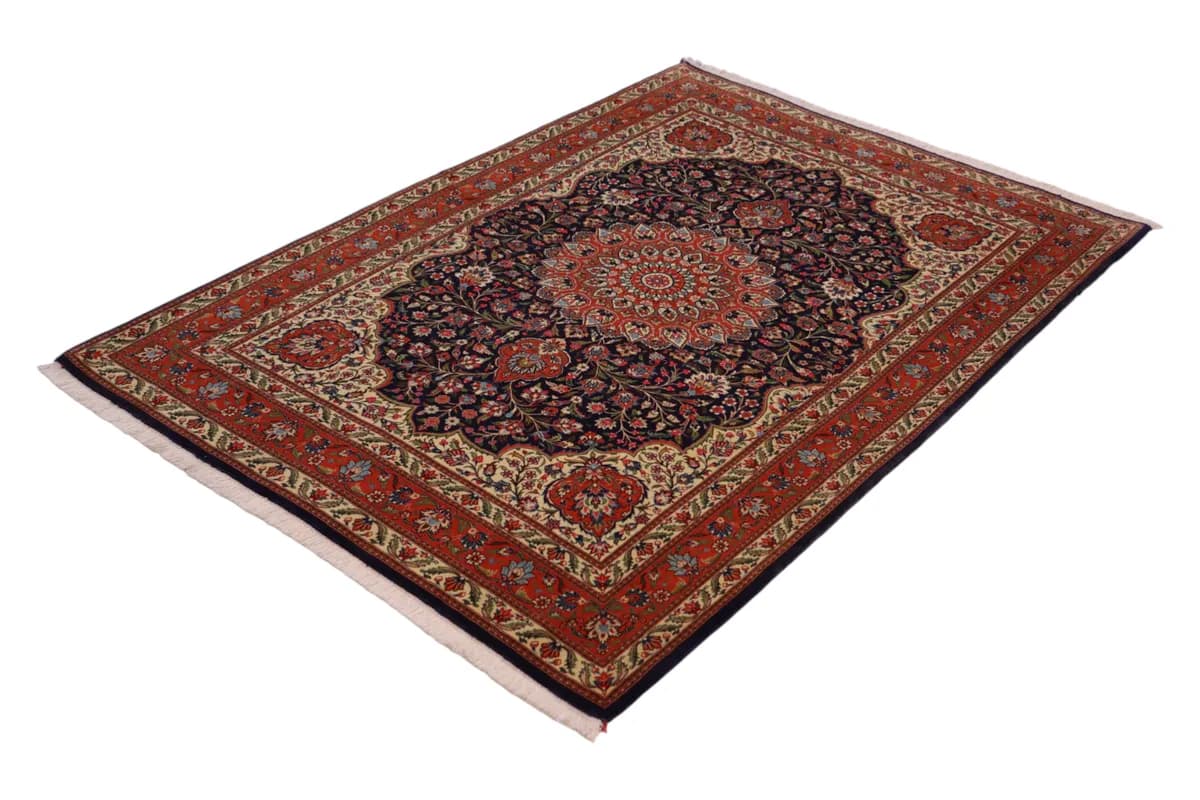
This is a hand-knotted tribal weaving from Zabol, also written Zabul, in Iran's Sistan and Baluchestan province, one of the oldest continuously woven corners of the Persian world. Rugs from this remote southeastern region are usually built from bold, angular tribal geometry in earthy natural dyes. This piece measures 222 x 153 cm (7'3" x 5'0"), and it takes an altogether different, more classical direction.
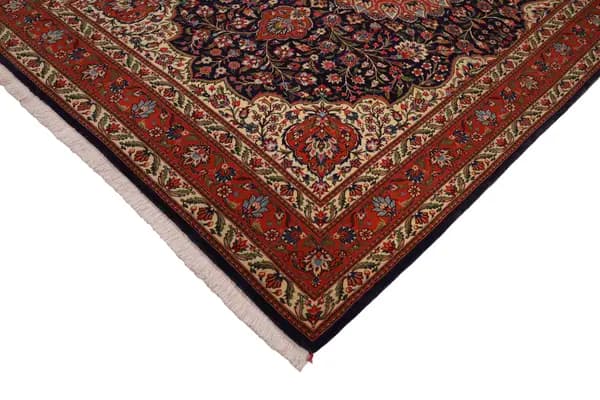
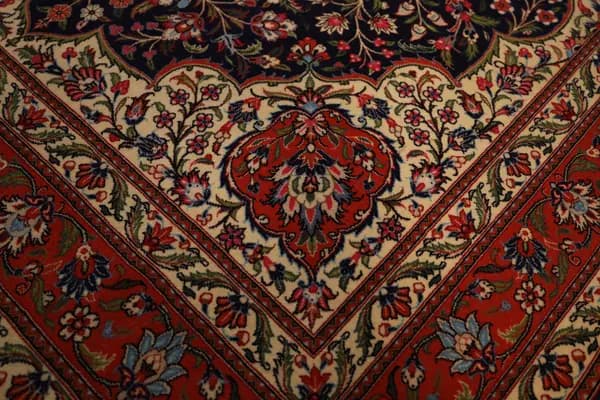
A deep navy field carries a dense scatter of small florals in olive, powder blue and dark rose, and at its centre glows a red sunburst medallion outlined in cream. The same brick red returns in the four corner spandrels, giving the composition a symmetry more often drawn to a workshop plan than knotted from memory. A wide ivory border, close to a fifth of the rug's width, carries red palmettes and a fine trace of olive vining. Against the navy, medallion and florals read with unusual clarity, where on a redder ground they would simply blend.
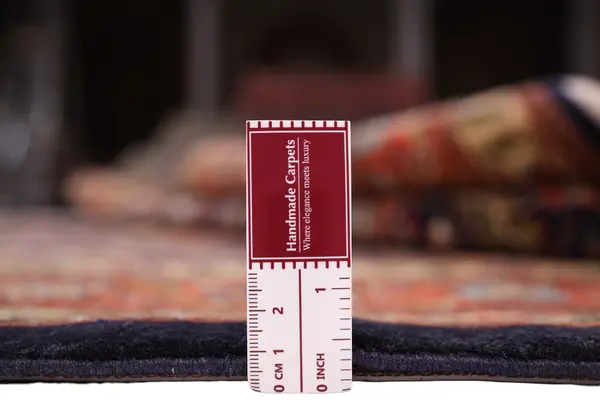
The wool is hand-spun, its thread slightly uneven, and that unevenness is what gives the surface its faint, shifting sheen, strongest across the medallion. At 201,000 to 250,000 knots per square metre, the density is enough to hold a medallion and border this defined, unusual for a design carried from memory rather than a drawn plan on the loom. A pile kept to 12 millimetres stays short and even, so the sunburst sits forward on the surface rather than receding into depth, and light catches it directly.
In a living room, laid before a sofa or a quiet armchair, the navy ground holds its own against dark furniture and warms a pale floor without the heat of a redder rug. Underfoot the wool is dense, short and firm, made to be walked on rather than kept for best. As afternoon light crosses the room, the sheen in the medallion catches it, and the sunburst seems to glow a little brighter before settling back into the navy.
Baluch rugs are tribal weavings from the Baloch people of eastern Iran, primarily Khorasan and Sistan-Baluchestan provinces, as well as neighbouring regions in Afghanistan and Pakistan. Knotted with the asymmetrical (Persian) knot, traditionally on an all-wool foundation, they are immediately recognisable by their dark, rich palette of deep reds, indigo blues, and dark browns with ivory and orange accents.
Geometric tribal motifs, rows of small guls, diamonds, and angular rosettes, dominate the design language. Prayer rug layouts with the tree-of-life motif appear frequently. Typically small-format pieces, Baluch rugs are woven from the weavers' own flocks, sometimes incorporating goat hair and natural camel-hair fields.
Fine quality weave
At 222 × 153 cm (3.40 m²) this is a medium rug. It works in front of a sofa, in front of a bed or in a study. It is too small for a dining table — there you want about 80 cm of clearance so a chair does not tip over the edge when pushed back.
Yes, knotted by hand — knot by knot on a loom, not machine-made. The density is 201,000 to 250,000 knots per square metre; across 3.40 m² that is roughly 680,000 to 850,000 individual knots, every one of them tied by hand.
Hand-spun wool still carries its own lanolin, which keeps liquid sitting on the surface for a moment: blot quickly, with clear water and a light cloth, working inwards and without rubbing. Otherwise regular vacuuming along the pile is enough. Turn the rug once or twice a year so light and footfall reach it evenly.
We are in the Hamburg Speicherstadt. Come and see this rug in daylight, or write to us — a person answers.
Certificate included verifying origin, materials, and craftsmanship.
Ref: 658418