Gholtough
127 × 74 cm
795 €





455 €
Incl. VAT
In Stock · Ready to Ship
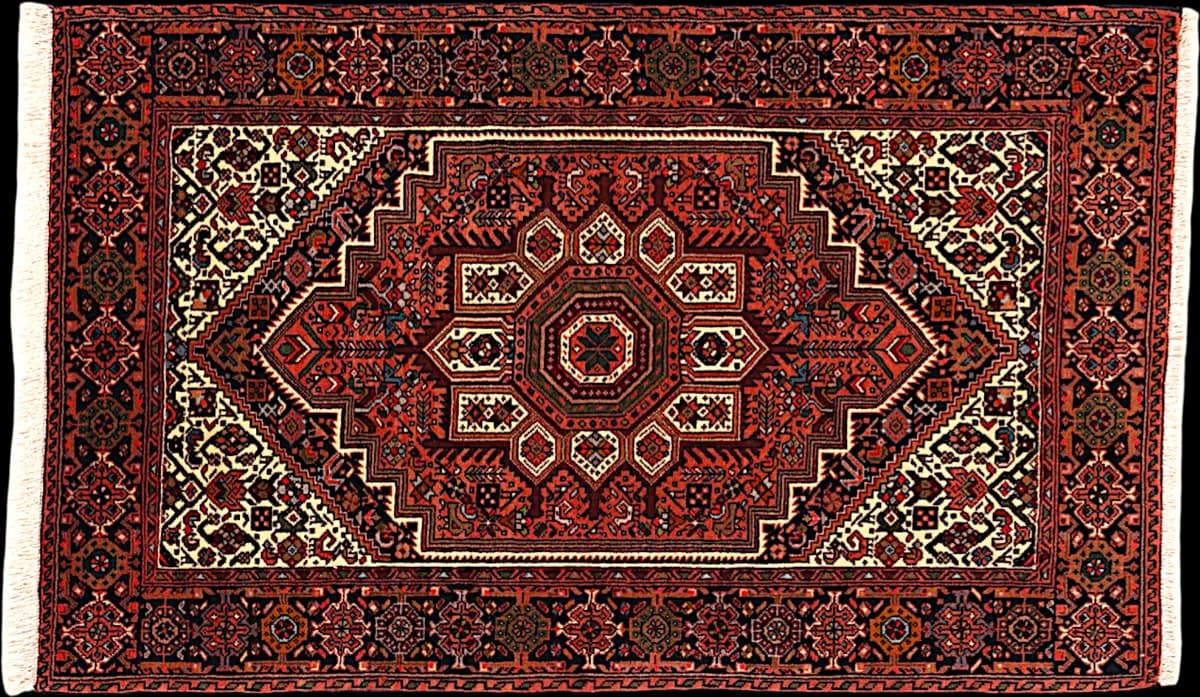
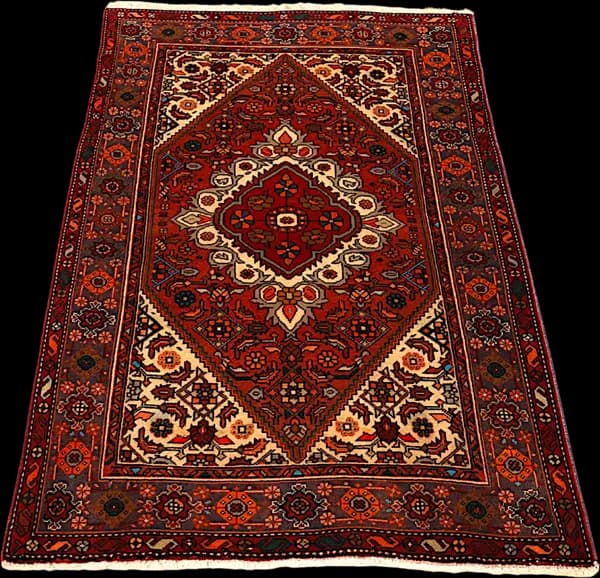
This is a Gholtough, also written Goltugh, a village rug from the Kurdish region of western Iran, sized 122 x 75 cm (4'0" x 2'6"). Gholtough weavers work in bold, freehand geometric designs and a rich, earthy palette, closer in spirit to nomadic weaving than to a workshop's drawn cartoon. What sets this piece apart is how cleanly its medallion is drawn, for a tradition that usually favours a looser hand.
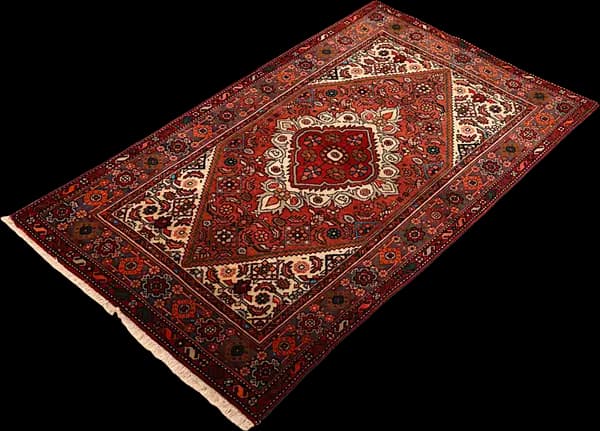
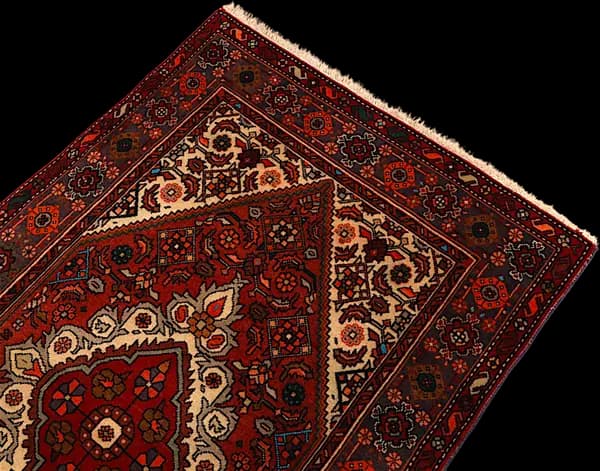
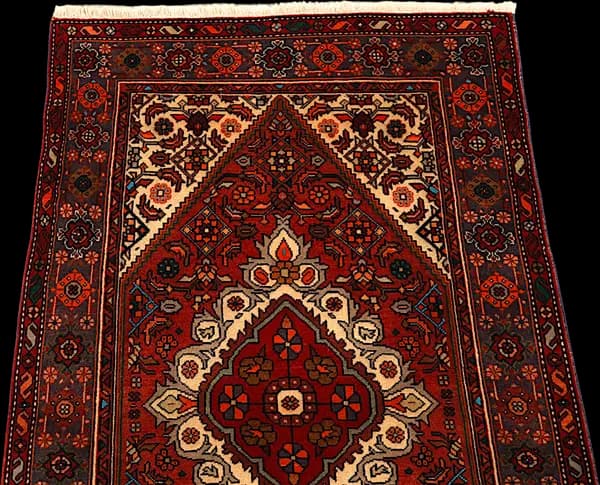
The field is a deep brick red, and a large lozenge medallion with a jagged edge sits at its centre. Look closer and it proves to be built in two layers: a cream outer diamond framing a smaller, dark burgundy one, its rosettes touched with rust, slate-blue and teal. Floral sprays fill the four corners of the red field, and a broad navy-grey border of small geometric rosettes closes the design, taking up close to a fifth of the rug.
The rug is hand-knotted with the symmetric knot, on a cotton foundation, using hand-spun wool for the pile. Hand-spinning never comes out perfectly even, and it is this that gives the red field its depth, taking the dye with small variations rather than lying flat. At 201,000 to 250,000 knots per square metre, the density is modest for a Kurdish loom, but on a rug this size it was enough to hold the double medallion's edges sharp and true.
At 122 x 75 cm, this is a rug for a doorway, a landing, or beside a bed - seen up close rather than across a room. The brick red holds its warmth where daylight is scarce, lifting a dim hallway rather than fading into it. Underfoot the wool sits dense and firm, built for a step rather than kept for display, and the matte surface keeps giving that red a different weight as the light turns through the day.
Bidjar rugs come from the town of Bijar in Kurdistan Province, northwest Iran, and are famously known as the "Iron Rugs of Persia." Woven with the symmetrical (Turkish) knot on a cotton foundation with double weft, they undergo a unique wet-weaving technique: the wool is dampened during production and compacted with heavy metal combs, creating an extraordinarily dense, rigid structure.
The most common traditional pattern is the Herati (Mahi) motif, a flower with four leaves and small fish-like elements, often combined with medallion designs. The extreme density means Bidjar carpets cannot be folded, only rolled, and their pile stands firmly upright for decades.
Fine quality weave
At 122 × 75 cm (0.92 m²) this is a small rug. It works beside a bed, in a reading corner, in front of a fireplace or as a mat by a door. It does not furnish a room; it makes a point in one.
Yes, knotted by hand — knot by knot on a loom, not machine-made. The density is 201,000 to 250,000 knots per square metre; across 0.92 m² that is roughly 180,000 to 230,000 individual knots, every one of them tied by hand.
Hand-spun wool still carries its own lanolin, which keeps liquid sitting on the surface for a moment: blot quickly, with clear water and a light cloth, working inwards and without rubbing. Otherwise regular vacuuming along the pile is enough. Turn the rug once or twice a year so light and footfall reach it evenly.
We are in the Hamburg Speicherstadt. Come and see this rug in daylight, or write to us — a person answers.
Certificate included verifying origin, materials, and craftsmanship.
Ref: 279018