Gholtough
122 × 75 cm
455 €







795 €
Incl. VAT
In Stock · Ready to Ship
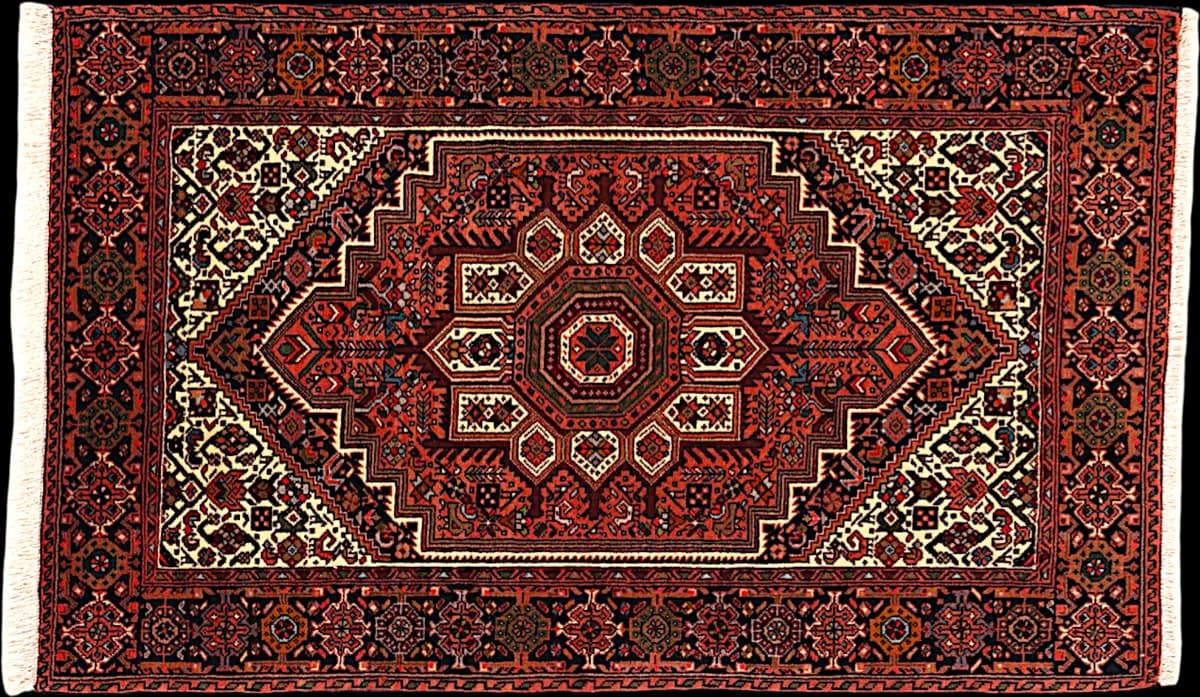
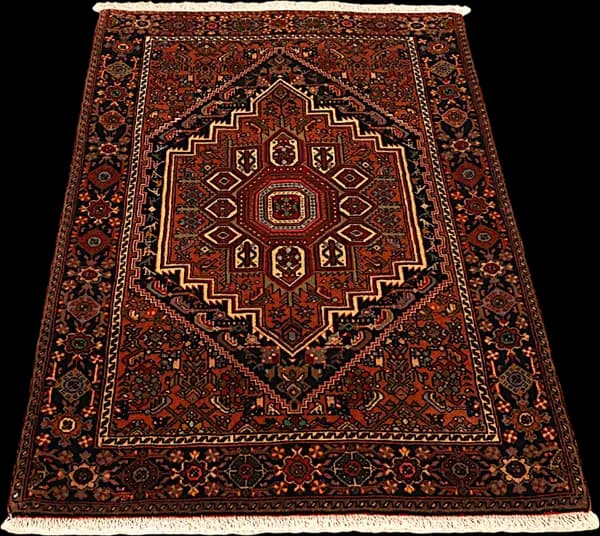
This is a Gholtough, also written Goltugh, a village weaving from the Kurdish region of western Iran, measuring 122 x 77 cm (4'0" x 2'6"). Kurdish village rugs are known for bold, freehand geometric design and an honest, unpolished character, and this small piece carries an unusual amount of it: a medallion built with the graphic clarity of something far larger.
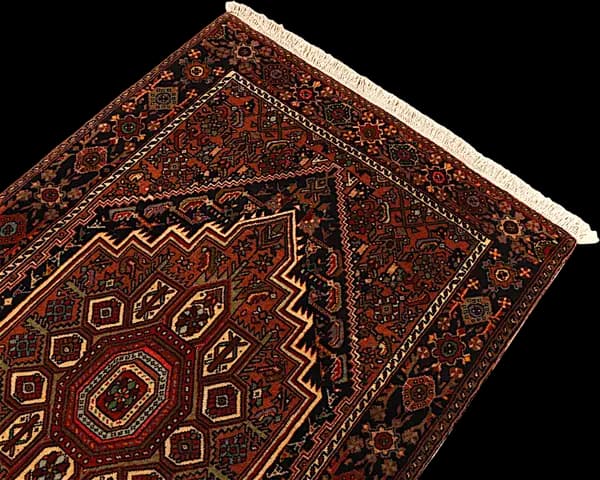
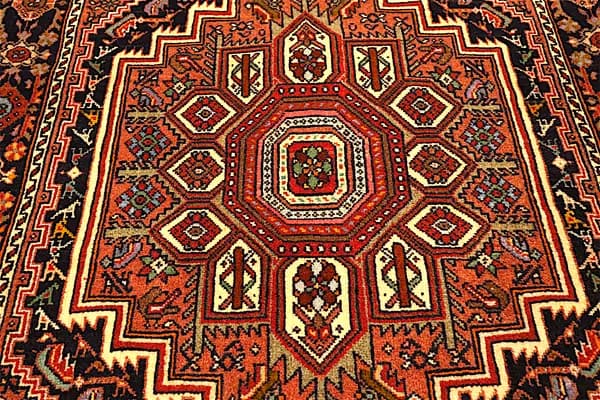
The first impression is a warm rust field with a stepped ivory medallion at its centre. The medallion itself is built in layers: an outer serrated diamond, a ring of eight small diamond compartments, and a tiny octagon at its core, almost like a target. Small florals and geometric motifs in sage, mustard, pale pink and light blue scatter across the rust around it. A wide navy border, filled with polychrome rosettes and diamonds, holds the whole design firmly in place.
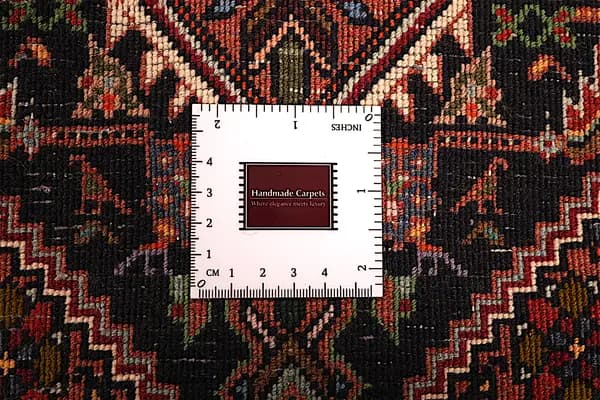
Gholtough rugs are hand-knotted with the symmetric knot, in hand-spun wool on a cotton foundation, at 201,000 to 250,000 knots per square metre. Hand-spun yarn varies in thickness from knot to knot, which is why the small motifs carry a gentle irregularity rather than a machine-drawn crispness. That density still let the weaver, working freehand from memory, lay out the medallion's three layers with real precision - a hierarchy a simpler village medallion would not attempt.
At 122 x 77 cm, this suits a hallway, a study, or the floor by a door - seen daily rather than crossed at a glance. The rust field warms a pale floor and holds its own against dark wood, while the ivory medallion keeps drawing the eye back. Underfoot the wool is dense and slightly springy, suited to everyday use. As light moves through the room, it is the small octagon at the medallion's core that catches it last.
Bidjar rugs come from the town of Bijar in Kurdistan Province, northwest Iran, and are famously known as the "Iron Rugs of Persia." Woven with the symmetrical (Turkish) knot on a cotton foundation with double weft, they undergo a unique wet-weaving technique: the wool is dampened during production and compacted with heavy metal combs, creating an extraordinarily dense, rigid structure.
The most common traditional pattern is the Herati (Mahi) motif, a flower with four leaves and small fish-like elements, often combined with medallion designs. The extreme density means Bidjar carpets cannot be folded, only rolled, and their pile stands firmly upright for decades.
Fine quality weave
At 122 × 77 cm (0.94 m²) this is a small rug. It works beside a bed, in a reading corner, in front of a fireplace or as a mat by a door. It does not furnish a room; it makes a point in one.
Yes, knotted by hand — knot by knot on a loom, not machine-made. The density is 201,000 to 250,000 knots per square metre; across 0.94 m² that is roughly 190,000 to 230,000 individual knots, every one of them tied by hand.
Hand-spun wool still carries its own lanolin, which keeps liquid sitting on the surface for a moment: blot quickly, with clear water and a light cloth, working inwards and without rubbing. Otherwise regular vacuuming along the pile is enough. Turn the rug once or twice a year so light and footfall reach it evenly.
We are in the Hamburg Speicherstadt. Come and see this rug in daylight, or write to us — a person answers.
Certificate included verifying origin, materials, and craftsmanship.
Ref: 223293