Turkaman
201 × 150 cm
1.767 €
677 €
Incl. VAT
In Stock · Ready to Ship
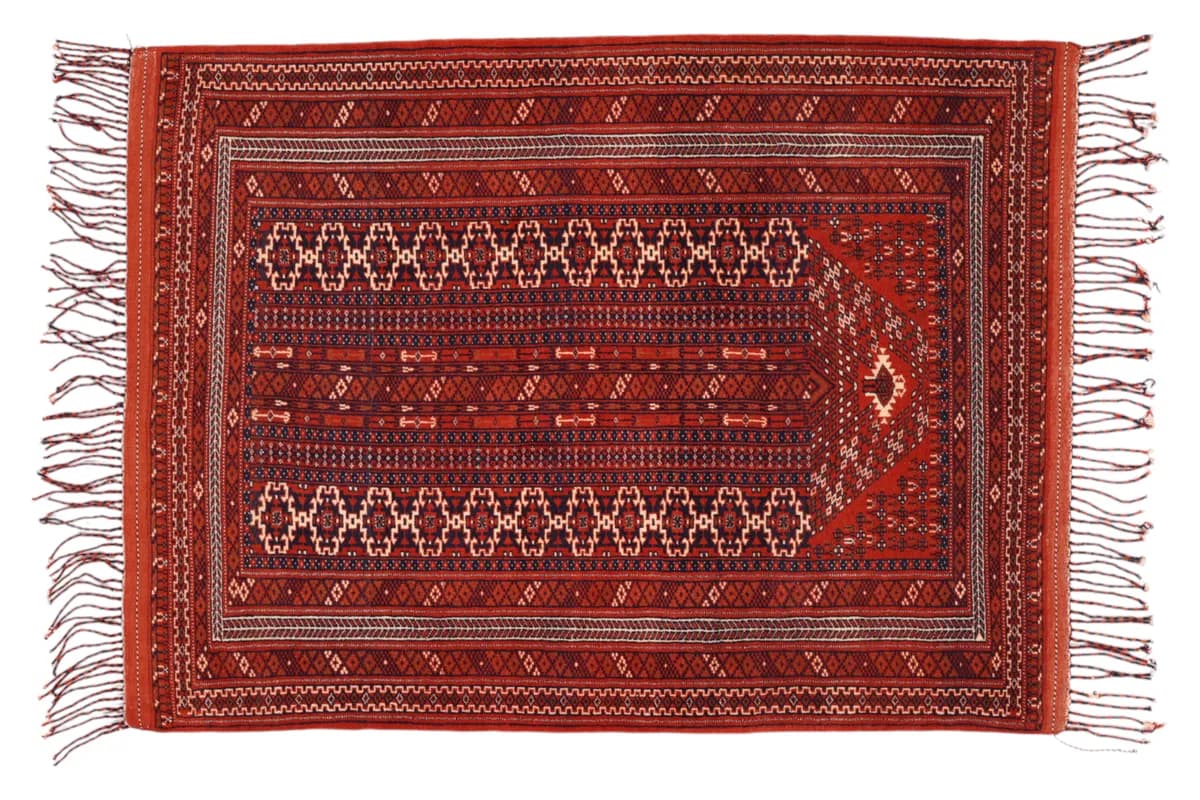
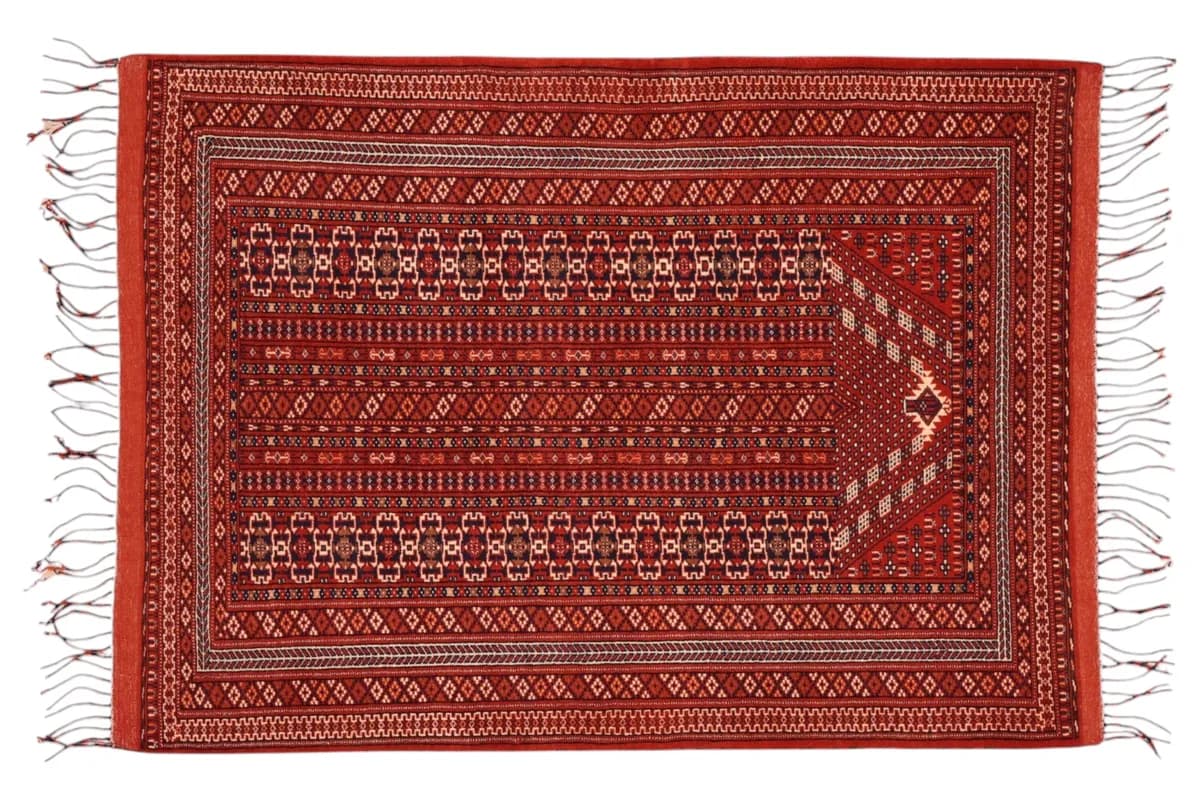
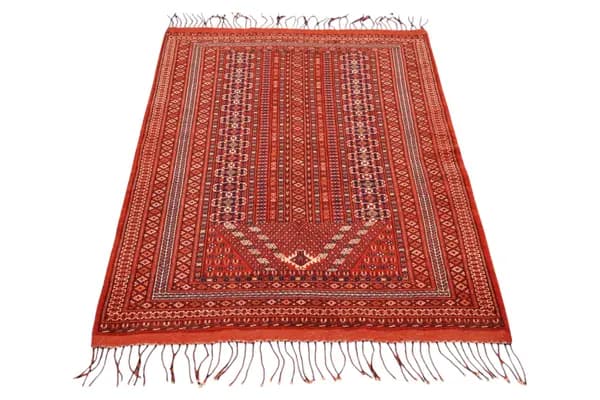
Among Turkmen weavings, the format that survives in real numbers is the prayer rug, or namazlik, a small piece meant for a single person to kneel on rather than to cover a room. This one measures 137 x 103 cm (4'6" x 3'5"), knotted by nomadic weavers of Central Asia whose work is normally recognised at a glance by rows of repeating gul medallions across a deep red ground. What makes this piece worth pausing over is that it breaks from that repetition entirely, built instead around a single architectural point.
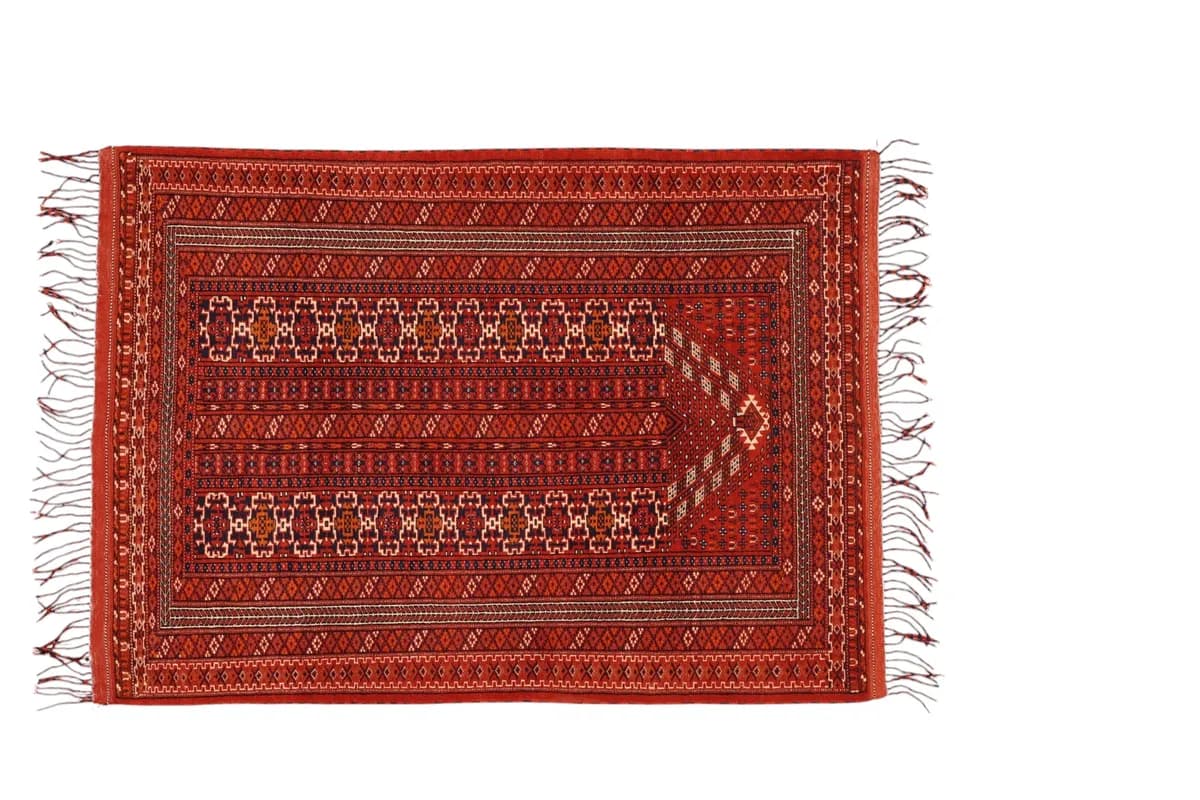
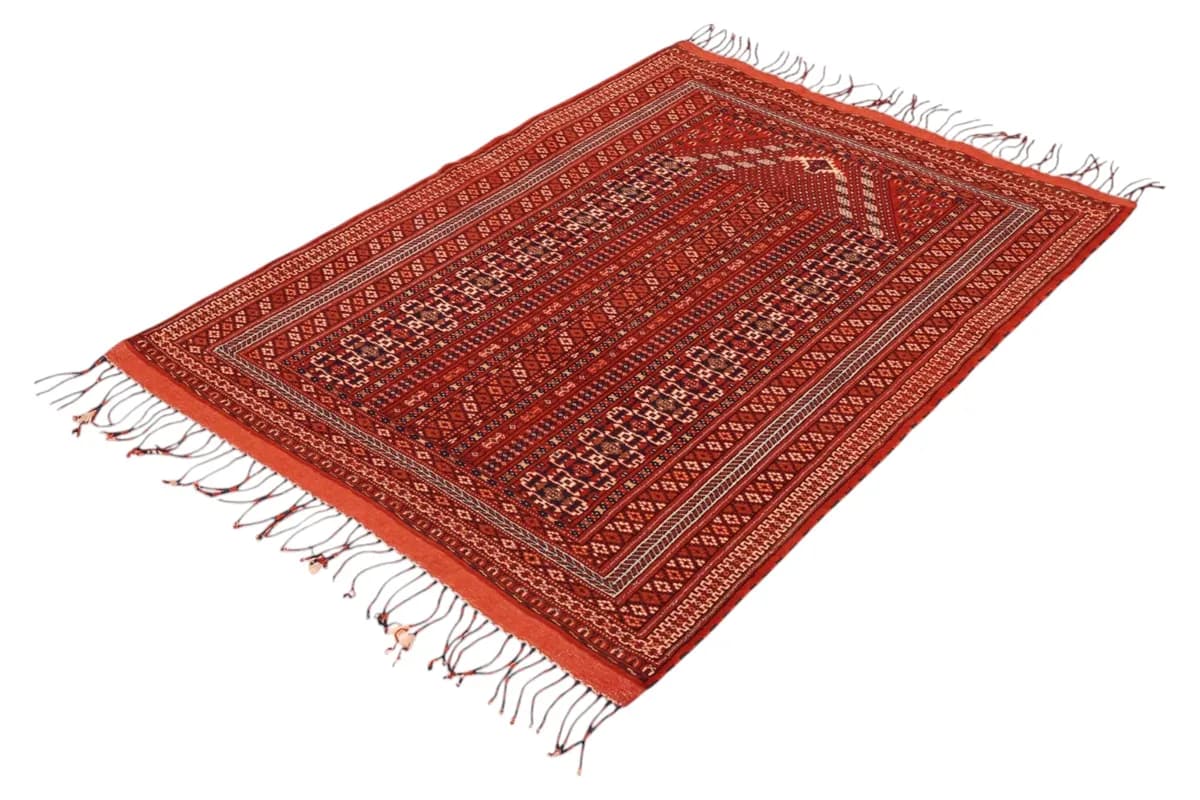
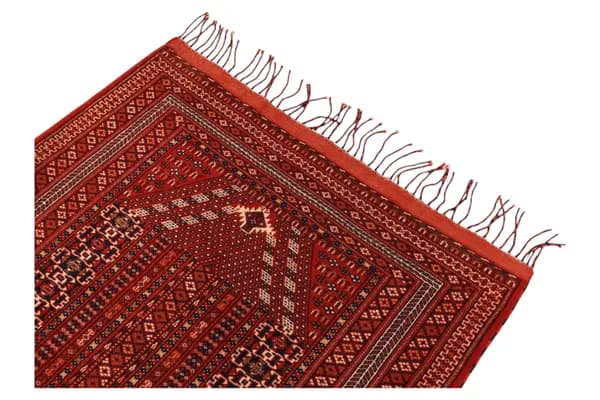
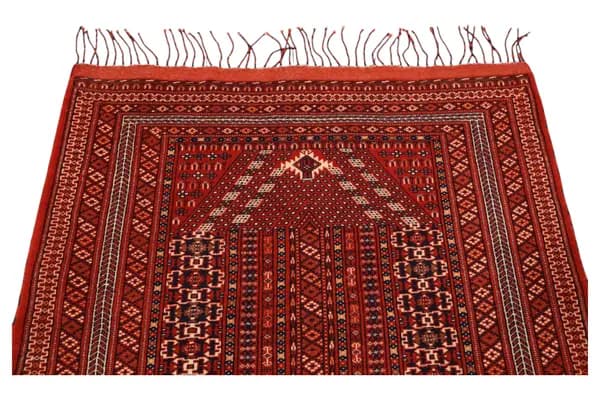
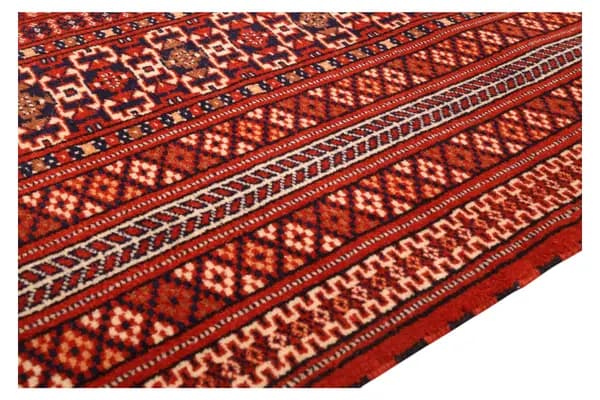
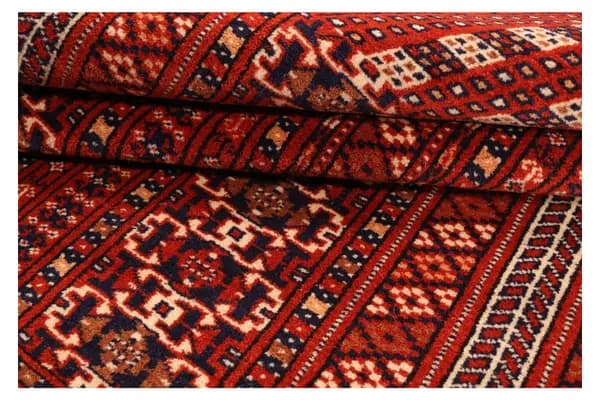
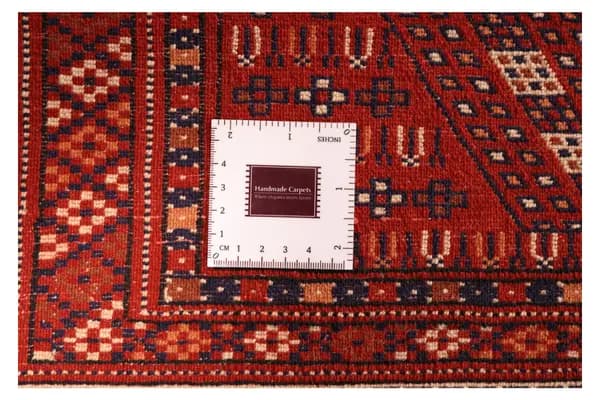
The field glows a deep brick red, the kind of red this weaving tradition is built on, but instead of the expected lattice of guls it carries one sharply stepped diagonal niche in ivory and dark navy, rising like a doorway to a small diamond medallion near the top. Bands of hooked and diamond motifs in camel and dark brown fill the space around it, structured rather than scattered. A run of narrow guard borders in red, ivory and navy geometric patterning frames the whole field, closed off by a plain rust-red outer band, together making up roughly a fifth of the rug's width and holding the eye in toward that single converging point.
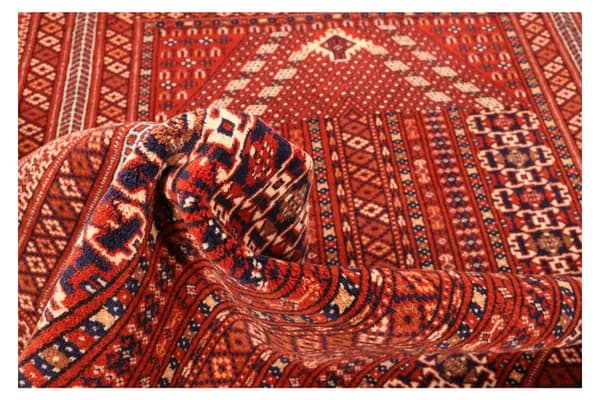
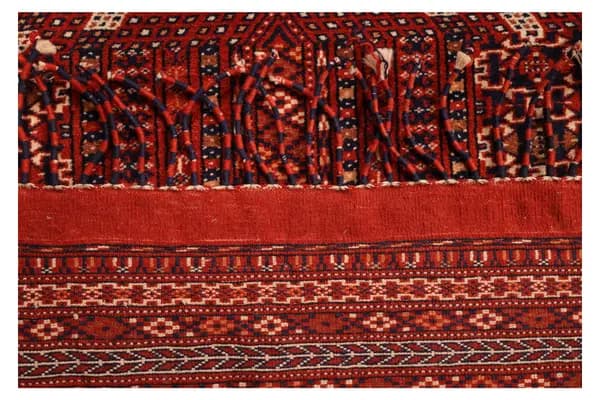
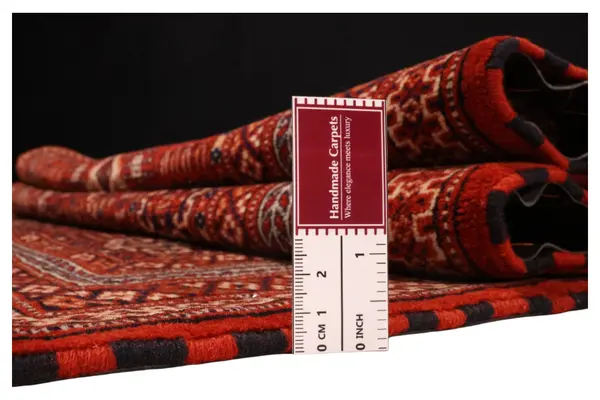
That precision is a product of the knotting, not just the drawing. At 441,000 to 500,000 knots per square metre, worked by hand in wool on a cotton warp, the weaver had enough resolution to hold the stepped edge of the niche crisp and straight rather than blurred into a stair-step blur, which is what a coarser knot count would have produced. The wool pile stands 6 mm deep, hand-spun, giving the surface a matte, slightly uneven texture with real shadow at the edges of each motif, the mark of a hand rather than a machine. This is a new piece, made within the last two decades, so the wool has not yet had decades of feet to soften it, and it comes to you close to how it left the loom.
A rug this size was never meant to anchor a living room, and it does not need to. It belongs somewhere close and looked at often: beside a bed, in a study by a reading chair, or at a turn in a hallway where someone passes daily. Against pale floorboards the red holds real warmth without overwhelming the space, and the ivory-and-navy niche reads clearly even from a distance. Underfoot it is dense and firm, built for a spot that takes daily use rather than one kept for show, and as the light shifts through the day, that single stepped niche is what keeps drawing the eye back.
More on Turkmen rugs: origin, making and how to recognise a genuine piece
Exceptionally fine weave
At 137 × 103 cm (1.41 m²) this is a small rug. It works beside a bed, in a reading corner, in front of a fireplace or as a mat by a door. It does not furnish a room; it makes a point in one.
Yes, knotted by hand — knot by knot on a loom, not machine-made. The density is 441,000 to 500,000 knots per square metre; across 1.41 m² that is roughly 620,000 to 710,000 individual knots, every one of them tied by hand.
Hand-spun wool still carries its own lanolin, which keeps liquid sitting on the surface for a moment: blot quickly, with clear water and a light cloth, working inwards and without rubbing. Otherwise regular vacuuming along the pile is enough. Turn the rug once or twice a year so light and footfall reach it evenly.
We are in the Hamburg Speicherstadt. Come and see this rug in daylight, or write to us — a person answers.
Certificate included verifying origin, materials, and craftsmanship.
Ref: 291201