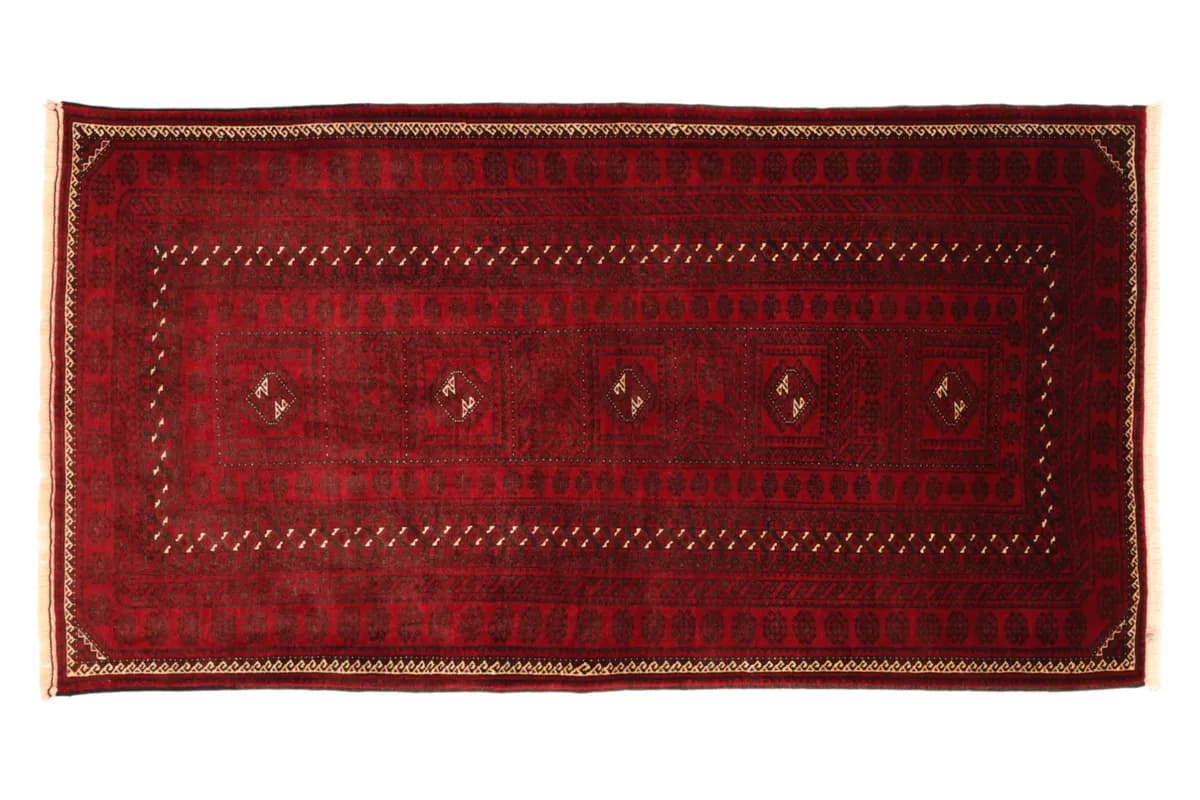
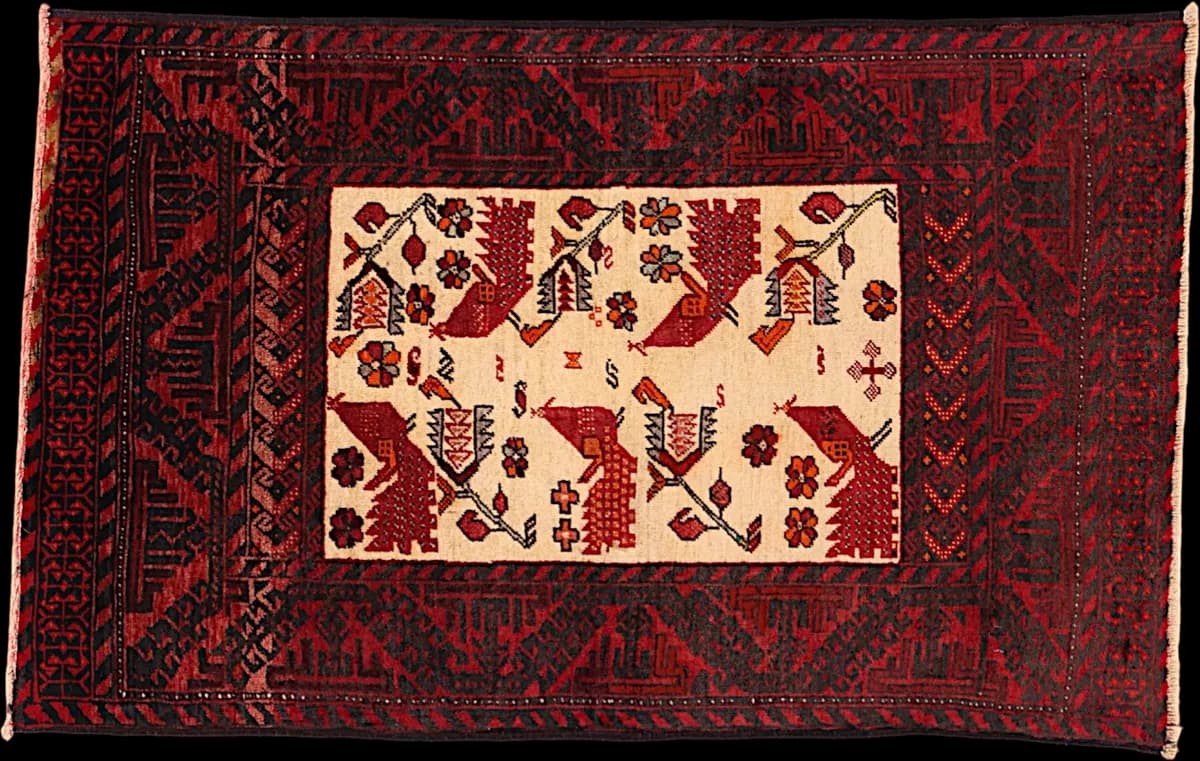
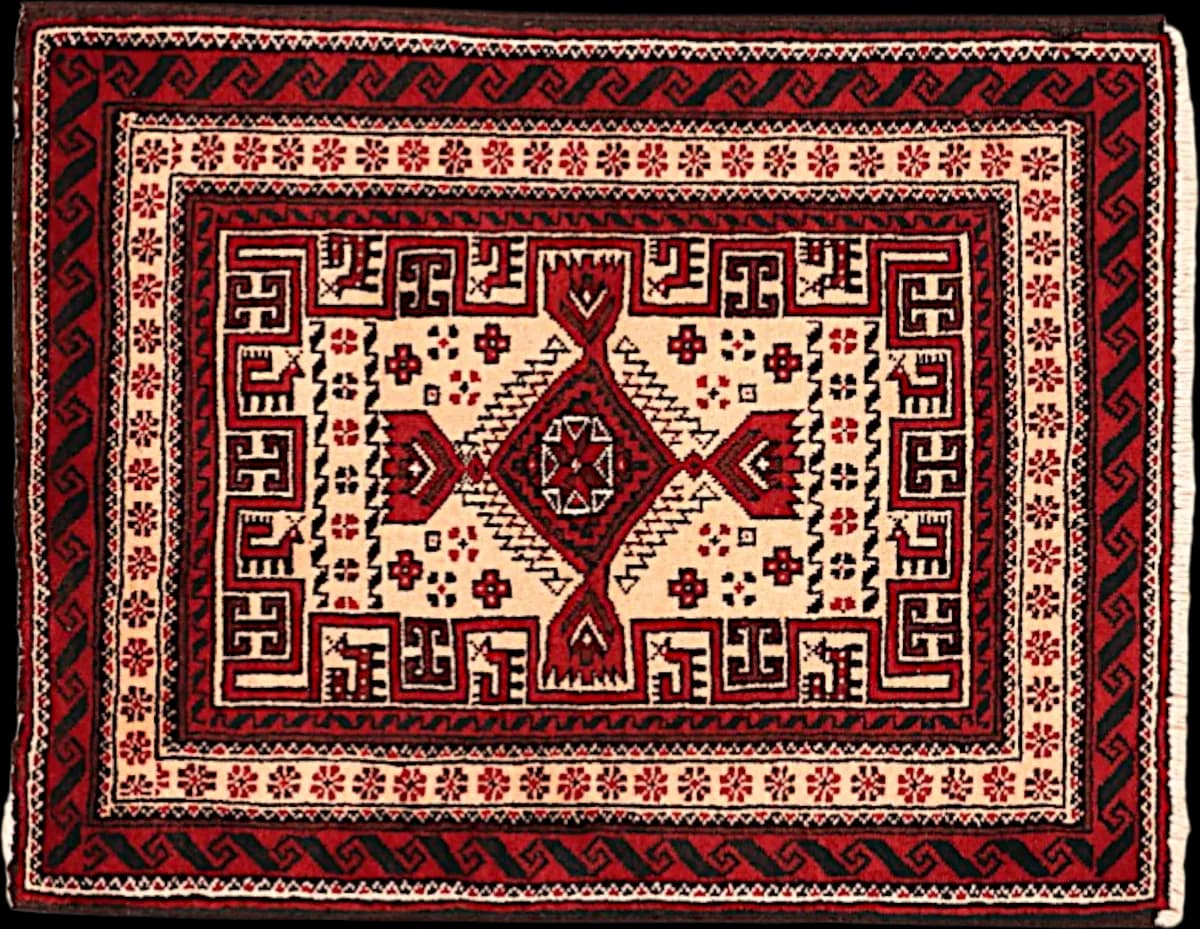
Belutsch
175 × 94 cm
569 €





504 €
Incl. VAT
In Stock · Ready to Ship
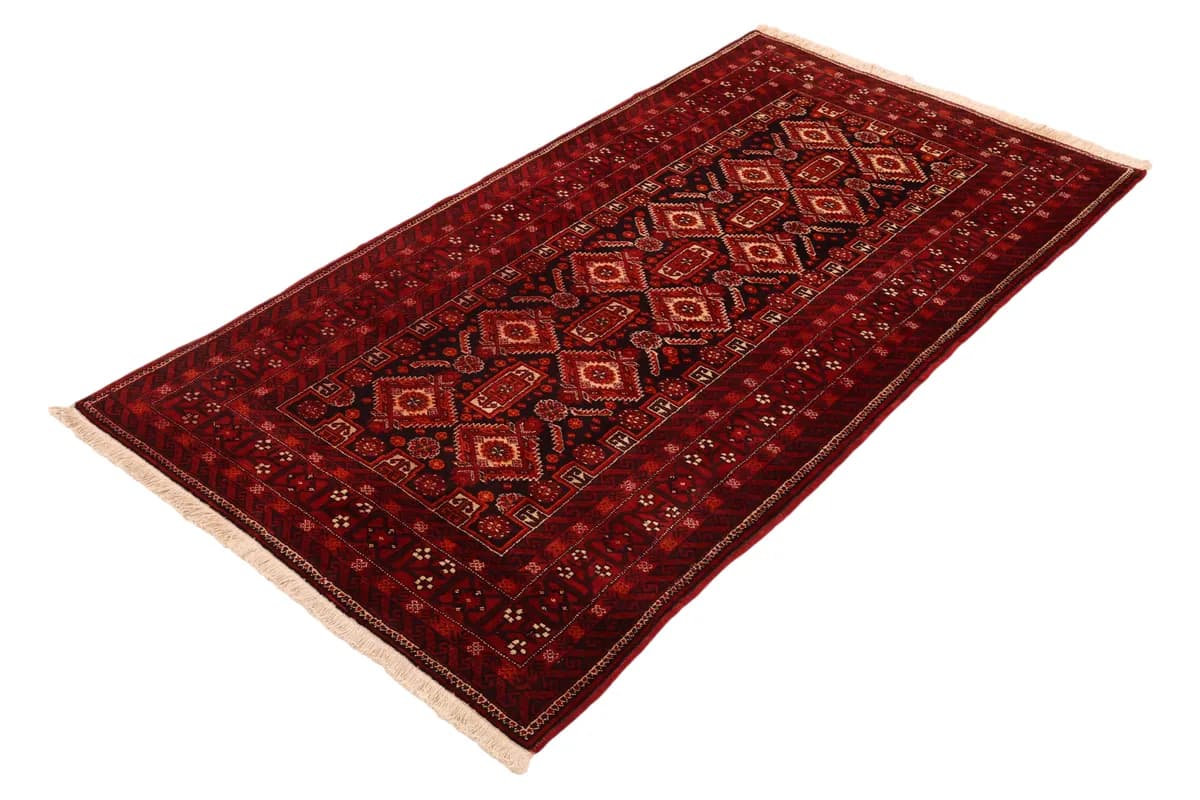
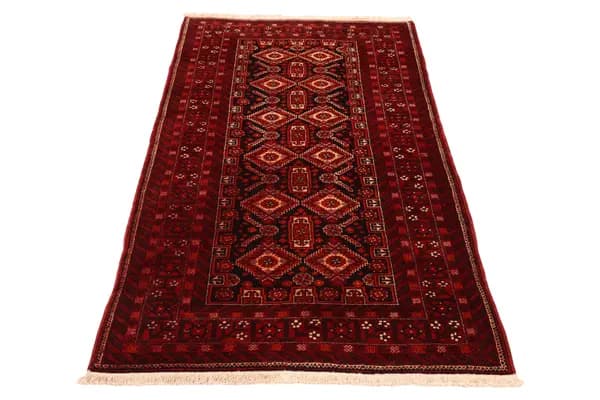
A Baluch runner, hand-knotted in the tribal borderlands of southeastern Iran, measuring 184 x 96 cm (6'0" x 3'2"). Baluch weavers work from memory rather than a drawn plan, and their rugs are known for deep, earthy colour and bold geometric pattern rather than the softer, curved medallions of Persian city workshops. This piece takes that geometry further than most: instead of the tribe's familiar single prayer-niche field, it carries a full column of diamonds run down its length, giving it the graphic punch of a runner built for a corridor rather than a single point of prayer.
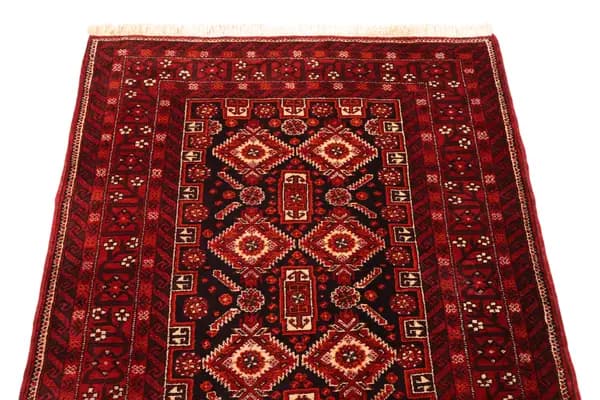
The ground is a deep blackish-blue, saturated enough to read as near-black from across a room. Down its centre marches a chain of interlocking diamond medallions in rust red and brick orange, each one opening onto a small ivory-cream centre that catches the eye like a row of lit windows. Rectangular guard panels flank the chain on either side, and the whole field is held by a wide dark red border, its edge marked with a fine stripe of ivory-dotted diamonds that stands out sharply against the darker ground. Scattered florets fill the remaining space, but they stay in the background; the diamond chain is what the eye follows.
The wool is hand-spun, and it was clipped to a firm 6 mm pile that gives the surface a slightly ribbed texture, typical of nomadic weaving rather than a workshop finish. Knotted at 128,000 to 160,000 knots per square metre on a cotton warp, it sits at a density that suits bold geometry rather than fine curved drawing — coarse enough to keep the diamond edges crisp, tight enough to hold their shape after twenty to forty years of use. That combination, hand-spun wool at tribal density, is exactly what lets a pattern this graphic survive without softening at the edges.
A runner of this size and character belongs in a hallway or along a landing, somewhere it is seen in passing rather than all at once. The near-black ground carries its own weight in a dimly lit corridor, and the rust-red diamonds warm the space without needing daylight to do it. Underfoot it is dense and firm, built for a well-used passage rather than a room kept for best, and as light crosses it through the day the ivory centres are what continue to catch the eye.
More on Baluch rugs: origin, making and how to recognise a genuine piece
Traditional weave
At 184 × 96 cm (1.77 m²) this is a small rug. It works beside a bed, in a reading corner, in front of a fireplace or as a mat by a door. It does not furnish a room; it makes a point in one.
Yes, knotted by hand — knot by knot on a loom, not machine-made. The density is 128,000 to 160,000 knots per square metre; across 1.77 m² that is roughly 230,000 to 280,000 individual knots, every one of them tied by hand.
Hand-spun wool still carries its own lanolin, which keeps liquid sitting on the surface for a moment: blot quickly, with clear water and a light cloth, working inwards and without rubbing. Otherwise regular vacuuming along the pile is enough. Turn the rug once or twice a year so light and footfall reach it evenly.
We are in the Hamburg Speicherstadt. Come and see this rug in daylight, or write to us — a person answers.
Certificate included verifying origin, materials, and craftsmanship.
Ref: 335112