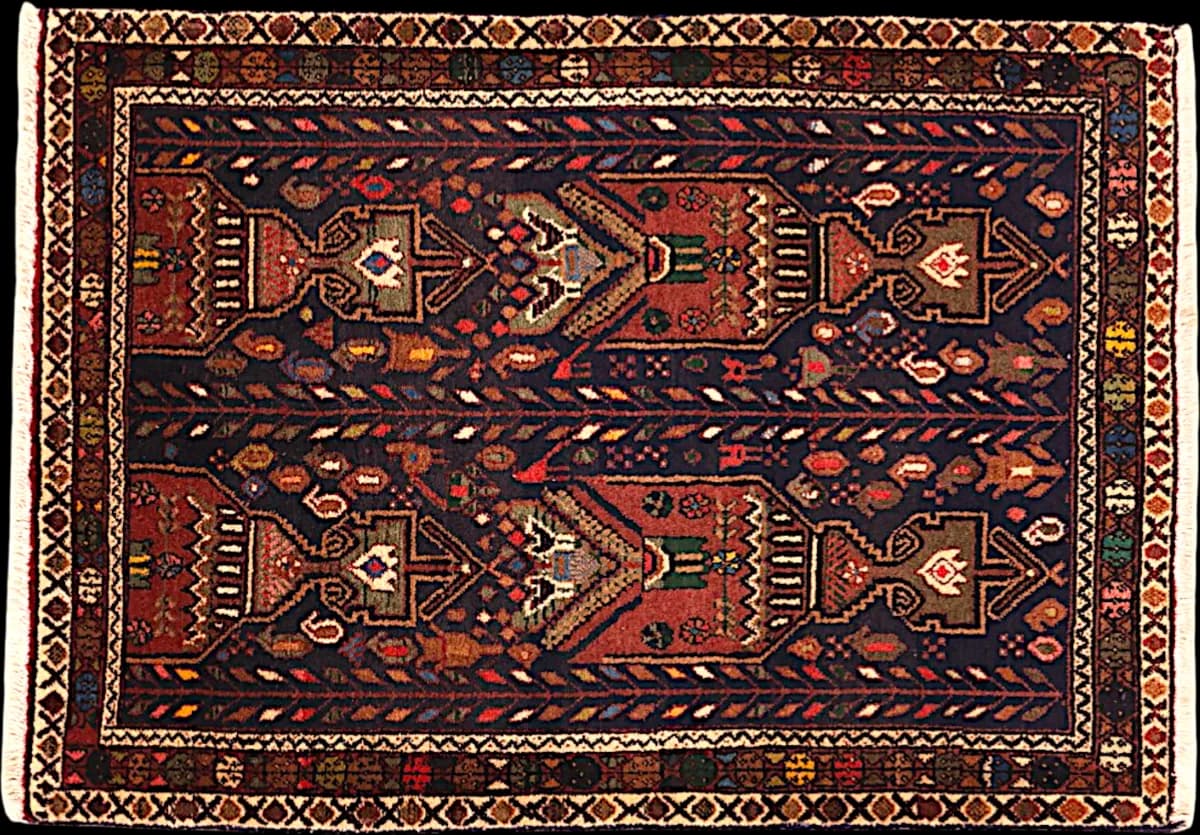
Shahr-e Babak
282 × 214 cm
2.080 €







3.150 €
Incl. VAT
In Stock · Ready to Ship
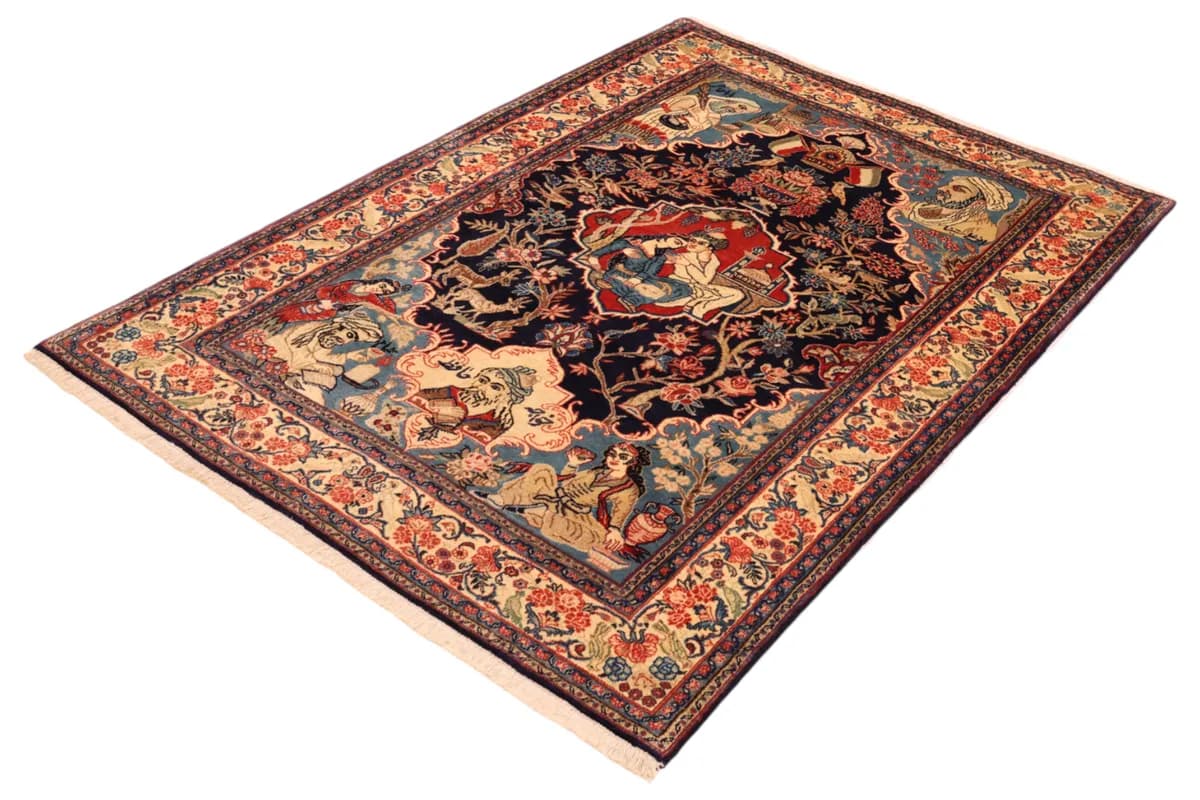
This is a Shahr-Babak rug, also written Shahr-e Babak, 197 x 136 cm (6'6" x 4'6"), woven in the town of that name in Kerman province by Afshari tribal weavers working under the strong influence of Kerman's classical workshops. The type is known for pairing bold tribal energy with refined Persian motifs. This particular piece goes further still, into pictorial narrative rather than repeating pattern.
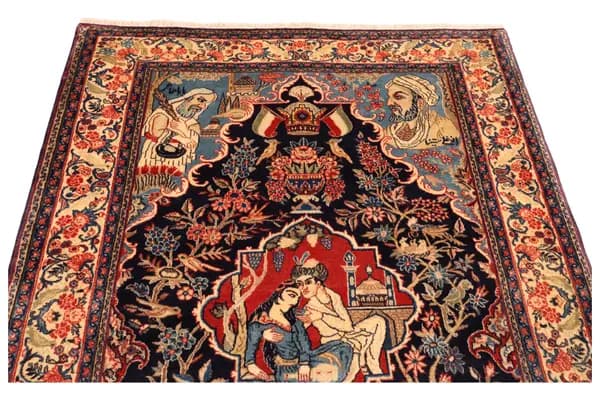
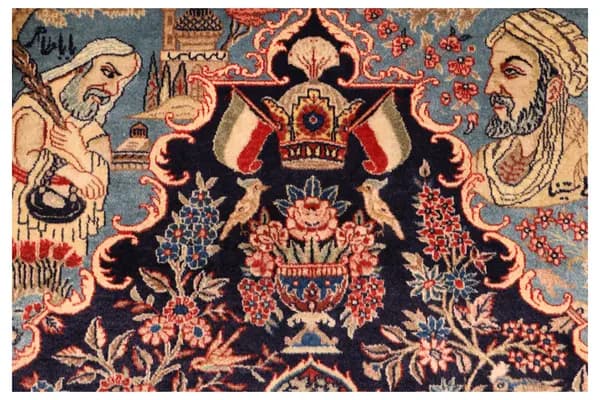
The ground is a deep navy blue, unusually dark for a village weaving. Red and blue floral vines run through it in loose bands, framing portrait vignettes — turbaned men set into the corners, and at the centre a courting couple in brick red and dusty rose against powder-blue spandrels. Rather than one medallion repeated outward, the field reads as a gallery of faces held in dense vine work. A wide ivory border, carrying the same red and blue scrollwork, closes the composition and holds the dark field in check.
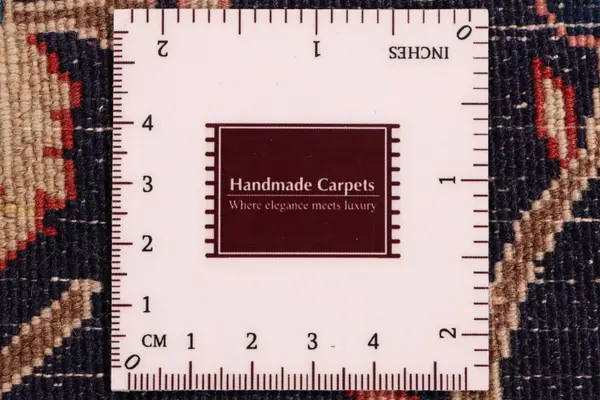
Hand-knotted, the finer weavers in this tradition favour the asymmetric knot under Kerman influence, which allows the tighter line a portrait needs to stay readable. Density runs to 251,000-320,000 knots per square metre, high for a village loom, and it shows in the crispness of the faces and turbans. The pile is hand-spun wool on a cotton warp; the slight unevenness of hand-spun yarn gives the surface its matte depth rather than a flat, even sheen. Forty to sixty years old, the wool has already settled into the piece you see today.
At 197 x 136 cm this suits a bedroom, or a quiet corner beside a favourite chair. The navy ground holds its own against a pale floor, and the ivory border catches light rather than absorbing it. Underfoot the hand-spun wool is dense and slightly springy, firm enough for daily use. What stays with you is the faces — a different one seems to catch your eye each time the light shifts.
Shahr-e Babak rugs come from the ancient city of Shahr-e Babak in Kerman Province, south-central Iran, founded during the Sasanian dynasty. The majority Afshar tribal population brings a Turkic heritage, yet the rugs are knotted with the asymmetrical (Persian) knot, reflecting the strong influence of the Kerman weaving tradition on local production.
Geometric designs with one to three lozenge-shaped medallions reflect influences from Turkmen, Caucasian, Baluch, and Qashqai traditions. Colours range from deep cranberry red and navy to pastels with white-and-gold trim. The blend of nomadic energy and urban construction makes each piece distinctive.
Fine quality weave
At 197 × 136 cm (2.68 m²) this is a medium rug. It works in front of a sofa, in front of a bed or in a study. It is too small for a dining table — there you want about 80 cm of clearance so a chair does not tip over the edge when pushed back.
Yes, knotted by hand — knot by knot on a loom, not machine-made. The density is 251,000 to 320,000 knots per square metre; across 2.68 m² that is roughly 670,000 to 860,000 individual knots, every one of them tied by hand.
Hand-spun wool still carries its own lanolin, which keeps liquid sitting on the surface for a moment: blot quickly, with clear water and a light cloth, working inwards and without rubbing. Otherwise regular vacuuming along the pile is enough. Turn the rug once or twice a year so light and footfall reach it evenly.
We are in the Hamburg Speicherstadt. Come and see this rug in daylight, or write to us — a person answers.
Certificate included verifying origin, materials, and craftsmanship.
Ref: 759552