Shahr-e Babak
109 × 77 cm
365 €





2.080 €
Incl. VAT
In Stock · Ready to Ship
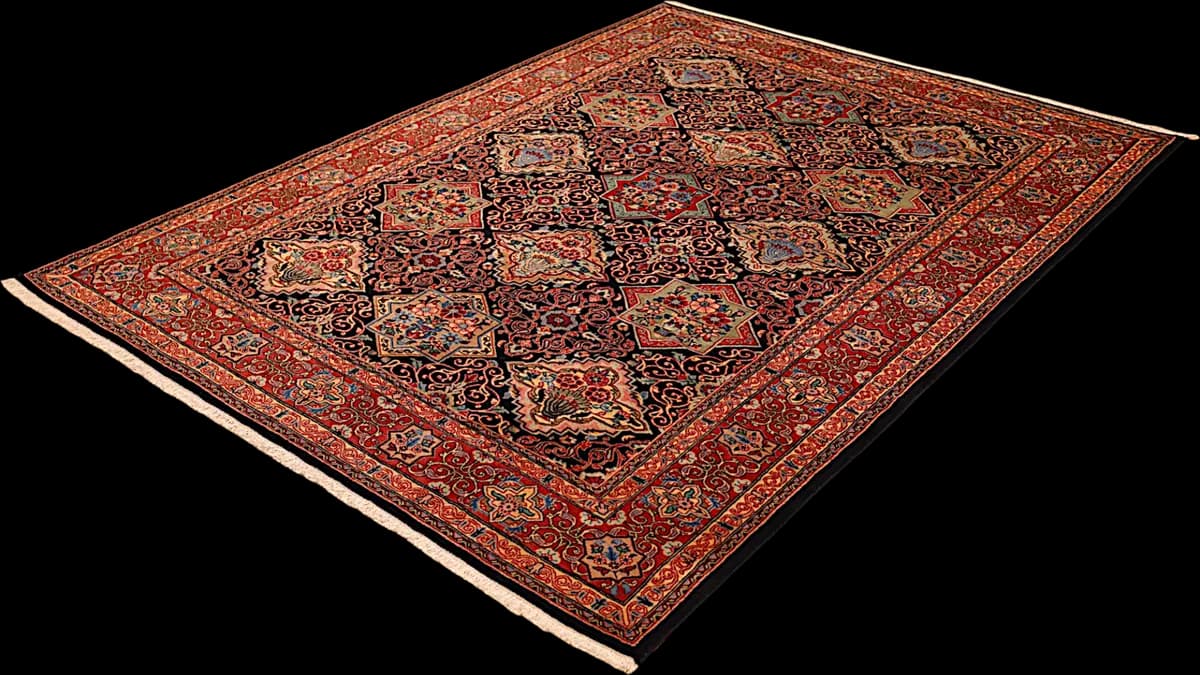
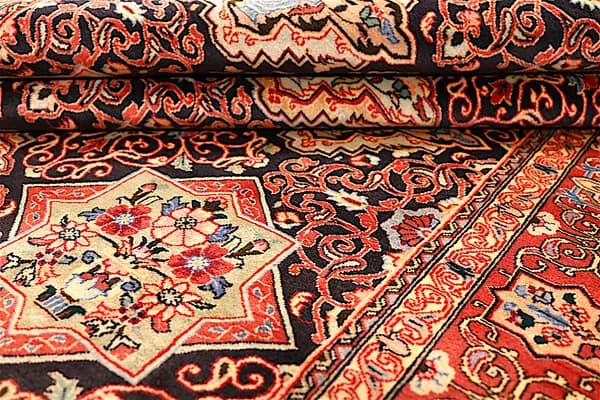
This is a village rug from Shahr-e Babak, also written Shahr-Babak, in Iran's Kerman province, 282 x 214 cm (9'3" x 7'0"). Woven by Afshari tribal weavers under strong Kerman influence, the type pairs bold tribal energy with classical Persian motifs. Here that shows in the field itself: rather than one large medallion, the design breaks into a regular grid of small diamonds and stars.
The rug opens on a deep navy field scattered with jewel-like medallions in cream, sage green and dusty pink. Each diamond and star sits in its own cell, filled with a small floral bouquet and linked by dense red scrollwork, so the field reads as a continuous lattice rather than one composition. A broad brick-red border, about a sixth of the width, closes the design with scrolling vine and ivory cartouches, its warmth set against the field's cool.
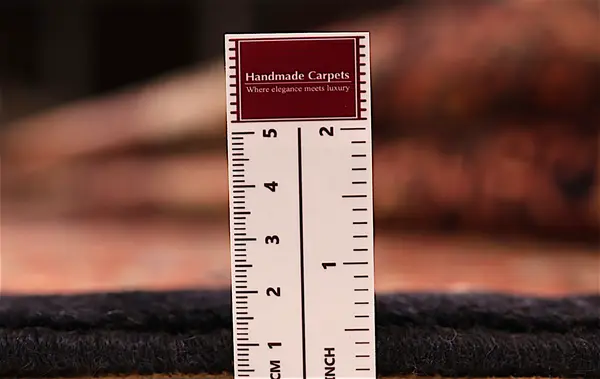
The wool is hand-spun, keeping the yarn slightly irregular and giving the pile a quiet, matte surface rather than any high sheen. Knotted by hand at 201,000 to 250,000 knots per square metre on a cotton warp, the rug holds its small motifs in clear focus, without the extreme fineness of Kerman's finest asymmetric work; this is a rug built for pattern and presence rather than for precision alone. At 12 mm the pile has a full depth underfoot.
A rug this size suits a living or dining room, set beneath a table or a sofa group where the lattice can be taken in from more than one angle. The navy field holds its own against dark wood, while the brick-red border warms a pale floor and the pink and sage accents lift a neutral room. Underfoot the pile is dense and full, made for daily use. As light crosses the room, the cream cartouches catch first.
Shahr-e Babak rugs come from the ancient city of Shahr-e Babak in Kerman Province, south-central Iran, founded during the Sasanian dynasty. The majority Afshar tribal population brings a Turkic heritage, yet the rugs are knotted with the asymmetrical (Persian) knot, reflecting the strong influence of the Kerman weaving tradition on local production.
Geometric designs with one to three lozenge-shaped medallions reflect influences from Turkmen, Caucasian, Baluch, and Qashqai traditions. Colours range from deep cranberry red and navy to pastels with white-and-gold trim. The blend of nomadic energy and urban construction makes each piece distinctive.
Fine quality weave
At 282 × 214 cm (6.03 m²) this is a large rug. It sits under a seating group with the front legs of sofa and chairs on it, or under a dining table for four. A table for six wants about 80 cm of clearance all round, and needs more.
Yes, knotted by hand — knot by knot on a loom, not machine-made. The density is 201,000 to 250,000 knots per square metre; across 6.03 m² that is roughly 1.2 to 1.5 million individual knots, every one of them tied by hand.
Hand-spun wool still carries its own lanolin, which keeps liquid sitting on the surface for a moment: blot quickly, with clear water and a light cloth, working inwards and without rubbing. Otherwise regular vacuuming along the pile is enough. Turn the rug once or twice a year so light and footfall reach it evenly.
We are in the Hamburg Speicherstadt. Come and see this rug in daylight, or write to us — a person answers.
Certificate included verifying origin, materials, and craftsmanship.
Ref: 983859