Shahr-e Babak
223 × 163 cm
3.150 €




978 €
Incl. VAT
In Stock · Ready to Ship
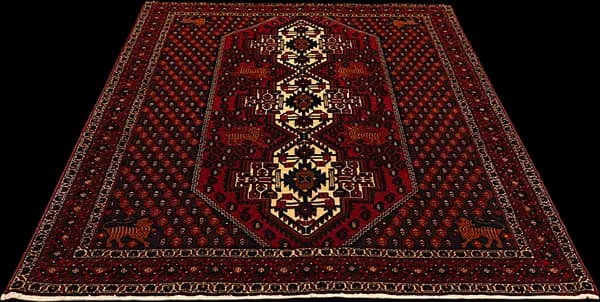
This is a village rug from Shahr-e Babak, also written Shahr-Babak, in Kerman province, Iran, 205 x 138 cm (6'9" x 4'6"), hand-knotted by Afshari tribal weavers working under the strong influence of the wider Kerman tradition. The type is known for pairing bold tribal energy with classical Persian medallion structure, producing pieces that read as both rustic and composed.
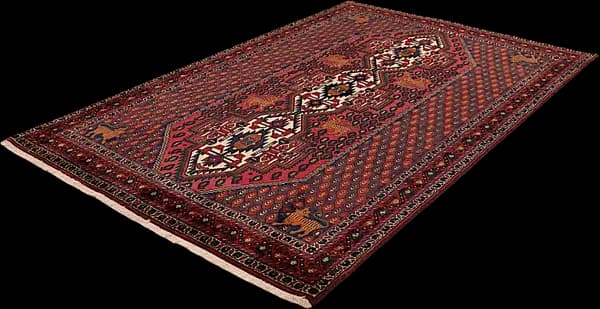
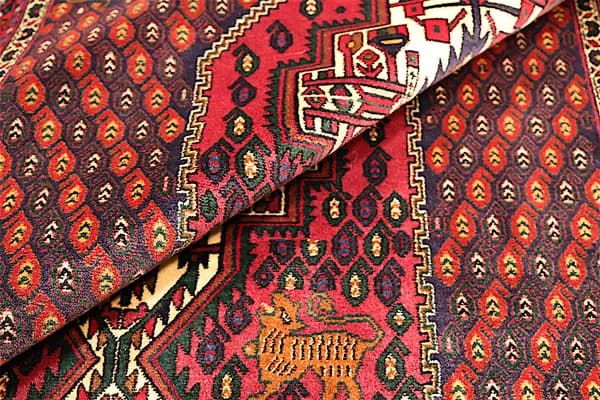
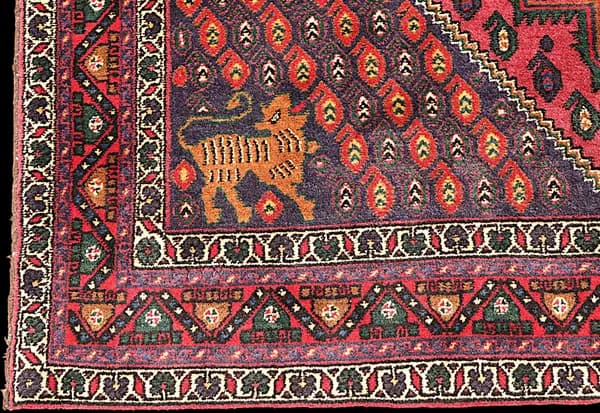
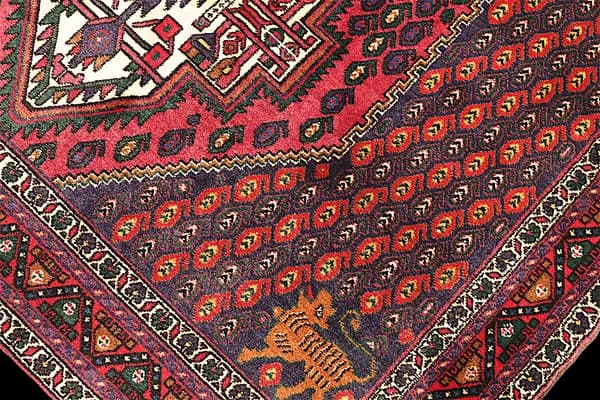
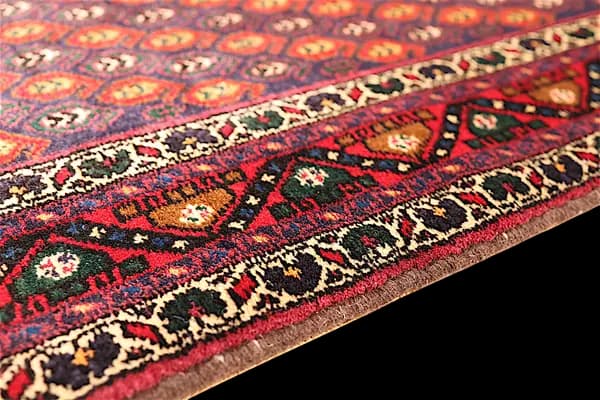
The field is a dense navy diamond lattice threaded with brick red, and down its centre run three cream medallions linked into a single chain rather than standing apart. Each medallion carries navy and rust motifs at its core. In the four green corner spandrels sit small orange-tan animal figures, drawn with head, legs and tail plain enough to read as lions or tigers. The border is a dark red-brown band, narrow against the size of the field, held between black guard stripes patterned with hooked cream motifs.
Village weavers here work from memory rather than a fixed cartoon, which explains the freehand looseness in the medallion chain and the animal figures — a workshop drawing would not allow it. The pile is handspun wool on a cotton warp, knotted at 201,000 to 250,000 knots per square metre, a density that favours character over precision and gives the surface its compact, matte face. At 10 mm the pile sits full underfoot, and the asymmetric knot favoured under Kerman influence keeps the lattice sharp even at this density.
This rug suits a seating area or a bedroom, sized to sit beside a bed or under a chair group rather than anchor a large room. The navy field holds its own against dark wood and warms a pale floor, while brick red and cream keep it from feeling heavy. Underfoot the handspun wool is dense and firm, made for daily use. Live with it and the corner animal figures are what you keep noticing.
Shahr-e Babak rugs come from the ancient city of Shahr-e Babak in Kerman Province, south-central Iran, founded during the Sasanian dynasty. The majority Afshar tribal population brings a Turkic heritage, yet the rugs are knotted with the asymmetrical (Persian) knot, reflecting the strong influence of the Kerman weaving tradition on local production.
Geometric designs with one to three lozenge-shaped medallions reflect influences from Turkmen, Caucasian, Baluch, and Qashqai traditions. Colours range from deep cranberry red and navy to pastels with white-and-gold trim. The blend of nomadic energy and urban construction makes each piece distinctive.
Fine quality weave
At 205 × 138 cm (2.83 m²) this is a medium rug. It works in front of a sofa, in front of a bed or in a study. It is too small for a dining table — there you want about 80 cm of clearance so a chair does not tip over the edge when pushed back.
Yes, knotted by hand — knot by knot on a loom, not machine-made. The density is 201,000 to 250,000 knots per square metre; across 2.83 m² that is roughly 570,000 to 710,000 individual knots, every one of them tied by hand.
Hand-spun wool still carries its own lanolin, which keeps liquid sitting on the surface for a moment: blot quickly, with clear water and a light cloth, working inwards and without rubbing. Otherwise regular vacuuming along the pile is enough. Turn the rug once or twice a year so light and footfall reach it evenly.
We are in the Hamburg Speicherstadt. Come and see this rug in daylight, or write to us — a person answers.
Certificate included verifying origin, materials, and craftsmanship.
Ref: 563297