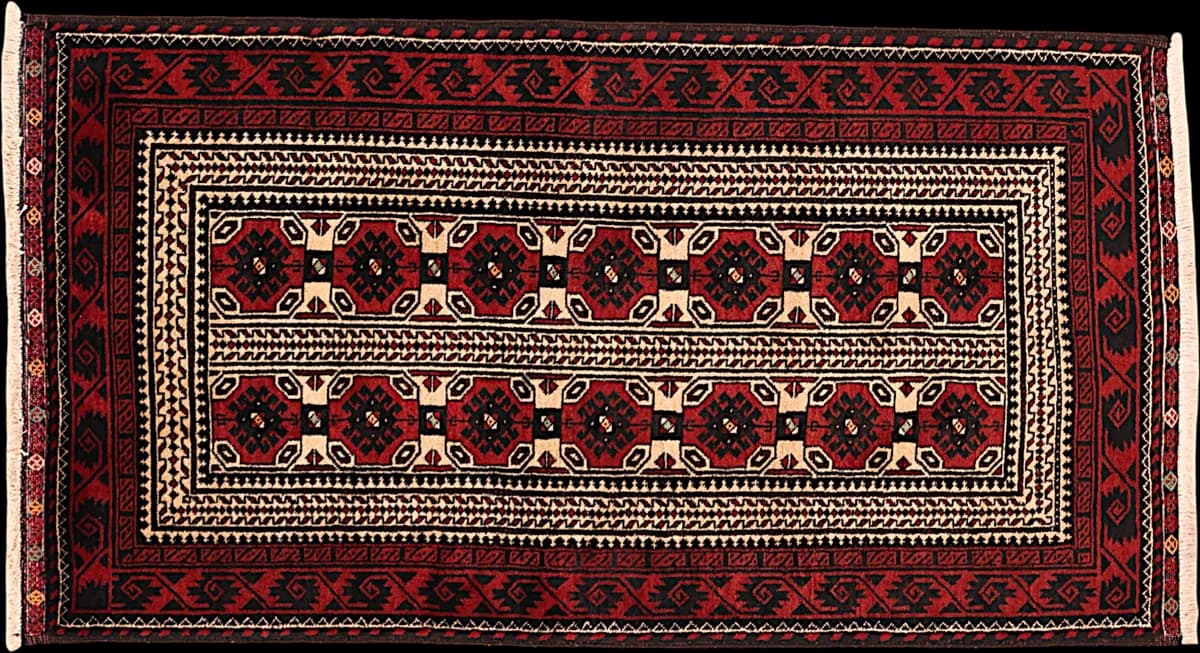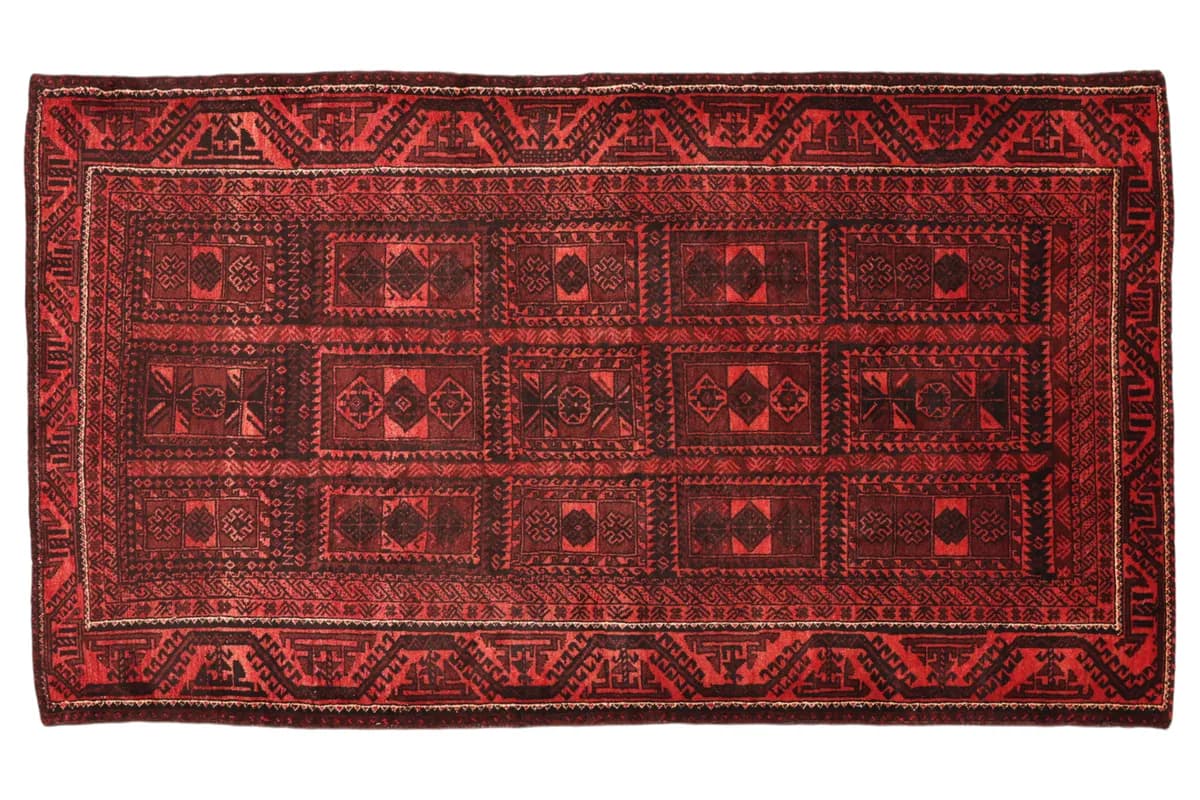
Belutsch
205 × 117 cm
710 €






775 €
Incl. VAT
In Stock · Ready to Ship
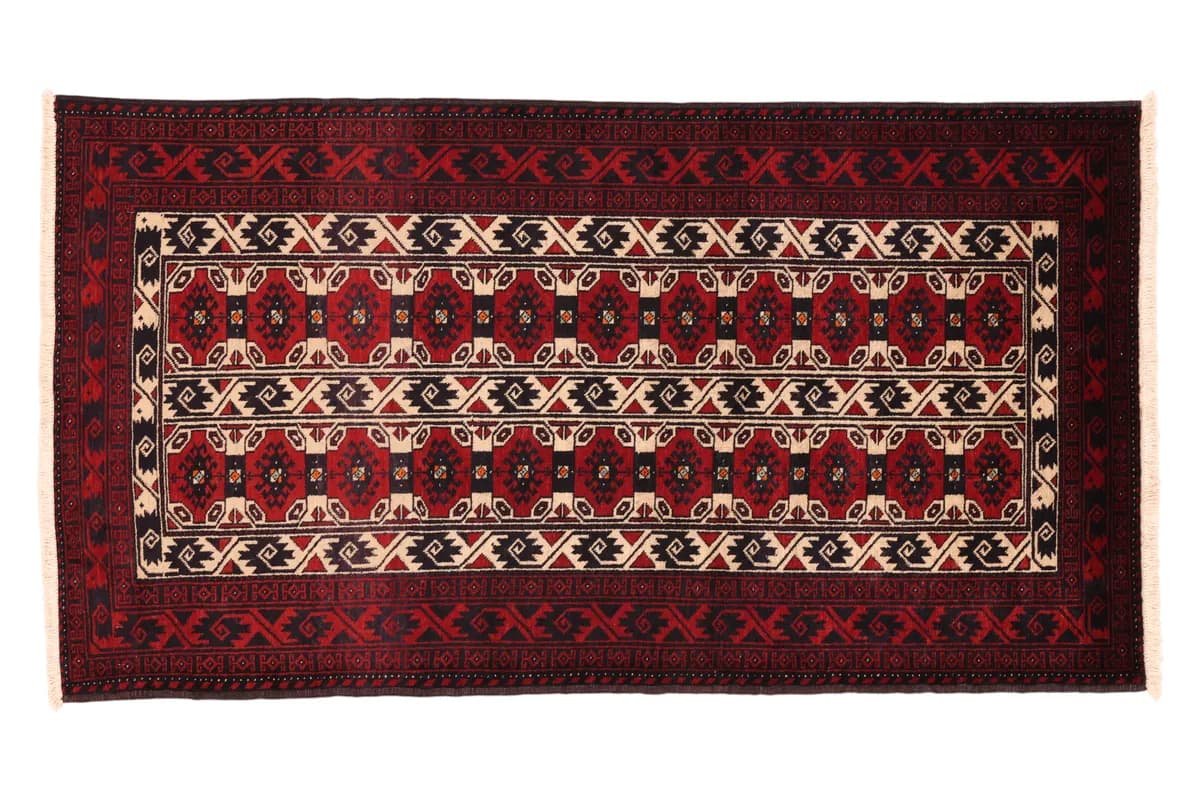
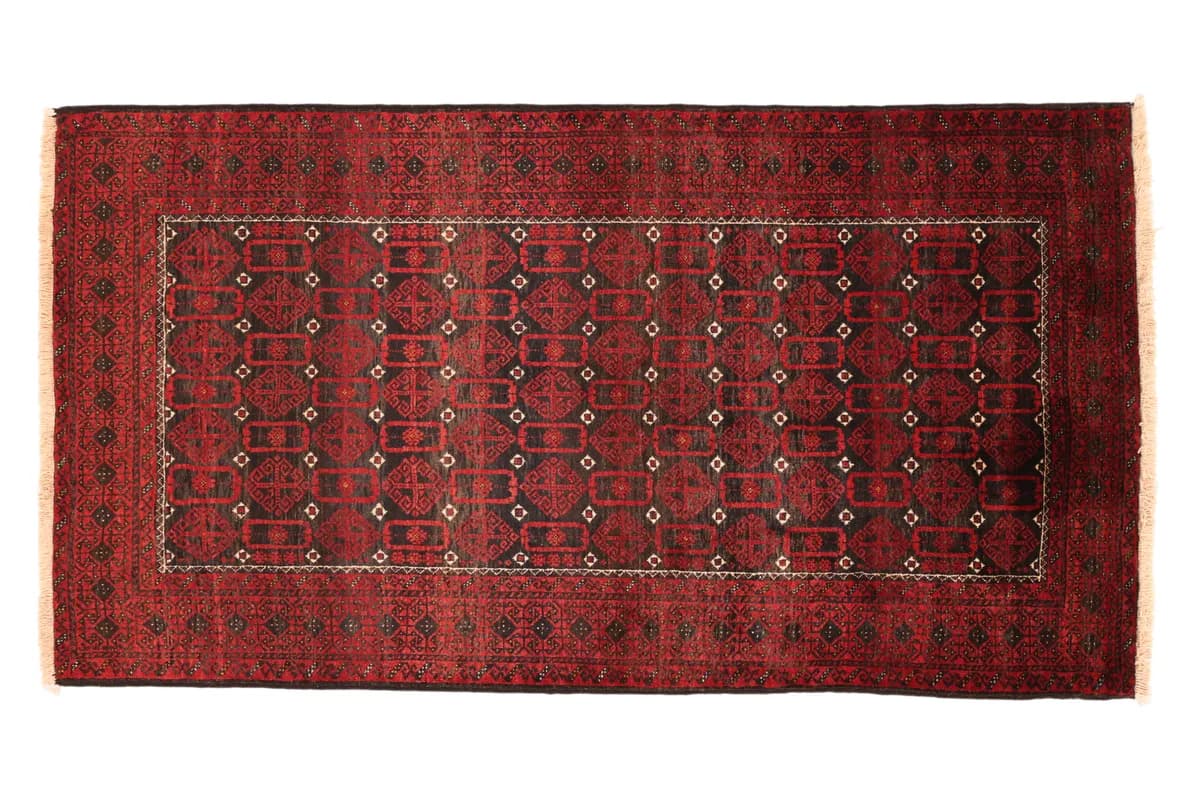
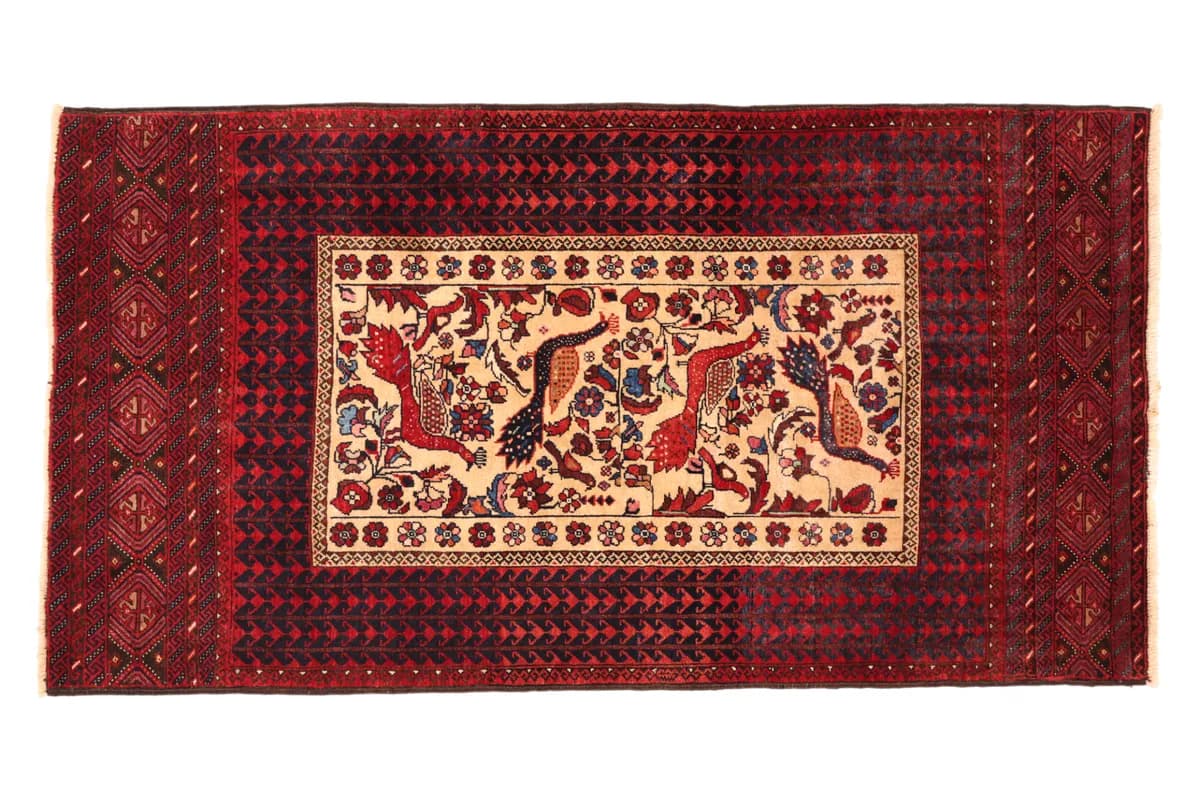
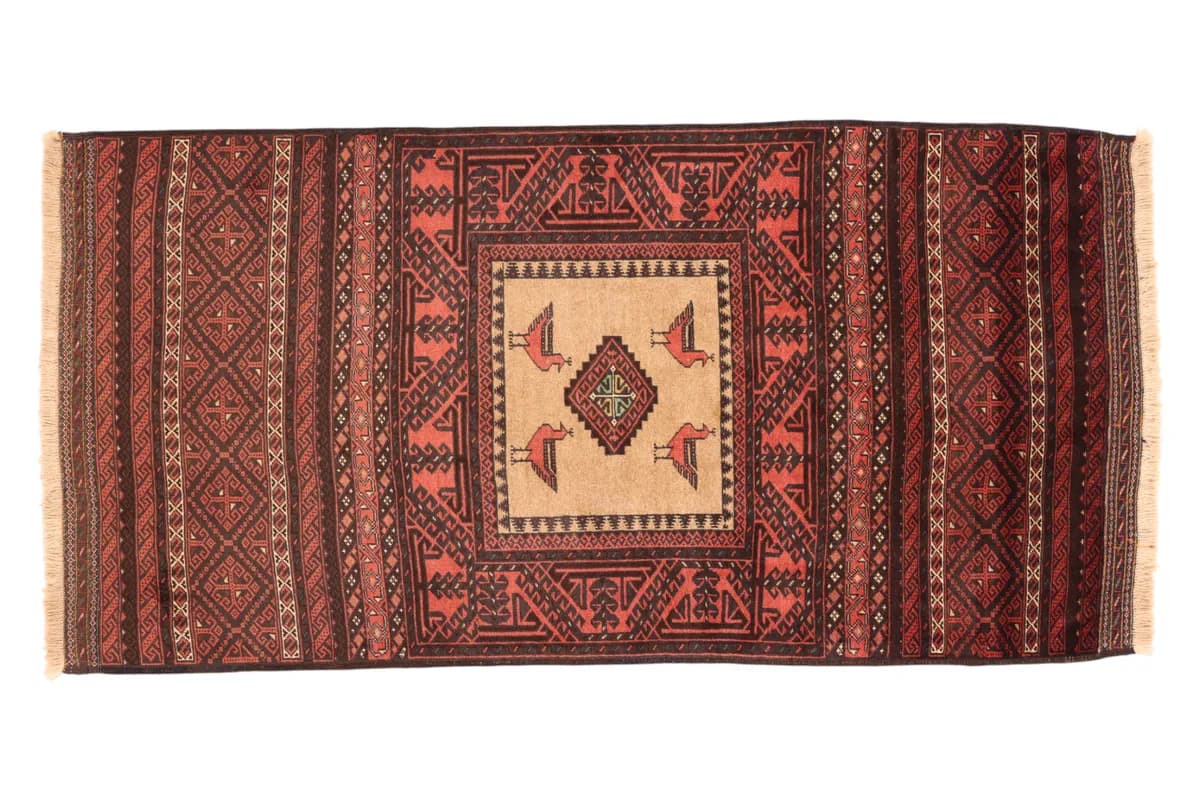
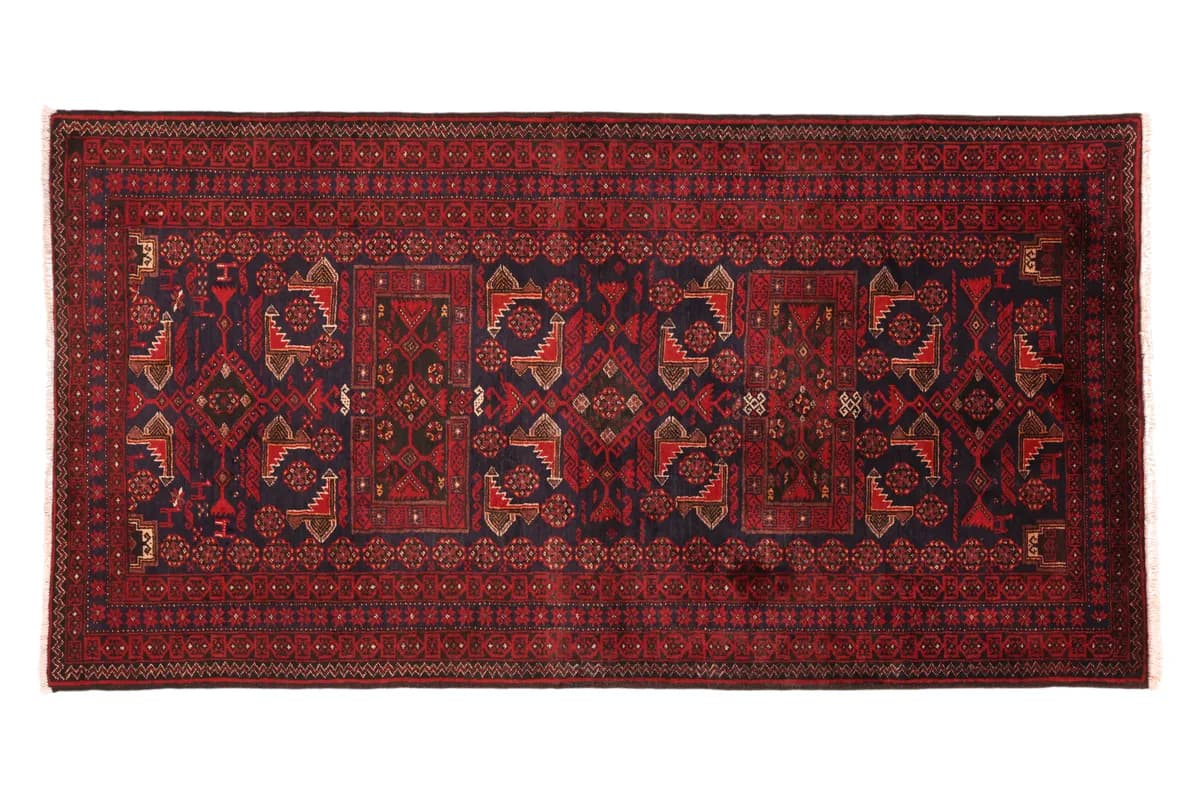
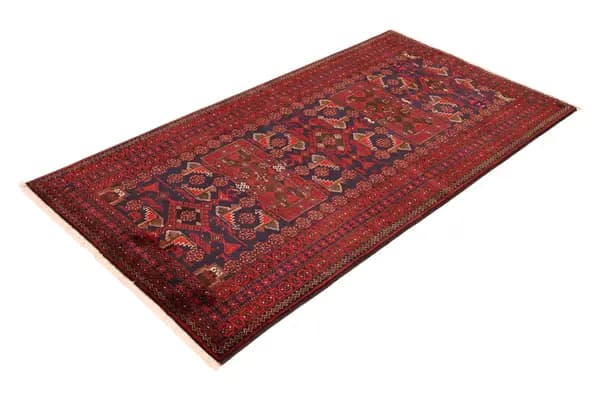
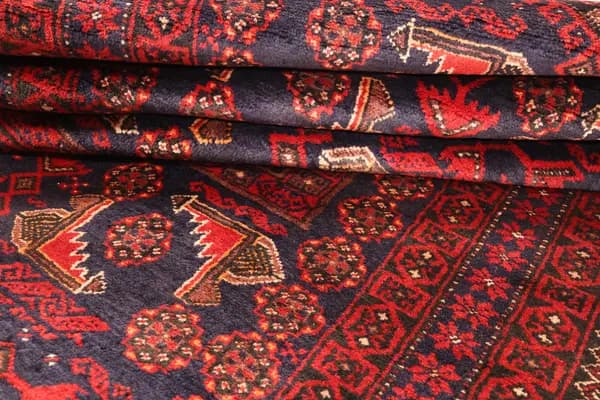
A Baluch, also written Belouch, is a tribal weaving from the borderlands of south-eastern Iran, and this one measures 194 x 101 cm (6'4" x 3'4"). The type is known for deep, earthy reds set against indigo blue, and for compositions built around a single medallion or a prayer-niche shape, carried in the weaver's memory rather than drawn on paper. Here the medallion idea is doubled: two are stacked, one above the other, rather than the usual one.
The field is a deep navy, close to black in places, filling the ground with small hooked geometric devices. Set into it, the two rectangular medallions sit like a pair of framed panels, each edged in cream, each holding a darker centre, with a red diamond marking the space between them. A wide border in brick red runs around the whole piece, carrying a steady line of small octagons, and is held on either side by narrower ivory diamond lattice guard stripes that cut sharply against the dark field.
The wool here is hand-spun, both in the warp and the pile, and the whole rug is hand-knotted. Hand-spun yarn is thicker and less even than machine-spun wool, so it does not allow the very fine knot counts of a city workshop; this piece sits at 128,000 to 160,000 knots per square metre, which is normal and honest for a rug made on a portable tribal loom rather than a workshop frame. That coarser yarn is exactly what gives the surface its soft, matte texture and its slightly rugged edges, and it is why the two medallions do not sit in perfect mirror symmetry: they were knotted from memory, not from a fixed plan, and the small variations between them are the record of a hand working without a cartoon to follow. At 6 mm the pile is dense and short, built to hold its shape underfoot.
At just over a metre wide, this is a rug for a bedroom floor beside the bed, a small study, or a hallway that gets little daylight. The near-black navy ground holds its own against dark wood and gives a pale floor real depth, while the brick-red border and the ivory lattice catch what light there is and keep the piece from ever looking heavy. Underfoot it is dense and firm, a rug made to be walked on rather than kept for looking at, and the kind of piece that rewards a second glance each time the light crosses the border.
More on Baluch rugs: origin, making and how to recognise a genuine piece
Traditional weave
At 194 × 101 cm (1.96 m²) this is a small rug. It works beside a bed, in a reading corner, in front of a fireplace or as a mat by a door. It does not furnish a room; it makes a point in one.
Yes, knotted by hand — knot by knot on a loom, not machine-made. The density is 128,000 to 160,000 knots per square metre; across 1.96 m² that is roughly 250,000 to 310,000 individual knots, every one of them tied by hand.
Hand-spun wool still carries its own lanolin, which keeps liquid sitting on the surface for a moment: blot quickly, with clear water and a light cloth, working inwards and without rubbing. Otherwise regular vacuuming along the pile is enough. Turn the rug once or twice a year so light and footfall reach it evenly.
We are in the Hamburg Speicherstadt. Come and see this rug in daylight, or write to us — a person answers.
Certificate included verifying origin, materials, and craftsmanship.
Ref: 878855