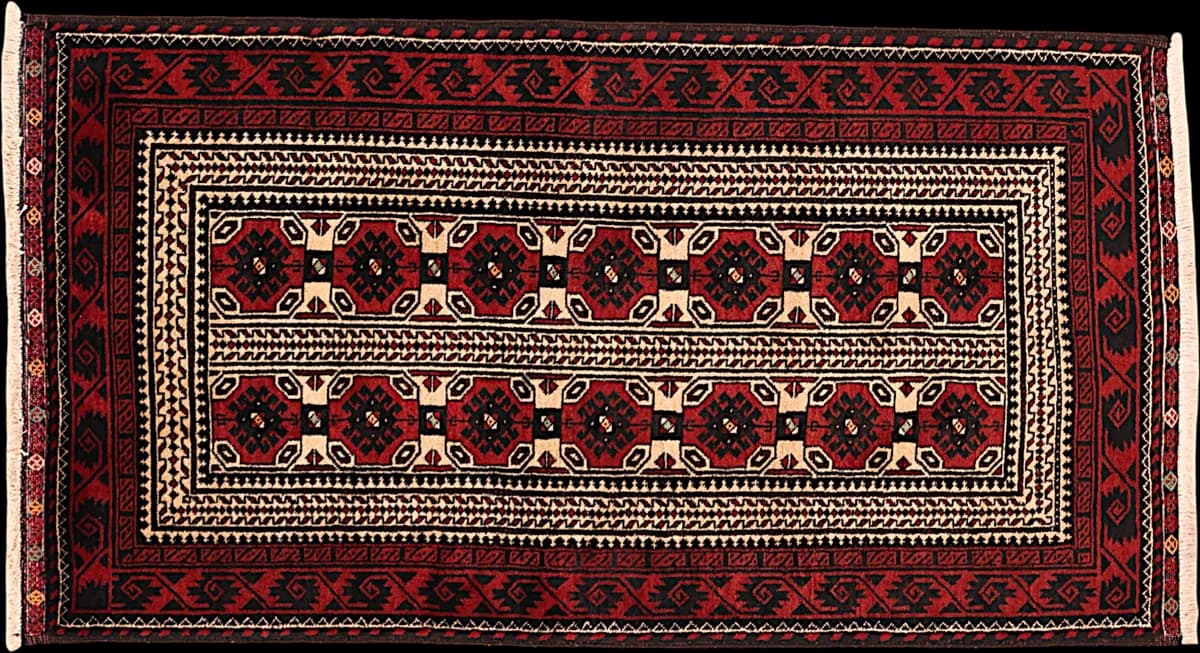
Belutsch
165 × 89 cm
366 €






611 €
Incl. VAT
In Stock · Ready to Ship
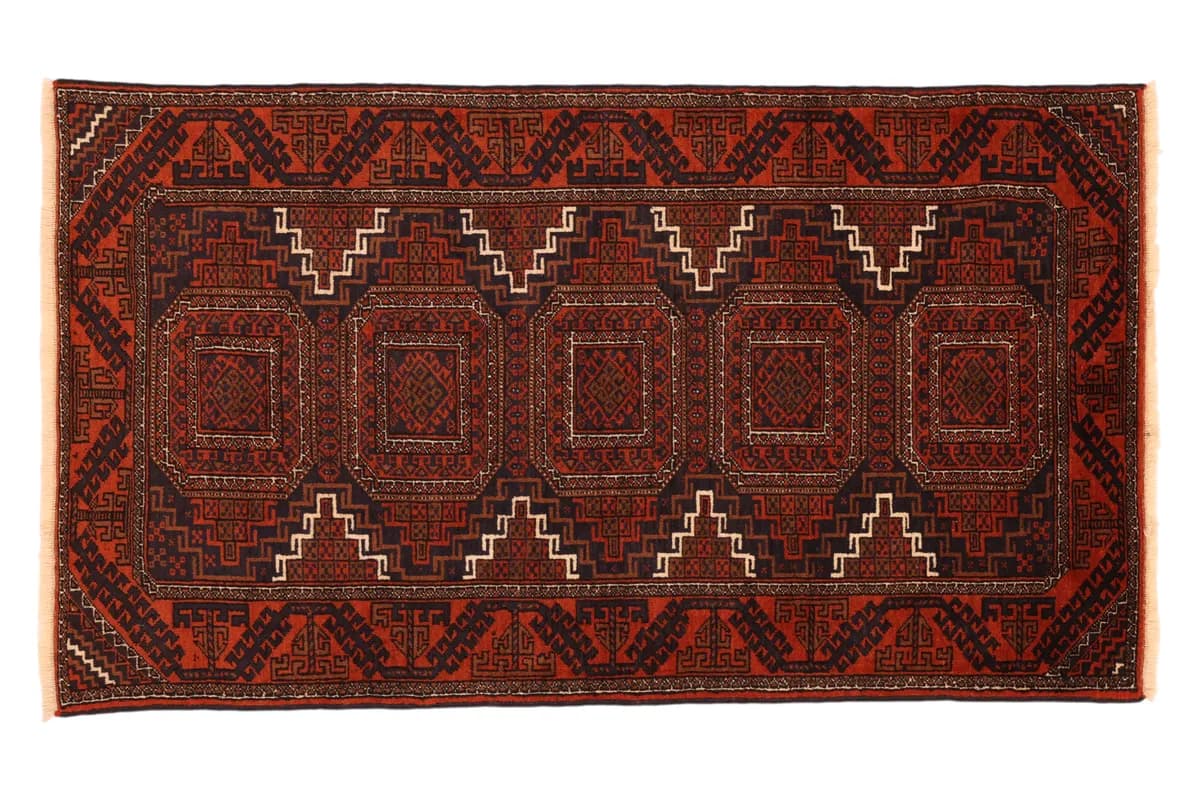
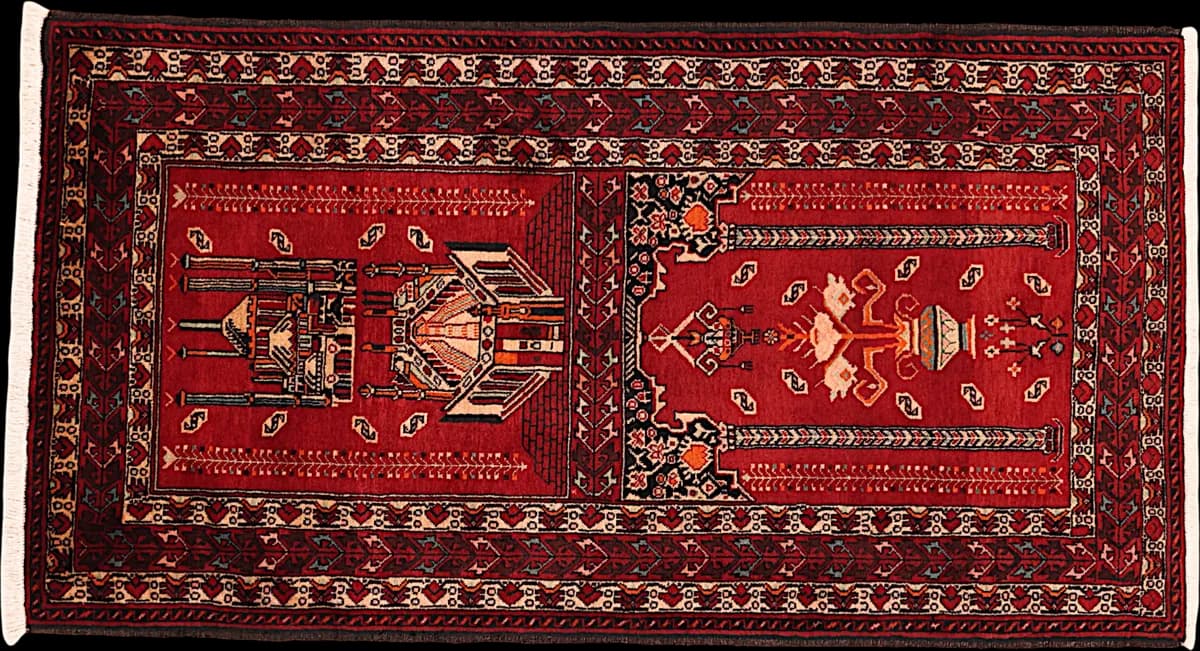
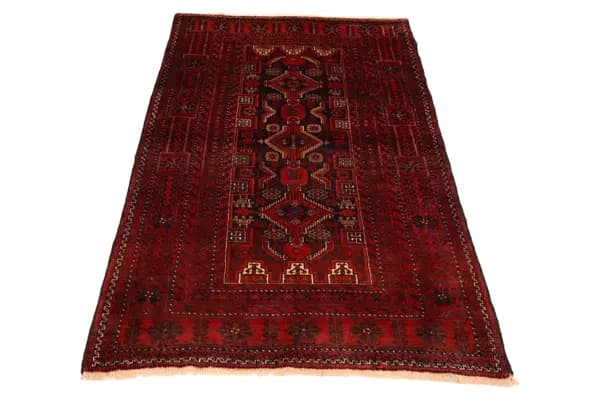
Belutsch rugs are woven by nomadic and semi-nomadic tribes from the borderlands of southeastern Iran, carried on portable looms and knotted from memory rather than from any drawn plan. The type is known for its deep, earthy palette of red and indigo and for bold, angular geometry, often arranged in the mihrab layouts once used as prayer rugs. This piece measures 182 x 97 cm (6'0" x 3'2"), and it carries the family's usual restraint with one exception: a single square of vivid cobalt set into the centre of its middle medallion.
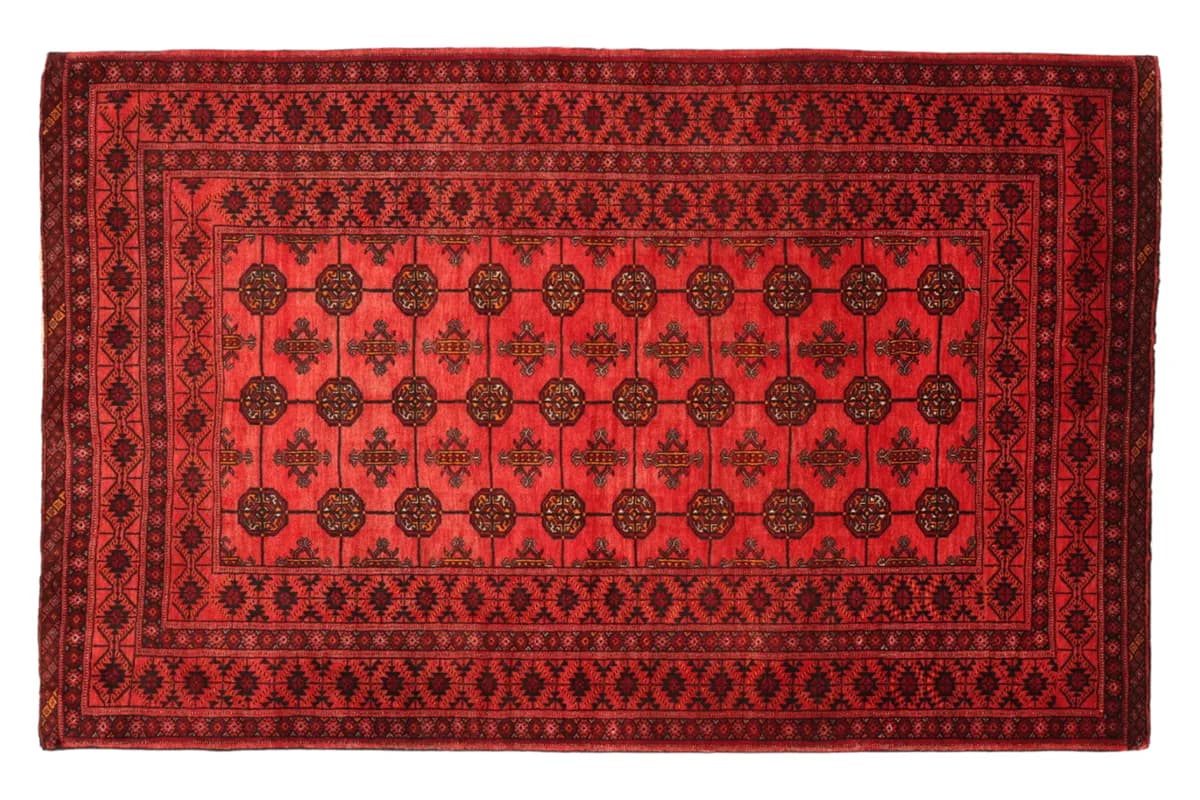
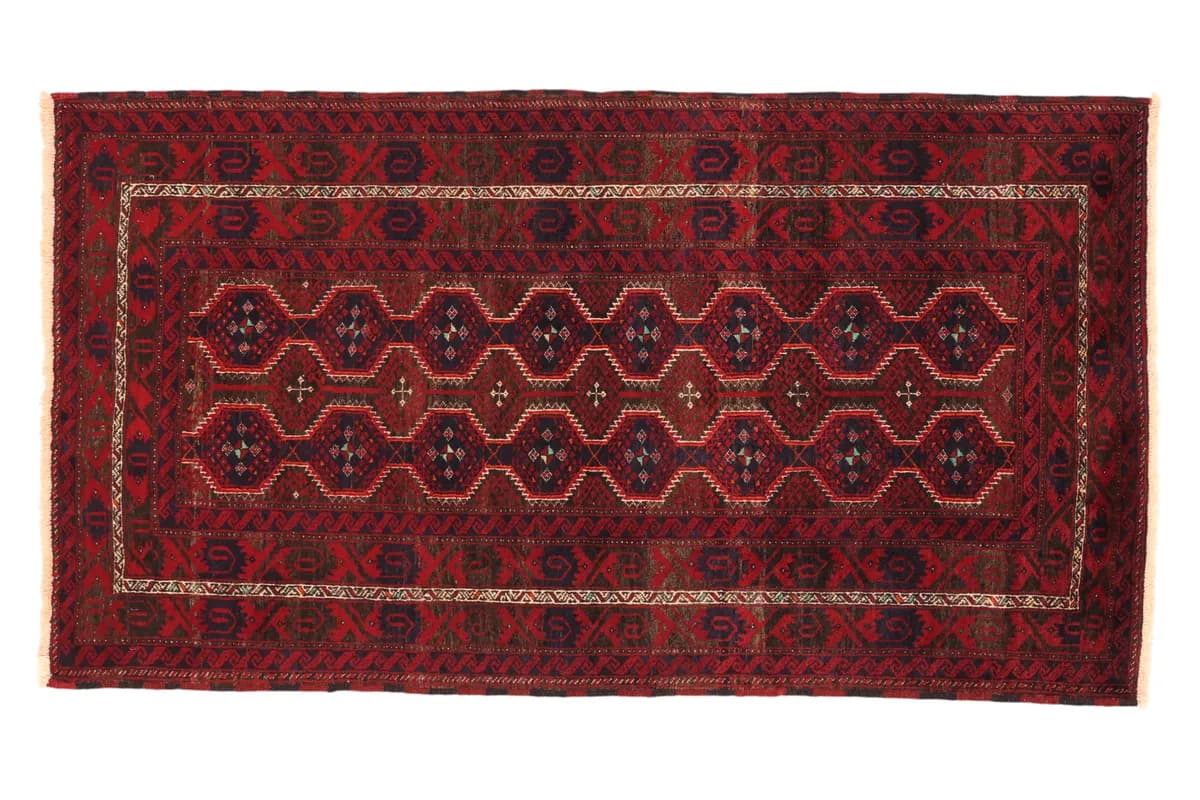
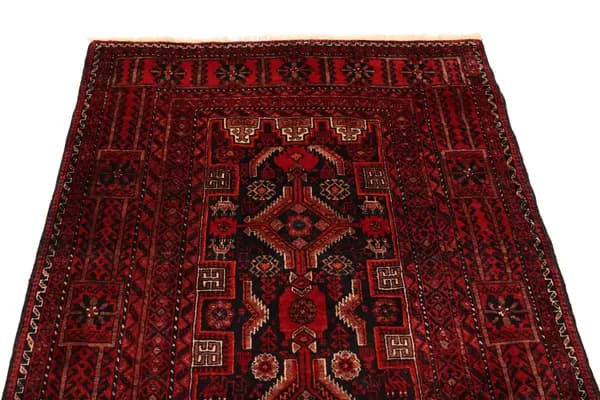
The first impression is a strong brick red, out of which a column of three large hooked diamond medallions rises on a ground of deep indigo, smaller diamond fillers filling the gaps between them. Ivory zigzag stripes run as guards along the edge of the field, and around the whole composition sits a wide, plain red border, backed by a narrower band of small compartments holding rosettes and hook motifs. Look at the centre medallion and the cobalt square sits there quietly, a single note of brighter colour in a palette that otherwise keeps to red and indigo throughout.
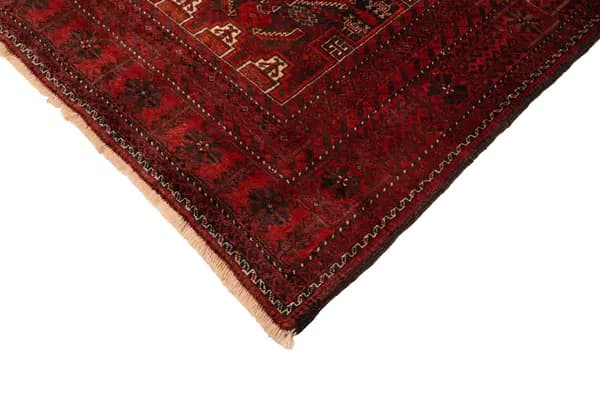
The wool is hand-spun rather than machine-spun, which gives the pile its slightly uneven, faintly nubbled surface and the soft variation you can see along the ivory pattern lines. Knotted at 128,000 to 160,000 knots per square metre onto a cotton warp, it sits at a density typical of tribal work, fine enough to hold the diamonds' hooked edges crisply, open enough to have been finished within a season rather than a year. Because there was no cartoon to follow, the weaver held the pattern in memory as she worked, and the cobalt square reads less like a design rule than a decision made at the loom, one medallion picked out from the other two.
At 182 x 97 cm this is a rug for a bedroom or a small study, beside a bed or under a reading chair, somewhere it will be seen up close rather than from across a room. The red holds its warmth against pale floorboards, and the indigo keeps it from ever looking pale itself. The pile is firm underfoot at 6 mm, dense enough for daily footsteps rather than a rug to be stepped around. Morning light will find that cobalt square first, every time.
More on Baluch rugs: origin, making and how to recognise a genuine piece
Traditional weave
At 182 × 97 cm (1.77 m²) this is a small rug. It works beside a bed, in a reading corner, in front of a fireplace or as a mat by a door. It does not furnish a room; it makes a point in one.
Yes, knotted by hand — knot by knot on a loom, not machine-made. The density is 128,000 to 160,000 knots per square metre; across 1.77 m² that is roughly 230,000 to 280,000 individual knots, every one of them tied by hand.
Hand-spun wool still carries its own lanolin, which keeps liquid sitting on the surface for a moment: blot quickly, with clear water and a light cloth, working inwards and without rubbing. Otherwise regular vacuuming along the pile is enough. Turn the rug once or twice a year so light and footfall reach it evenly.
We are in the Hamburg Speicherstadt. Come and see this rug in daylight, or write to us — a person answers.
Certificate included verifying origin, materials, and craftsmanship.
Ref: 921155