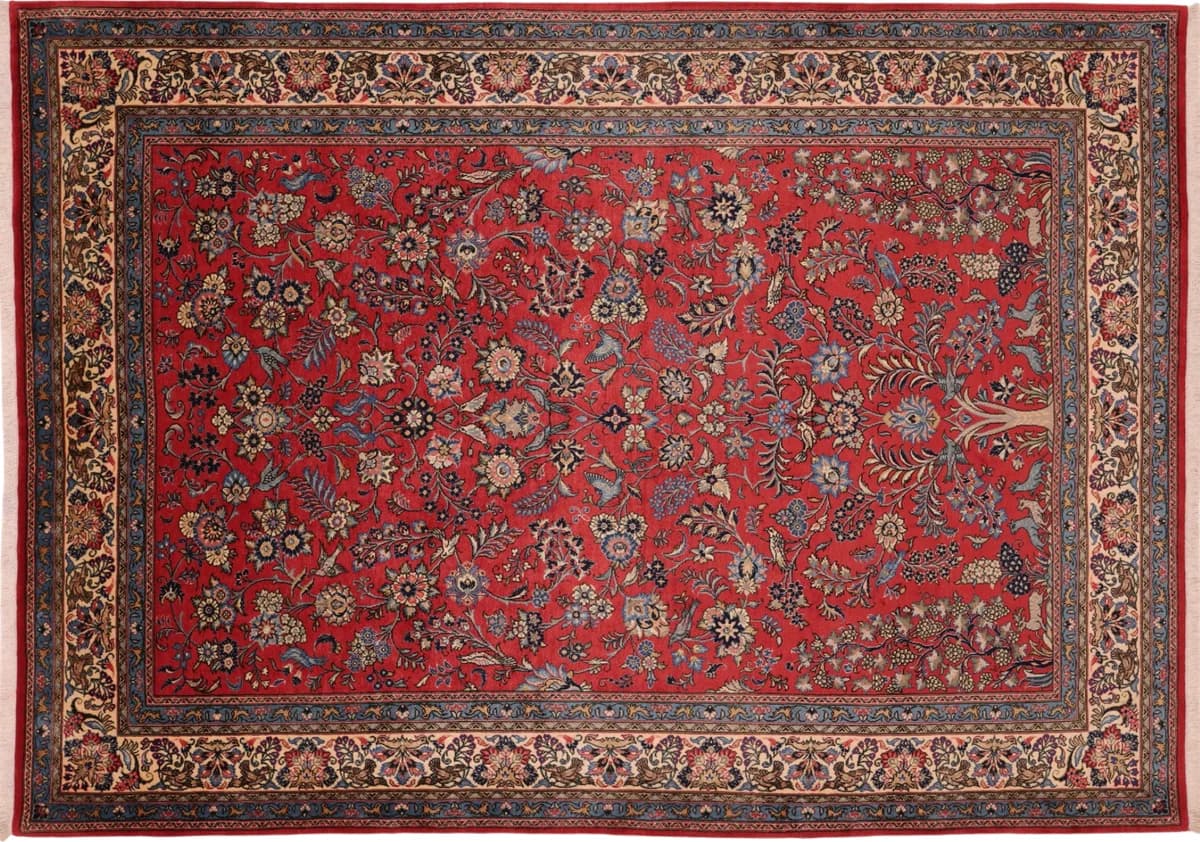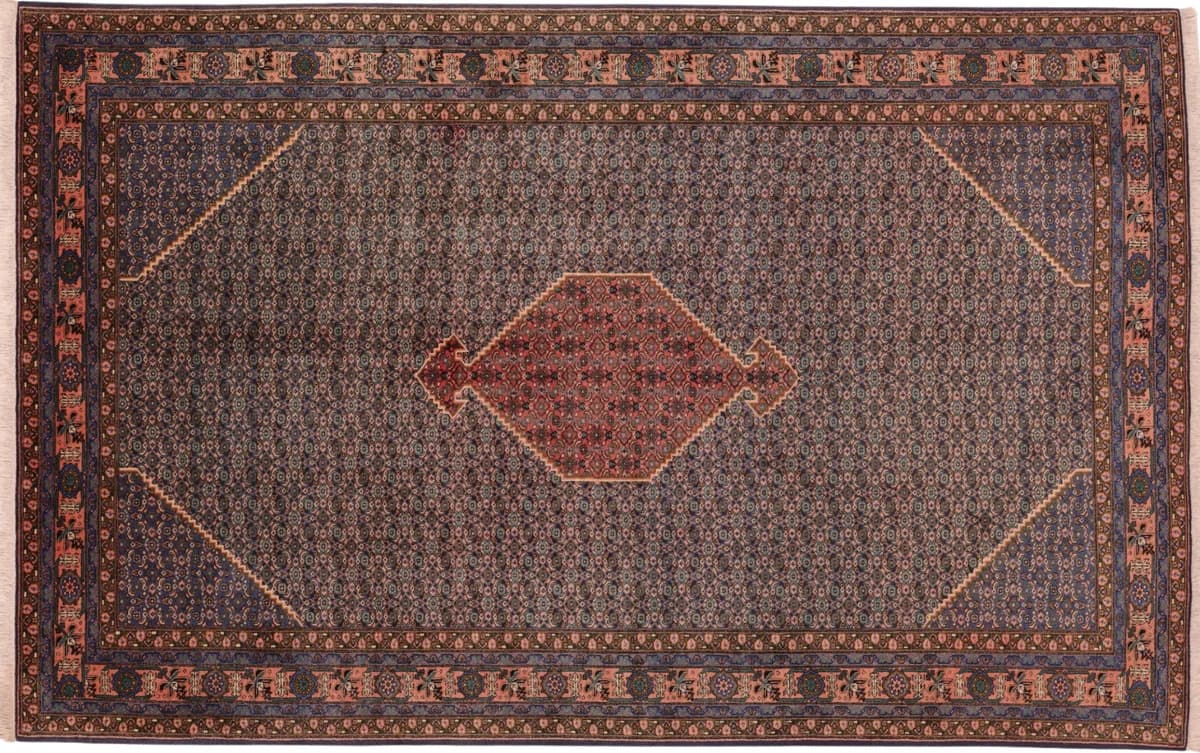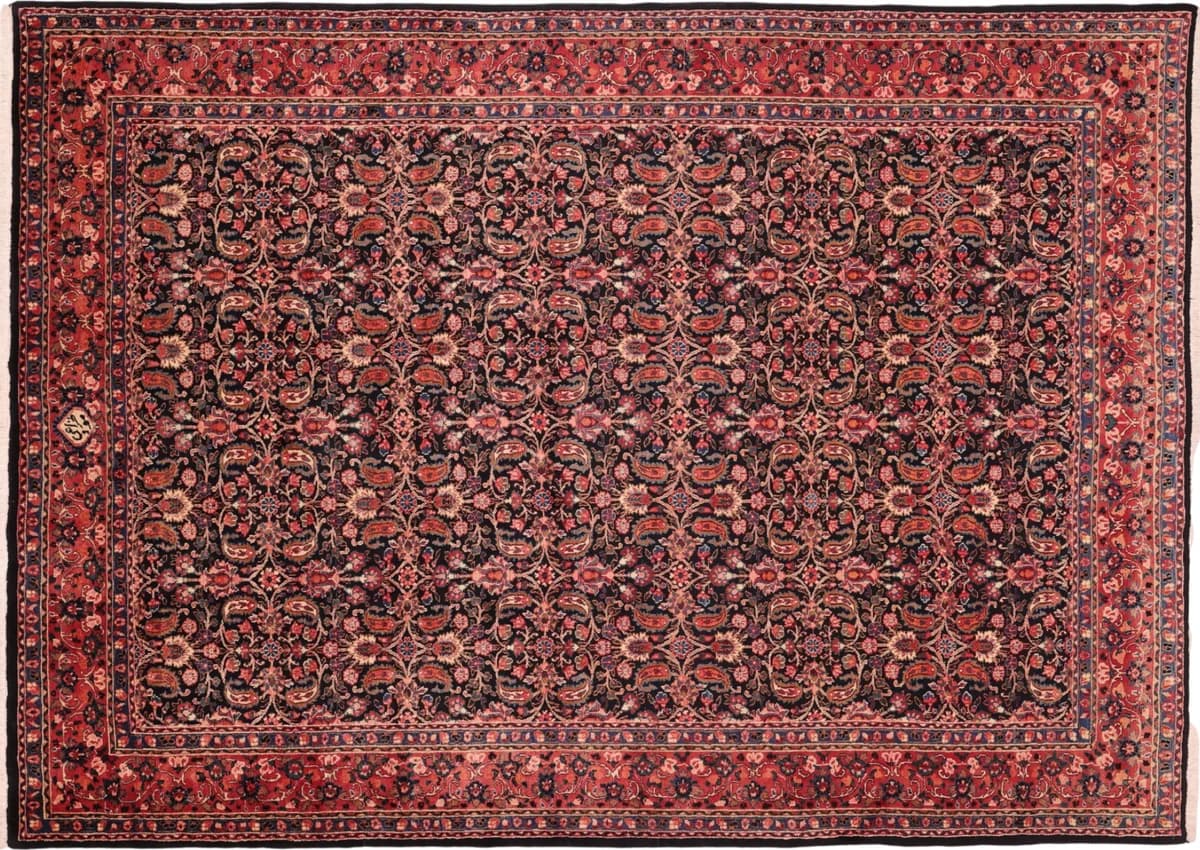
Nanadj
300 × 210 cm
5.100 €






5.850 €
Incl. VAT
In Stock · Ready to Ship
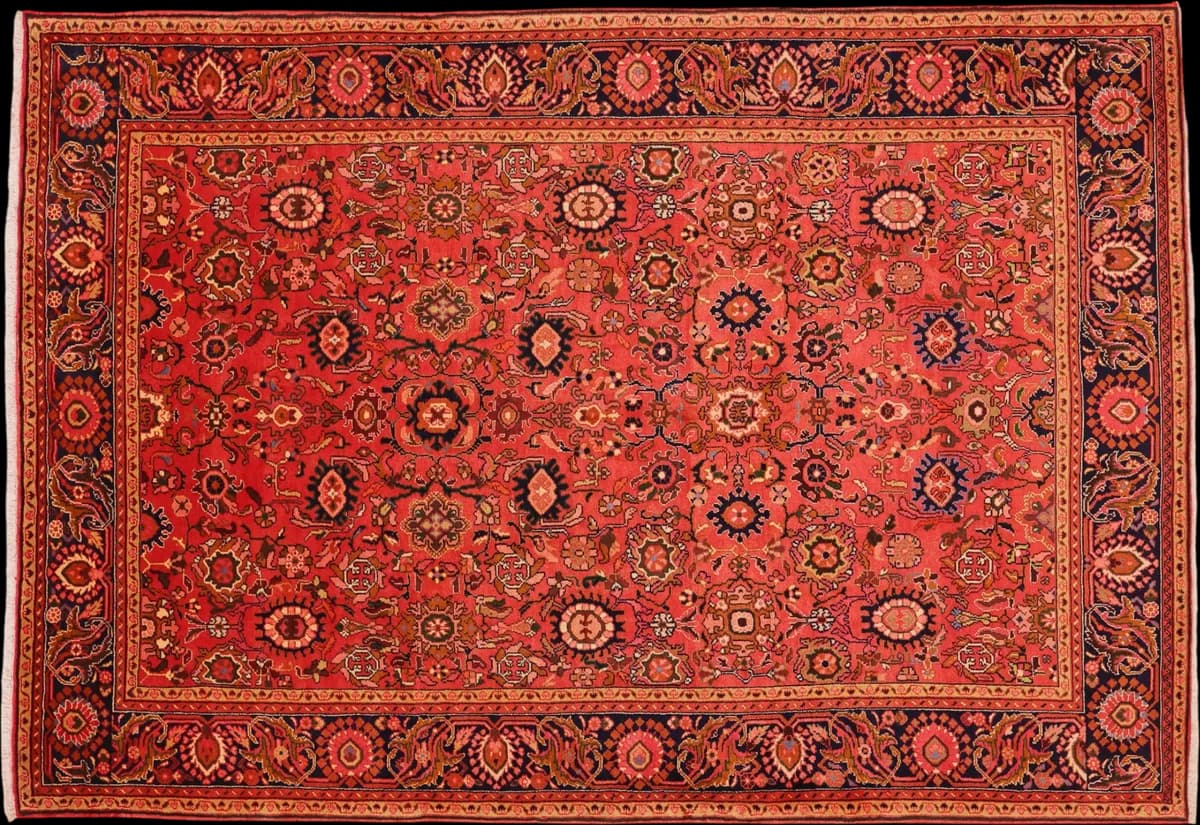
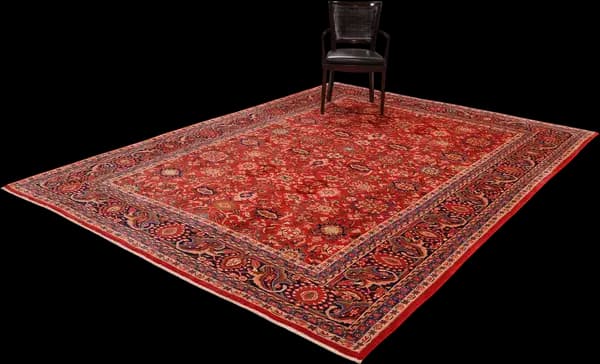
This is a Nanadj, a village weaving from the Kurdish districts of the Hamadan region in western Iran, 345 x 258 cm (11'4" x 8'6"). Rugs of this type have been known in the antique trade since the early twentieth century, made with the single-weft Sennah Baft technique typical of Hamadan and valued for combining bold Kurdish geometry with a plain, practical hand.
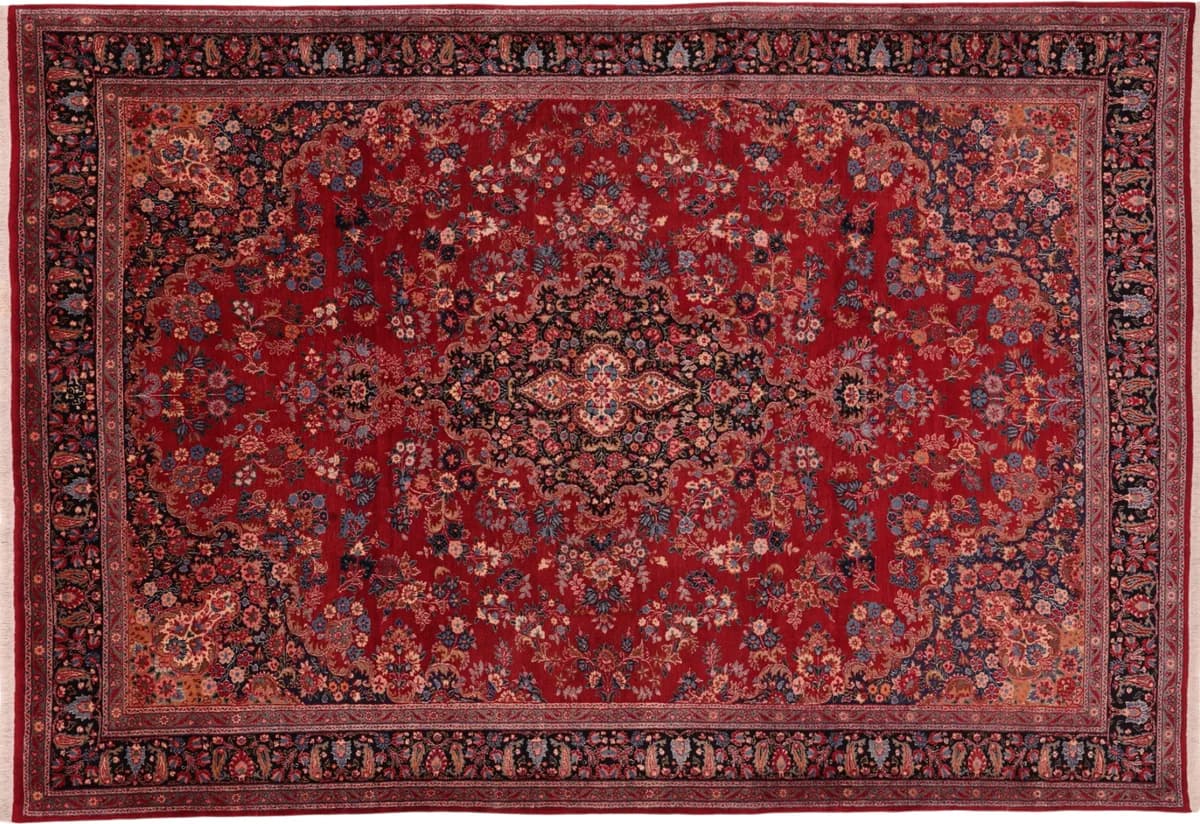
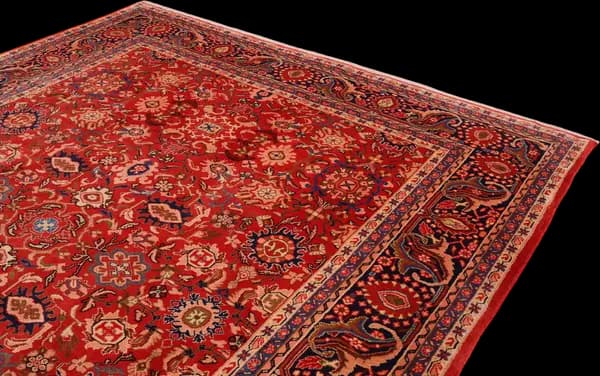
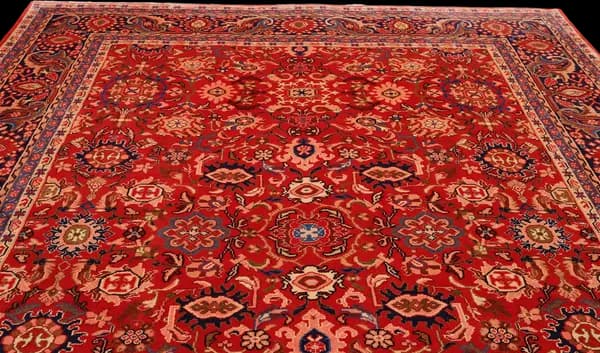
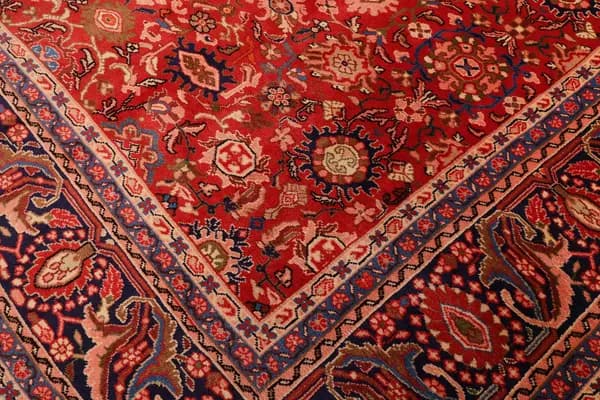
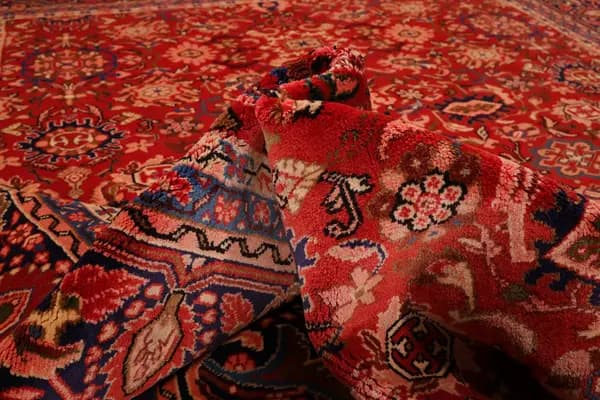
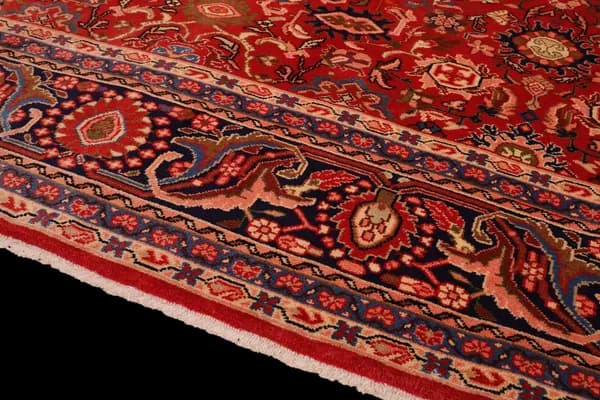
The field is a deep, saturated brick red, filled edge to edge with a fine, repeating lattice of rosettes and serrated leaves — the classic Mahi, or "fish", pattern, drawn here without a central medallion to interrupt its rhythm. The eye moves outward to a wide navy-blue border, its ground carrying large palmettes and curling vine scrollwork that read, for a moment, almost like creatures before resolving into foliage. Narrower ivory and floral guard stripes frame this border, which makes up close to a fifth of the rug's width.
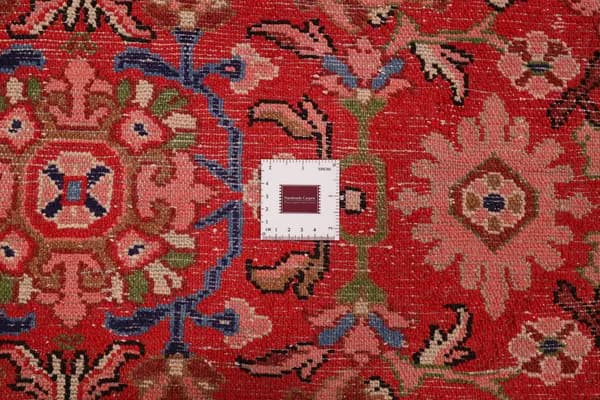
The pile is hand-spun wool, knotted onto a cotton warp at 201,000 to 250,000 knots per square metre, a workmanlike density built for firmness rather than the extreme fineness of a city workshop. Hamadan village weavers use the single-weft Sennah Baft structure, which locks each row more securely than a double-weft ground and lets a pattern this dense stay crisp without a cartoon to follow. The result is a Mahi lattice that reads evenly across the whole field, with no medallion needed to hold it together.
A rug of this size suits a dining room or a living room, sitting under a table and chairs or anchoring a seating group. The brick red holds its own against dark wood and leather, and warms a pale floor without any help. Underfoot the pile is dense and firm rather than plush, made for daily use rather than for best. Its plain, confident pattern is easy to live with, and the palmettes in the border are what you keep noticing as the light crosses the room.
Nanaj rugs come from a village in the northern part of Hamadan Province, western Iran. Like all Hamadan-region rugs, they are woven with the symmetrical (Turkish) knot on cotton foundations with the characteristic single-weft construction, one row of weft between each row of knots, creating a firm handle and distinctive ribbed appearance on the reverse.
The Herati pattern predominates, rendered in a classic palette of red and blue from natural madder root and indigo. Hand-spun wool produces a durable, practical carpet with clear graphic design language suited for both traditional and curated modern interiors.
Fine quality weave
At 345 × 258 cm (8.90 m²) this is a very large rug. It carries a whole seating group with every furniture leg on it, or a dining table with the chairs pushed back. In a small room it becomes the floor rather than a rug.
Yes, knotted by hand — knot by knot on a loom, not machine-made. The density is 201,000 to 250,000 knots per square metre; across 8.90 m² that is roughly 1.8 to 2.2 million individual knots, every one of them tied by hand.
Hand-spun wool still carries its own lanolin, which keeps liquid sitting on the surface for a moment: blot quickly, with clear water and a light cloth, working inwards and without rubbing. Otherwise regular vacuuming along the pile is enough. Turn the rug once or twice a year so light and footfall reach it evenly.
We are in the Hamburg Speicherstadt. Come and see this rug in daylight, or write to us — a person answers.
Certificate included verifying origin, materials, and craftsmanship.
Ref: 200227