Sarough
211 × 80 cm
990 €






7.350 €
Incl. VAT
In Stock · Ready to Ship
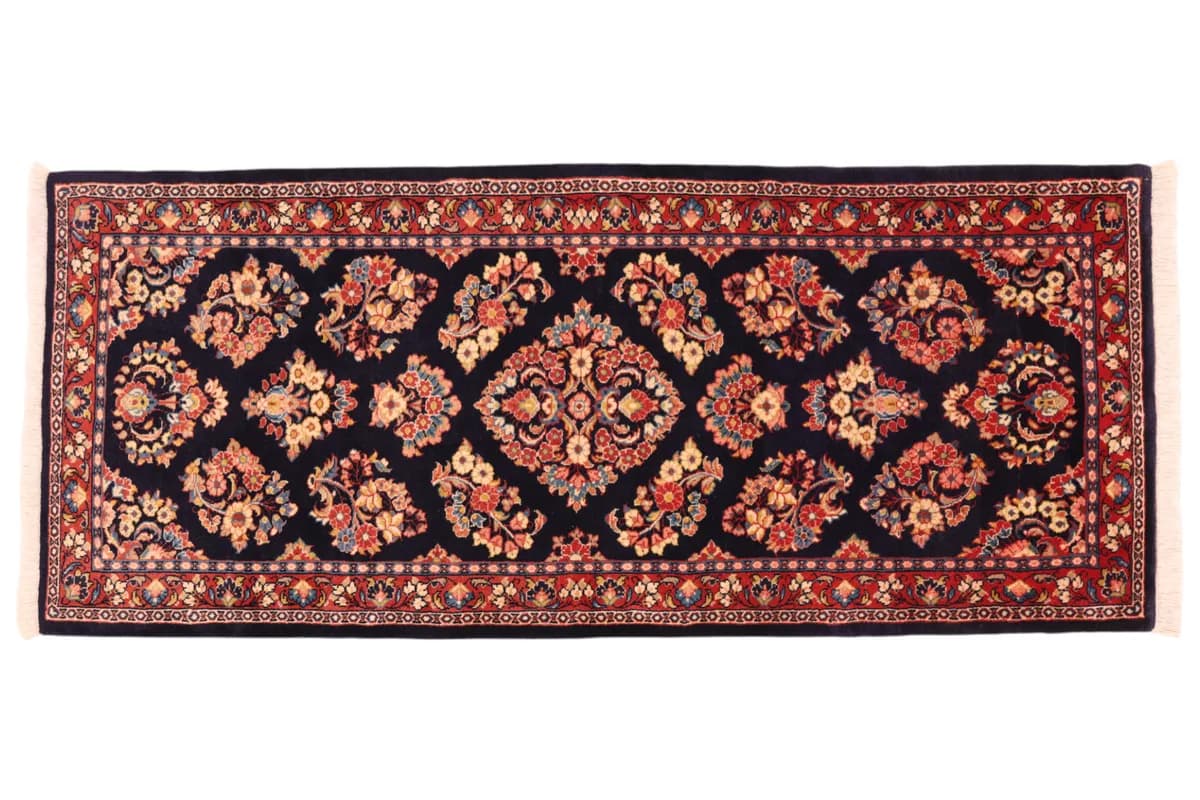
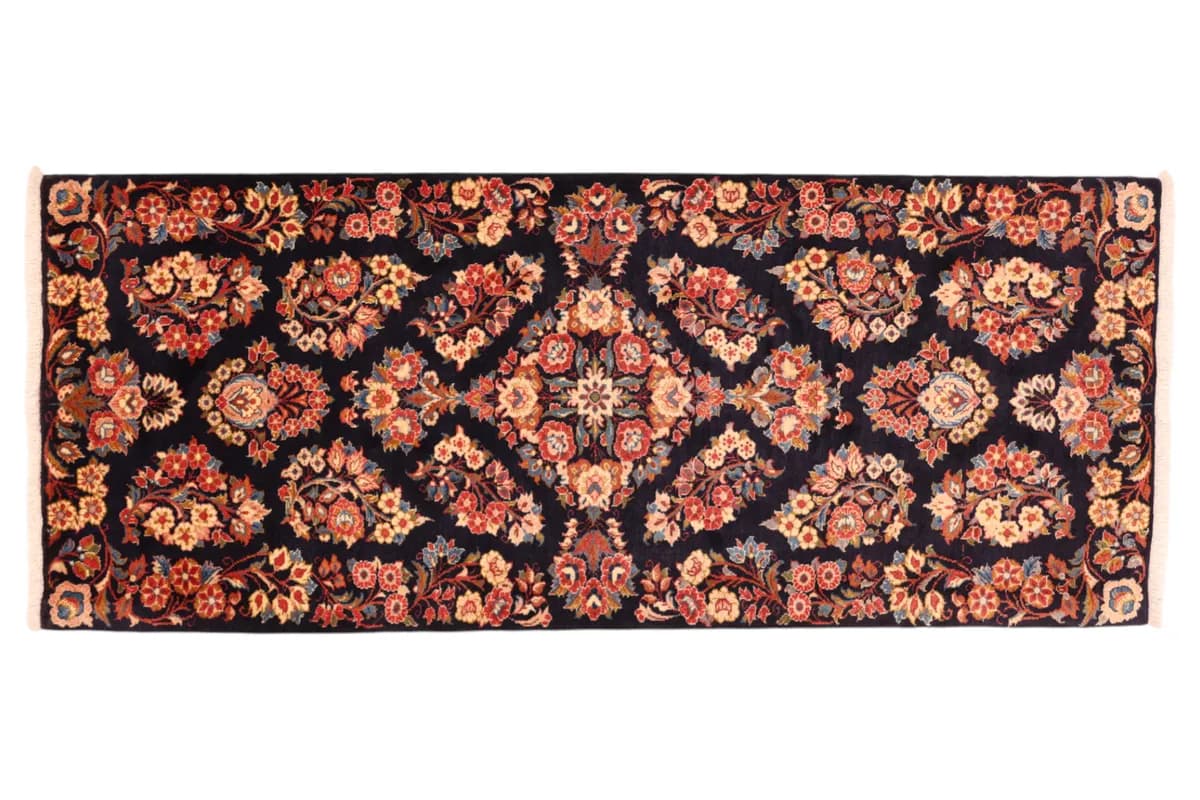
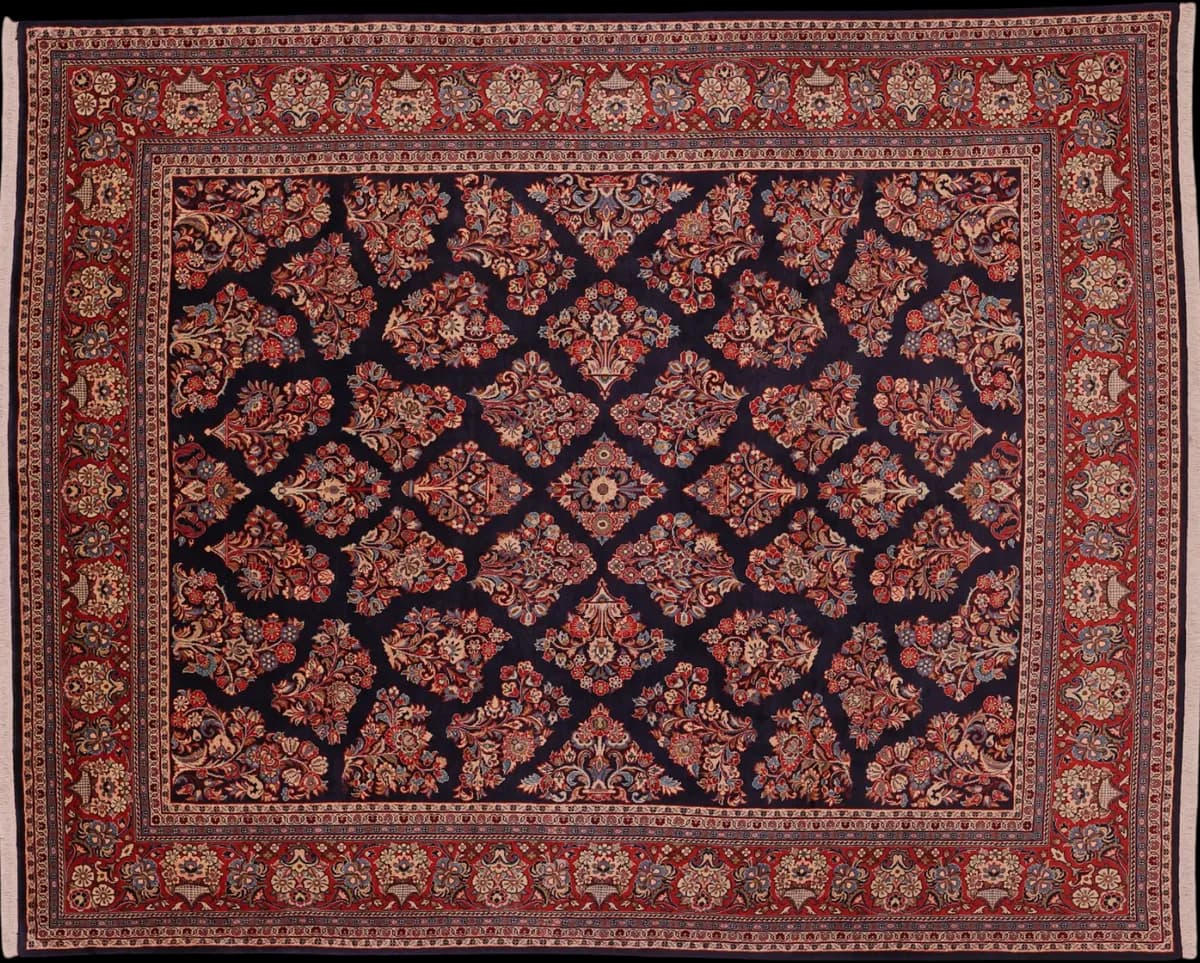
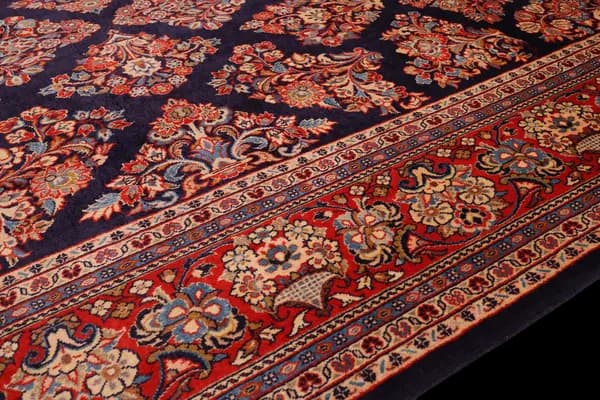
This is a Sarough, hand-knotted in the Arak weaving region of west-central Iran, measuring 300 x 240 cm (9'10" x 7'10"). The type is best known for its warm "Persian red" grounds and its dense, controlled floral drawing, the pattern that made it a favourite of the finest American houses in the early twentieth century. Here the workshop has kept that discipline of drawing but set it against a field of deep navy rather than red, an unusual choice for the type and the first thing you notice.
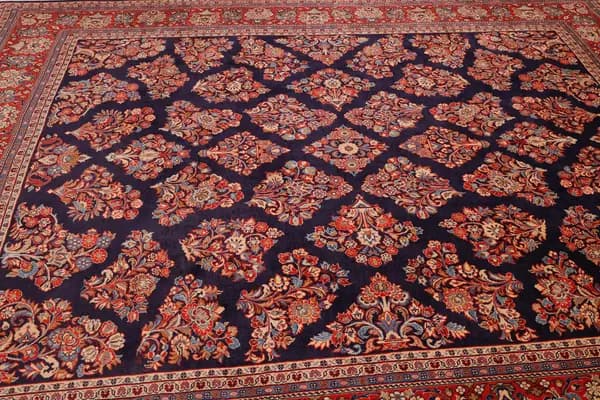
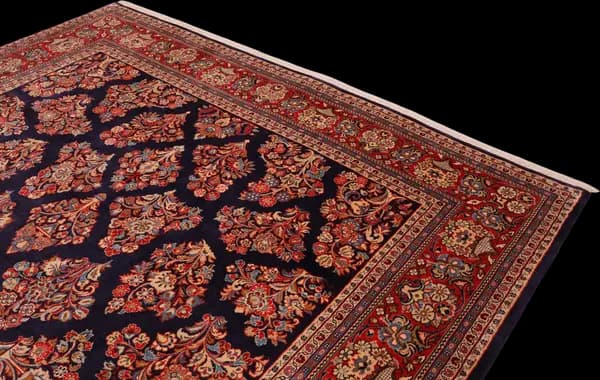
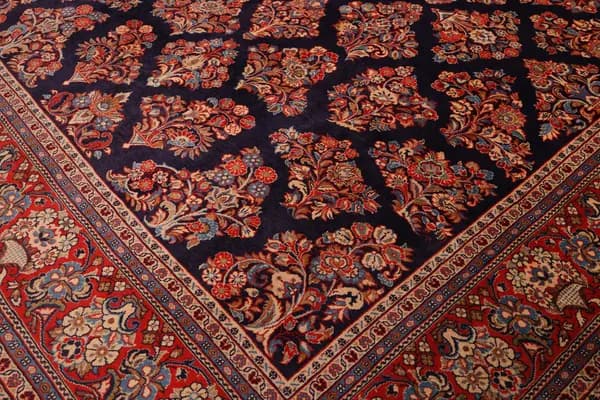
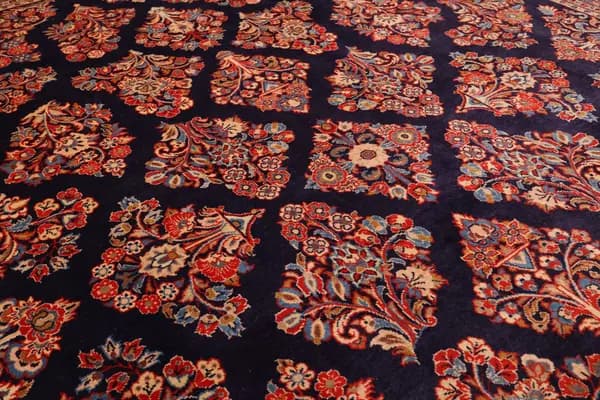
Against that near-black navy ground sits a diamond lattice of floral sprays, drawn from the Mahi tradition, each cell holding a small bouquet in cream and ivory with touches of steel blue and dusty rose. The grid reads with a crispness closer to architecture than to the soft floral blur these rugs often show, every diamond edge held straight and every repeat true to the last. A broad brick-red border, filled with its own floral sprays and running to roughly a fifth of the rug's width, closes the design and gives the whole piece its strongest contrast, red against navy rather than red against red.
That crispness is a direct result of how finely the rug is knotted. At 161,000 to 200,000 knots per square metre, the weaver had enough resolution in the grid to draw straight diamond edges rather than let them soften into curves, which is what happens at coarser densities. The pile is hand-spun wool, knotted onto a cotton foundation and left at 12 mm, dense and short rather than deep, which is what gives the surface its fine, even hand and its light, even sheen. Woven twenty to forty years ago, it has already had the years needed to settle into that hand without wearing thin.
A rug of this size sits naturally under a dining table or in a living room seating group, and here the navy ground does real work in either setting: it holds its own against dark wood furniture instead of disappearing under it, while the red border keeps the room from turning too cool. Underfoot the pile is dense and firm, built for a room that gets used rather than one that gets admired from the doorway. Move a lamp across it in the evening and the light sheen catches the lattice edges in turn, so the grid seems to shift very slightly as you cross the room.
More on Sarough rugs: origin, making and how to recognise a genuine piece
Traditional weave
At 300 × 240 cm (7.20 m²) this is a large rug. It sits under a seating group with the front legs of sofa and chairs on it, or under a dining table for four. A table for six wants about 80 cm of clearance all round, and needs more.
Yes, knotted by hand — knot by knot on a loom, not machine-made. The density is 161,000 to 200,000 knots per square metre; across 7.20 m² that is roughly 1.2 to 1.4 million individual knots, every one of them tied by hand.
Hand-spun wool still carries its own lanolin, which keeps liquid sitting on the surface for a moment: blot quickly, with clear water and a light cloth, working inwards and without rubbing. Otherwise regular vacuuming along the pile is enough. Turn the rug once or twice a year so light and footfall reach it evenly.
We are in the Hamburg Speicherstadt. Come and see this rug in daylight, or write to us — a person answers.
Certificate included verifying origin, materials, and craftsmanship.
Ref: 668283