Belutsch
190 × 107 cm
579 €







1.114 €
Incl. VAT
In Stock · Ready to Ship
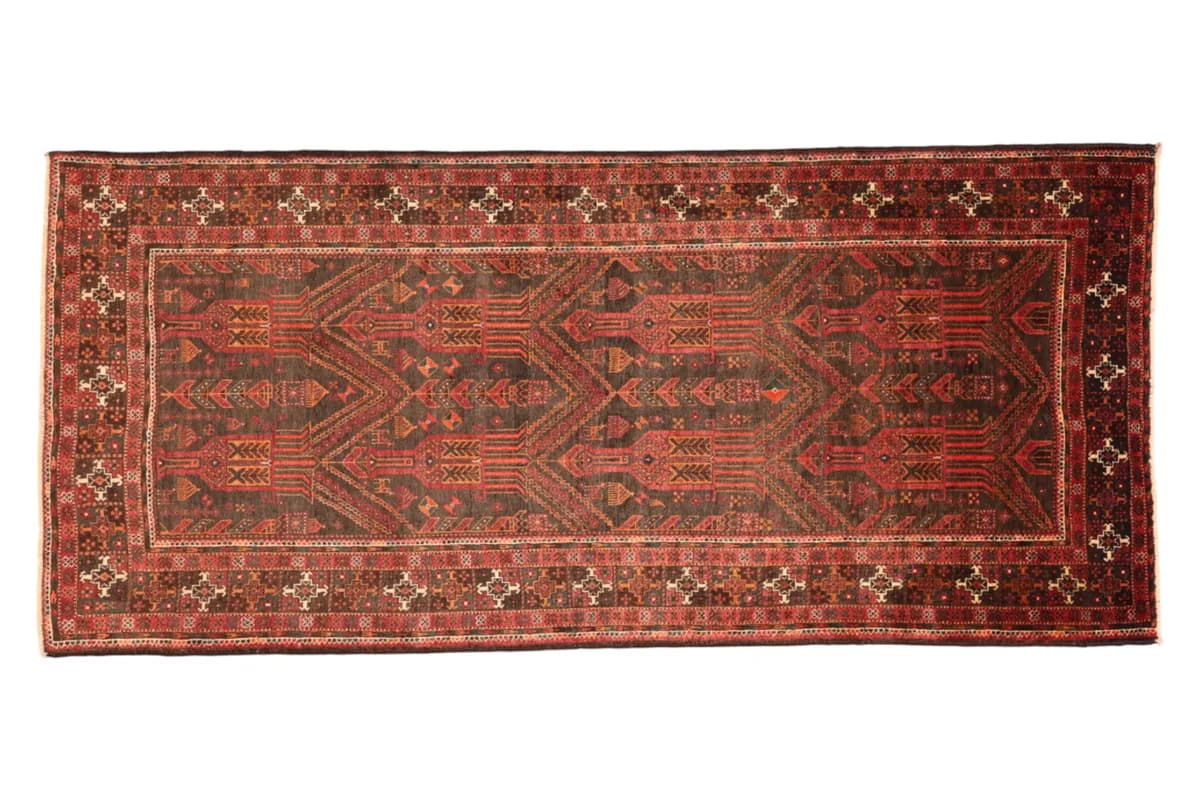
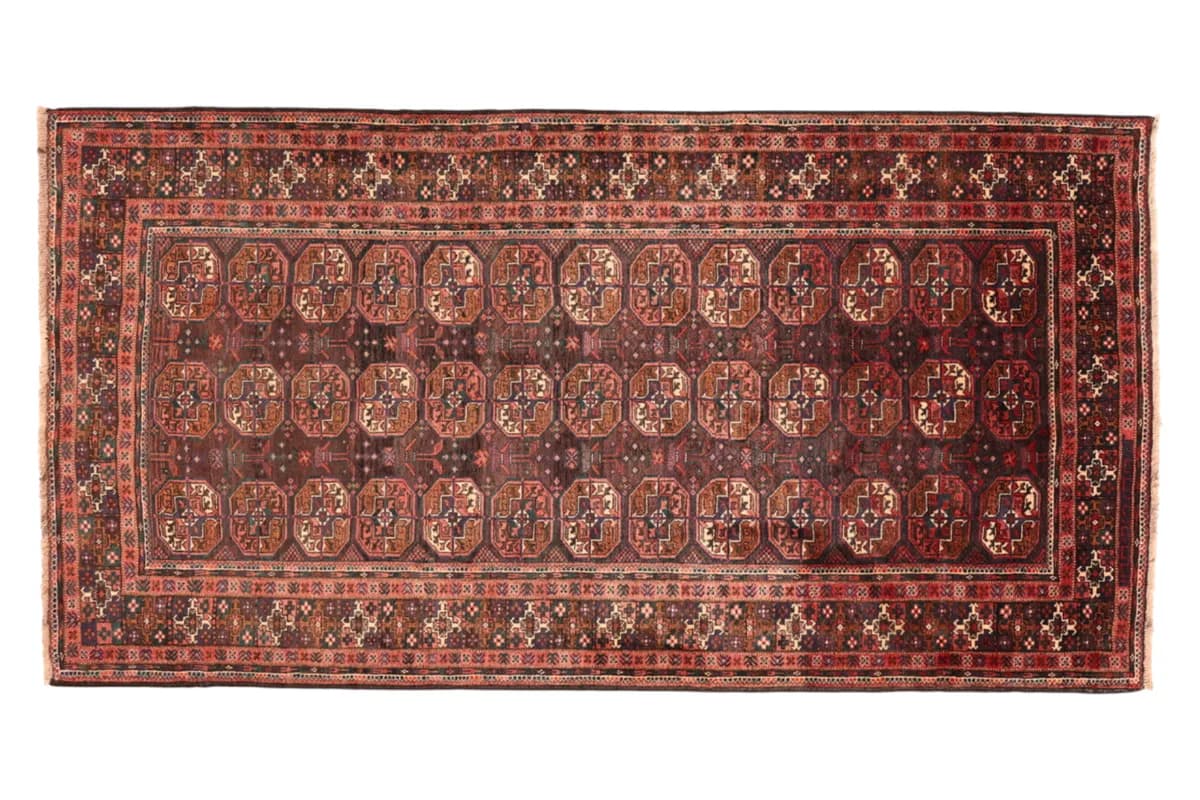
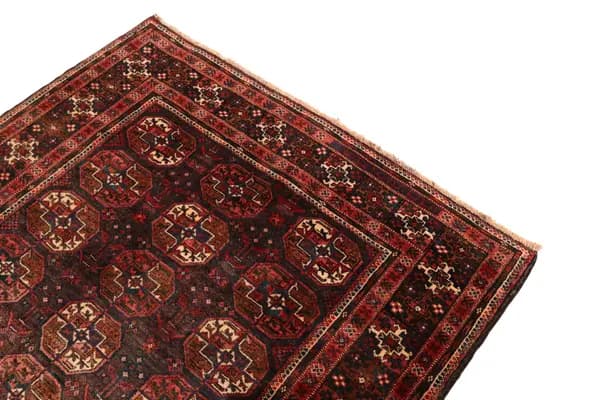
This is a Baluch, also written Belouch — a tribal rug from the borderlands of southeastern Iran and the regions around it, sized 229 x 120 cm (7'6" x 3'11"). The type is known above all for deep, earthy reds and indigo, and for prayer-niche mihrab layouts knotted from memory on a portable loom, generation to generation, with no cartoon to follow. This particular piece takes the same tribal hand and turns it toward something more ordered: a medallion grid rather than a mihrab, drawn with unusual discipline for the type.
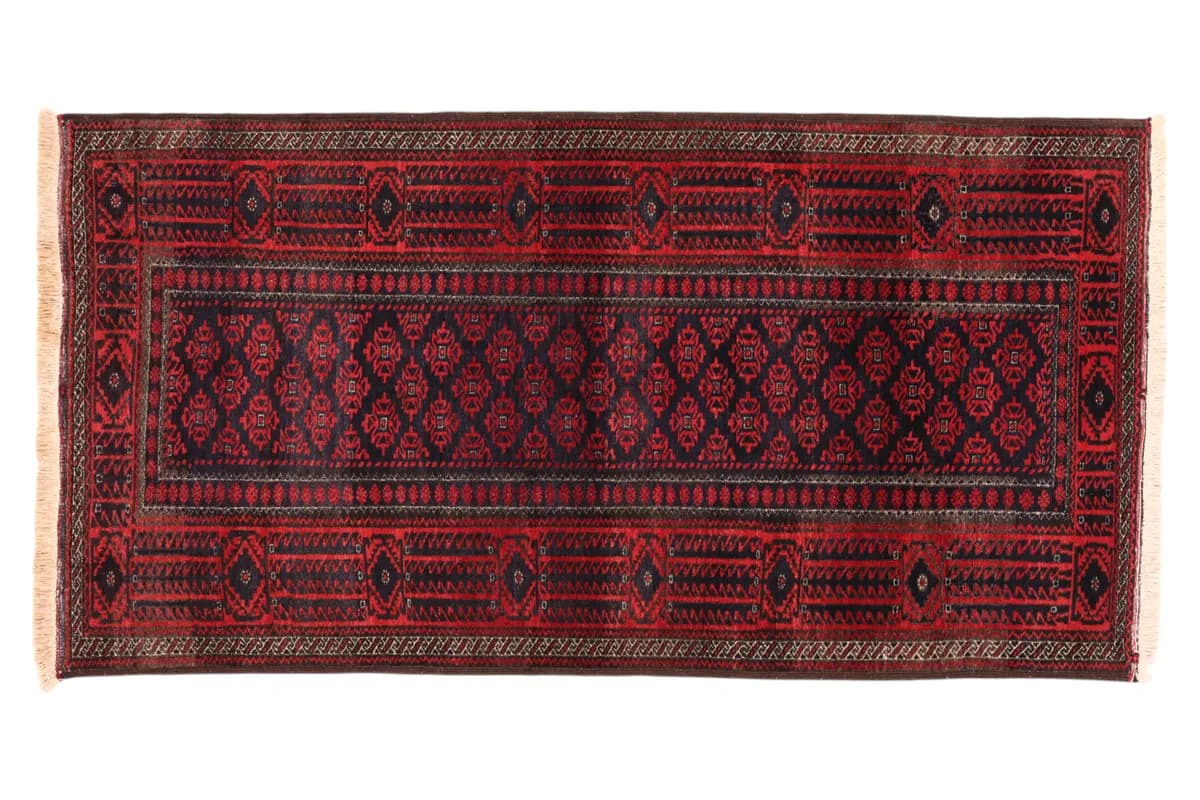
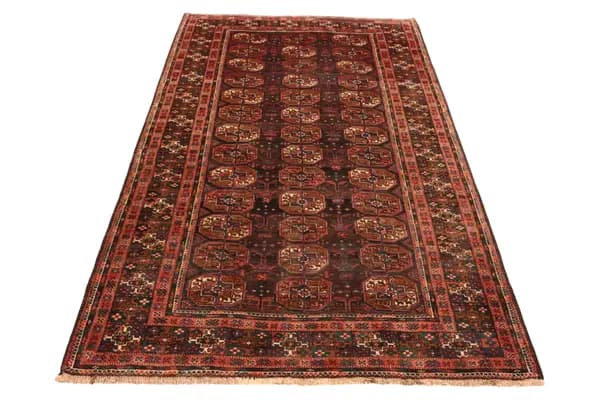
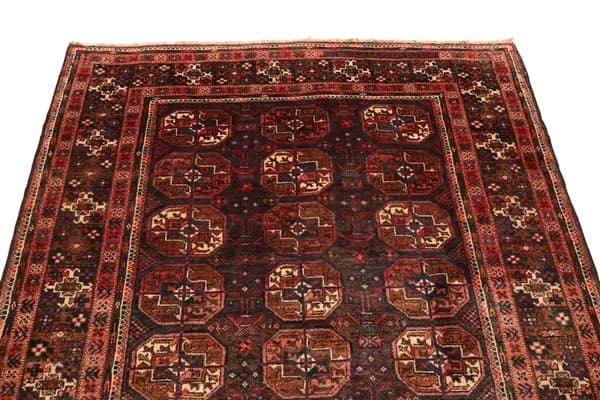
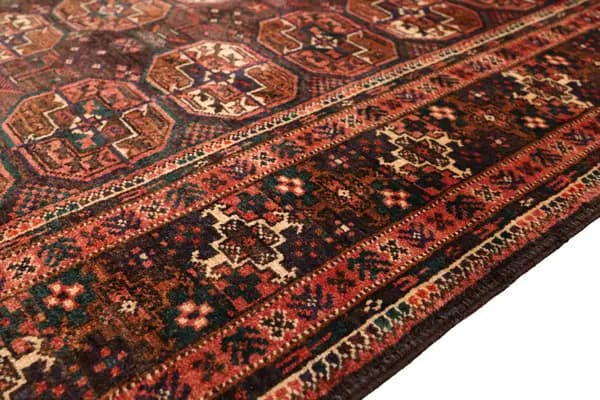
The ground is a deep mahogany-red, almost brown, and across it run three long rows of large octagonal medallions, thirteen columns wide, each filled in rust-brown and camel around an ivory centre. Between the octagons the dark field stays largely plain, with only the faintest scatter of small diamonds breaking the space. Around all of this runs a wide rose-red border, carrying a cream diamond-hook lattice, and the whole is closed at each edge by a narrow, dark zigzag guard stripe.
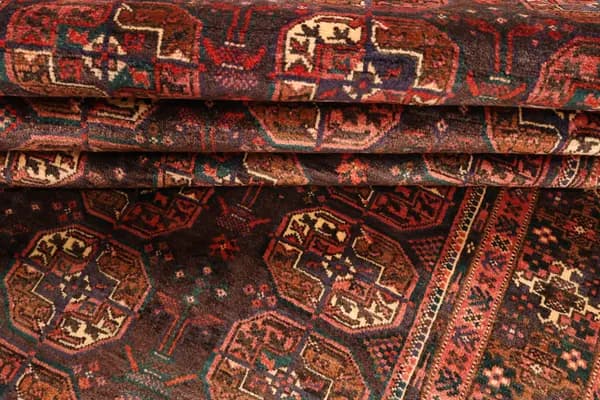
Every knot was tied by hand, from memory, and what stands out is how evenly the grid holds: three rows of octagons, the same size, spaced with none of the small shifts or restarts that usually mark a tribal field. The wool, hand-spun for both foundation and pile, varies slightly in thickness from strand to strand, and that variation is exactly what gives the surface its matte, textured hand-spun look rather than any sheen. At 128,000 to 160,000 knots per square metre and a 6 mm pile, the weave sits on the coarser side, which keeps the geometry bold and clearly read rather than finely drawn, and after twenty to forty years of use the wool still holds its form.
At just over two metres by one, this is a rug for a hallway, a landing, or the floor beside a bed, and its mahogany ground brings warmth into rooms that see little daylight. Underfoot it is dense, low and firm, made for a floor that gets walked on rather than kept for best. As the light moves across it through the day, the grid of octagons stays exactly where it was drawn, calm and steady under a pattern that, in this type, is usually anything but.
More on Baluch rugs: origin, making and how to recognise a genuine piece
Traditional weave
At 229 × 120 cm (2.75 m²) this is a medium rug. It works in front of a sofa, in front of a bed or in a study. It is too small for a dining table — there you want about 80 cm of clearance so a chair does not tip over the edge when pushed back.
Yes, knotted by hand — knot by knot on a loom, not machine-made. The density is 128,000 to 160,000 knots per square metre; across 2.75 m² that is roughly 350,000 to 440,000 individual knots, every one of them tied by hand.
Hand-spun wool still carries its own lanolin, which keeps liquid sitting on the surface for a moment: blot quickly, with clear water and a light cloth, working inwards and without rubbing. Otherwise regular vacuuming along the pile is enough. Turn the rug once or twice a year so light and footfall reach it evenly.
We are in the Hamburg Speicherstadt. Come and see this rug in daylight, or write to us — a person answers.
Certificate included verifying origin, materials, and craftsmanship.
Ref: 941476