Between knotted rug and kilim
A fully knotted rug has a pile of twelve to eighteen millimetres, soft and springy. A kilim has none at all: the pattern comes from warp and weft alone, and the rug is the same on both faces.
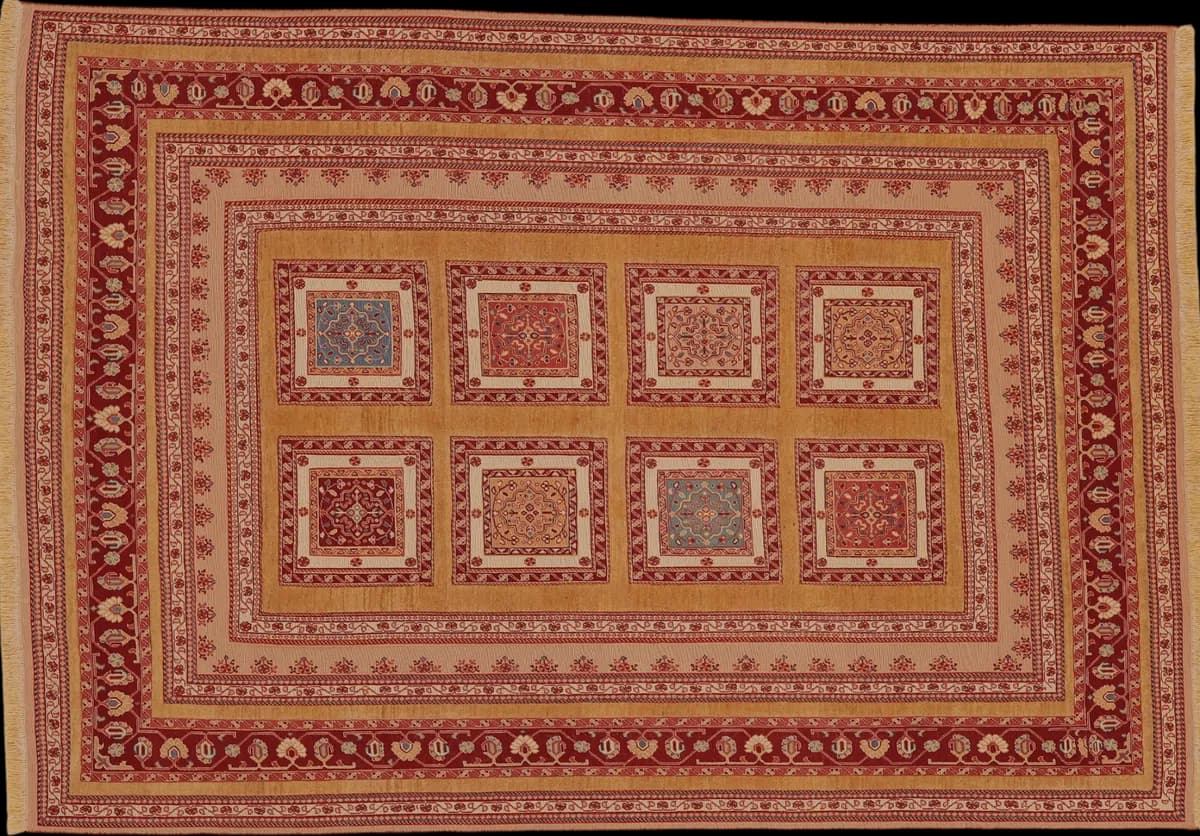
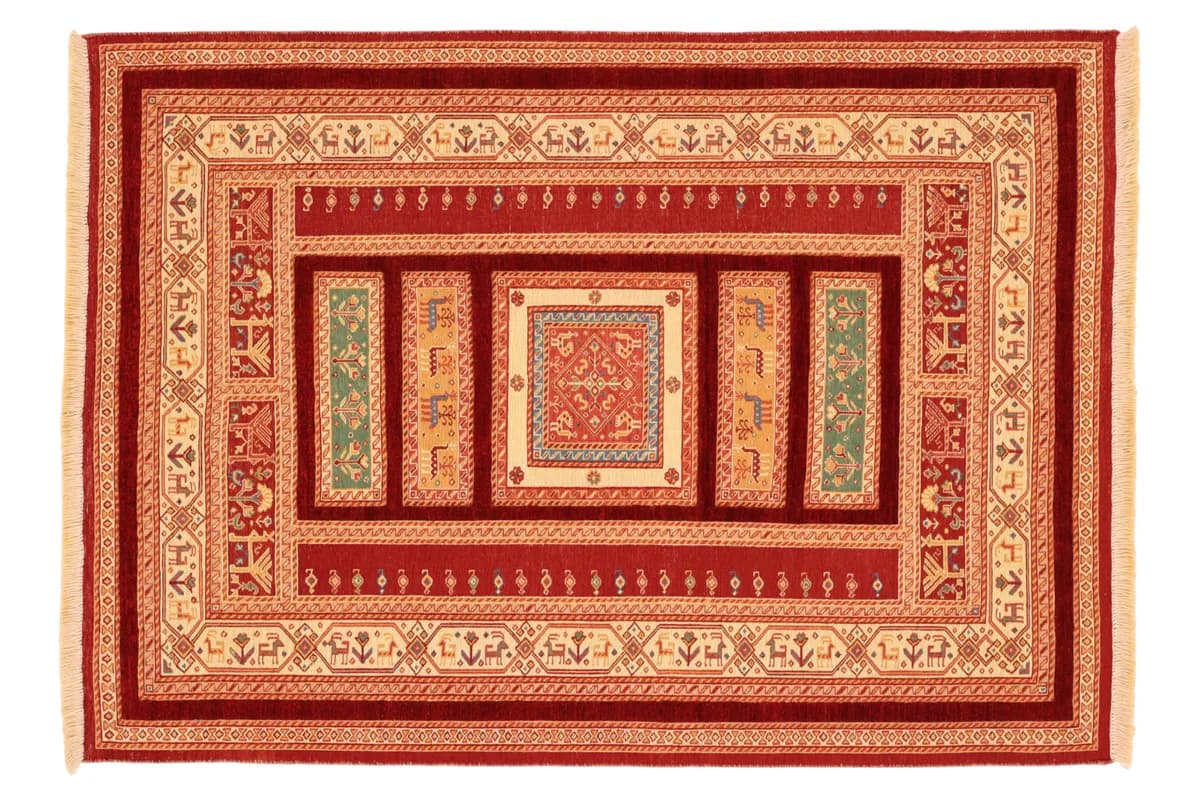
Nim Baft sits between them. It is knotted, but the pile stays short — around eight millimetres. The result is a surface perceived as texture rather than as padding: firmer underfoot than a high-pile rug, but not as flat and textile as a kilim.
The name says so without ceremony. Nim means half, baft means woven. Anyone who knows that does not need the category explained — it explains itself.
The Soosani embroidery
Many Nimbaft pieces carry embroidery as well. The technique resembles the Soosani tradition, in which motifs are applied to the finished fabric with needle and thread rather than knotted in.
That produces a second layer: a knotted ground with a stitched drawing over it. The applied motifs stand slightly raised and catch light differently from the pile beneath.
For a buyer that means looking more closely. Embroidery is mechanically more vulnerable than a knot — it sits on the fabric rather than in it. A vacuum with a rotating brush is not a bad idea here; it is simply out of the question.
- Reduced pile of around eight millimetres.
- Textured rather than plush surface.
- Often stitched motifs over the knotted ground.
- Cotton warp with light, smooth fringes.
- Around 250,000 knots despite the low pile height.
Which room a Nimbaft suits
The flat construction builds up little and passes under doors that close close to the floor. Chairs run over it rather than sinking in.
The textured surface is a decision. Anyone looking for a soft, deep pile underfoot is in the wrong place; anyone wanting a surface with character, seen as much as felt, is in the right one.
Where embroidery is applied, the rug does not belong in the main traffic route. A hallway in daily use stresses the applied threads more than the knotted ground would need.
Care
Vacuum without a rotating brush, along the pile. With stitched motifs the brush is excluded — it pulls at threads that sit on the fabric rather than being anchored in it.
Blot spills at once with clear water and a light cloth, working from the outside in. On a low pile a roughened patch stays visible, so blot rather than rub.
Do not beat it where embroidery is present. What does a dense wool rug no harm loosens applied threads.
Nimbaft or kilim?
Both sit away from the full-pile rug. The difference is whether there is any pile at all.
| Criterion | Nimbaft | Kilim |
|---|---|---|
| Structure | knotted, pile reduced | woven, no pile |
| Pile height | around 8 mm | no pile, 3–5 mm overall |
| Usable both sides | no | yes |
| Surface | textured | flat and textile |
| Decoration | often stitched on | in the weave |
Read the full guide: Kilim or knotted rug: what is the difference?
Common questions
What does Nimbaft mean?
Persian for "half woven": nim means half, baft means woven. The name states the technique — half-pile work between a fully knotted rug and a flatweave — rather than a place.
Is a Nimbaft a kilim?
No. A kilim has no pile at all; the pattern comes from warp and weft alone and both faces are the same. A Nimbaft is knotted, only the pile stays short at around eight millimetres. It has a front and a back.
What is Soosani embroidery?
A technique in which motifs are applied to the finished fabric with needle and thread rather than knotted in. They stand slightly raised and catch light differently from the pile beneath — and they are mechanically more vulnerable, because they sit on the fabric rather than in it.
Does a Nimbaft feel hard?
Firmer than a high-pile rug, but not hard. Around eight millimetres still gives noticeable pile; the surface is perceived as texture rather than padding. Anyone wanting a soft, deep pile is better served by a Gabbeh.
How do I care for a Nimbaft with embroidery?
Vacuum without a rotating brush and do not beat it. The stitched threads sit on the fabric rather than being anchored in it, and both pull at them. Blot spills rather than rubbing, because a roughened patch stays visible on a low pile.