Khorasan
289 × 197 cm
4.950 €
415 €
Incl. VAT
In Stock · Ready to Ship
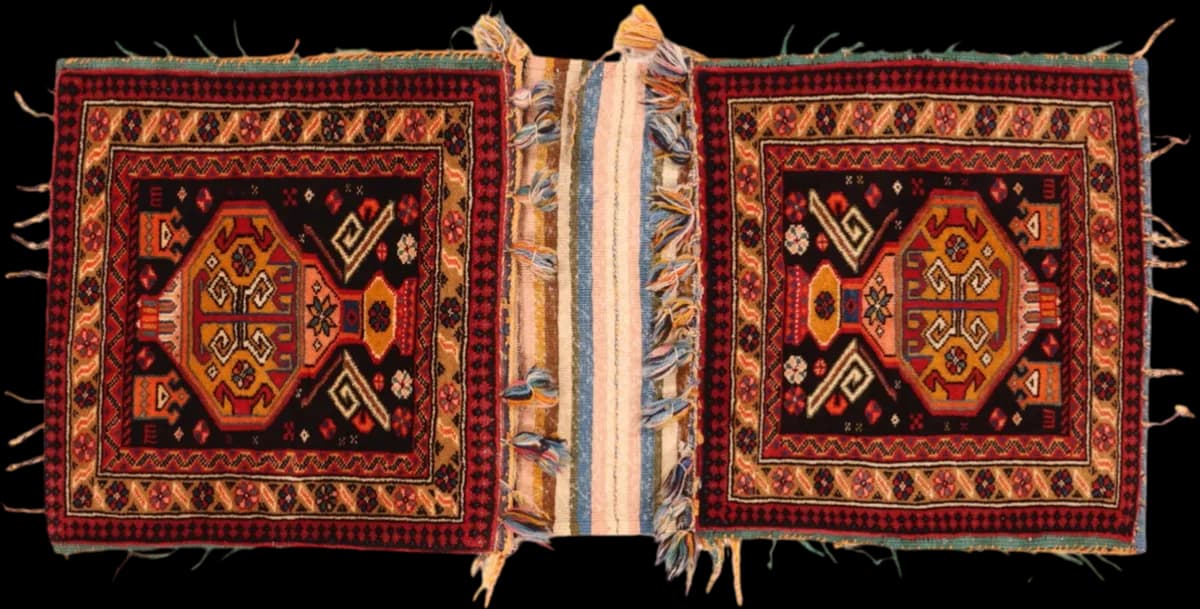
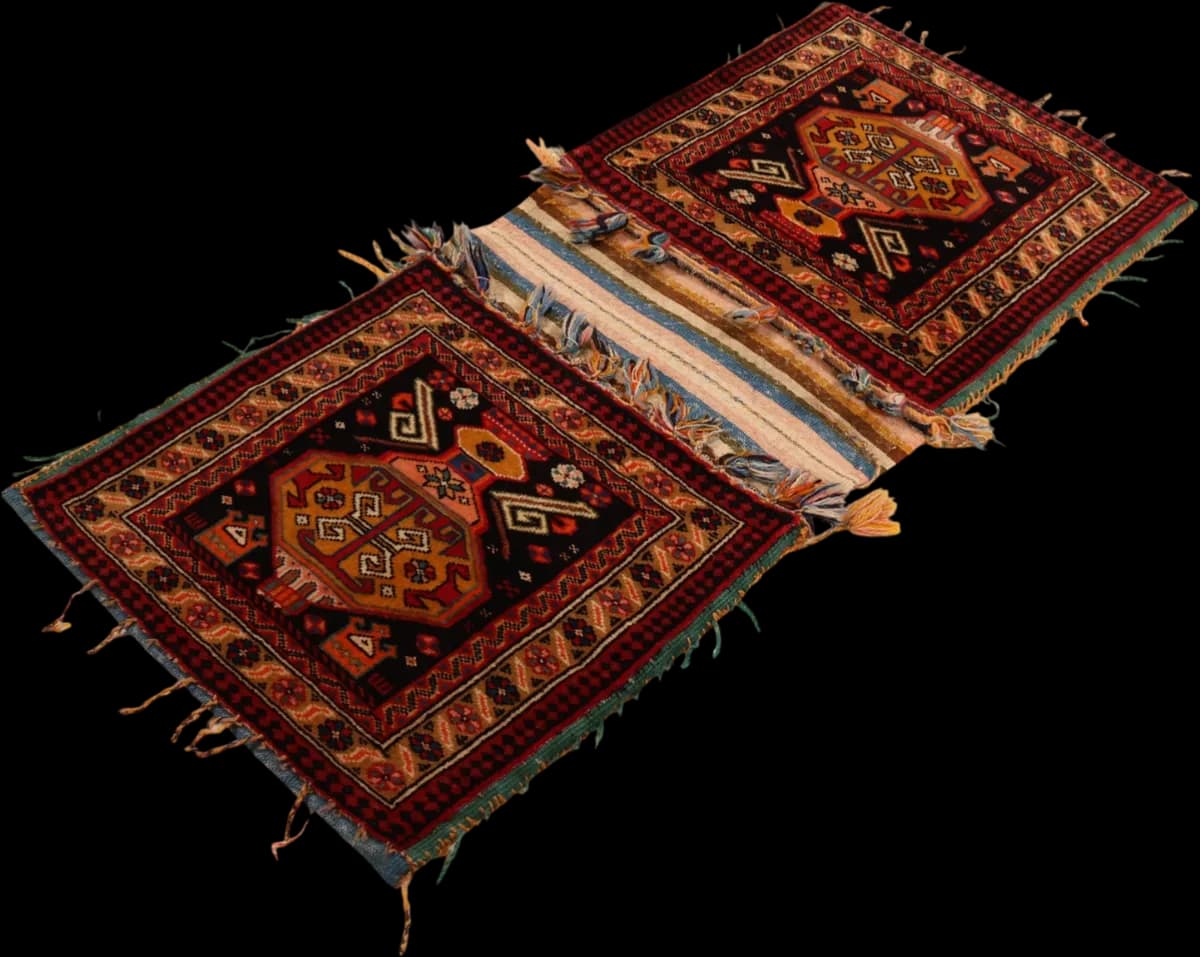
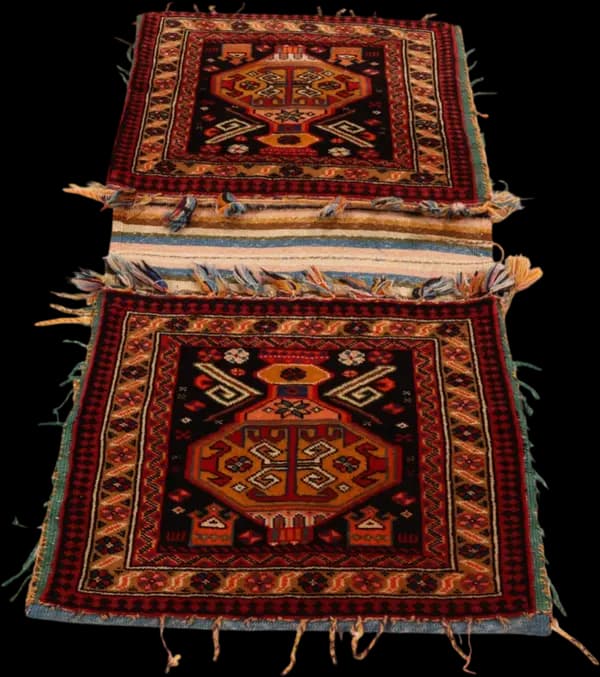
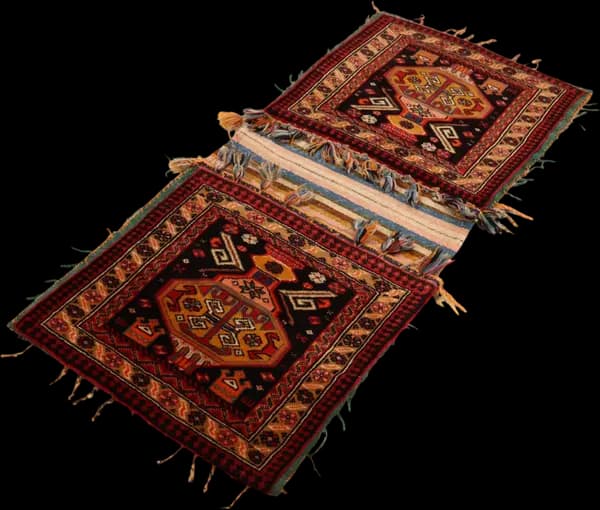
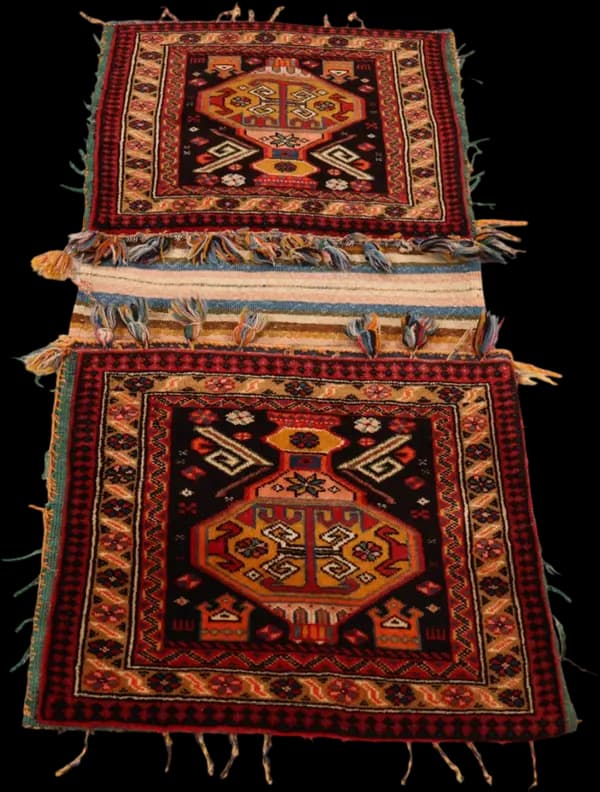
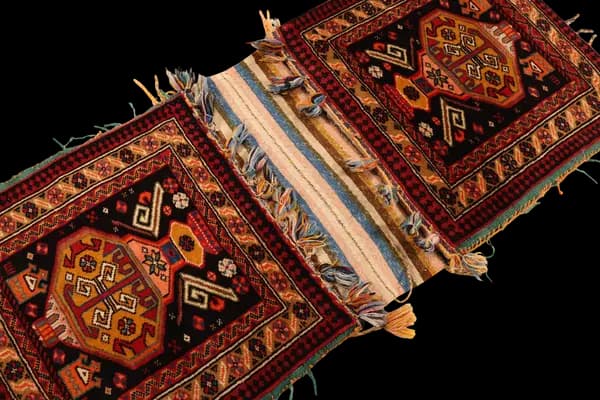
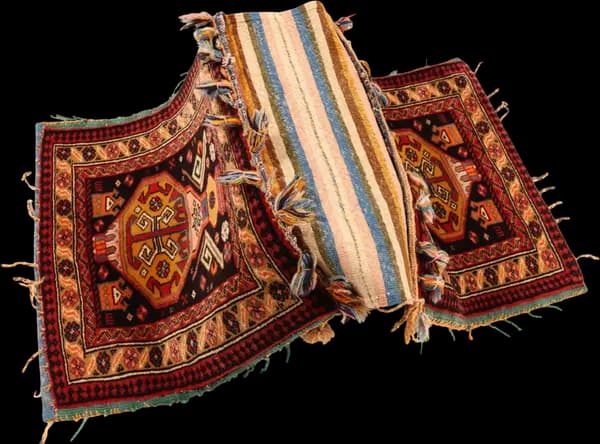
This is a khorjin, a Persian nomadic saddlebag, complete in its original form and measuring 126 x 56 cm (4'2" x 1'10"). It comes from Khorasan in northeastern Iran, also written Khorassan, a region famed for its grand medallion carpets; the same weavers, working further afield with their flocks, carried this smaller tradition of pack bags into daily use.
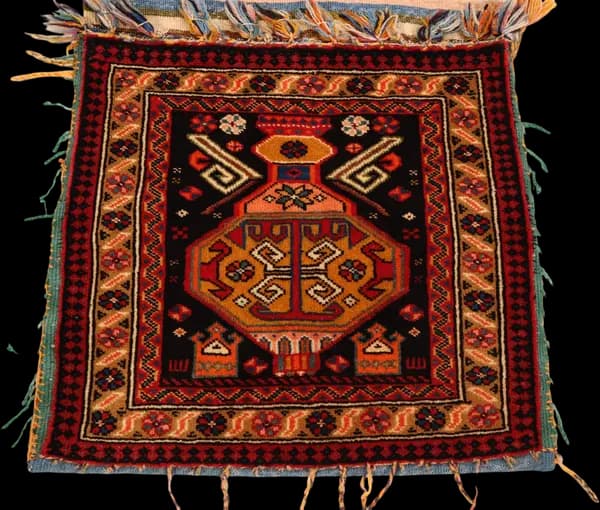
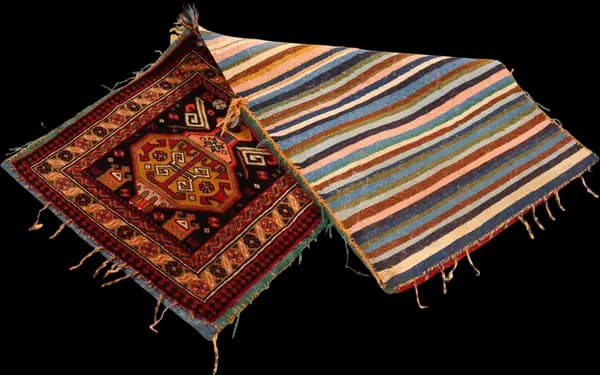
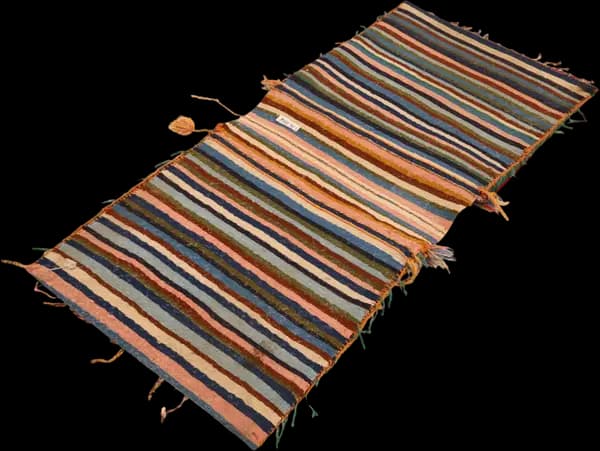
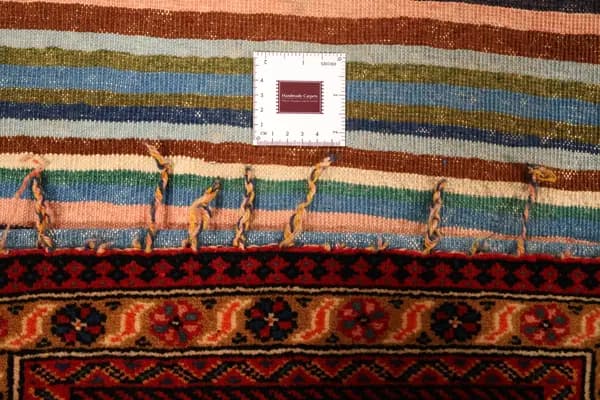
A field of deep black dominates each face, broken by a large stepped hexagonal medallion in orange and gold. Two such faces sit side by side, mirror images of one another, each medallion flanked by small hooked tree forms. A narrow border of deep madder red with a fine diamond lattice frames the panel, set within a wider camel-gold band of floral diamonds. Between the two faces runs the original flatwoven neck, striped in cream, blue, brown and rust, its fringes still hanging free.
The two faces are hand-knotted in hand-spun wool on a cotton warp, at 128,000 to 160,000 knots per square metre - coarser than a city workshop, but enough to turn the medallion's steps cleanly. The pile stands at 12 millimetres, giving the surface a structured, springy hand. The connecting neck, flatwoven rather than knotted, was built on the same loom before the piece was folded into a bag - which is why its stripes and fringes have survived, where most khorjins keep only one face.
At just over a metre, this piece suits a hallway table, a study wall, or a spot by a door. Against pale floors, the black ground and its glowing medallion hold their own; near dark wood, the red and camel borders step forward. The knotted wool feels dense, the striped flatweave beside it thin and ribbed - two textures, one story. Morning light draws the gold through the day.
Qashqai rugs are woven by the Qashqai confederacy, a Turkic nomadic people who migrate seasonally through the Zagros Mountains of Fars Province, southwestern Iran. Constructed entirely from wool, pile, warp, and weft from the tribe's own flocks, these are among the finest nomadic rugs produced in Iran, with bold geometric diamond medallions and rich, saturated natural dyes.
Stylised animals, birds, flowers, and tribal symbols are woven freehand from memory, no cartoon or pattern paper is used. The lanolin-rich wool from Qashqai grazing routes produces a distinctive natural sheen. Characteristic red or brown dyed wefts and barber-pole selvages are reliable identifiers.
Traditional weave
At 126 × 56 cm (0.71 m²) this is a runner. It belongs in a hallway, an entrance, on a landing or lengthways beside a bed. It is too narrow for the middle of a room.
Yes, knotted by hand — knot by knot on a loom, not machine-made. The density is 128,000 to 160,000 knots per square metre; across 0.71 m² that is roughly 90,000 to 110,000 individual knots, every one of them tied by hand.
Hand-spun wool still carries its own lanolin, which keeps liquid sitting on the surface for a moment: blot quickly, with clear water and a light cloth, working inwards and without rubbing. Otherwise regular vacuuming along the pile is enough. Turn the rug once or twice a year so light and footfall reach it evenly.
We are in the Hamburg Speicherstadt. Come and see this rug in daylight, or write to us — a person answers.
Certificate included verifying origin, materials, and craftsmanship.
Ref: 177993