Belutsch
172 × 82 cm
486 €






881 €
Incl. VAT
In Stock · Ready to Ship
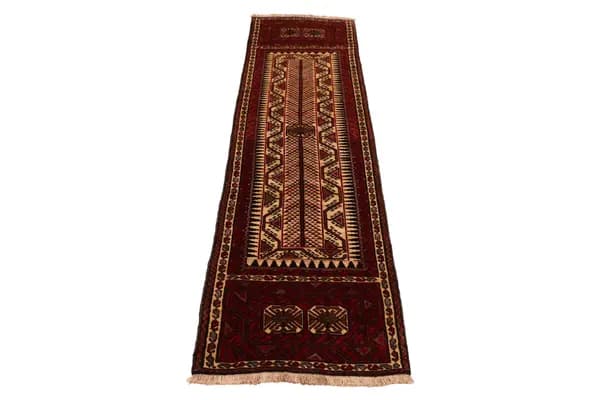
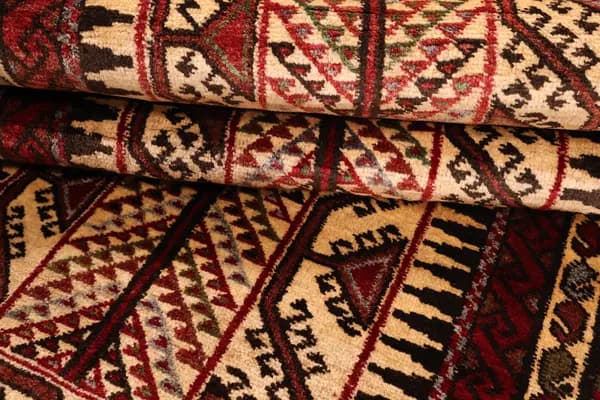
This is a Baluch runner, a tribal weaving from the border country of southeastern Iran, made on a portable loom and knotted from memory rather than from a drawn plan. The type is known for its deep, earthy reds and indigo, and for prayer-niche layouts carried across generations of weavers. At 301 x 75 cm (9'11" x 2'6"), this piece takes the familiar Baluch vocabulary and arranges it not as one continuous field but as three distinct zones, giving it a more architectural order than the type usually shows.
The first impression is of a long ivory band held between two panels of dark wine red. That pale centre carries rows of small trees, chevrons and a close diamond lattice, all outlined in dark brown, with muted olive, slate blue-grey, mustard and dusky pink worked through the geometry. Exactly at the midpoint of the ivory field sits a single small diamond medallion, marking the centre of the runner. Each red end panel holds its own stacked pair of diamond medallions, and a narrow maroon guard border, patterned with small diamonds and hooks in ivory, olive and rust, runs the length of the piece, sharp against the cream centre and settling quietly into the red at either end.
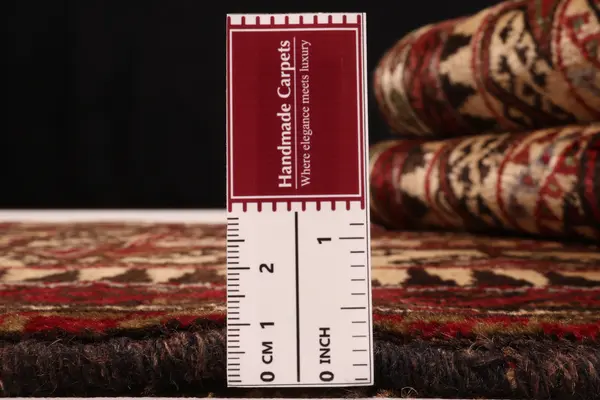
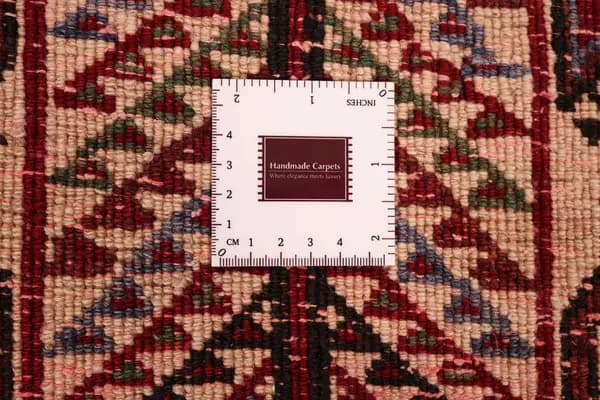
The wool is hand-spun, which is why the surface has no directional sheen and reads as matt and slightly textured rather than glossy. A cotton warp gives the structure its stability, while a knot density of 128,000 to 160,000 per square metre and a 6mm pile keep the geometry crisp without softening the outlines. Working entirely from memory, without a cartoon to follow, the weaver still held three separate compositions in balance across the width of the loom, which is a harder discipline than repeating one pattern throughout.
A runner of this length and this composure belongs in a hallway or along a landing, somewhere it is seen end to end rather than all at once. The ivory centre lifts a dark or narrow hallway considerably, while the two red panels settle naturally near doorways at either end. Underfoot it is dense and firm, built for a floor that gets used rather than admired from the side, and the flat, tight wool takes daily traffic without complaint. Morning light along its length picks out the small trees and chevrons first, then settles on the medallion at the centre, so the eye always finds its way back to the middle of the room.
More on Baluch rugs: origin, making and how to recognise a genuine piece
Traditional weave
At 301 × 75 cm (2.26 m²) this is a runner. It belongs in a hallway, an entrance, on a landing or lengthways beside a bed. It is too narrow for the middle of a room.
Yes, knotted by hand — knot by knot on a loom, not machine-made. The density is 128,000 to 160,000 knots per square metre; across 2.26 m² that is roughly 290,000 to 360,000 individual knots, every one of them tied by hand.
Hand-spun wool still carries its own lanolin, which keeps liquid sitting on the surface for a moment: blot quickly, with clear water and a light cloth, working inwards and without rubbing. Otherwise regular vacuuming along the pile is enough. Turn the rug once or twice a year so light and footfall reach it evenly.
We are in the Hamburg Speicherstadt. Come and see this rug in daylight, or write to us — a person answers.
Certificate included verifying origin, materials, and craftsmanship.
Ref: 315101