Koliai
292 × 150 cm
1.650 €






1.094 €
Incl. VAT
In Stock · Ready to Ship
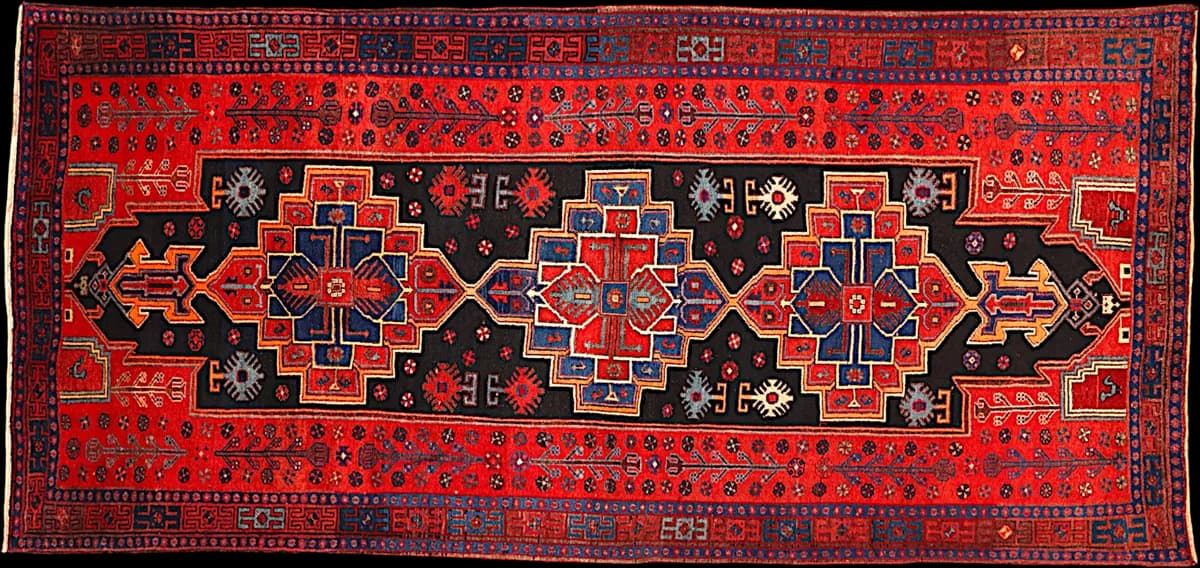
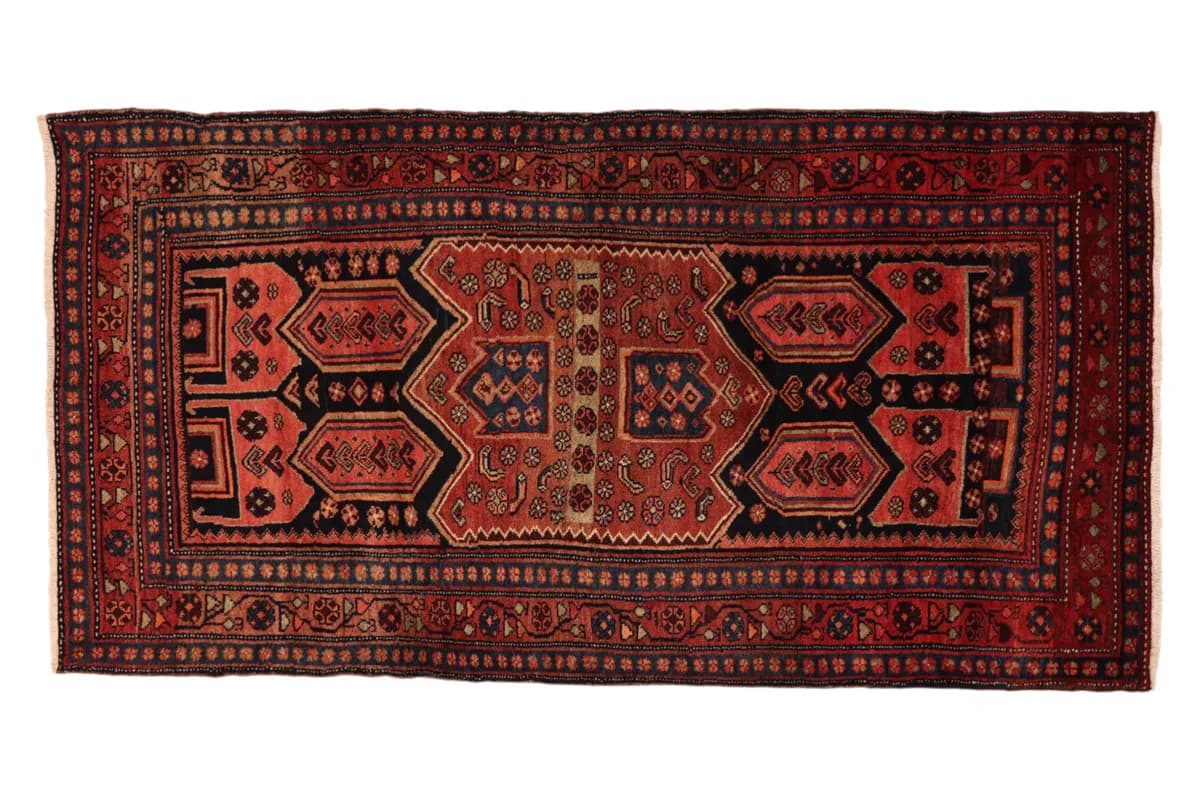
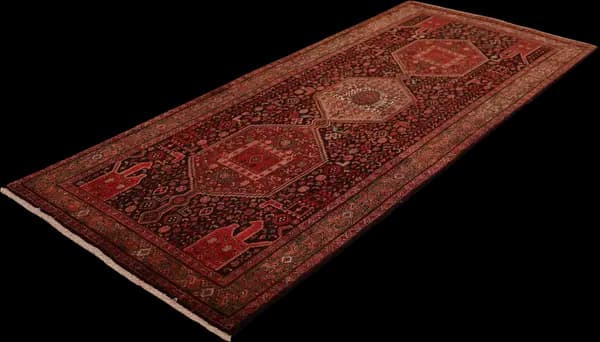
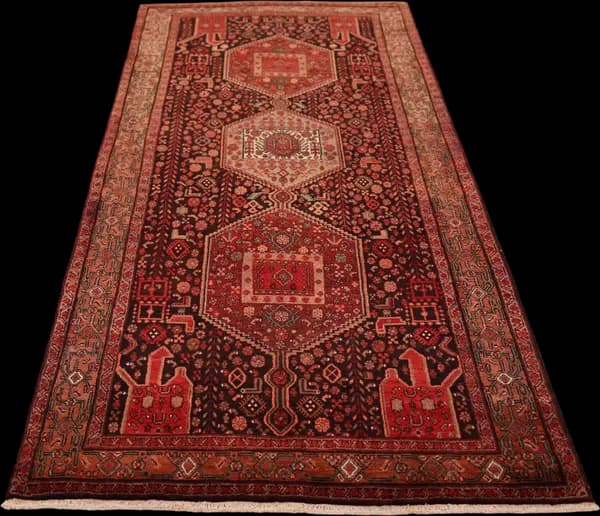
This is a Kordi runner, a Kurdish weaving from the wide arc of Kurdish-settled Iran that stretches from Kurdistan and Kermanshah toward Khorasan, measuring 295 x 130 cm (9'8" x 4'3"). Kurdish weavings are known above all for their structure: dense, robust, tied with the symmetric knot on a wool foundation, and carrying a character that can swing from bold geometry to soft floral work depending on the region it came from. This one leans toward geometry, but with a quiet order running through it that the type does not always show.
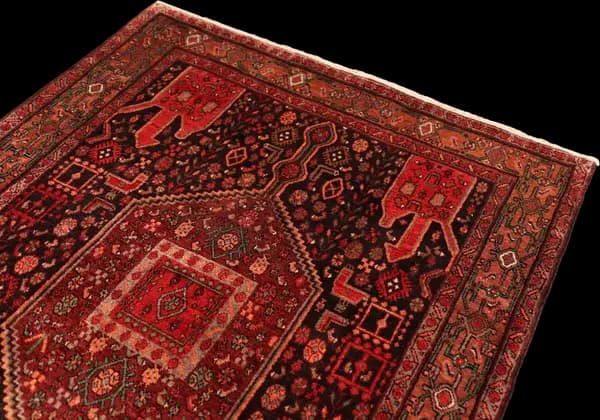
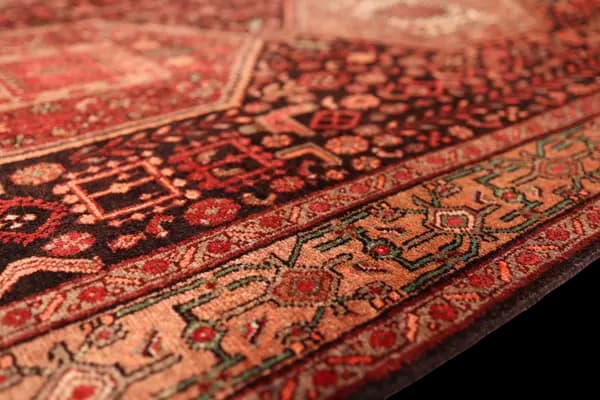
The field is a deep blackish-brown with a reddish undertone, scattered thickly with small floral sprigs that give it texture rather than open space. Across this dark ground sit three hexagonal medallions in a row, like beads on a thread, and here the order appears: the two outer medallions are a strong brick red, but the centre one is ivory, breaking the repetition and giving the whole field a calm, almost symmetrical axis. Hooked, pole-like pendants extend from each medallion toward the top and bottom edges, a tribal 'tree' motif reaching into the field. A wide salmon-pink border, carrying a floral vine and taking up close to a fifth of the total width, frames the piece in a colour far lighter than anything within it.
The wool is hand-spun and knotted onto a cotton warp, and it is this hand-spinning, not the finishing, that gives the surface its slightly grainy, matte character rather than any sheen. At a density of 128,000 to 160,000 knots per square metre, the weaver worked at the pace typical of tribal work knotted from memory rather than from a drawn plan, which is exactly why the medallions carry the small, human irregularities that make each one distinct rather than a repeat of the last. At 12 mm the pile sits short and dense, built for use rather than display, and forty to sixty years on, it still holds its form.
A runner of this width and length belongs in a hallway or along a landing, and here the dark field earns its keep: where daylight is scarce, the salmon border and the ivory medallion give the space light of its own rather than borrowing it. Underfoot it is dense and firm, a weave that takes daily footsteps without complaint. Walk its length and the eye keeps returning to that pale centre medallion, steady among the red, the one calm note in a field that never quite repeats itself.
More on Kordi rugs: origin, making and how to recognise a genuine piece
Traditional weave
At 295 × 130 cm (3.84 m²) this is a runner. It belongs in a hallway, an entrance, on a landing or lengthways beside a bed. It is too narrow for the middle of a room.
Yes, knotted by hand — knot by knot on a loom, not machine-made. The density is 128,000 to 160,000 knots per square metre; across 3.84 m² that is roughly 490,000 to 610,000 individual knots, every one of them tied by hand.
Hand-spun wool still carries its own lanolin, which keeps liquid sitting on the surface for a moment: blot quickly, with clear water and a light cloth, working inwards and without rubbing. Otherwise regular vacuuming along the pile is enough. Turn the rug once or twice a year so light and footfall reach it evenly.
We are in the Hamburg Speicherstadt. Come and see this rug in daylight, or write to us — a person answers.
Certificate included verifying origin, materials, and craftsmanship.
Ref: 347012