Exclusive
Nain | Exclusivewith silk
200 × 150 cm
2.670 €


2.242 €
Incl. VAT
In Stock · Ready to Ship
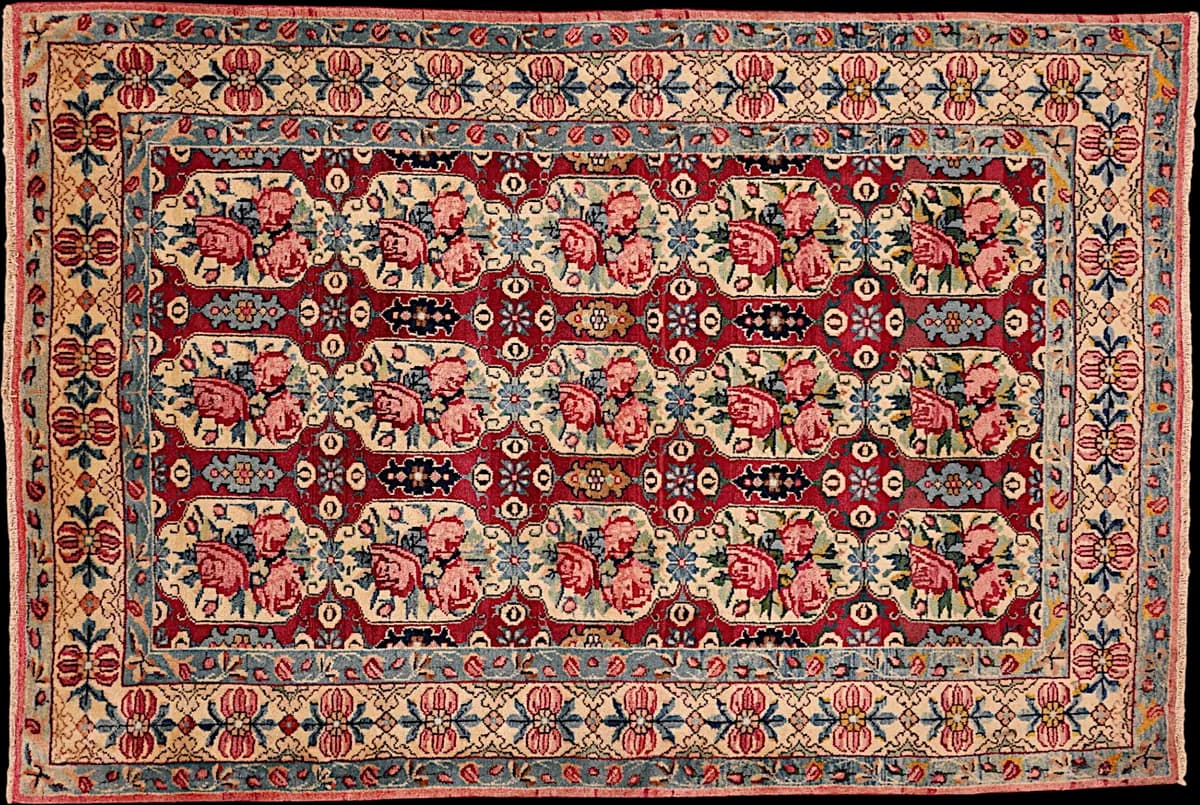
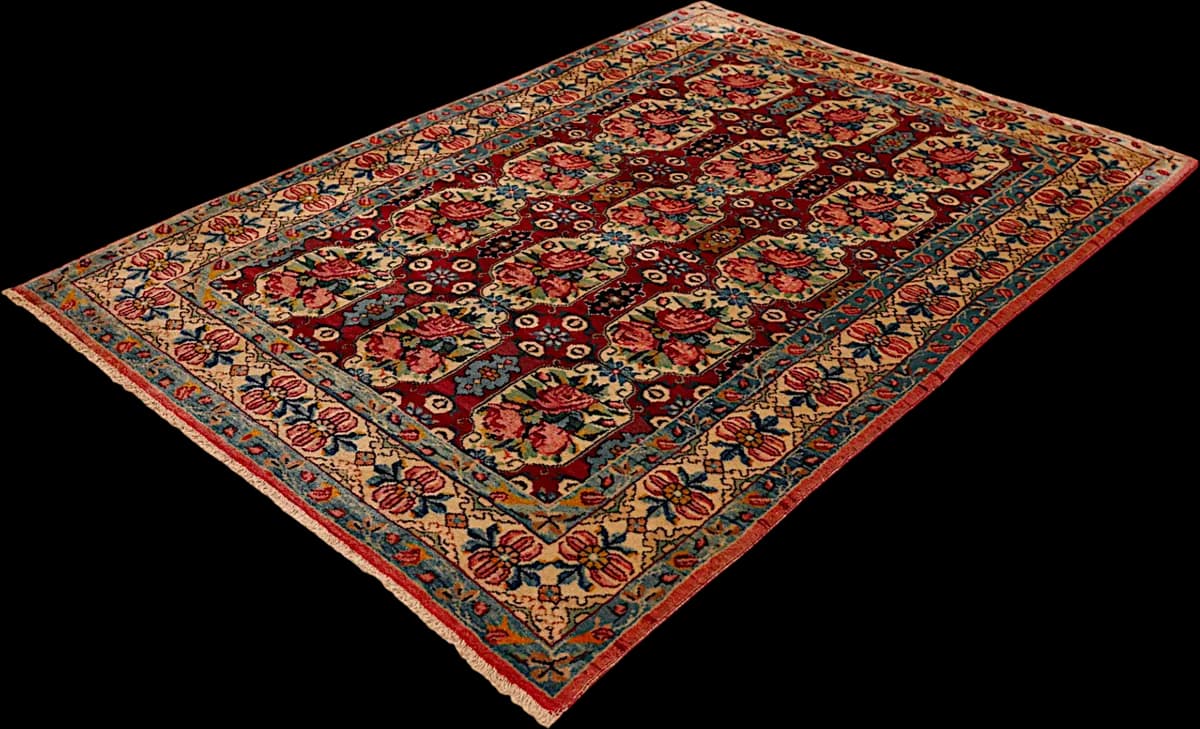
This is a Peradombe, also written Paradombe, a village weaving from the Persian countryside, 213 x 143 cm (7'0" x 4'8"). Peradombe rugs sit between workshop and nomad camp, woven for the weaver's own home rather than for export, valued for honest construction and warmth of colour. Here the classic Ghol Farang rose is set out as a grid of bouquets rather than gathered into a single medallion.
The first impression is a dense grid of pink rose bouquets held in ivory cartouches across a deep wine-red field. Each compartment carries its own posy, sage-green leaves framing the dusky roses, and between the cartouches sit small rosette medallions, their centres picked out in navy and mustard, giving the grid a second, quieter rhythm. A blue-teal floral meander runs around the field, wide enough to hold its own against the red, closed on the outer edge by a narrow pink guard stripe.
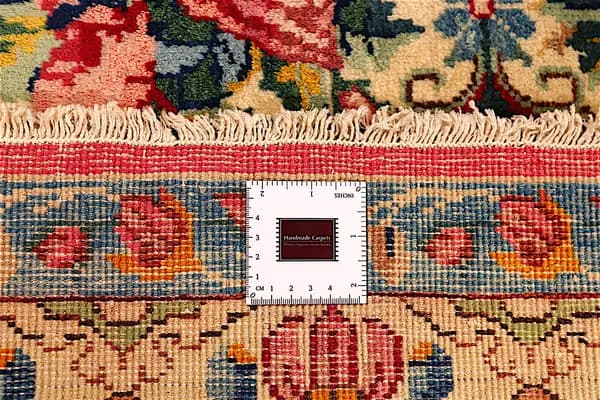
The rug is hand-knotted on a cotton warp, its pile hand-spun wool, worked at a density of roughly 128,000 to 160,000 knots per square metre. That is a moderate count for a village loom, and it shows in the pile itself: an even, matte surface with the slight irregularity of wool spun by hand, and a pile of about 12 millimetres giving real depth underfoot. Without a workshop cartoon to follow, the weaver repeated cartouche and rosette from memory, which is why the grid keeps its order without ever quite squaring itself off.
This rug suits a bedroom floor or the seating corner of a smaller living room. The wine-red ground holds its own against dark wood and warms a pale floor, while the ivory cartouches keep it light. Underfoot the wool is dense and slightly springy, made to be walked on rather than kept for best. As daylight moves across it, the rosettes catch the light first, before the red settles again.
Loribaft rugs are woven by Lori (Lur) tribes in the Zagros Mountains of western Iran, spanning parts of Lorestan, Khuzestan, and Fars provinces. The name "Loribaft" means "woven by Lori" and designates a distinctive tribal weaving tradition rooted in nomadic life, where rugs are made on horizontal ground looms during seasonal migrations.
Traditionally constructed entirely from wool, pile, warp, and weft, Loribaft rugs feature bold geometric patterns with confident colour contrasts in rich reds, blues, and natural earth tones. The thick, lustrous pile and hand-spun wool give them a grounded, authentic character.
Traditional weave
At 213 × 143 cm (3.05 m²) this is a medium rug. It works in front of a sofa, in front of a bed or in a study. It is too small for a dining table — there you want about 80 cm of clearance so a chair does not tip over the edge when pushed back.
Yes, knotted by hand — knot by knot on a loom, not machine-made. The density is 128,000 to 160,000 knots per square metre; across 3.05 m² that is roughly 390,000 to 490,000 individual knots, every one of them tied by hand.
Hand-spun wool still carries its own lanolin, which keeps liquid sitting on the surface for a moment: blot quickly, with clear water and a light cloth, working inwards and without rubbing. Otherwise regular vacuuming along the pile is enough. Turn the rug once or twice a year so light and footfall reach it evenly.
We are in the Hamburg Speicherstadt. Come and see this rug in daylight, or write to us — a person answers.
Certificate included verifying origin, materials, and craftsmanship.
Ref: 357084