Koliai
284 × 160 cm
2.370 €






856 €
Incl. VAT
In Stock · Ready to Ship
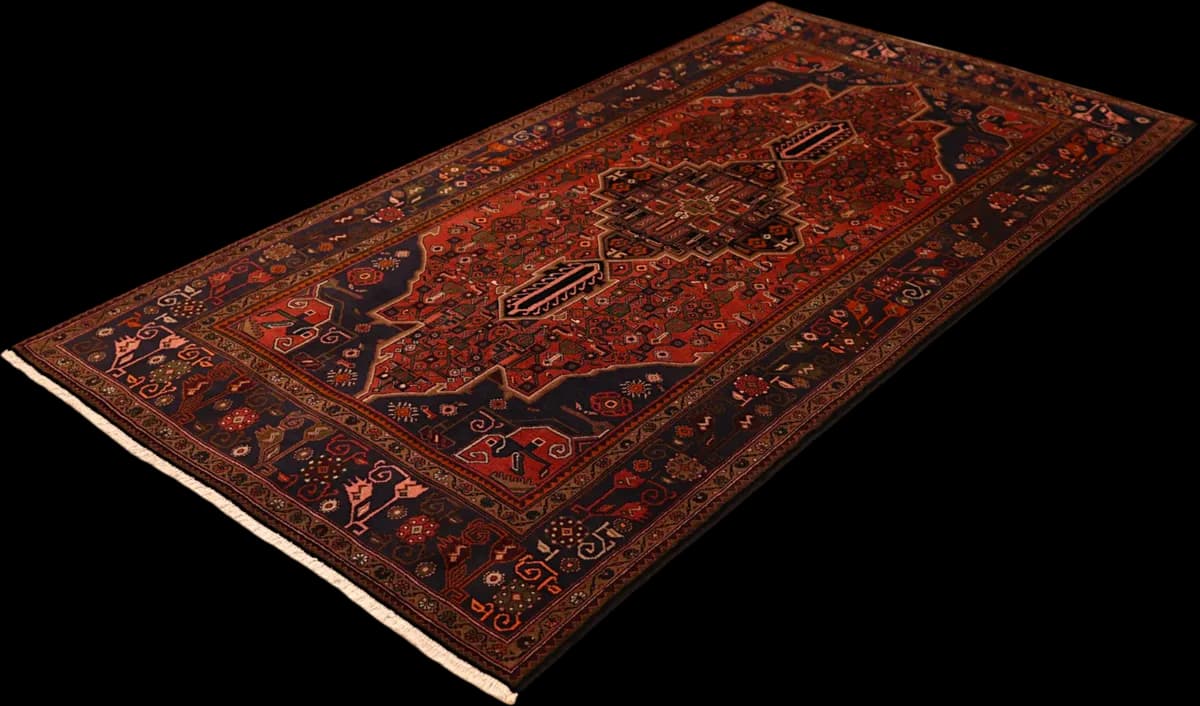
The rug in front of you is a Koliai, a tribal weaving from the Songhor district in Kurdish western Iran, part of the wider Kurdistan and Kermanshah weaving tradition. It measures 291 x 151 cm (9'6" x 4'11"). Koliai rugs are knotted by Kurdish mountain tribes and are known above all for their density, their high pile and their lively, saturated colour, usually built around a bold central medallion.
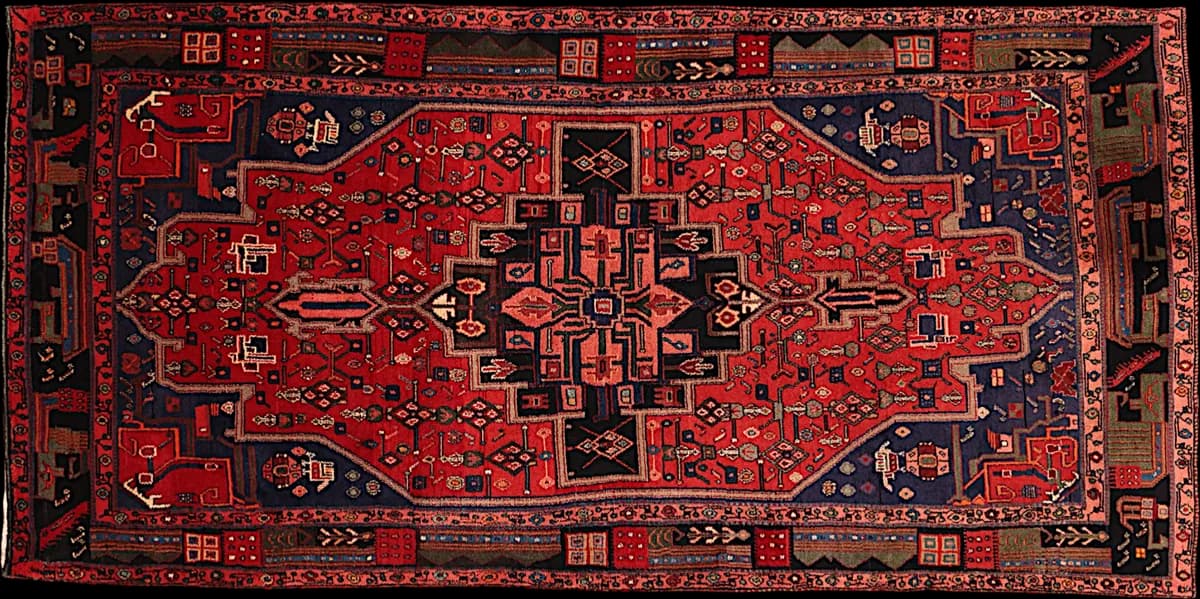
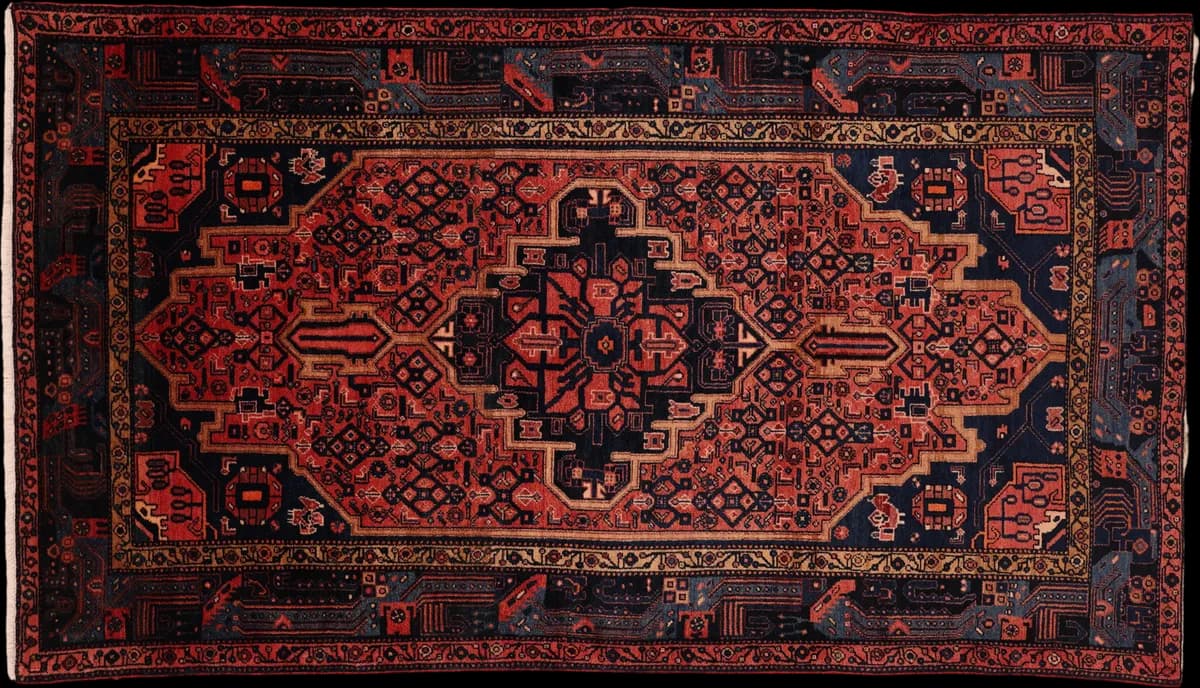
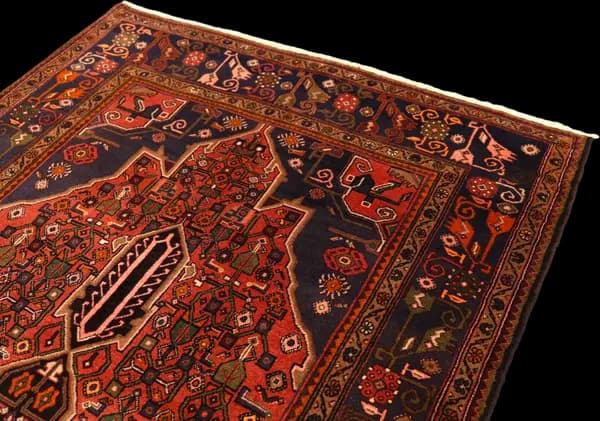
The field is a warm coral red, and against it sits a stepped medallion, black at its centre, edged in cream, with pink and cream pendant panels running above and below. It is a far starker pairing than the softly blended medallions this weaving is usually known for, closer to graphic than decorative. Small diamond and floral motifs fill the coral ground around it, densely packed, while the corners are cut off in navy, matching the wide navy border that carries its own run of polychrome floral and geometric bands, framed by narrower camel and red guard stripes.
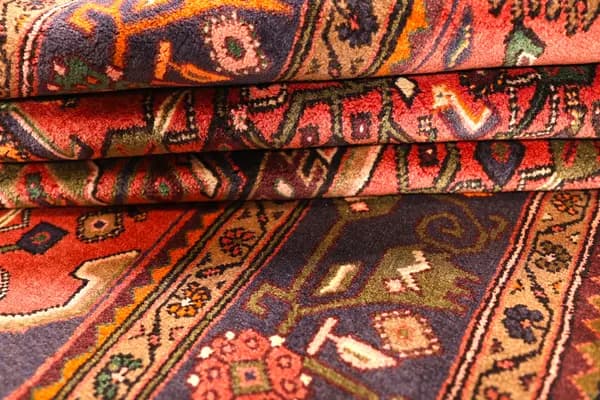
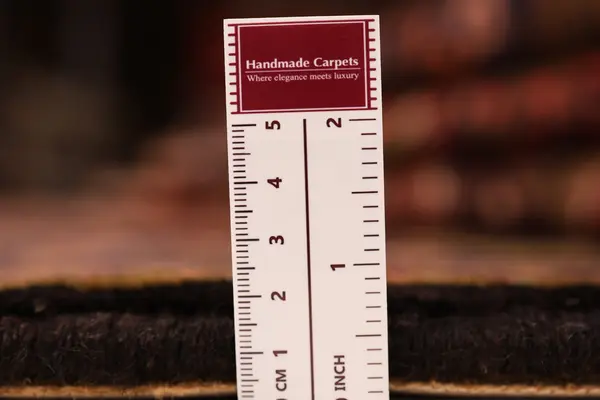
This is hand-knotted work, done from memory rather than a drawn plan, at a density of 128,000 to 160,000 knots per square metre, firm by tribal standards and enough to hold that stepped medallion in crisp, clean lines rather than letting it soften into the field. The pile is hand-spun wool, 12 mm deep, matte and textured underfoot, with the lanolin still in the fibre giving it real body and resistance to wear. A cotton warp places the piece in the more recent decades of Koliai weaving, twenty to forty years old, and that combination of firm knotting and a weaver working from memory alone is exactly what gives this particular medallion its unusually architectural weight.
A rug of this shape and size suits a hallway or landing well, somewhere the coral field can carry warmth into a space that gets little daylight of its own. The black and cream medallion still reads clearly from a distance, so it holds its own even in a passing glance on the way through the house. Underfoot it is dense and firm rather than soft and sinking, built for a floor that gets walked on rather than admired from the edge of a room. Even under artificial light in the evening, that stepped medallion keeps its edge, and the coral around it never quite goes flat.
More on Koliayie rugs: origin, making and how to recognise a genuine piece
Traditional weave
At 291 × 151 cm (4.39 m²) this is a medium rug. It works in front of a sofa, in front of a bed or in a study. It is too small for a dining table — there you want about 80 cm of clearance so a chair does not tip over the edge when pushed back.
Yes, knotted by hand — knot by knot on a loom, not machine-made. The density is 128,000 to 160,000 knots per square metre; across 4.39 m² that is roughly 560,000 to 700,000 individual knots, every one of them tied by hand.
Hand-spun wool still carries its own lanolin, which keeps liquid sitting on the surface for a moment: blot quickly, with clear water and a light cloth, working inwards and without rubbing. Otherwise regular vacuuming along the pile is enough. Turn the rug once or twice a year so light and footfall reach it evenly.
We are in the Hamburg Speicherstadt. Come and see this rug in daylight, or write to us — a person answers.
Certificate included verifying origin, materials, and craftsmanship.
Ref: 376877