Koliai
307 × 159 cm
1.650 €



903 €
Incl. VAT
In Stock · Ready to Ship
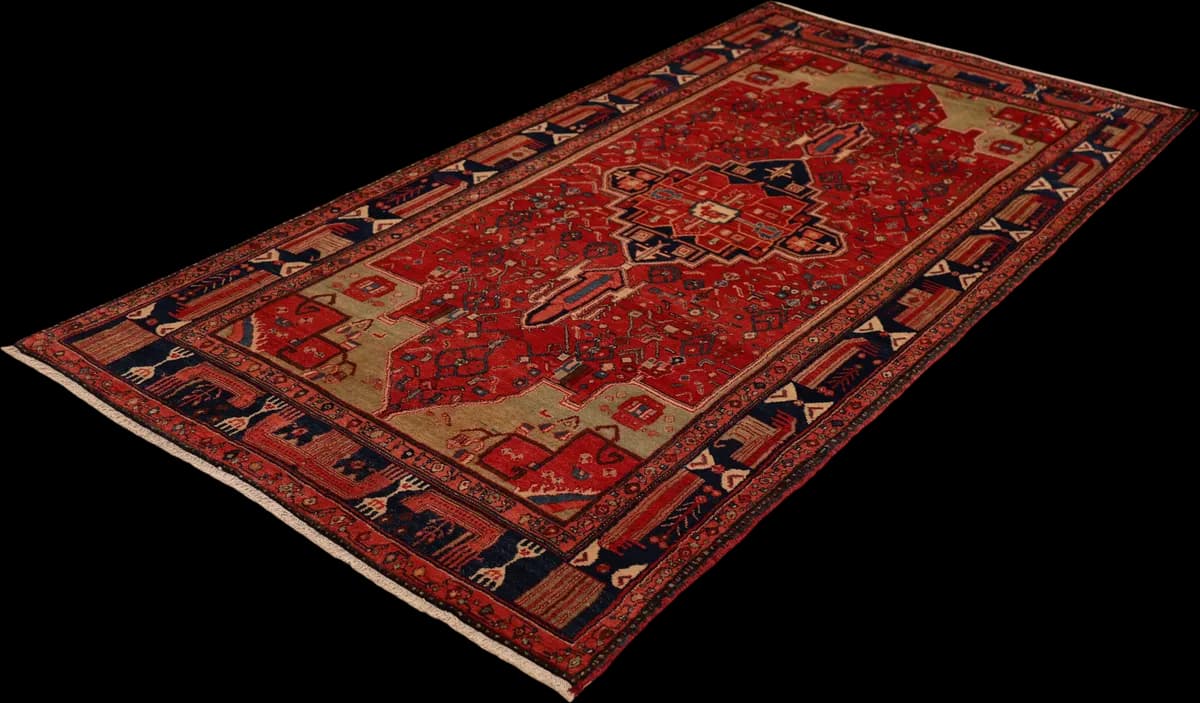
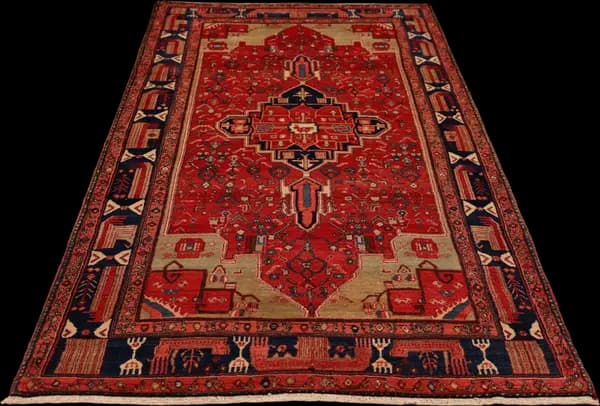
This is a Koliai, a Kurdish tribal weaving from the Songhor district of western Iran, within the wider Kermanshah weaving region. It measures 295 x 157 cm (9'8" x 5'2"). Koliai rugs are prized for their dense knotting, deep pile and lively colour, usually carried by a single large central medallion built from the hexagonal Herati lattice — a design normally anchored, still, and symmetrical about its centre.
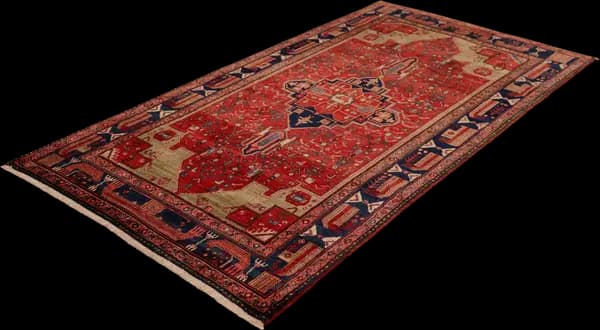
A dense brick red fills the field, scattered with small angular motifs in ivory and steel-blue. At its heart sits a hooked, stepped diamond medallion in navy with a red core, but rather than resting as one static form it stretches outward into two elongated, arrow-like pendants reaching toward the left and right edges of the field. Olive-khaki spandrels hold the four corners, outlined in cream against the red ground. The wide navy main border carries an ivory hooked zigzag, contained by a narrower salmon-pink guard border set with small rosettes, both bands standing firmly against the strength of the field.
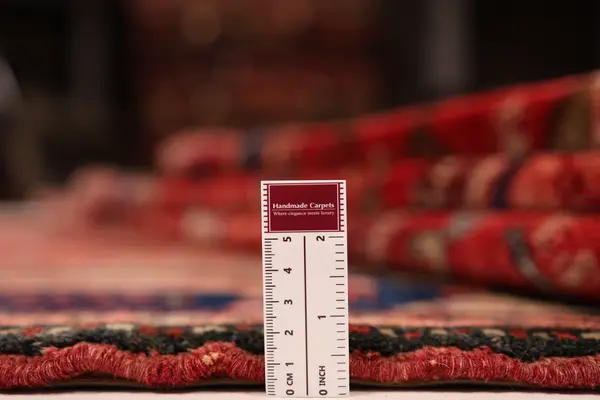
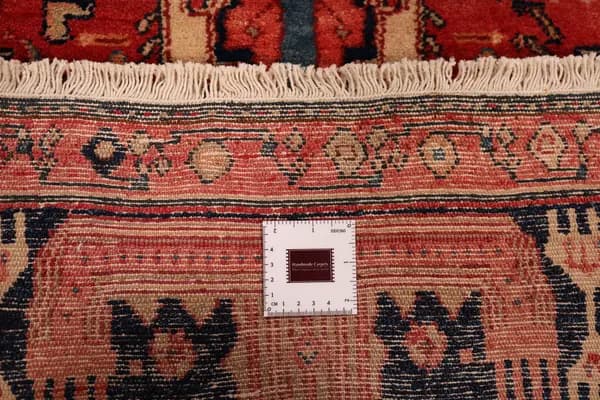
At 128,000 to 160,000 knots per square metre, on a cotton warp with a hand-spun wool pile set at 12 mm, this is a solidly and firmly knotted tribal rug rather than a fine city weave, and the pile is deep enough to hold the sharp hooked lines of the medallion without softening them. Hand-spun wool varies slightly along its length, which is why the surface reads matte rather than lustrous, with a quiet, chalky depth instead of directional sheen. More telling still is the drawing itself: this was knotted from memory, on a portable loom, without a paper plan, and the weaver has taken the usual round or diamond Koliai medallion and carried it sideways into two pointed pendants — a running line through the field where the pattern normally sits still.
A rug this size suits a seating area in a living room, or a generous hallway, more readily than a large dining table. Set against pale floorboards, the brick red warms the room; against dark furniture, the navy medallion and olive corners hold their own rather than fading into it. Underfoot it is dense and firm, built for a room that gets used rather than one kept for best. As light moves across it through the day, the hand-spun wool shifts in tone, and that outward-reaching medallion keeps the eye moving with it.
More on Koliayie rugs: origin, making and how to recognise a genuine piece
Traditional weave
At 295 × 157 cm (4.63 m²) this is a medium rug. It works in front of a sofa, in front of a bed or in a study. It is too small for a dining table — there you want about 80 cm of clearance so a chair does not tip over the edge when pushed back.
Yes, knotted by hand — knot by knot on a loom, not machine-made. The density is 128,000 to 160,000 knots per square metre; across 4.63 m² that is roughly 590,000 to 740,000 individual knots, every one of them tied by hand.
Hand-spun wool still carries its own lanolin, which keeps liquid sitting on the surface for a moment: blot quickly, with clear water and a light cloth, working inwards and without rubbing. Otherwise regular vacuuming along the pile is enough. Turn the rug once or twice a year so light and footfall reach it evenly.
We are in the Hamburg Speicherstadt. Come and see this rug in daylight, or write to us — a person answers.
Certificate included verifying origin, materials, and craftsmanship.
Ref: 438812