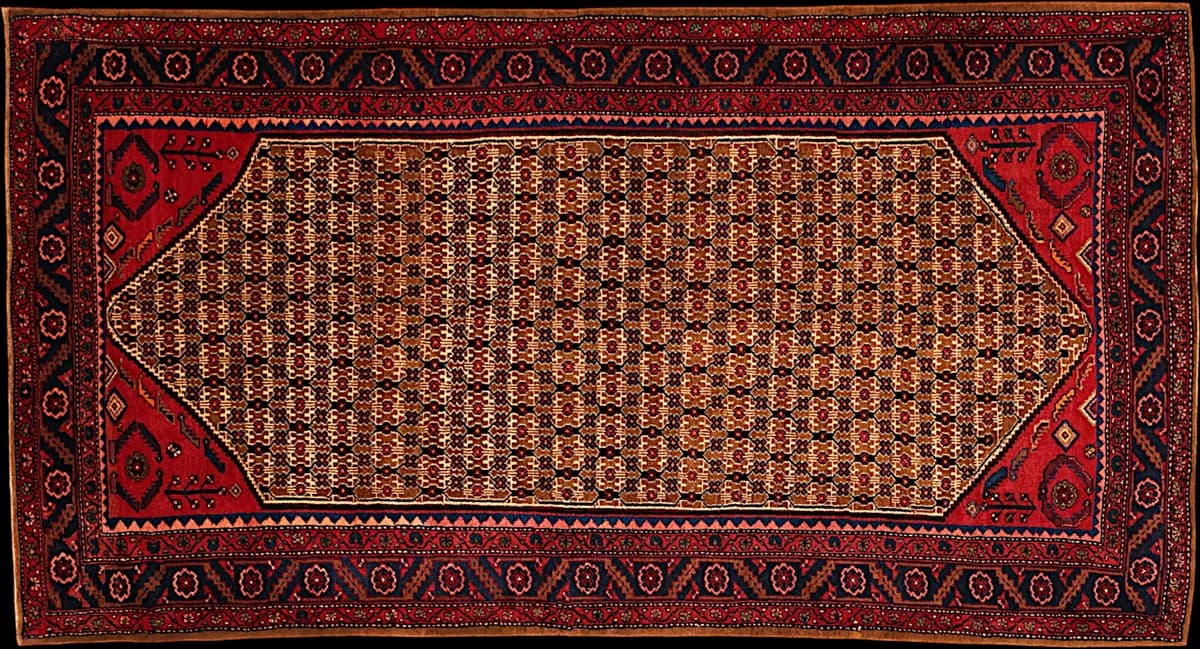
Koliai
302 × 153 cm
2.079 €







1.740 €
Incl. VAT
In Stock · Ready to Ship
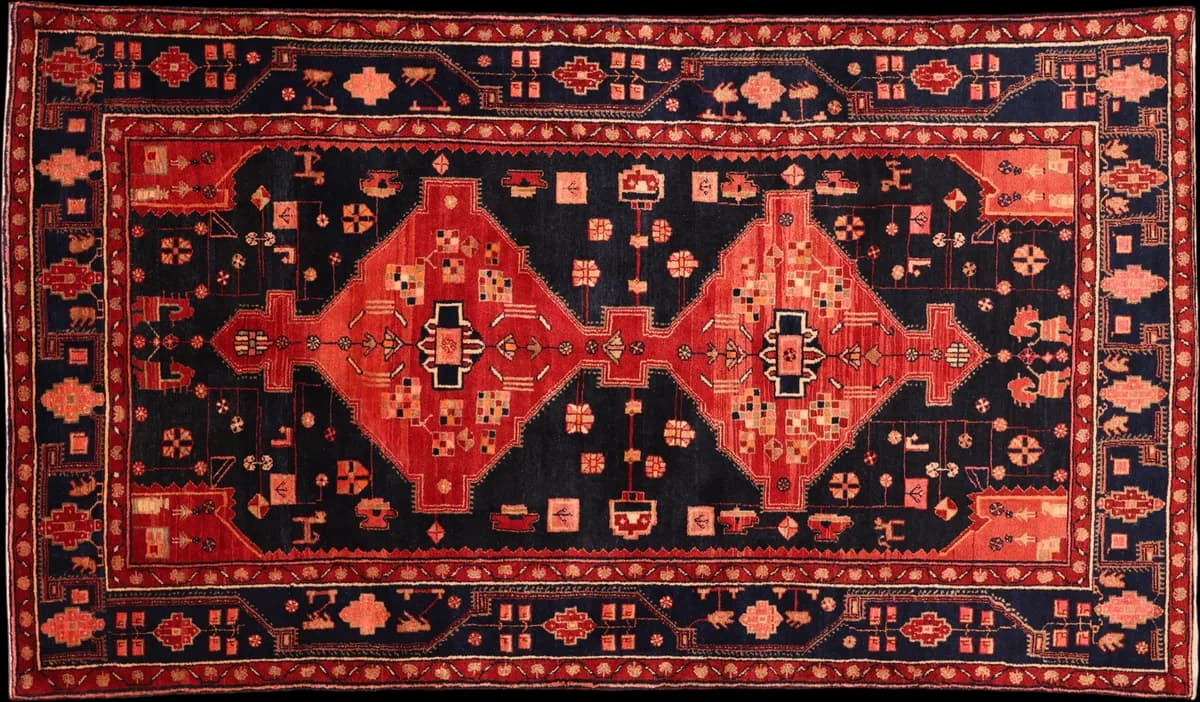
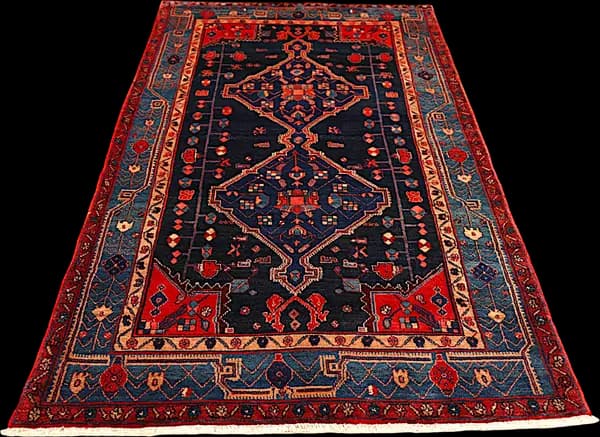
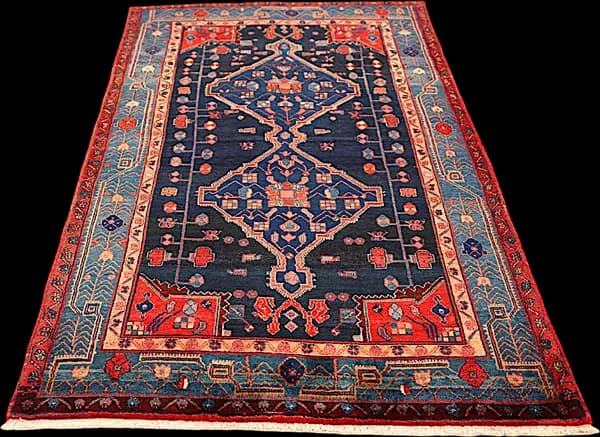
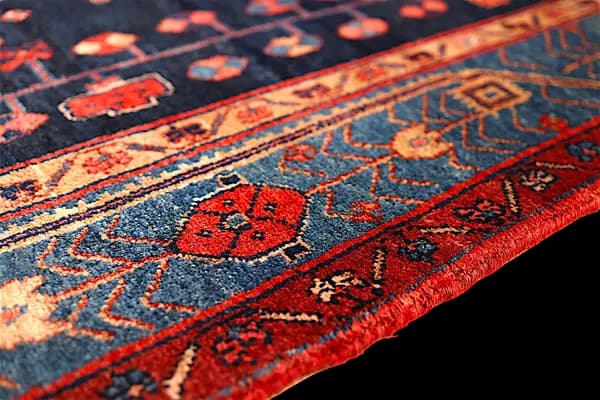
This is a Koliai, a Kurdish tribal weaving from the Songhor district of western Iran, part of the wider Kurdistan and Kermanshah weaving country, sized 280 x 153 cm (9'2" x 5'0"). The type is known for its firm knot, high pile and a single bold medallion set on a plain field — but this piece breaks from that formula by carrying two medallions instead of one, linked in a chain rather than fixed on a single centre.
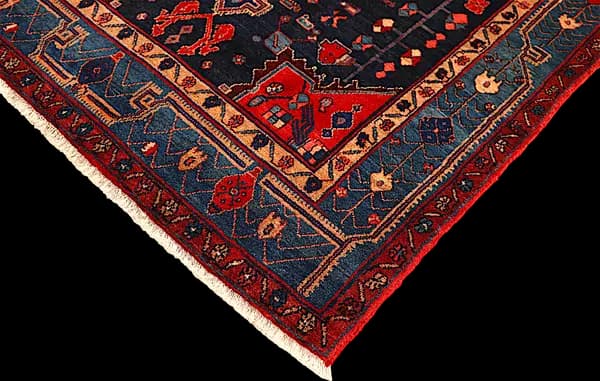
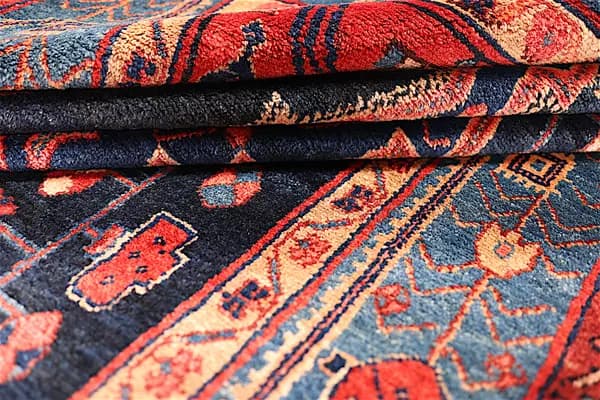
The field is a deep indigo, almost black in low light, and down its middle run two stepped hexagonal medallions, identical in outline, joined end to end so the eye moves along the chain rather than resting in one place. Small geometric motifs scatter around them in muted salmon, dusty pink and pale blue, and in each corner a triangle of brick red cuts sharply into the dark ground. Framing all of it is a wide cream border of floral vine work, held between a strong outer red and a quieter inner steel-blue, the palest passage on the rug and the one that carries the eye back out to its edge.
This was knotted from memory, on a portable loom, without a drawn plan — which is exactly why the medallion appears twice rather than once: a weaver working from an internal pattern will repeat a motif she knows rather than pin the whole design to a single fixed point, and the result reads as movement instead of the usual still symmetry. The wool is hand-spun and lanolin-rich, grazed on mountain pasture, and it is this that gives the surface its low, even sheen rather than any high polish. At around 12 mm the pile sits high enough to hold colour in real depth, knotted at 201,000 to 250,000 knots per square metre onto a cotton warp — dense enough to keep its edges crisp after decades underfoot.
A rug this size sits comfortably in a hallway, a study, or under a small seating group in a living room, and the indigo ground holds its own against dark floorboards or pale ones alike, with the red corners and cream border keeping the room from feeling flat. Underfoot it is dense and firm rather than soft, built for a room that gets used rather than kept for best. As daylight moves across it through the day, the two medallions catch the light in turn, so the chain down the centre never quite settles.
More on Koliayie rugs: origin, making and how to recognise a genuine piece
Fine quality weave
At 280 × 153 cm (4.28 m²) this is a medium rug. It works in front of a sofa, in front of a bed or in a study. It is too small for a dining table — there you want about 80 cm of clearance so a chair does not tip over the edge when pushed back.
Yes, knotted by hand — knot by knot on a loom, not machine-made. The density is 201,000 to 250,000 knots per square metre; across 4.28 m² that is roughly 0.9 to 1.1 million individual knots, every one of them tied by hand.
Hand-spun wool still carries its own lanolin, which keeps liquid sitting on the surface for a moment: blot quickly, with clear water and a light cloth, working inwards and without rubbing. Otherwise regular vacuuming along the pile is enough. Turn the rug once or twice a year so light and footfall reach it evenly.
We are in the Hamburg Speicherstadt. Come and see this rug in daylight, or write to us — a person answers.
Certificate included verifying origin, materials, and craftsmanship.
Ref: 786244