Koliai
328 × 165 cm
1.055 €





2.370 €
Incl. VAT
In Stock · Ready to Ship
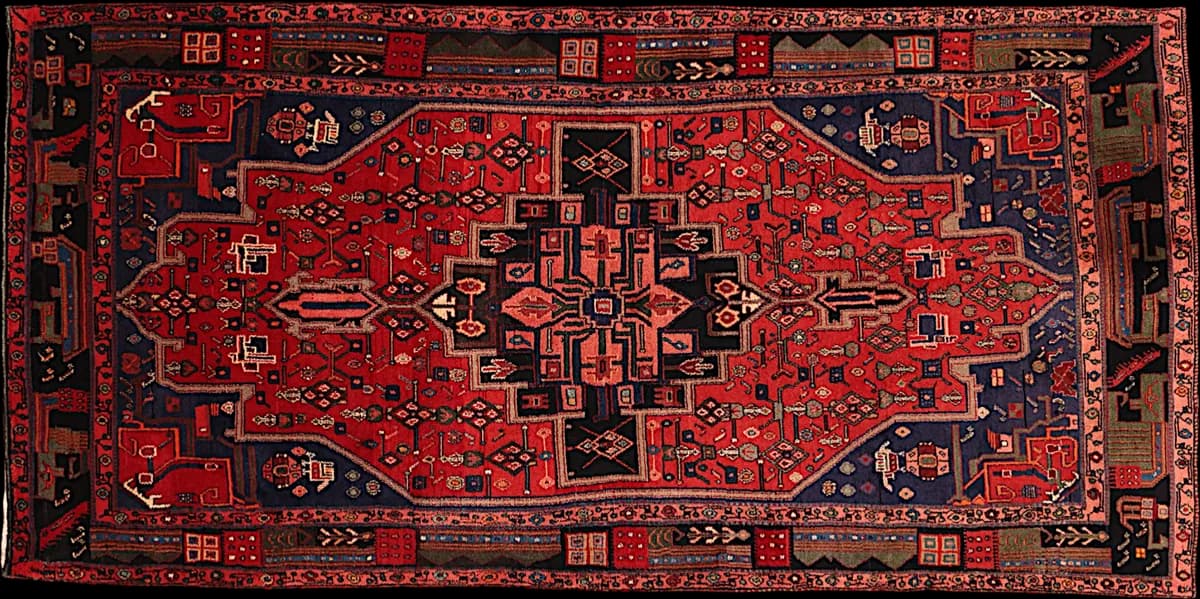
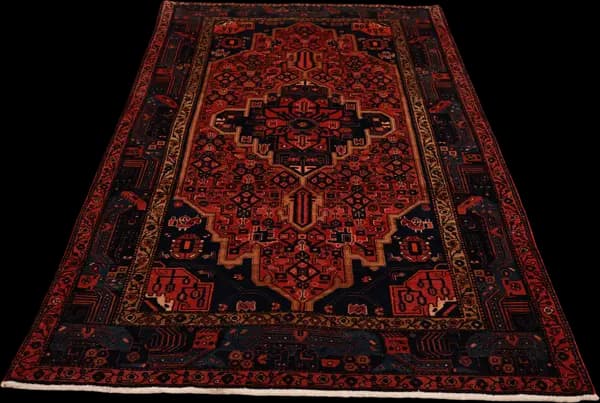
A Koliai rug, hand-knotted by Kurdish tribes who once led a nomadic life in the Songhor district of western Iran, part of the wider Kermanshah weaving region. It measures 284 x 160 cm (9'4" x 5'3"). The type is known for dense knotting, a high pile and a bold, energetic colour range, though this particular piece carries that energy with a calmer, more legible drawing than most Koliai work manages.
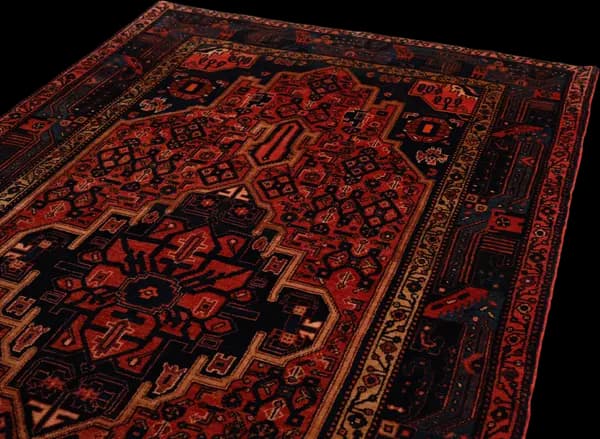
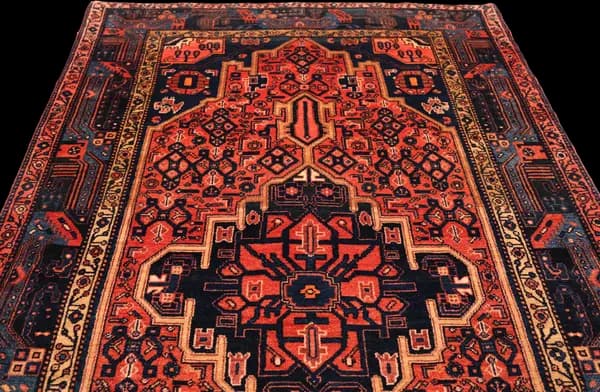
The field is a deep brick red, filled edge to edge with small-scale geometric patterning, and standing hard against it is a large medallion in black-navy, its outline jagged, traced through in camel-gold. Pendants drop from its points into the red ground. Small stylised shapes fill the four corners of the field, floral or geometric in character, with perhaps the faintest suggestion of a bird about them, though nothing so literal as a figure. The border carries the same contrast outward: a broad black-navy band worked in rust and camel, held between a narrow ivory guard stripe and fine lines of teal blue, the whole border making up close to a fifth of the rug's width.
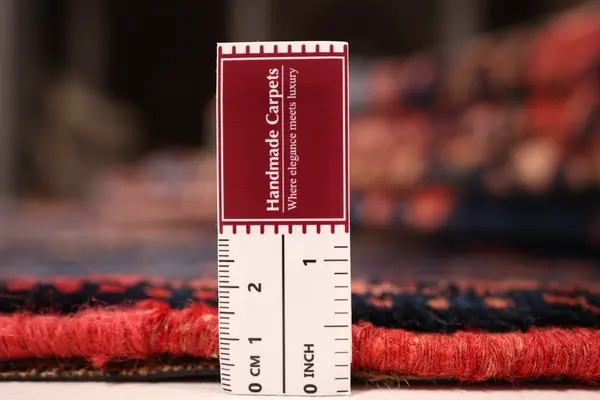
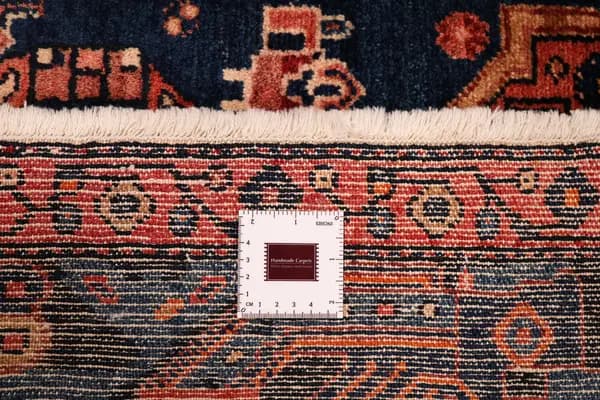
The pile is hand-spun wool, knotted onto a cotton warp, a later-generation Koliai construction, wool warp having been the older tribal practice. Hand-spinning leaves the yarn slightly uneven in thickness, which is what gives the surface its compact, faintly ribbed texture rather than a uniform sheen. At 12 mm the pile sits fairly high, so the medallion and field carry real depth rather than sitting flat. Knotted at 201,000 to 250,000 knots per square metre, firm and durable rather than the fine density of a city workshop, the whole design was worked from memory, with no drawn plan to follow, which makes it all the more notable that a pattern this size still reads as clearly as it does.
A rug of this size suits a seating area in a living room, laid in front of a sofa or under a low table rather than beneath a full dining setting. The brick red warms a pale floor and holds its own against dark wood or leather alike, while the black-navy medallion keeps the whole composition anchored rather than busy. Underfoot the wool is dense and slightly nubby, firm enough for daily use rather than a piece to be tiptoed around. Let the afternoon light move across it and the ribbed pile catches unevenly, so the red field seems to shift while the medallion holds dark and still at its centre.
More on Koliayie rugs: origin, making and how to recognise a genuine piece
Fine quality weave
At 284 × 160 cm (4.54 m²) this is a medium rug. It works in front of a sofa, in front of a bed or in a study. It is too small for a dining table — there you want about 80 cm of clearance so a chair does not tip over the edge when pushed back.
Yes, knotted by hand — knot by knot on a loom, not machine-made. The density is 201,000 to 250,000 knots per square metre; across 4.54 m² that is roughly 0.9 to 1.1 million individual knots, every one of them tied by hand.
Hand-spun wool still carries its own lanolin, which keeps liquid sitting on the surface for a moment: blot quickly, with clear water and a light cloth, working inwards and without rubbing. Otherwise regular vacuuming along the pile is enough. Turn the rug once or twice a year so light and footfall reach it evenly.
We are in the Hamburg Speicherstadt. Come and see this rug in daylight, or write to us — a person answers.
Certificate included verifying origin, materials, and craftsmanship.
Ref: 418123