Bakhtiar
282 × 214 cm
6.600 €






2.336 €
Incl. VAT
In Stock · Ready to Ship
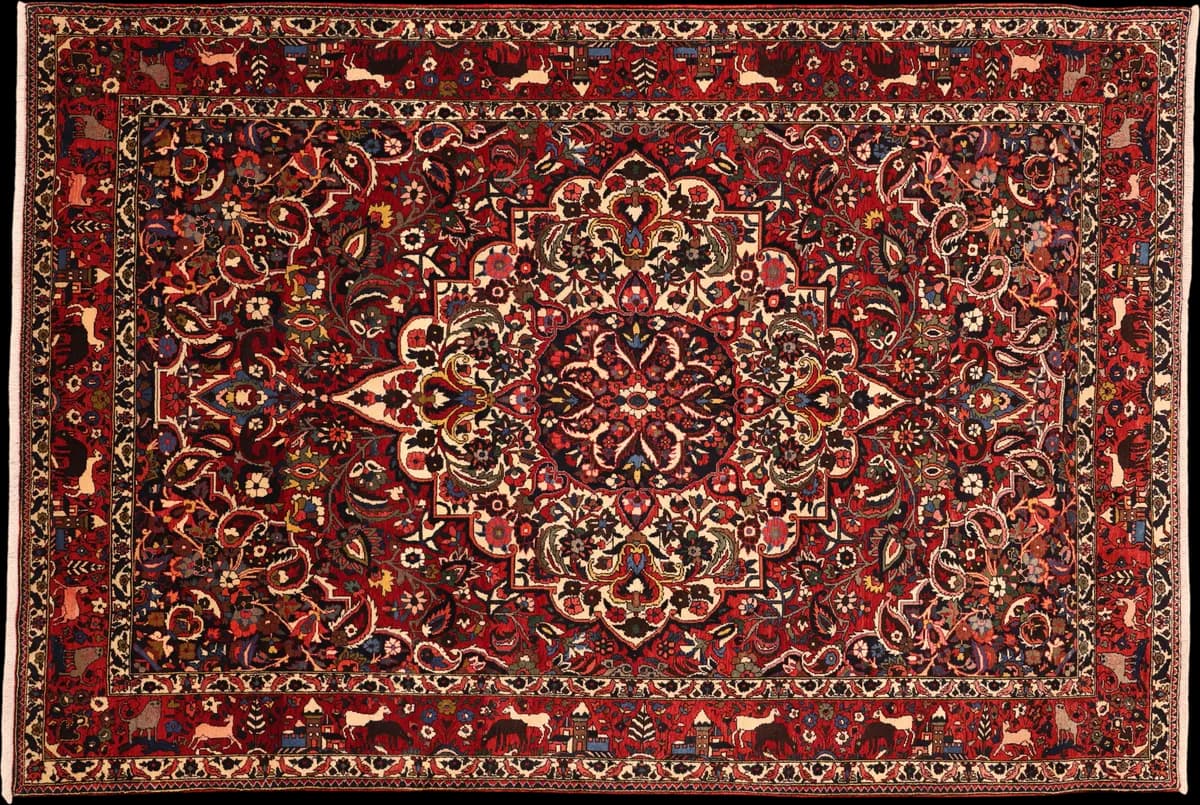
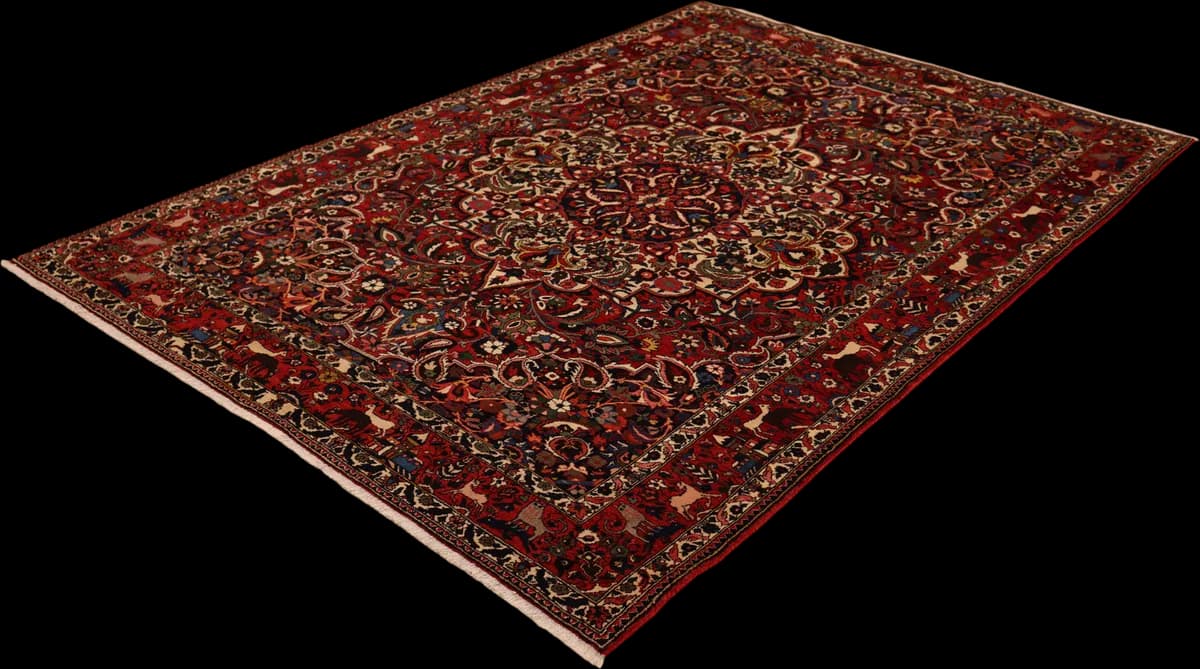
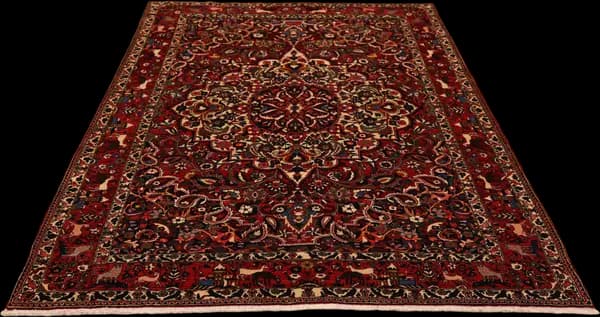
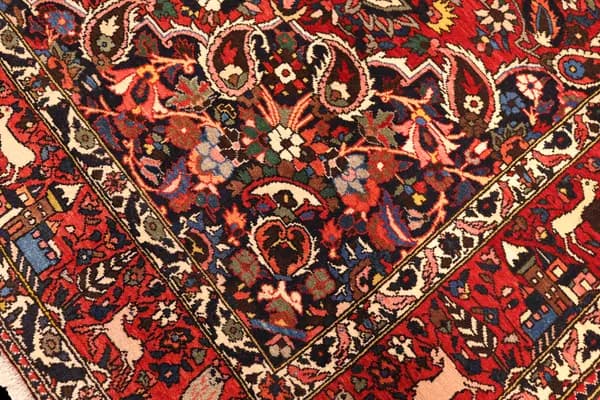
A Bakhtiari rug, also written Bakhtiar, from the Chaharmahal and Bakhtiari province in the Zagros foothills of southwest Iran, 315 x 215 cm (10'4" x 7'1"), hand-knotted by the once-nomadic Bakhtiari tribe, settled today around Shahr-e Kord. Bakhtiari weaving is known for bold, self-assured pattern knotted from memory rather than a fixed plan. Here that character sits inside a classic medallion composition, rather than the tribe's usual garden layout.
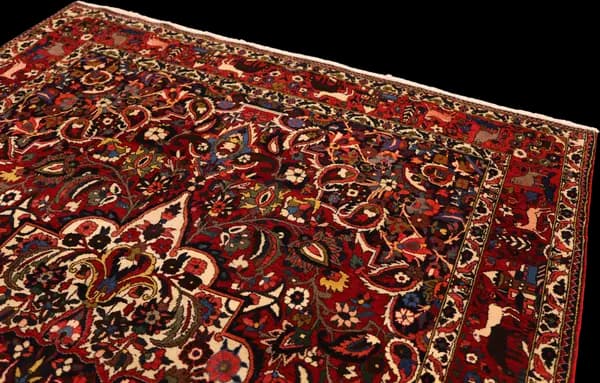
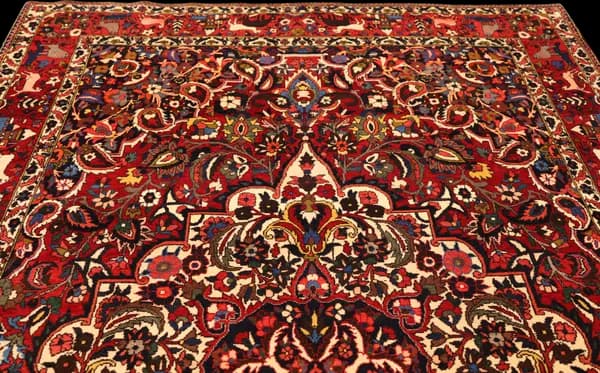
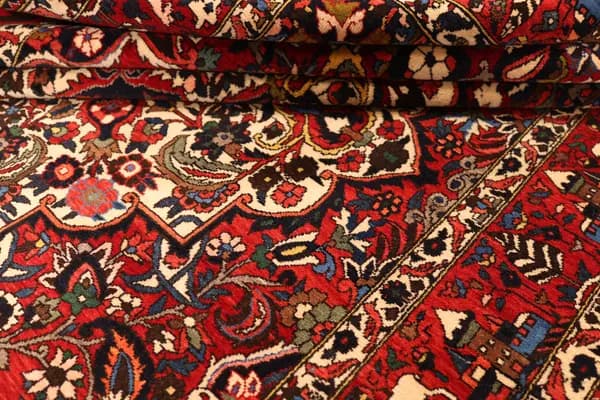
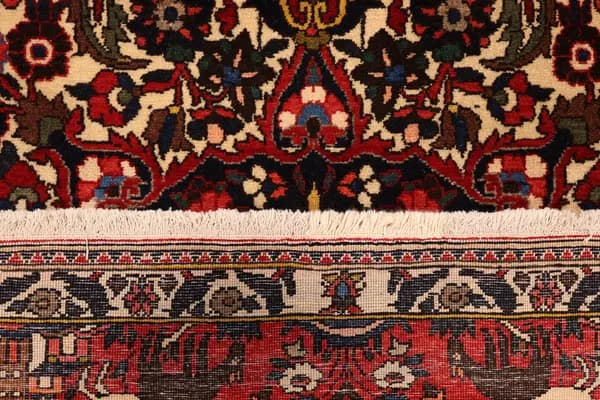
The first impression is a deep, glowing brick red with a light sheen. Across the field runs a dense scroll of floral vines in olive green, dusty rose, brown and cream. At the centre, a large lobed medallion holds its ground in navy, edged in ivory-cream and echoed by cartouche spandrels at each corner. The wide navy border carries, among its small repeating motifs, rows of animals, birds and stylised trees — a quieter narrative around a formal design.
The wool is hand-spun rather than machine-spun, so individual threads vary slightly in thickness and catch the light unevenly, which is what gives the field its soft sheen. The rug is knotted at 128,000 to 160,000 knots per square metre, enough density for the small animals and trees in the border to keep their shape rather than blur into the surrounding scrollwork. At a 12 mm pile height the surface stays even and crisp underfoot, with no flattening of the knots.
A rug of this size suits a dining table or a living room seating group, and its deep red holds its own against dark wood as easily as it warms a pale floor. Underfoot the hand-spun wool is dense and slightly springy, built for daily use rather than display. The small animals and trees in the border are what you keep noticing as you cross the room, a trace of memory inside a very formal design.
Bakhtiari rugs are woven by the Bakhtiari people in the Chahar Mahal region of west-central Iran, in the villages around Shahr-e Kord at the foot of the Zagros Mountains. Knotted on a cotton foundation with sturdy, hand-spun wool, they are robust village pieces built for generations of everyday use.
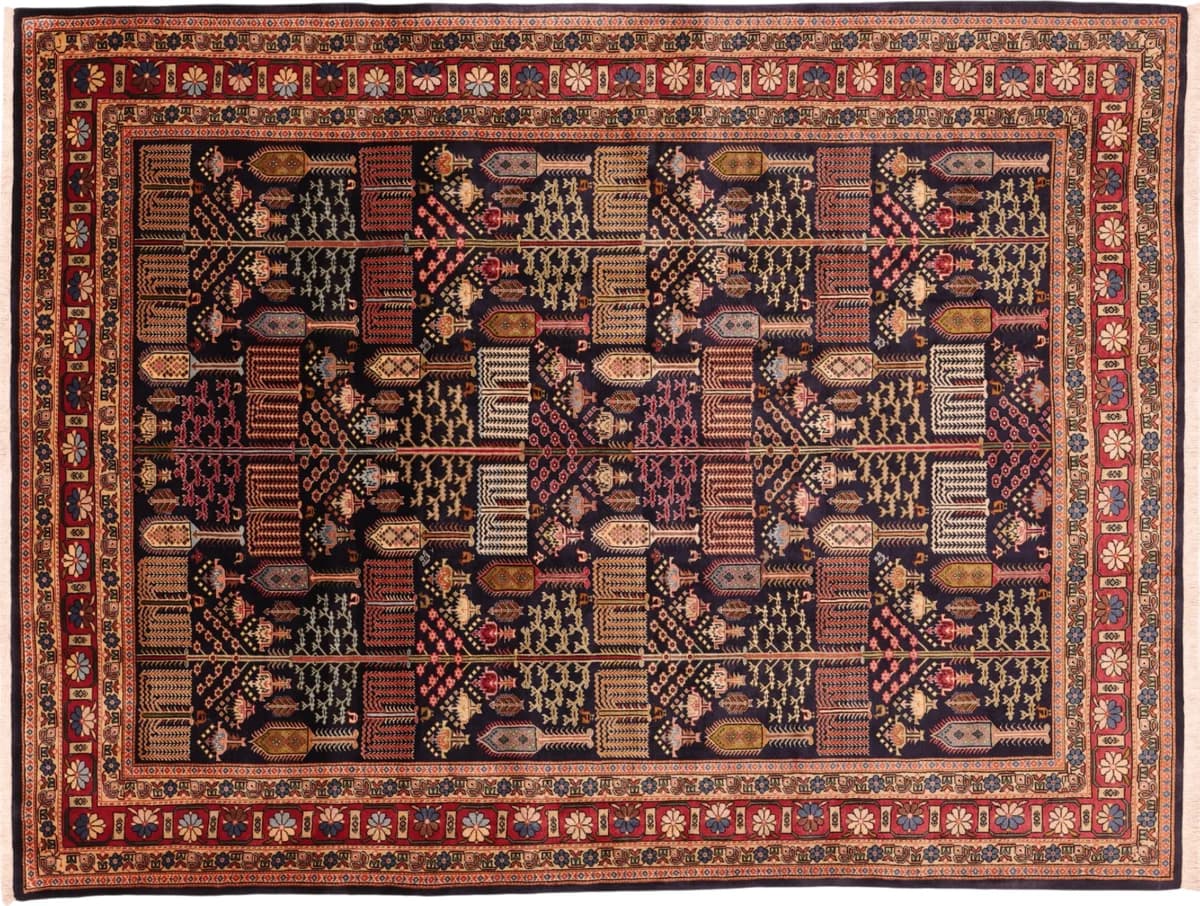
The signature Bakhtiari design is the kheshti, or garden panel: a grid of square compartments, each filled with a different tree, flower or bird motif, in warm reds, indigo, gold and green. It is one of the most instantly recognisable and cheerful layouts in all of Persian weaving.
Traditional weave
At 315 × 215 cm (6.77 m²) this is a large rug. It sits under a seating group with the front legs of sofa and chairs on it, or under a dining table for four. A table for six wants about 80 cm of clearance all round, and needs more.
Yes, knotted by hand — knot by knot on a loom, not machine-made. The density is 128,000 to 160,000 knots per square metre; across 6.77 m² that is roughly 0.9 to 1.1 million individual knots, every one of them tied by hand.
Hand-spun wool still carries its own lanolin, which keeps liquid sitting on the surface for a moment: blot quickly, with clear water and a light cloth, working inwards and without rubbing. Otherwise regular vacuuming along the pile is enough. Turn the rug once or twice a year so light and footfall reach it evenly.
We are in the Hamburg Speicherstadt. Come and see this rug in daylight, or write to us — a person answers.
Certificate included verifying origin, materials, and craftsmanship.
Ref: 391451