Tuyserkan
241 × 140 cm
859 €
673 €
Incl. VAT
In Stock · Ready to Ship
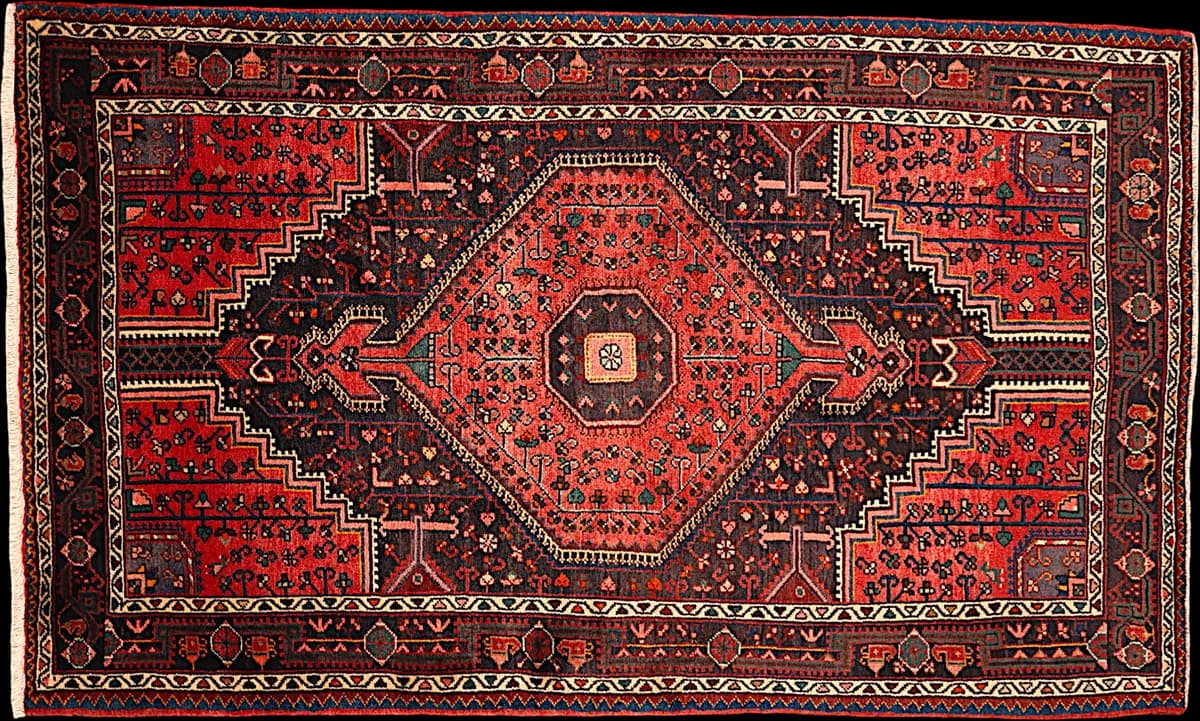
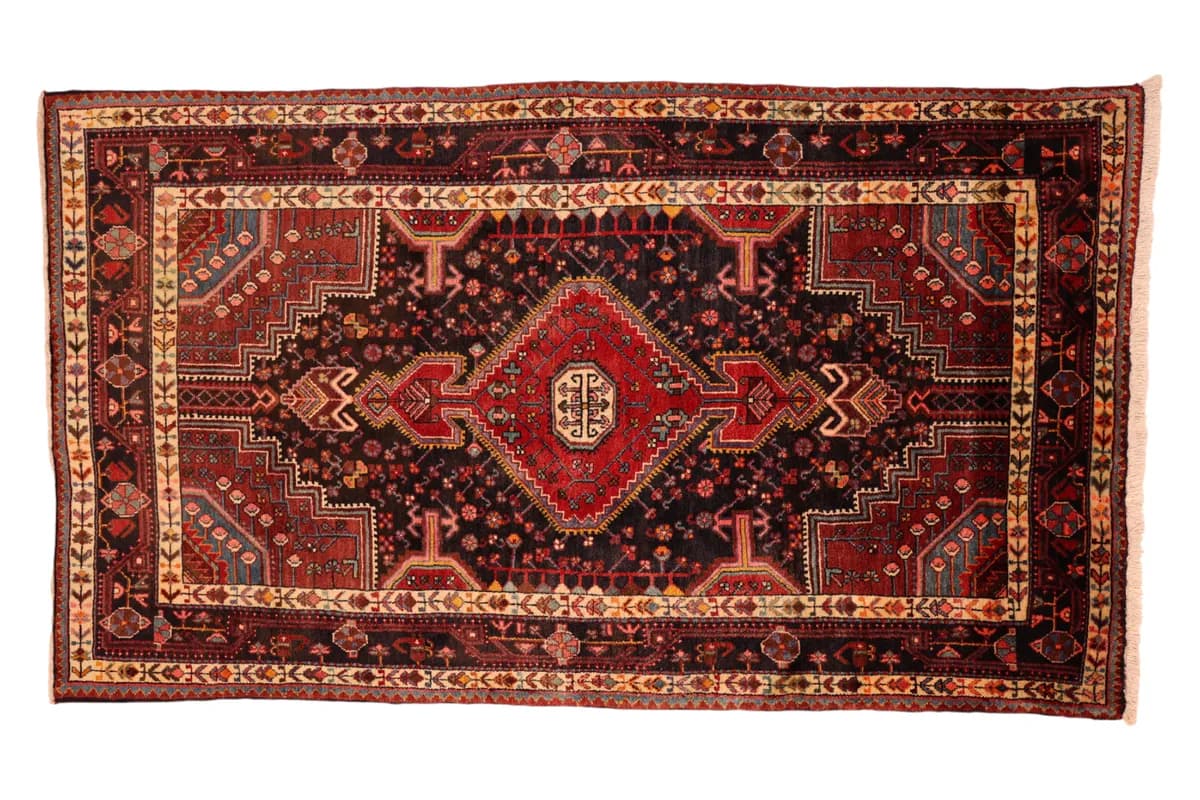
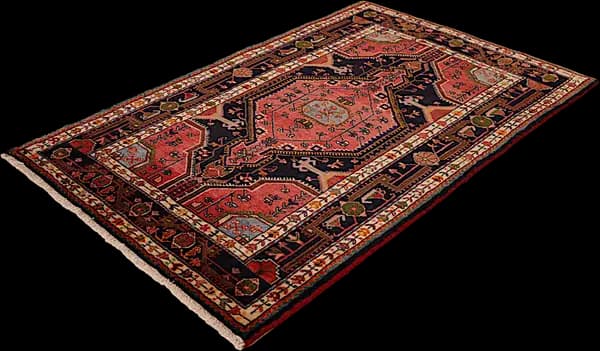
A village rug from Beghardeh, in the western weaving districts of Iran, hand-knotted and measuring 192 x 123 cm (6'4" x 4'0"). Beghardeh belongs to the working, everyday tradition of Persian village weaving rather than to the export workshops of the cities: simple geometric and floral patterns, wool spun by hand, and a construction built for daily use rather than display. What such pieces are known for is exactly this — an honesty of pattern and material that a city loom does not attempt.
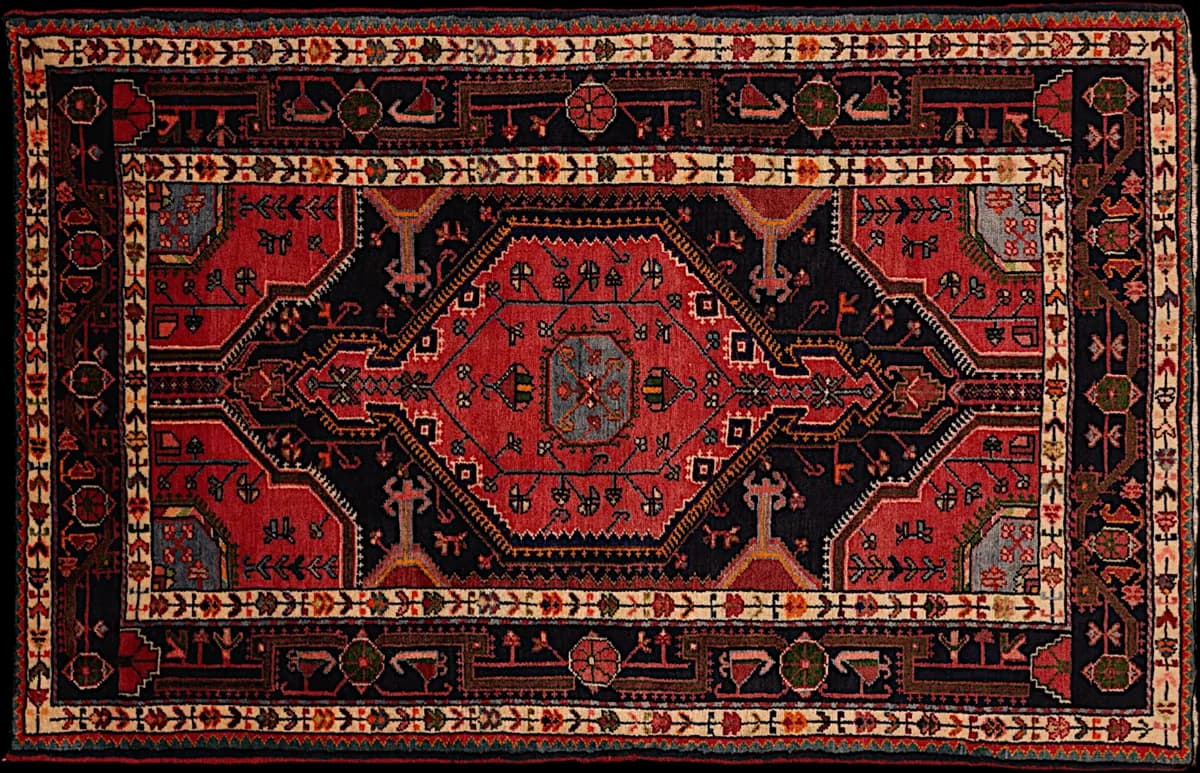
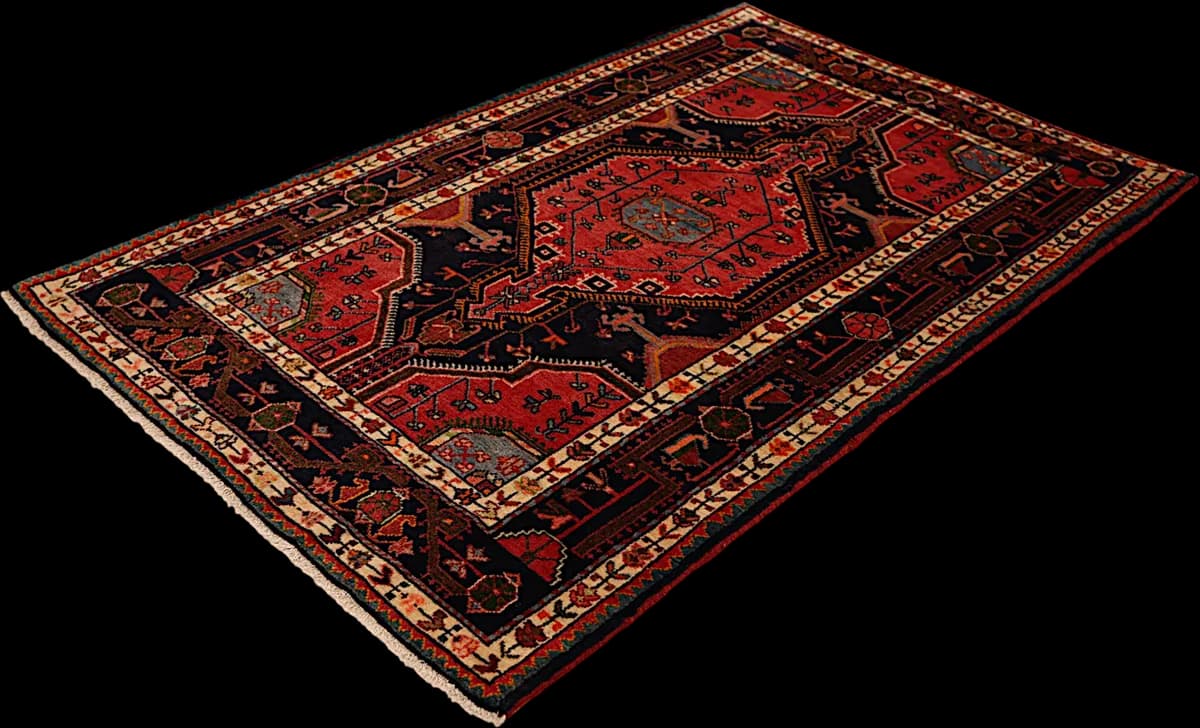
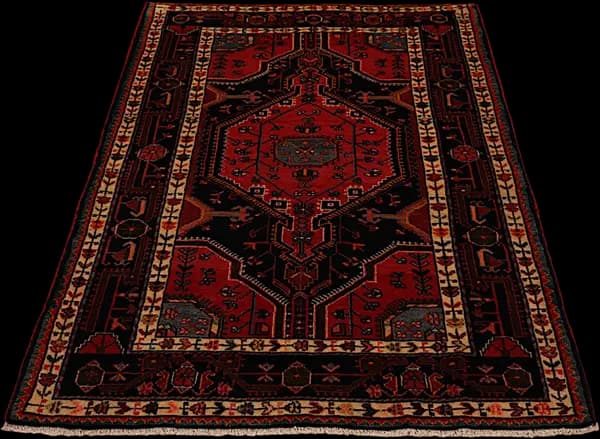
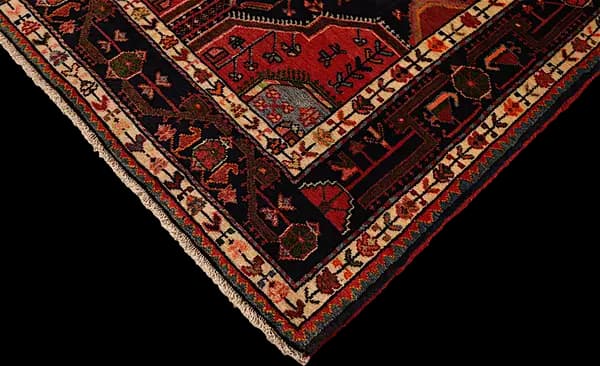
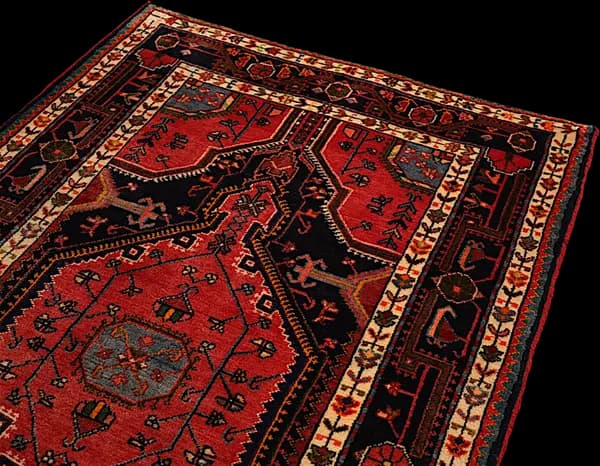
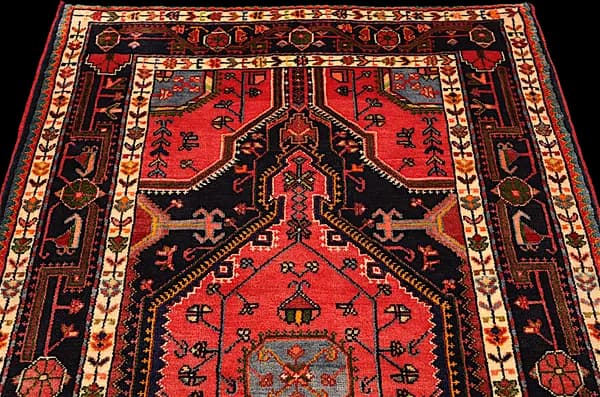
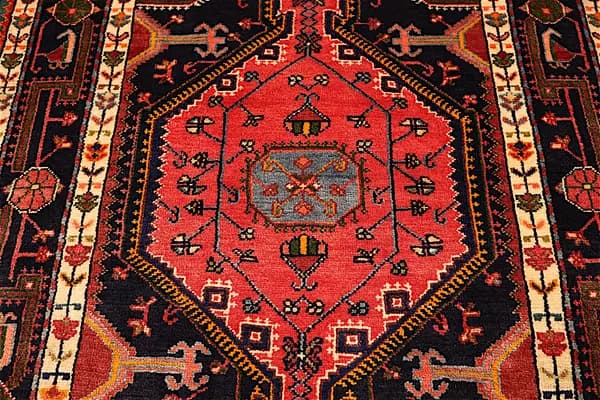
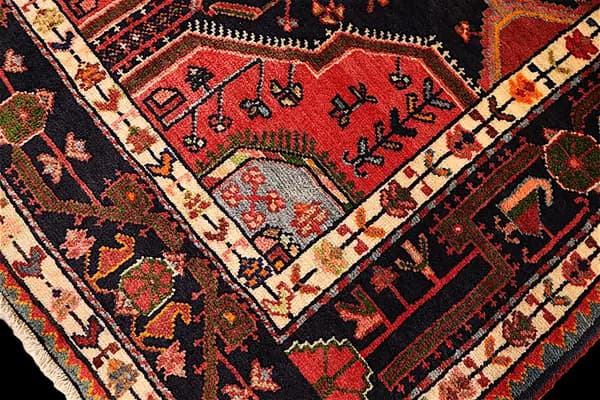
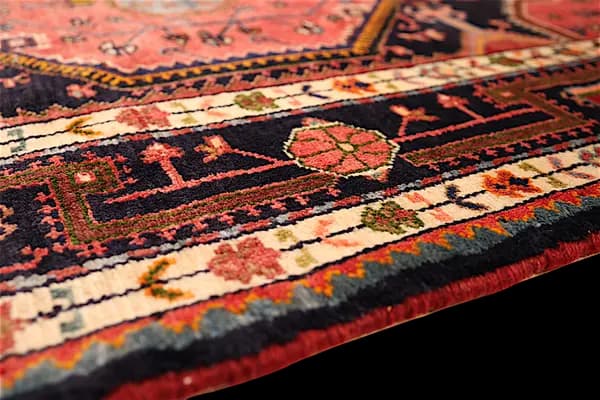
The field is a deep indigo-black, and across it sits a large stepped hexagonal medallion in a warm coral-red, bold enough to hold the eye at once. Where a workshop medallion would curve smoothly to a point, this one ends top and bottom in hooked, anchor-like pendants, giving it an angular, almost improvised outline. Small botehs are scattered through the surrounding black, and the corners are filled with the same red, tying the medallion back into the field. A wide black border carries rosettes and further hooked motifs, edged by narrower cream stripes worked with a small, multicoloured floral vine, and touches of mustard, muted teal and dusty rose lift the corners and medallion without disturbing the dark ground.
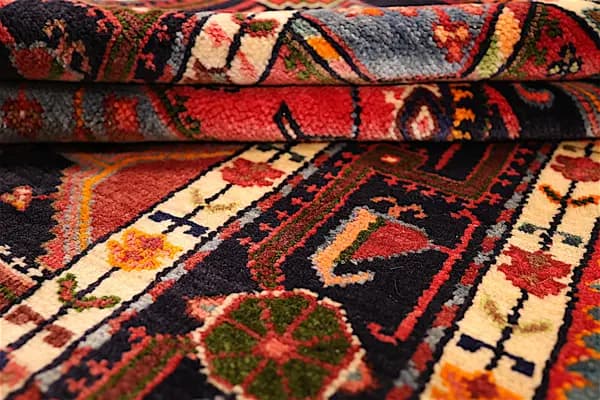
That hooked pendant is the fingerprint of a village hand rather than a drawn cartoon. Beghardeh weavers work from memory and local convention, not from a paper plan pinned above the loom, and a curve redrawn freehand tends to sharpen into a hook rather than stay smooth — which is exactly what has happened here. The wool itself is hand-spun onto a cotton warp, at a density of 321,000 to 380,000 knots per square metre, and left at a 10 mm pile, giving a surface with a matte, slightly uneven hand rather than the flat sheen of a machine-spun yarn. Twenty to forty years of use have not softened that character; if anything they have settled it.
At this size the rug suits a hallway, a landing, or a study rather than a large open room, and it is well chosen for a space with little daylight: the coral medallion holds its warmth against a dark or neutral floor, and the black ground reads as depth rather than gloom under artificial light. Underfoot it is dense and firm, built to take the daily passage a hallway asks for rather than to be kept for best. Walked past morning and evening, it is the kind of rug you notice again each time the light changes on it.
More on Beghardeh rugs: origin, making and how to recognise a genuine piece
Superior craftsmanship
At 192 × 123 cm (2.36 m²) this is a small rug. It works beside a bed, in a reading corner, in front of a fireplace or as a mat by a door. It does not furnish a room; it makes a point in one.
Yes, knotted by hand — knot by knot on a loom, not machine-made. The density is 321,000 to 380,000 knots per square metre; across 2.36 m² that is roughly 760,000 to 900,000 individual knots, every one of them tied by hand.
Hand-spun wool still carries its own lanolin, which keeps liquid sitting on the surface for a moment: blot quickly, with clear water and a light cloth, working inwards and without rubbing. Otherwise regular vacuuming along the pile is enough. Turn the rug once or twice a year so light and footfall reach it evenly.
We are in the Hamburg Speicherstadt. Come and see this rug in daylight, or write to us — a person answers.
Certificate included verifying origin, materials, and craftsmanship.
Ref: 560124