Exclusive
Nain | Exclusivewith silk
200 × 150 cm
2.670 €






2.250 €
Incl. VAT
In Stock · Ready to Ship
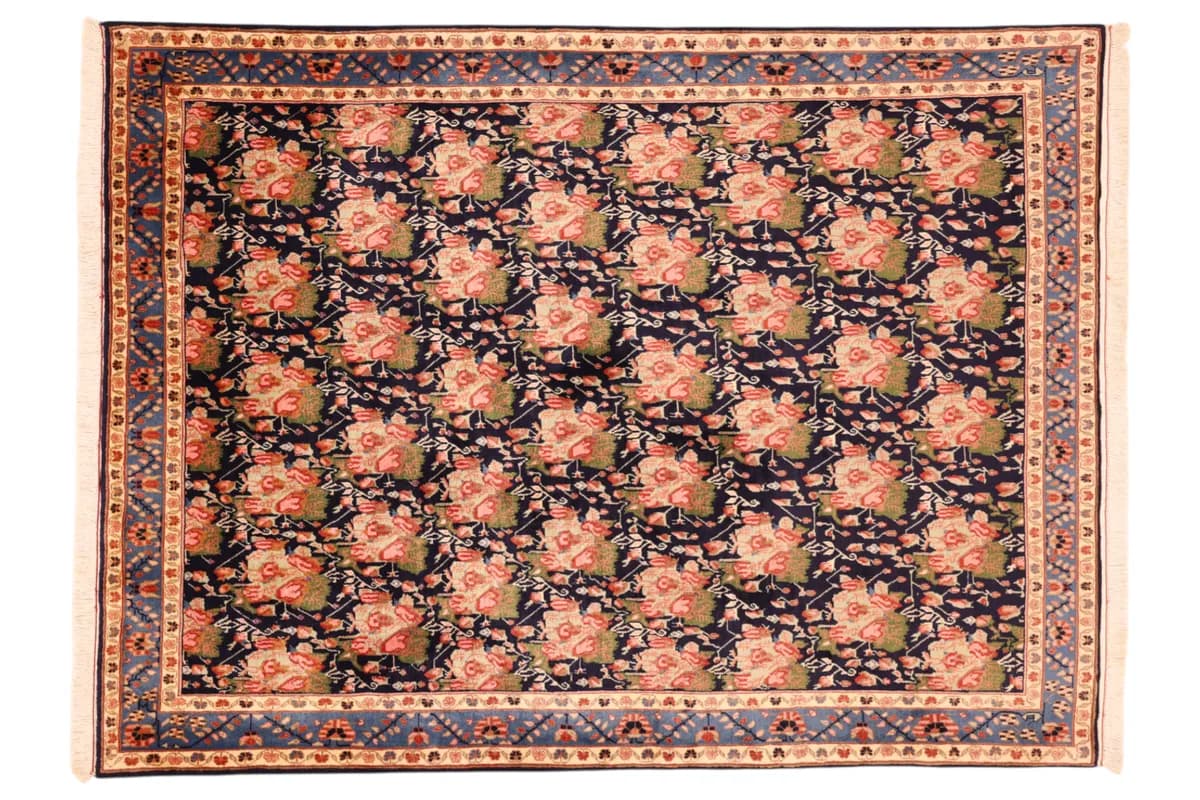
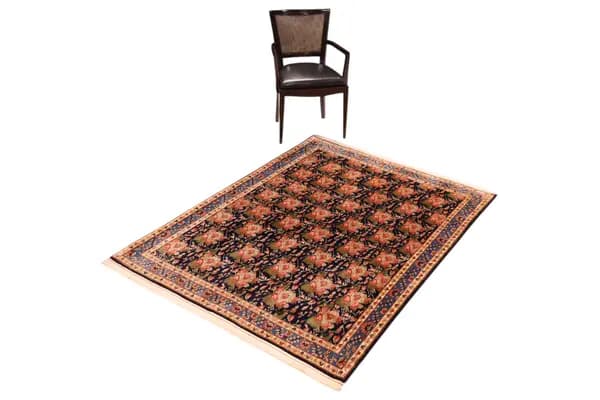
This is an Afshar, also written Afshari, a tribal weaving from the south of Iran, from the nomadic groups around Kerman province who are known for bold geometry and deep, saturated colour. At 199 x 149 cm (6'6" x 4'11") it is a rug for a single room rather than a hall, and it is also, for an Afshar, unusually gentle: the geometry has given way to flowers.
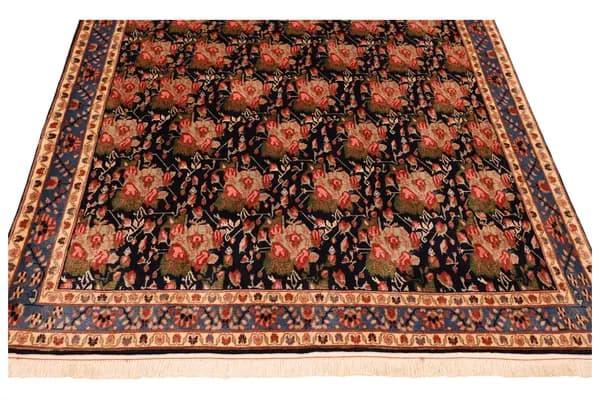
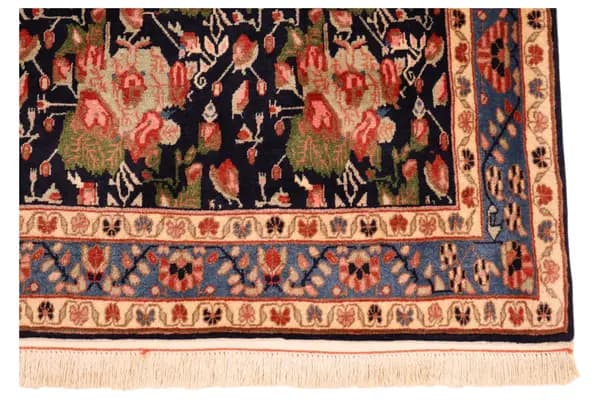
The ground is a deep navy blue, scattered with pink and salmon rose bouquets set in clear diagonal rows, each bouquet framed by sage and olive leaves and touches of cream. The effect is closer to a printed chintz than to the sharp lattice or medallion layouts this weaving is better known for. There is no centre to the design; the rows repeat until they meet a steel-blue border of small red and cream sprigs, framed by narrow ivory guard stripes with their own tiny motifs.
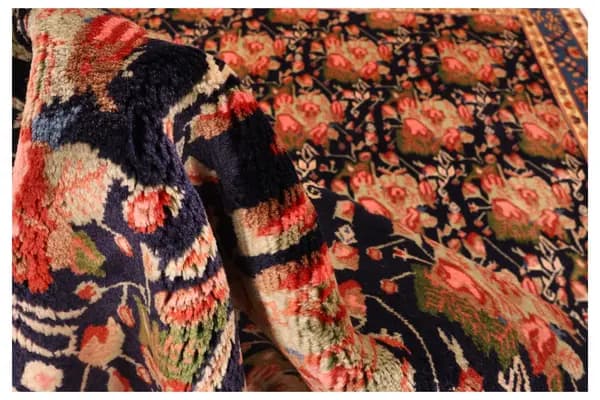
Knotted by hand in the symmetric, or Turkish, knot, this piece holds a density around 441,000 to 500,000 knots per square metre — fine for a nomadic rug, enough to keep the small rose motifs and border sprigs crisp rather than blurred. The pile is hand-spun wool, ten millimetres deep on a cotton warp, and it carries a light natural sheen that gives the roses a soft glow against the navy rather than the flat look of a printed chintz.
In a bedroom, the navy ground settles a pale floor while the pink and salmon roses keep the room from feeling heavy, even in soft, indirect light. Underfoot the pile is dense and springy, sturdy enough for daily use, and its light wool sheen shifts through the day, so the rose trellis never sits quite still.
Afshar rugs are semi-nomadic weavings from the Afshar people, a Turkic-origin tribe settled in southern Iran, primarily around Kerman Province in the Zagros foothills. Their weaving reflects a fascinating blend of Turkic heritage and Persian influence, with both symmetrical (Turkish) and asymmetrical (Persian) knots documented depending on the specific settlement.
Bold geometric designs with miniature boteh motifs, generous layouts, and influences from Kerman, Turkmen, Caucasian, and Qashqai traditions create a distinctive, eclectic aesthetic. The sturdy construction on wool or cotton foundation ensures excellent durability for everyday use.
Exceptionally fine weave
At 199 × 149 cm (2.97 m²) this is a medium rug. It works in front of a sofa, in front of a bed or in a study. It is too small for a dining table — there you want about 80 cm of clearance so a chair does not tip over the edge when pushed back.
Yes, knotted by hand — knot by knot on a loom, not machine-made. The density is 441,000 to 500,000 knots per square metre; across 2.97 m² that is roughly 1.3 to 1.5 million individual knots, every one of them tied by hand.
Hand-spun wool still carries its own lanolin, which keeps liquid sitting on the surface for a moment: blot quickly, with clear water and a light cloth, working inwards and without rubbing. Otherwise regular vacuuming along the pile is enough. Turn the rug once or twice a year so light and footfall reach it evenly.
We are in the Hamburg Speicherstadt. Come and see this rug in daylight, or write to us — a person answers.
Certificate included verifying origin, materials, and craftsmanship.
Ref: 563124