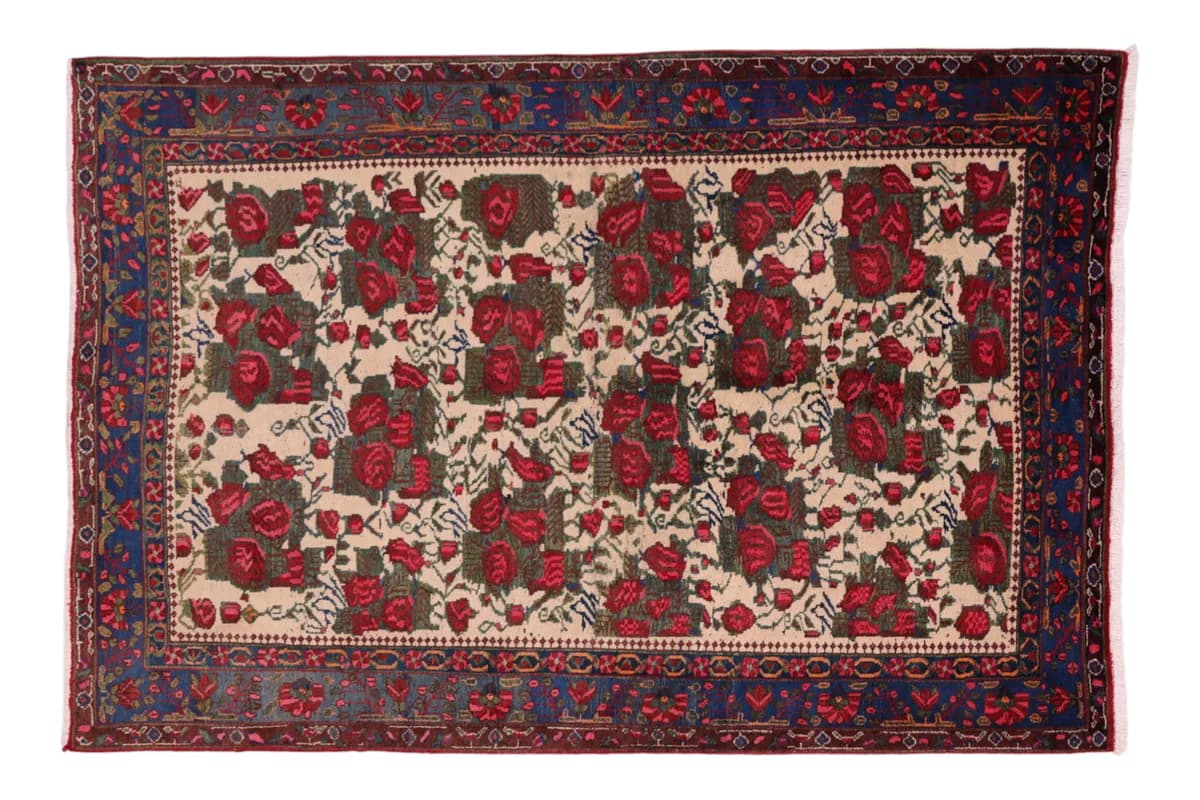
Afshar
213 × 143 cm
732 €






599 €
Incl. VAT
In Stock · Ready to Ship
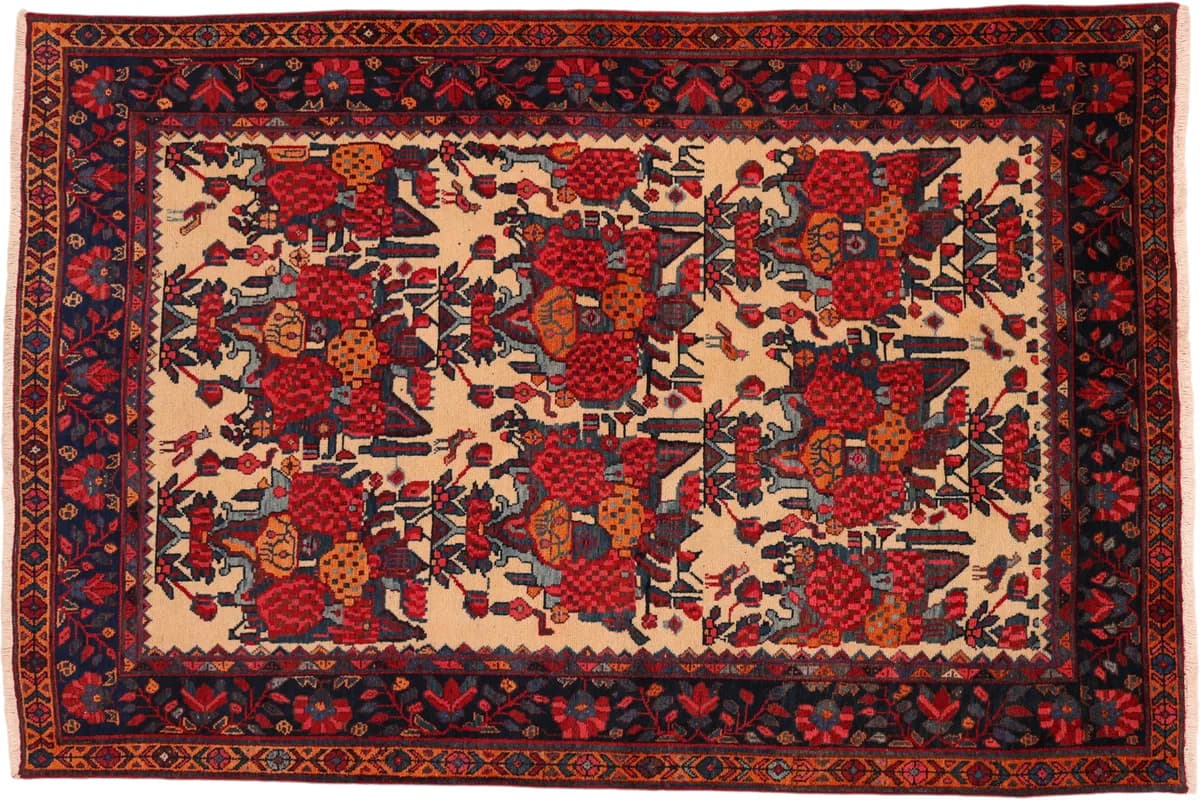
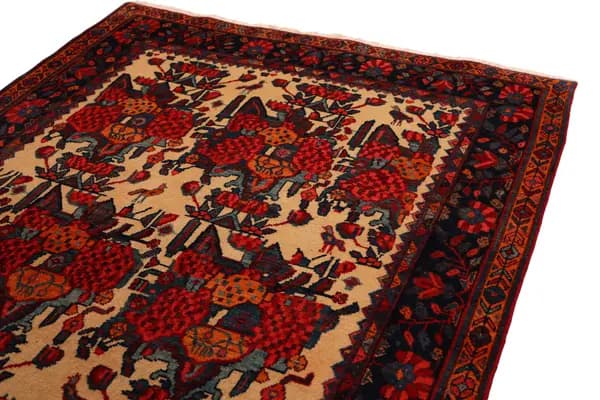
A Ghotblouie, a tribal weaving from the Zagros mountains of southern Iran, tied to the wider tribal rug tradition of Fars province. This example measures 225 x 148 cm (7'5" x 4'10"). Weavings of this kind are known for bold geometry and saturated colour, knotted from memory by weavers working outside any formal workshop system.
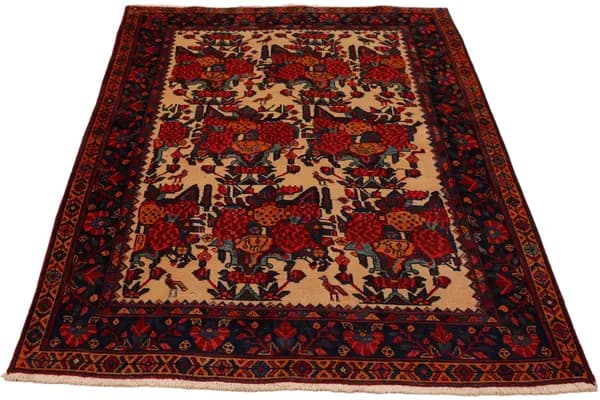
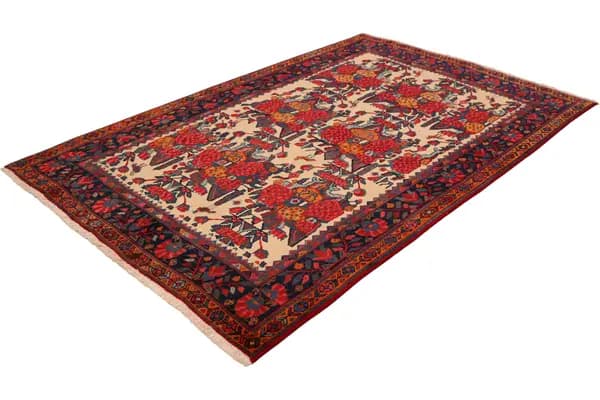
Here the ground breaks from that expectation: instead of the deep red field these rugs usually carry, the colour opens into a warm ivory, scattered with boteh and floral clusters in brick red, rust orange and touches of slate blue, set in loosely offset rows. A few of the smaller shapes drift toward something almost bird-like among the foliage, though they settle back into pattern rather than picture. There is no medallion to gather the eye; the field simply spreads, airy where this design is usually dense. A wide navy border, filled with red and blue vinework and edged by a narrow rust guard stripe, holds the whole field firmly in place, its darkness making the pale ground read even lighter by contrast.
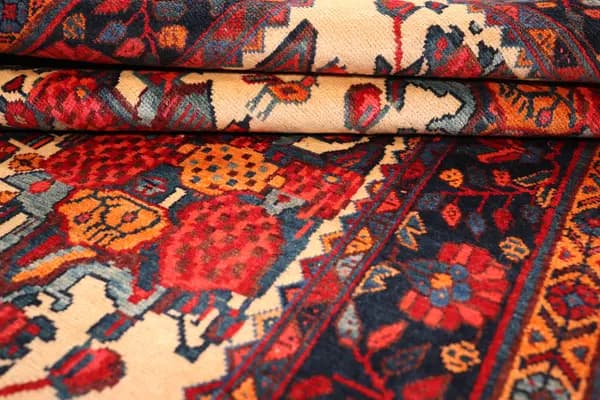
The wool is hand-spun, and hand-spinning never runs perfectly even, which is exactly what gives the surface its slightly irregular, matte texture rather than a uniform sheen. At 72,000 to 90,000 knots per square metre, the weave is open enough to let the weaver work boldly and quickly rather than trace a fine, pre-drawn plan, which is part of why the motifs here have room to breathe against the cream. The rug is forty to sixty years old, and a cotton foundation under a wool pile of this kind is built to be walked on for decades rather than kept for looking at.
In a seating area or a bedroom, this openness works to its advantage: the ivory ground lifts a room with little natural light, while the navy border keeps it anchored rather than washed out. Underfoot the wool sits dense and slightly springy at 12 mm, forgiving enough for daily use without asking for a hushed room around it. As the light shifts across the day, the cream field catches it while the red and navy hold their depth, and it is that quiet contrast, unusual for a Ghotblouie, that keeps drawing the eye back.
Loribaft rugs are woven by Lori (Lur) tribes in the Zagros Mountains of western Iran, spanning parts of Lorestan, Khuzestan, and Fars provinces. The name "Loribaft" means "woven by Lori" and designates a distinctive tribal weaving tradition rooted in nomadic life, where rugs are made on horizontal ground looms during seasonal migrations.
Traditionally constructed entirely from wool, pile, warp, and weft, Loribaft rugs feature bold geometric patterns with confident colour contrasts in rich reds, blues, and natural earth tones. The thick, lustrous pile and hand-spun wool give them a grounded, authentic character.
Artisan crafted
At 225 × 148 cm (3.33 m²) this is a medium rug. It works in front of a sofa, in front of a bed or in a study. It is too small for a dining table — there you want about 80 cm of clearance so a chair does not tip over the edge when pushed back.
Yes, knotted by hand — knot by knot on a loom, not machine-made. The density is 72,000 to 90,000 knots per square metre; across 3.33 m² that is roughly 240,000 to 300,000 individual knots, every one of them tied by hand.
Hand-spun wool still carries its own lanolin, which keeps liquid sitting on the surface for a moment: blot quickly, with clear water and a light cloth, working inwards and without rubbing. Otherwise regular vacuuming along the pile is enough. Turn the rug once or twice a year so light and footfall reach it evenly.
We are in the Hamburg Speicherstadt. Come and see this rug in daylight, or write to us — a person answers.
Certificate included verifying origin, materials, and craftsmanship.
Ref: 739309