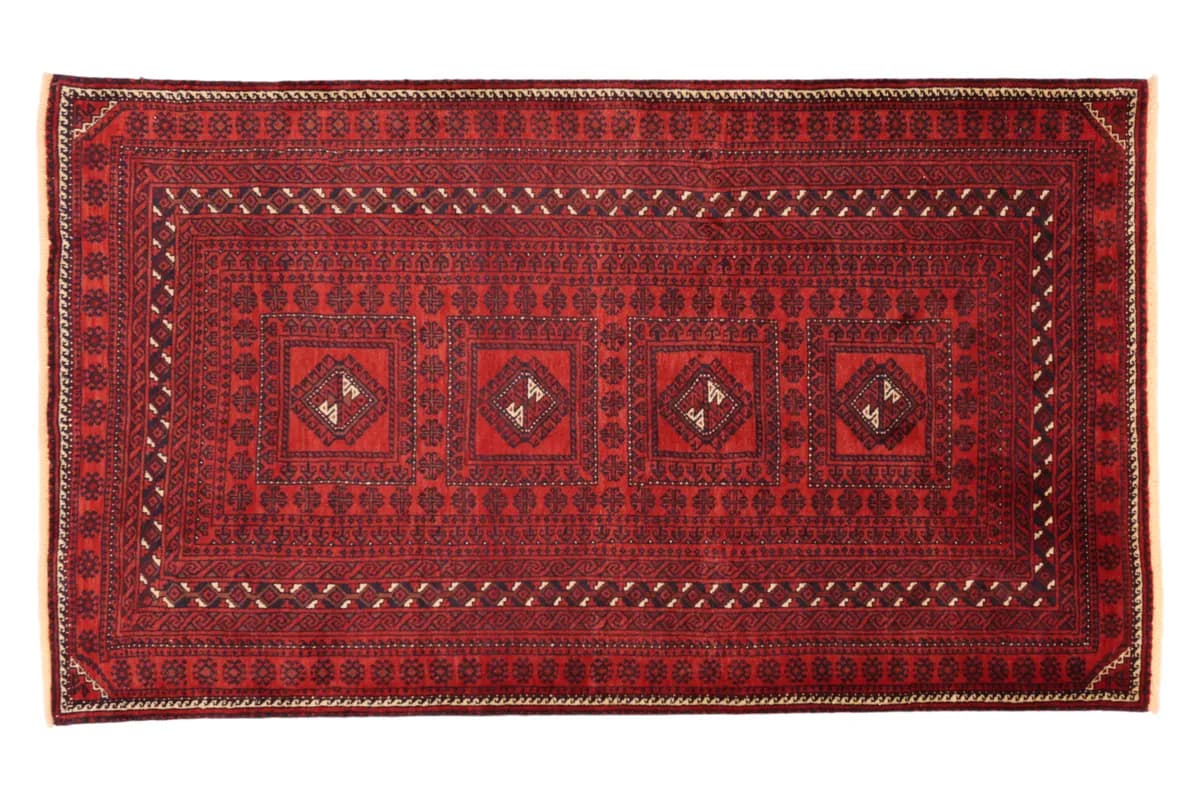
Belutsch
188 × 109 cm
584 €







544 €
Incl. VAT
In Stock · Ready to Ship
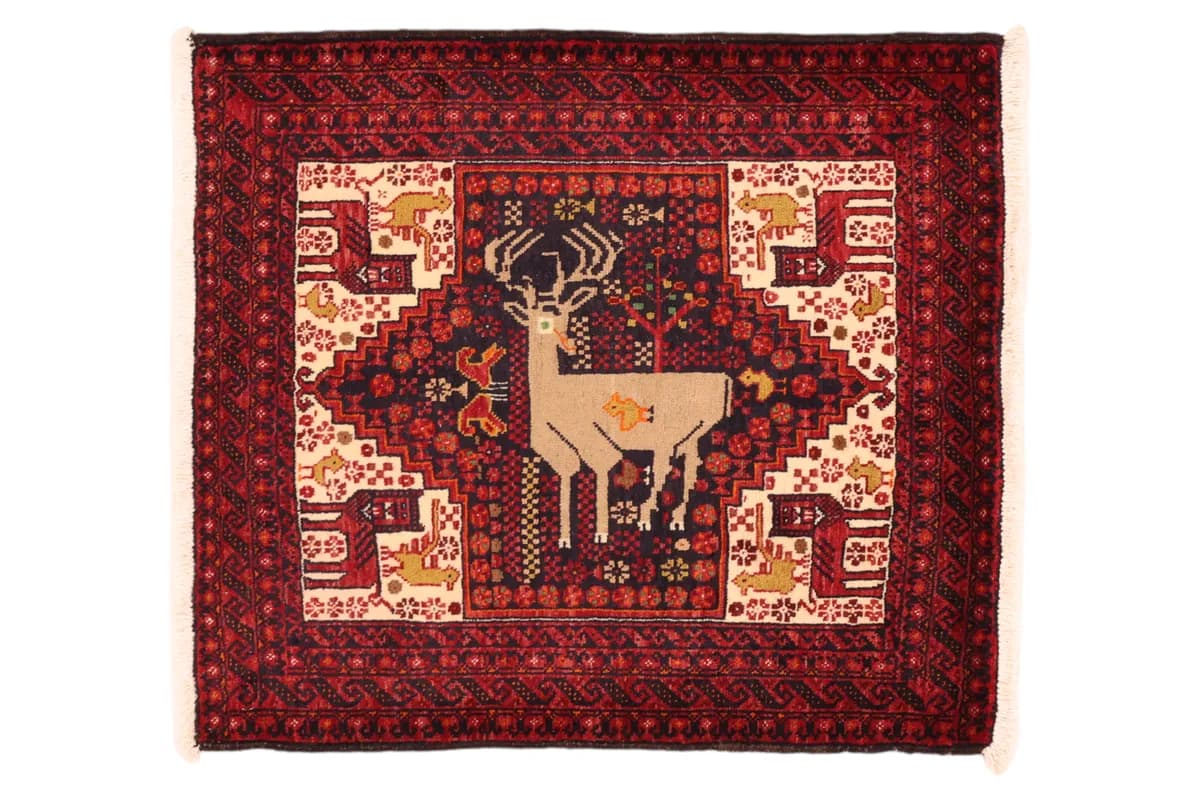
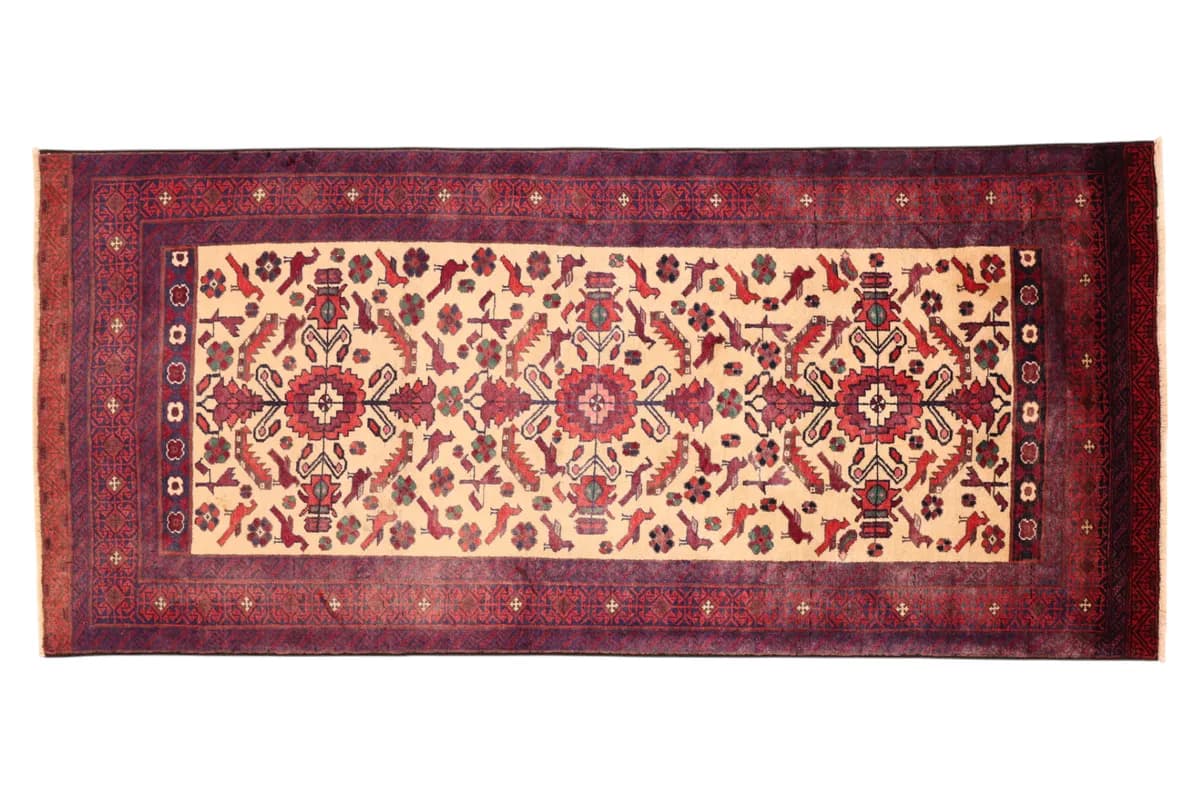
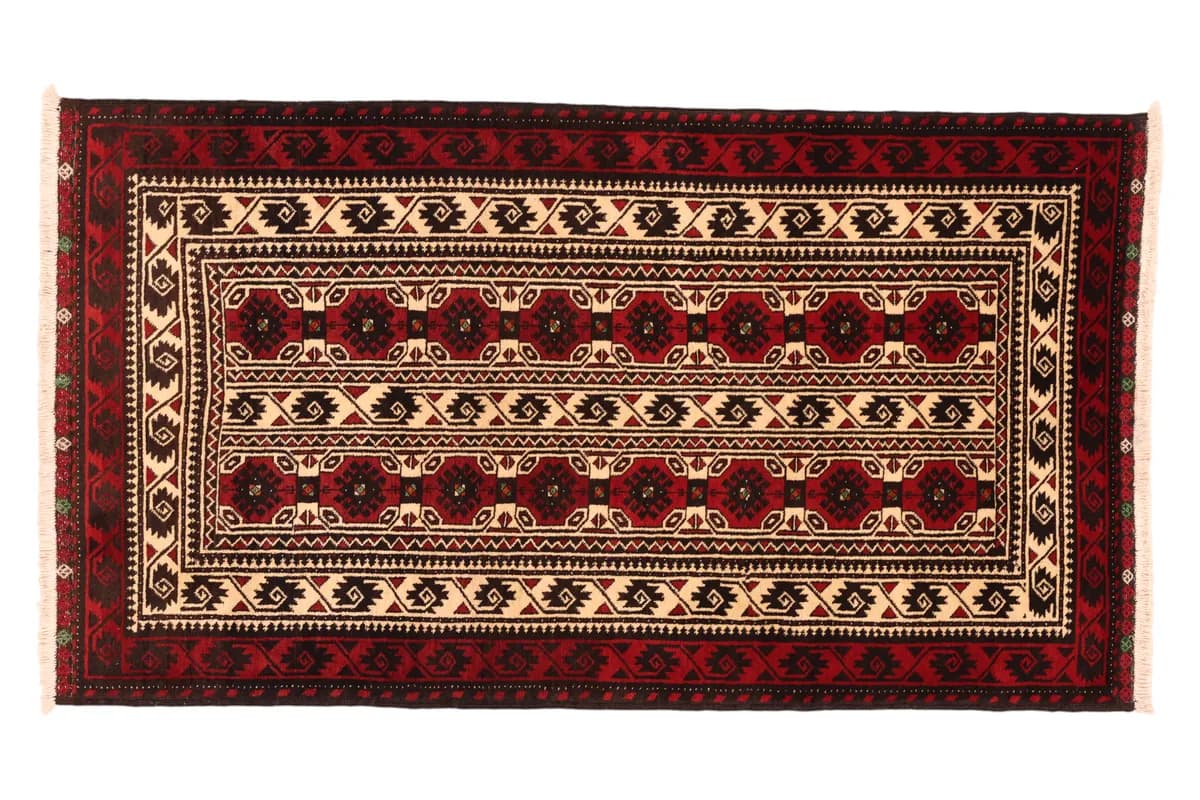
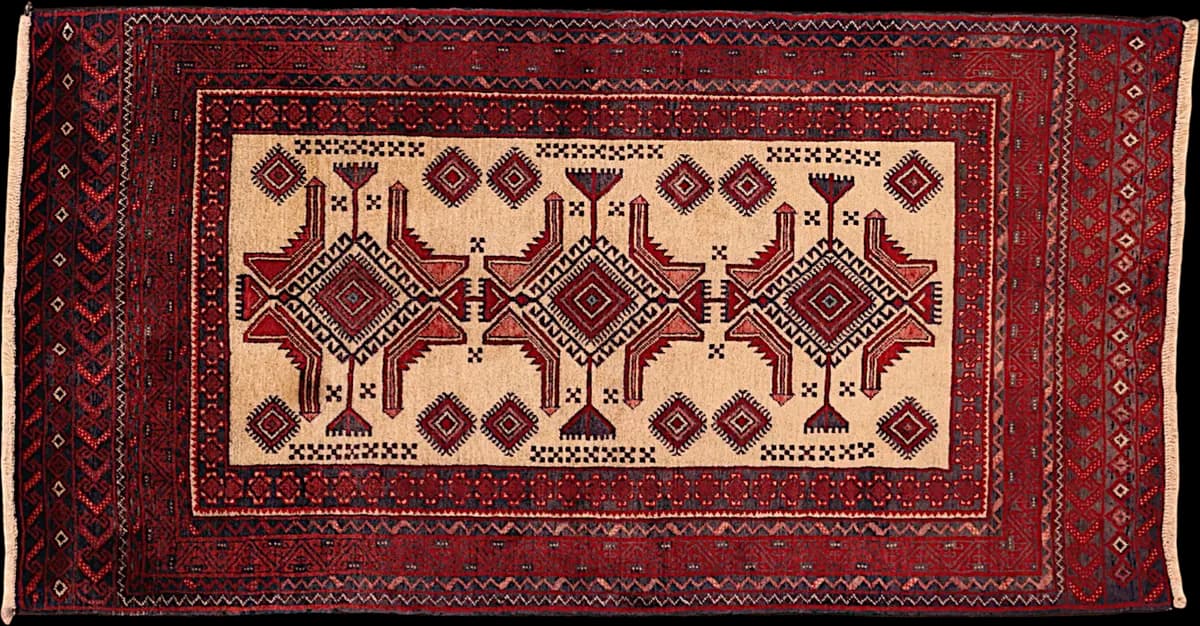
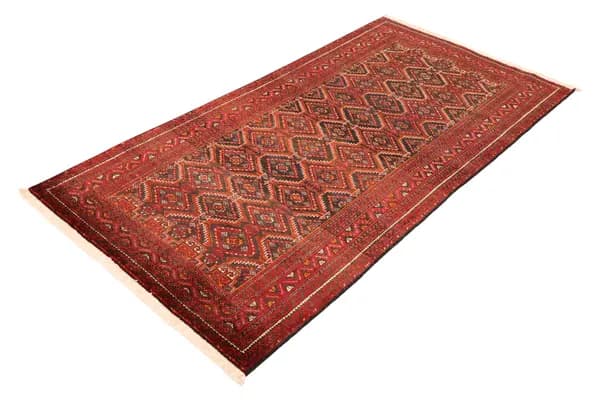
The rug in front of you is a Baluch, also written Belouch, a tribal weaving from the borderlands of southeastern Iran, knotted by nomadic hands from memory rather than from a drawn plan. It measures 195 x 98 cm (6'5" x 3'3"), a size long favoured by these weavers for pieces made to travel with a household rather than furnish one room for good. What marks Baluch work generally is its bold, angular geometry and its deep, earthy palette; what marks this particular piece is how evenly that geometry has been carried through, corner to corner, without the drift a memory-knotted rug usually shows.
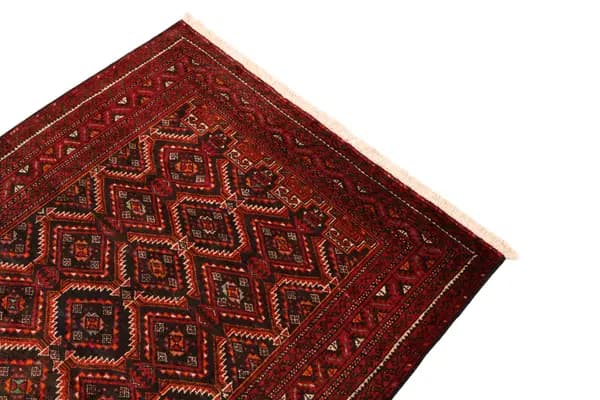
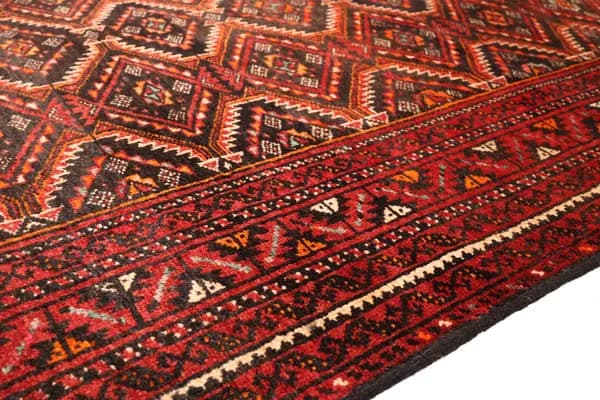
The first impression is dark and disciplined: a field of near-black brown, filled edge to edge with a diamond lattice, each diamond serrated at the edges and centred on a small rosette touched with turquoise and burnt orange. There is no medallion here to catch the eye and hold it — the pattern simply repeats, length after length, which is what gives the field its almost graphic weight. Around it runs a rust-red border, broken by narrow cream and dark-red zigzag guard stripes that lift noticeably against the black ground, and at the four inner corners, where lattice meets border, small hooked scroll motifs turn the field's edge rather than simply stopping it.
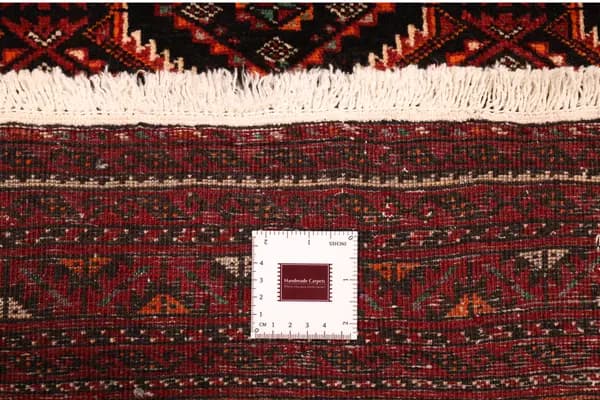
The wool here is hand-spun, knotted onto a cotton warp at a density of 128,000 to 160,000 knots per square metre and clipped low, to about 6 millimetres, which is what gives the surface its flat, matte, almost drawn-on quality rather than any sheen. Hand-spun wool takes dye a little unevenly by nature, which is usually where a tribal rug's irregularity shows — yet the lattice here has been kept remarkably true along its whole length, a steadiness of hand that is not always found in weaving done without a cartoon. At twenty to forty years old, the wool has already settled into the piece rather than sitting on top of it.
A rug this size and this dark earns its place in a hallway or landing, or beside a bed where the floor is seen underfoot rather than across a room. Against pale flooring the black-brown field grounds the space at once, and where a hallway gets little daylight, the rust border and cream stripes carry enough warmth to lift it on their own. Underfoot it is flat, dense and firm, built for a passage that gets walked rather than admired from a doorway, and the small turquoise and orange notes in each rosette are the sort of detail you keep noticing on the way past.
More on Baluch rugs: origin, making and how to recognise a genuine piece
Traditional weave
At 195 × 98 cm (1.91 m²) this is a small rug. It works beside a bed, in a reading corner, in front of a fireplace or as a mat by a door. It does not furnish a room; it makes a point in one.
Yes, knotted by hand — knot by knot on a loom, not machine-made. The density is 128,000 to 160,000 knots per square metre; across 1.91 m² that is roughly 240,000 to 310,000 individual knots, every one of them tied by hand.
Hand-spun wool still carries its own lanolin, which keeps liquid sitting on the surface for a moment: blot quickly, with clear water and a light cloth, working inwards and without rubbing. Otherwise regular vacuuming along the pile is enough. Turn the rug once or twice a year so light and footfall reach it evenly.
We are in the Hamburg Speicherstadt. Come and see this rug in daylight, or write to us — a person answers.
Certificate included verifying origin, materials, and craftsmanship.
Ref: 752524