Belutsch
212 × 97 cm
564 €





510 €
Incl. VAT
In Stock · Ready to Ship
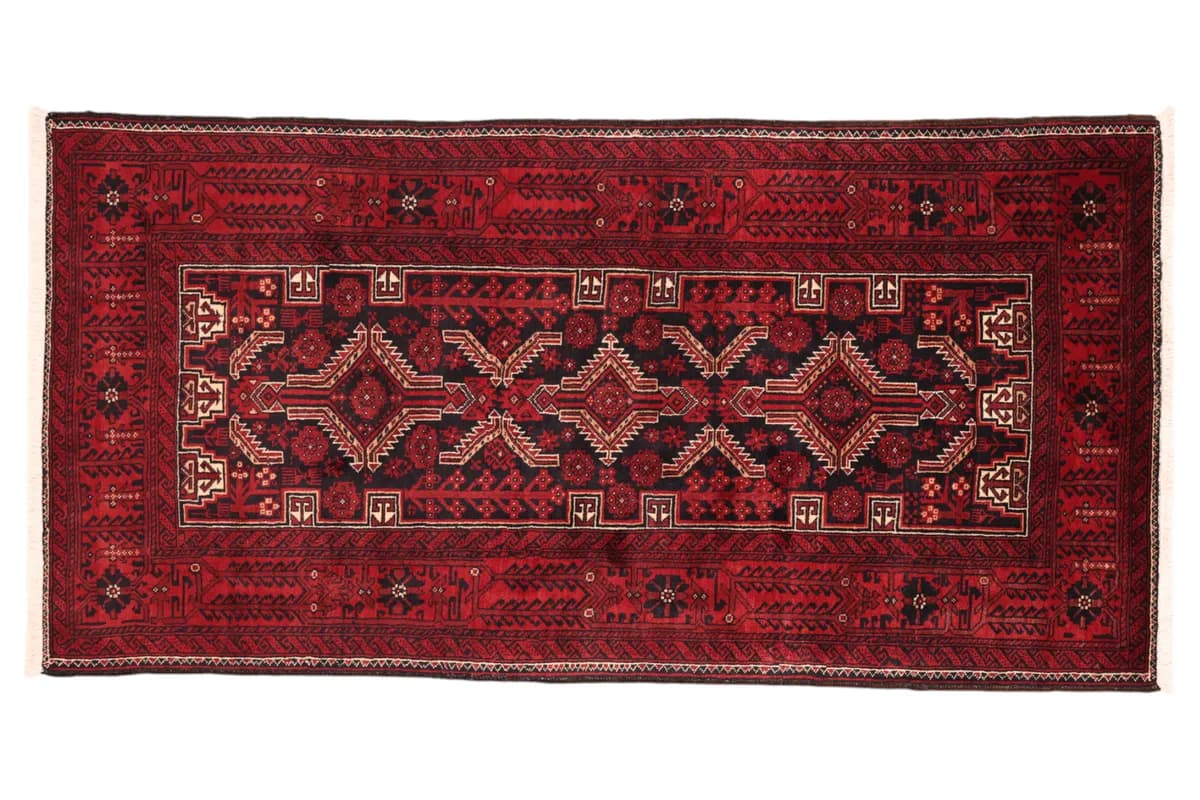
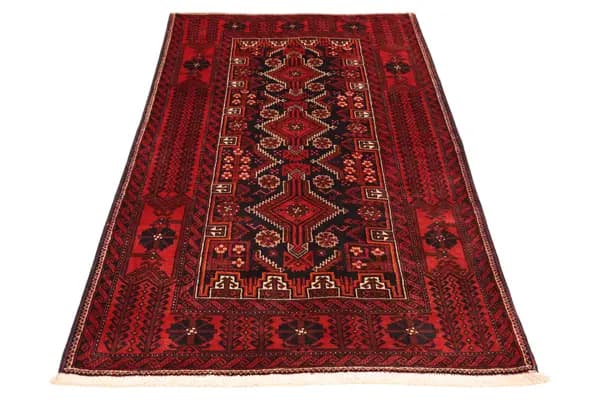
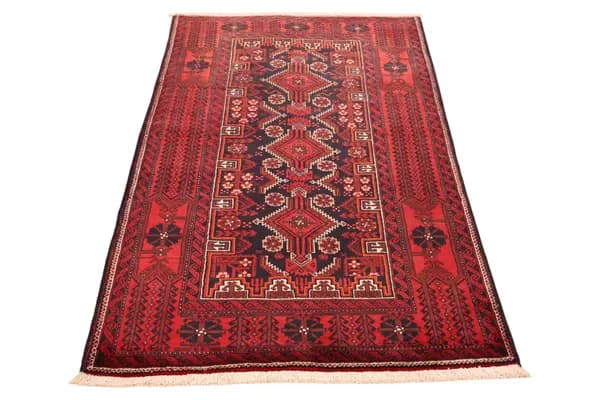
The Baluch is a tribal weaving from the borderlands of southeastern Iran, made on a portable loom from memory rather than a drawn plan. This piece measures 195 x 105 cm (6'5" x 3'5"). The type is known above all for deep earthy reds set against indigo, and for the mihrab, or prayer-niche, layout that runs through so many classic examples. Here that balance is turned around: the field itself is a near-black indigo, not the customary red.
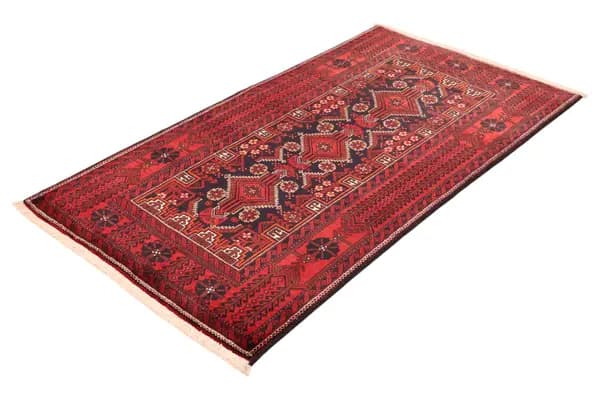
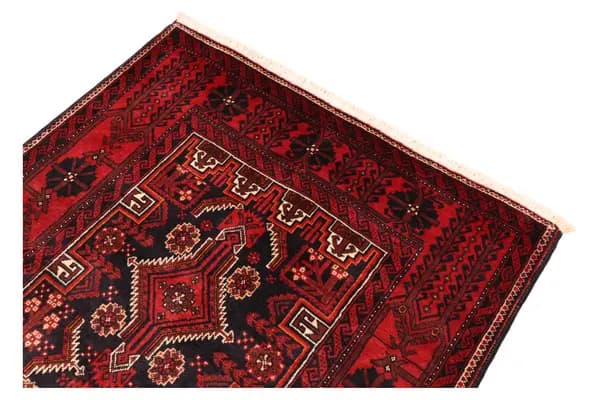
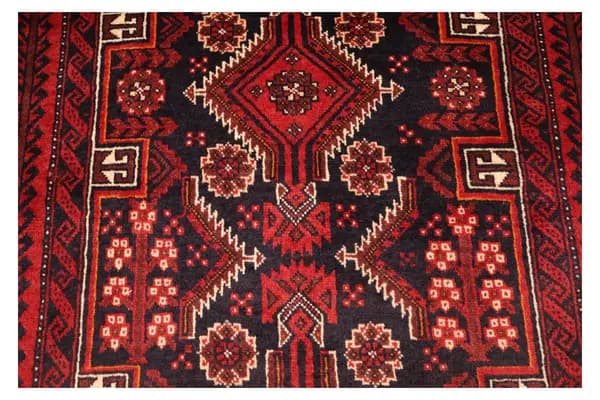
The first impression is of darkness held in check by colour. Down the centre, three hooked diamond medallions in brick red and terracotta stride across the indigo ground, each one outlined sharply enough to hold its shape from across the room. Small florets, ivory rosettes and tribal tree-and-comb devices fill the space around them, keeping the field busy without softening its geometry. A wide red border, banded with a dark serrated meander and rosette cartouches, closes the piece firmly, the red here answering the red of the medallions rather than competing with the indigo.
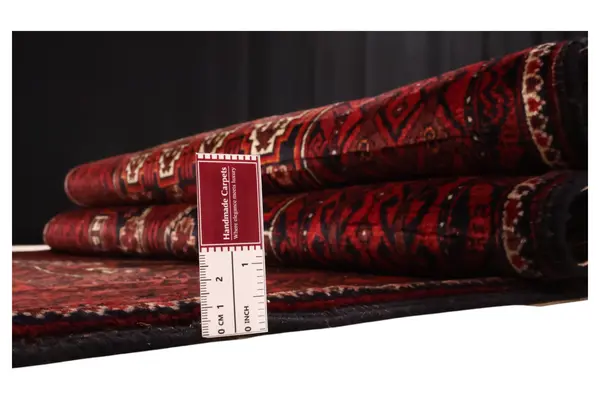
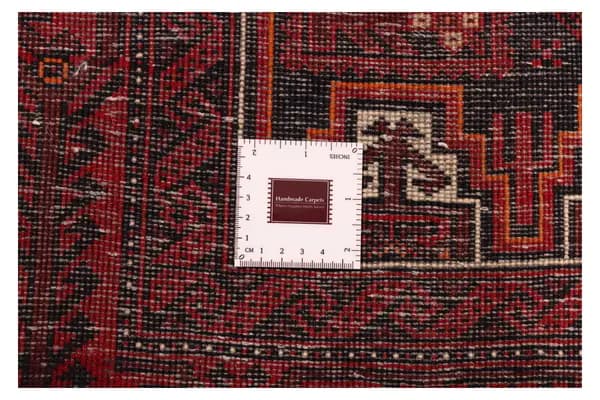
This is a hand-knotted rug, the pile hand-spun wool on a cotton warp, twenty to forty years old. Hand-spun wool has an irregular thickness that a machine-spun yarn never has, and it is this that gives the surface its warmth and slight unevenness even where the pattern itself is sharply drawn. At 128,000 to 160,000 knots per square metre and clipped close, to six millimetres, the weaver was still able to hold the hooked outlines of the diamonds crisp against the dark ground, which is why the pattern reads as bold rather than blurred. The result is a piece that keeps the tribal hand of a Baluch, also written Belouch, while pushing its geometry further forward than most.
A rug this size sits well beside a bed or in a study corner, somewhere it is seen up close rather than crossed constantly. Against a pale floor the indigo grounds the room instead of disappearing into it, and the red medallions keep their glow even in a dim corner where a lighter rug would flatten out. Underfoot it is dense and firm, the clipped wool giving a slightly textured, matte surface that takes daily use without complaint. Morning light picks out the terracotta and mustard outlining first, before settling into the deep, steady blue that holds the whole piece together.
More on Baluch rugs: origin, making and how to recognise a genuine piece
Traditional weave
At 195 × 105 cm (2.05 m²) this is a small rug. It works beside a bed, in a reading corner, in front of a fireplace or as a mat by a door. It does not furnish a room; it makes a point in one.
Yes, knotted by hand — knot by knot on a loom, not machine-made. The density is 128,000 to 160,000 knots per square metre; across 2.05 m² that is roughly 260,000 to 330,000 individual knots, every one of them tied by hand.
Hand-spun wool still carries its own lanolin, which keeps liquid sitting on the surface for a moment: blot quickly, with clear water and a light cloth, working inwards and without rubbing. Otherwise regular vacuuming along the pile is enough. Turn the rug once or twice a year so light and footfall reach it evenly.
We are in the Hamburg Speicherstadt. Come and see this rug in daylight, or write to us — a person answers.
Certificate included verifying origin, materials, and craftsmanship.
Ref: 767098