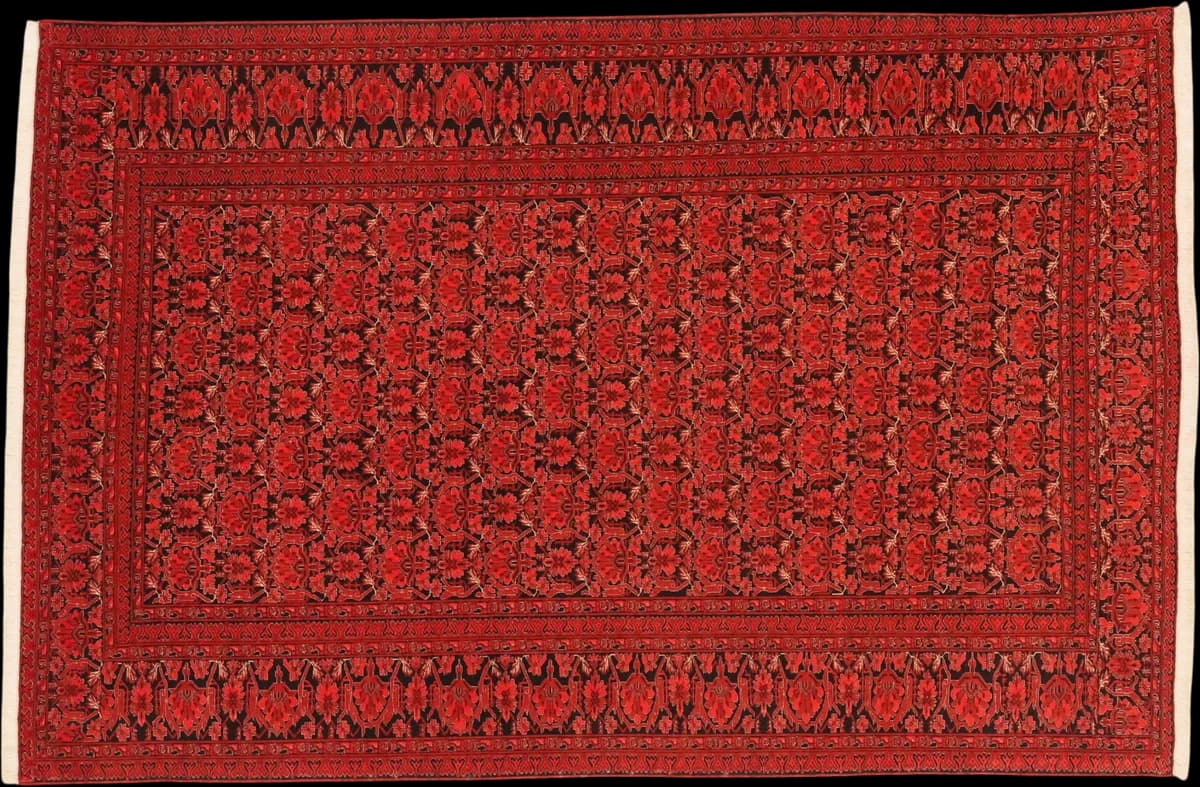
Belutsch
297 × 195 cm
4.800 €







553 €
Incl. VAT
In Stock · Ready to Ship
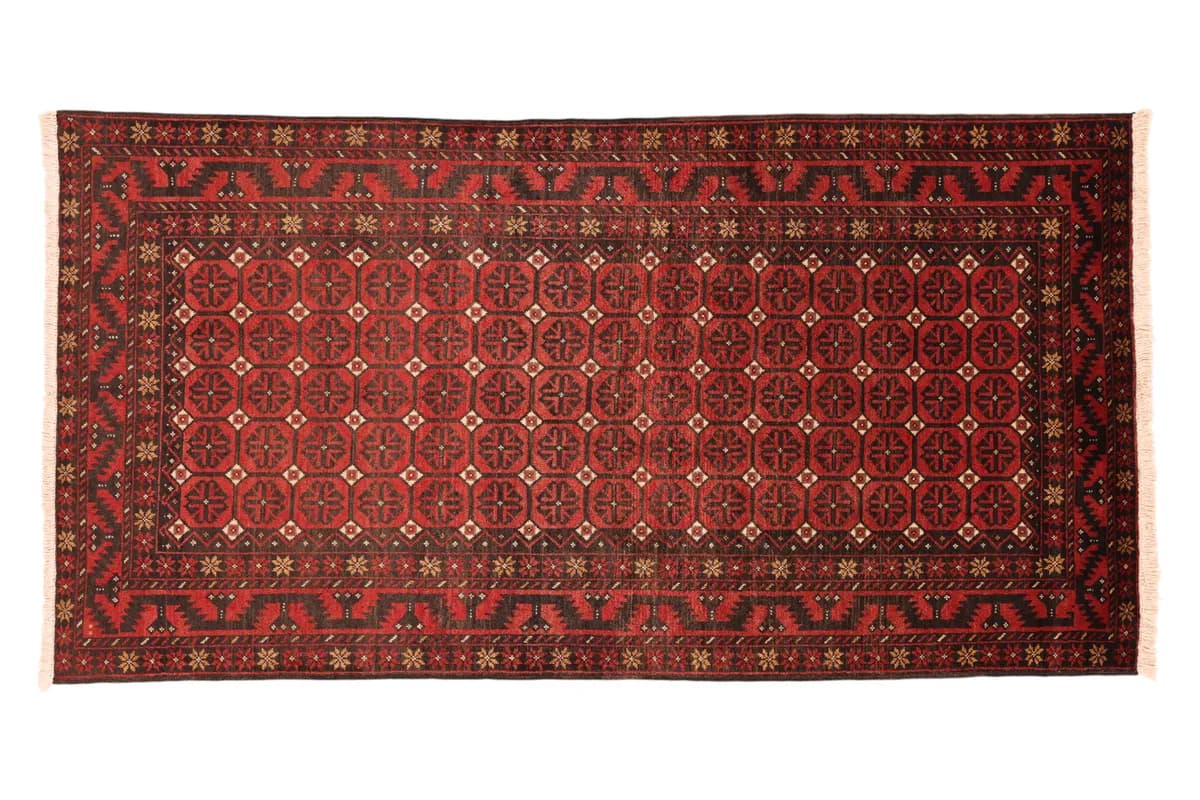
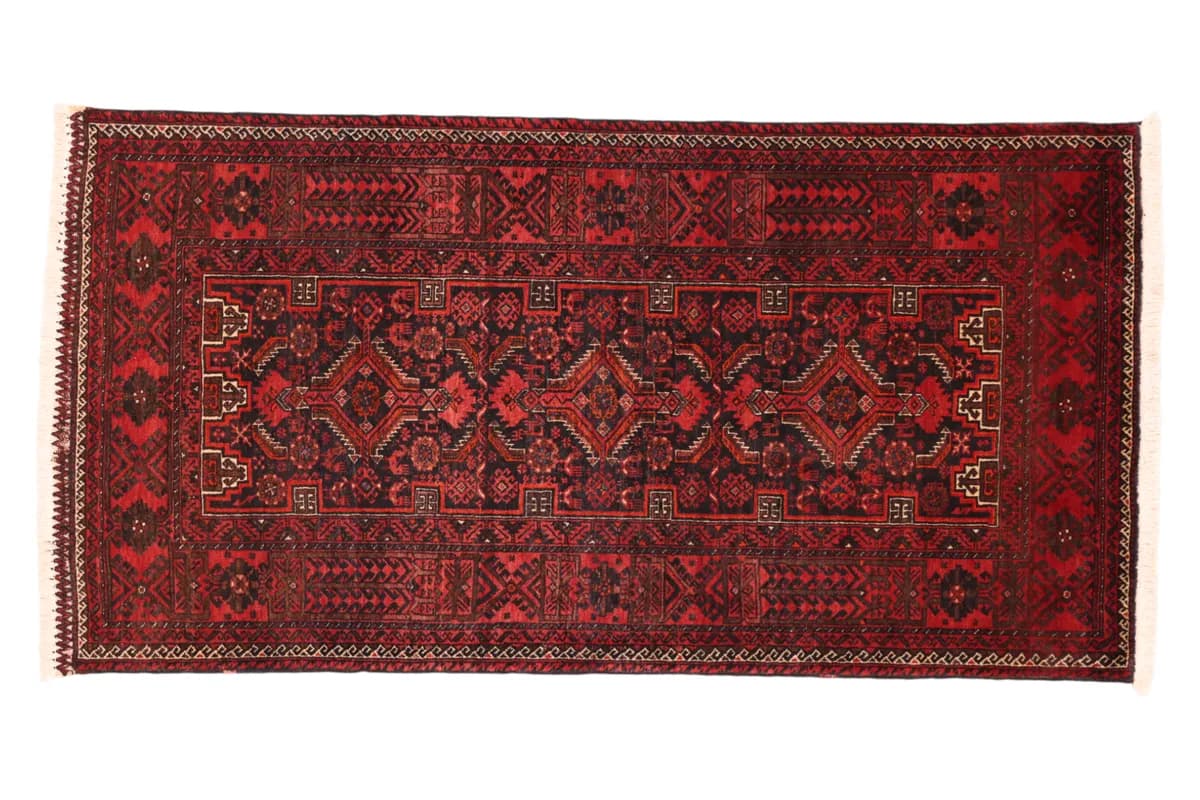
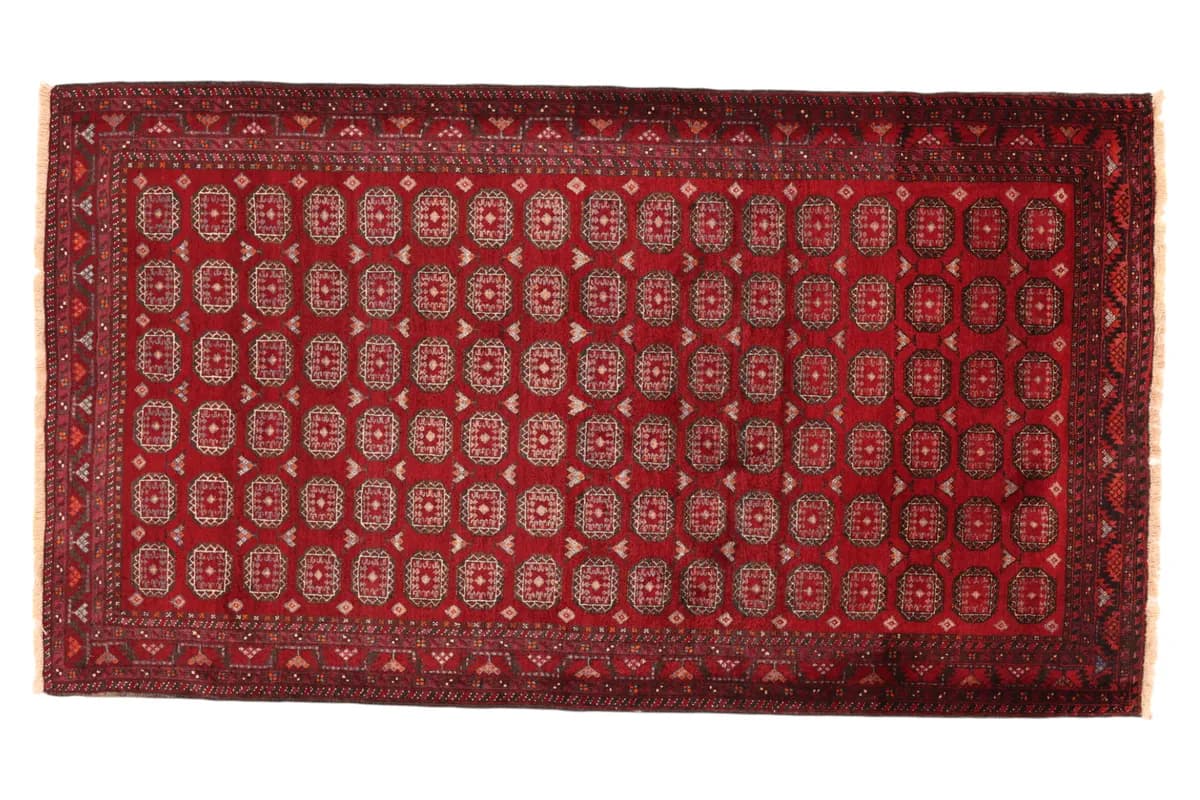
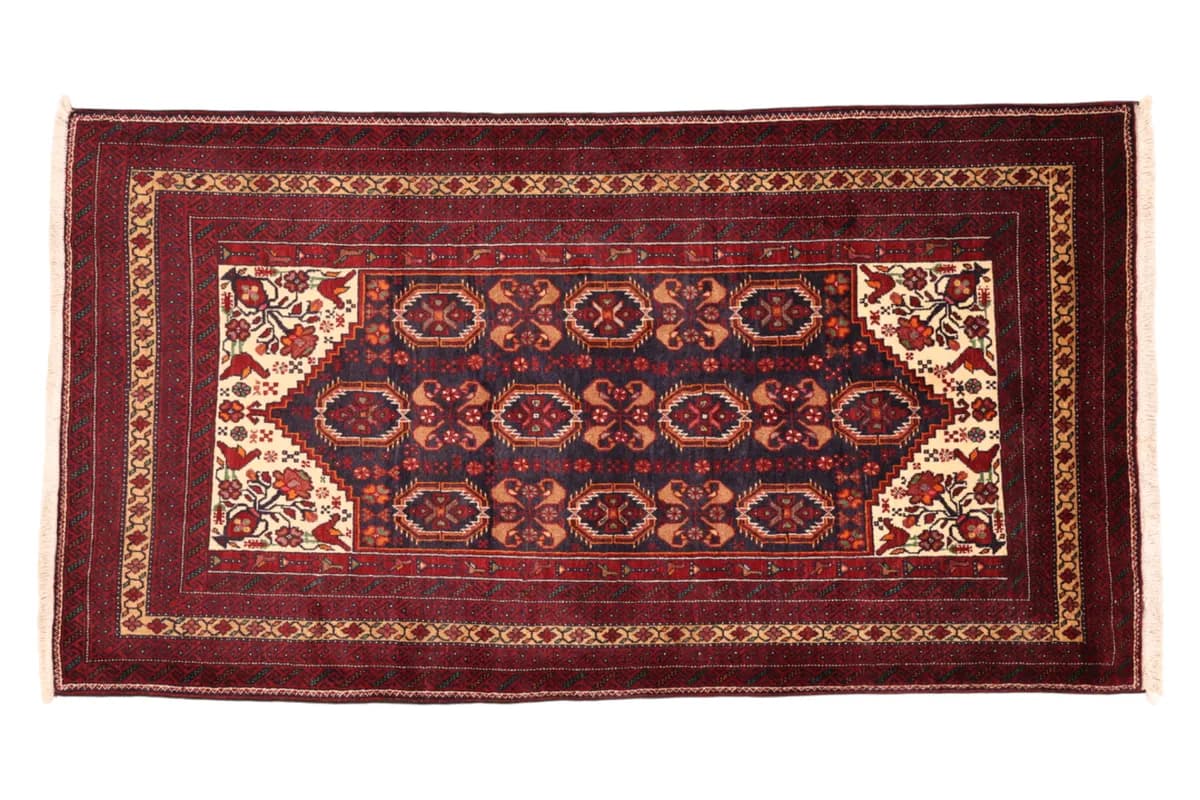
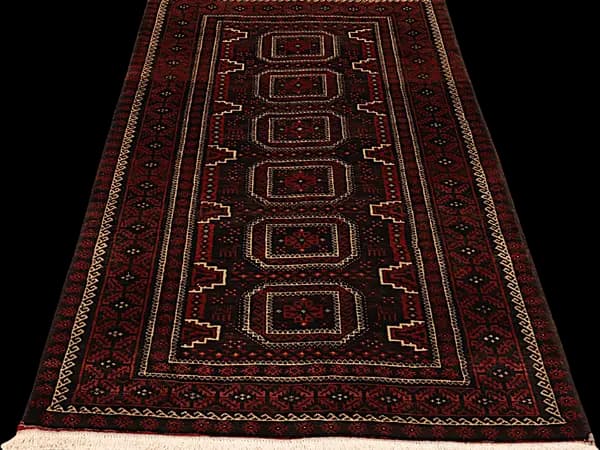
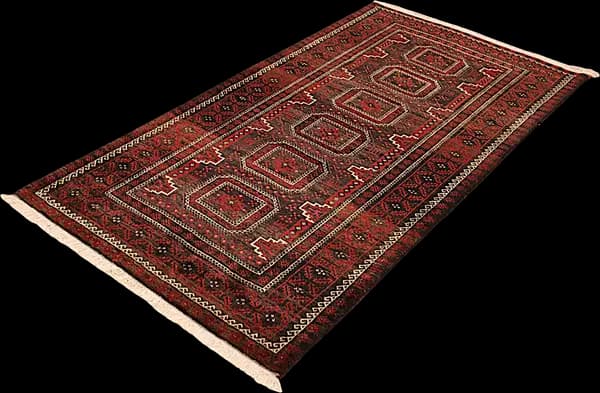
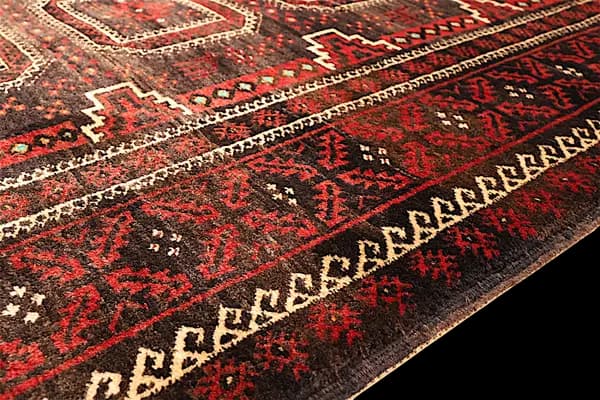
This is a Baluch rug, a tribal weaving from the border country of southeastern Iran, measuring 187 x 104 cm (6'2" x 3'5"). Baluch weavers are known for deep, earthy colour and for prayer-niche layouts carried across generations from memory rather than a drawn plan. What sets this piece apart from the usual single-medallion Baluch is that it carries not one medallion but six, set in an unbroken row.
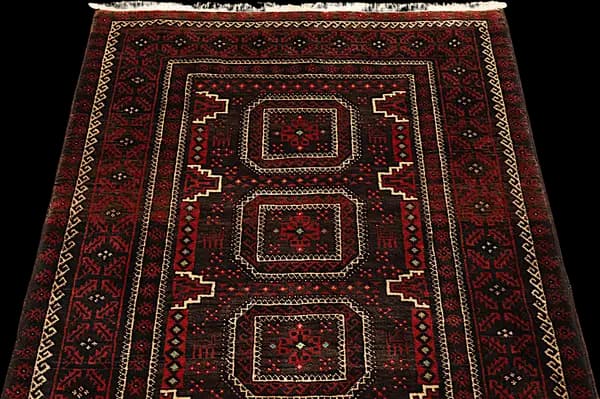
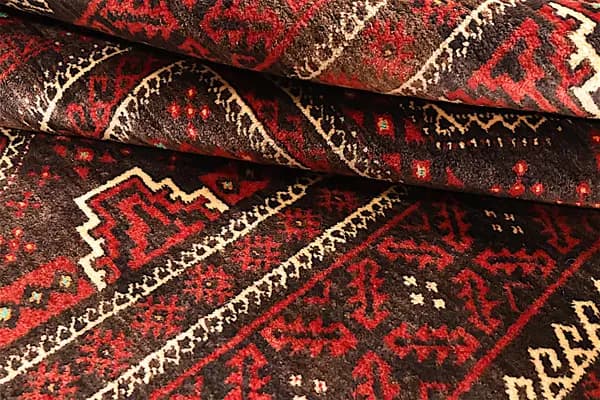
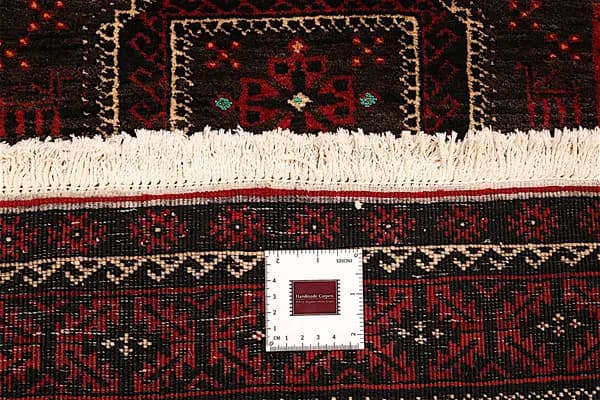
The ground is a deep, almost black brown, and against it the eye meets a steady procession of six octagonal medallions, each drawn to nearly the same shape and filled with the same inner marking, so that they read less as a centrepiece and more as a chain running the length of the field. Small points of turquoise sit at each medallion's heart, a quiet counter-note to the ivory diamond lattice that outlines them. A broad border in ziegel-to-blood red, patterned with the same fine cream lattice, closes the field on all sides and takes up close to a fifth of the rug's width, holding the dark centre firmly in place.
That rhythmic, band-like repetition is a Turkmen-Baluch habit, and it comes directly from the way the rug was made. Knotted by hand from memory rather than from a chart, at a density of 128,000 to 160,000 knots per square metre, the medallions repeat closely enough to read as a sequence but never so exactly as a machine would set them, and that quiet variation is the mark of a single weaver's hand rather than a fault in it. The pile is hand-spun wool over a cotton warp, kept to a short, even 6 mm, which is why the surface takes the light without shine and holds its geometry crisply rather than softening it. At twenty to forty years old, the wool has already settled into the rug rather than sitting on top of it.
A piece this size and this dark suits a hallway or a landing, somewhere the rug is met in passing rather than sat over, and the chain of medallions carries the eye along with it in exactly the way a corridor asks a pattern to. The near-black ground will not show the wear of a well-used passage, while the red border and ivory lattice keep the space from ever feeling closed in. Underfoot it is dense, short and firm, built for exactly this kind of daily crossing. Morning light along its length picks out the turquoise centres one after another, a small reward for anyone who slows down to look.
More on Baluch rugs: origin, making and how to recognise a genuine piece
Traditional weave
At 187 × 104 cm (1.94 m²) this is a small rug. It works beside a bed, in a reading corner, in front of a fireplace or as a mat by a door. It does not furnish a room; it makes a point in one.
Yes, knotted by hand — knot by knot on a loom, not machine-made. The density is 128,000 to 160,000 knots per square metre; across 1.94 m² that is roughly 250,000 to 310,000 individual knots, every one of them tied by hand.
Hand-spun wool still carries its own lanolin, which keeps liquid sitting on the surface for a moment: blot quickly, with clear water and a light cloth, working inwards and without rubbing. Otherwise regular vacuuming along the pile is enough. Turn the rug once or twice a year so light and footfall reach it evenly.
We are in the Hamburg Speicherstadt. Come and see this rug in daylight, or write to us — a person answers.
Certificate included verifying origin, materials, and craftsmanship.
Ref: 783233