Belutsch
190 × 99 cm
649 €






677 €
Incl. VAT
In Stock · Ready to Ship
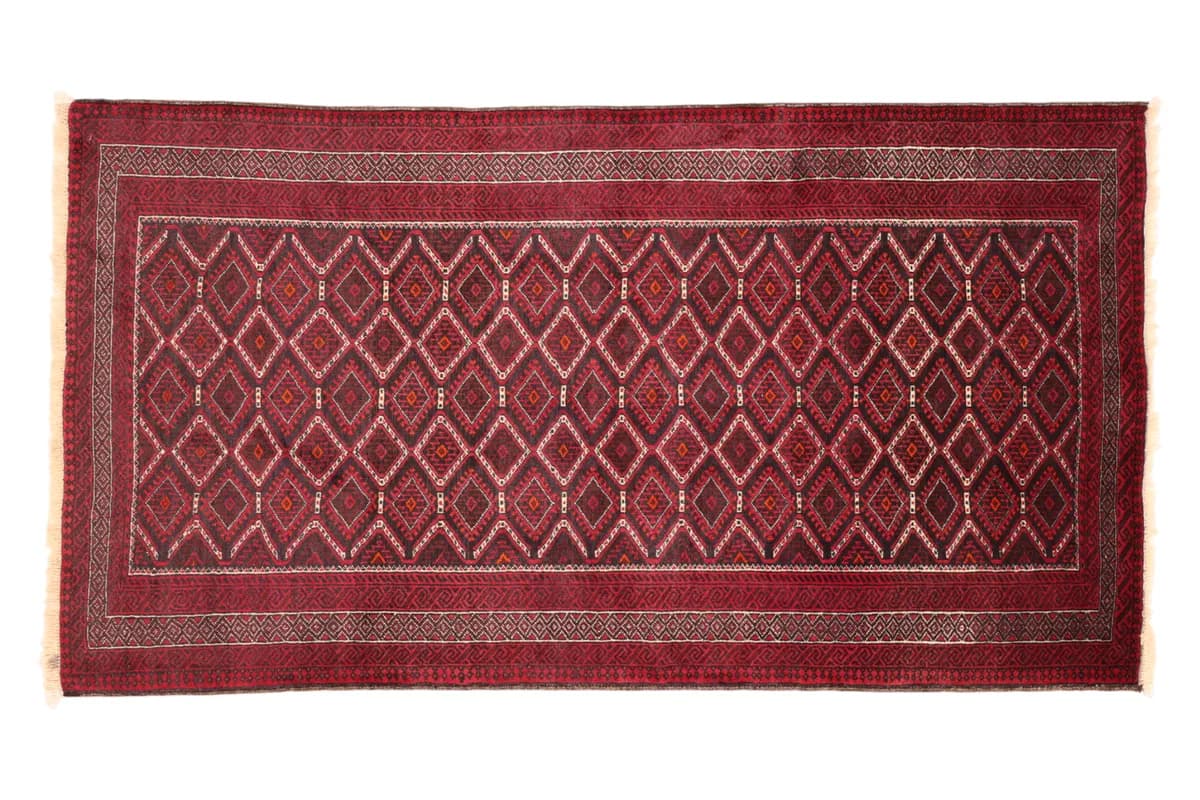
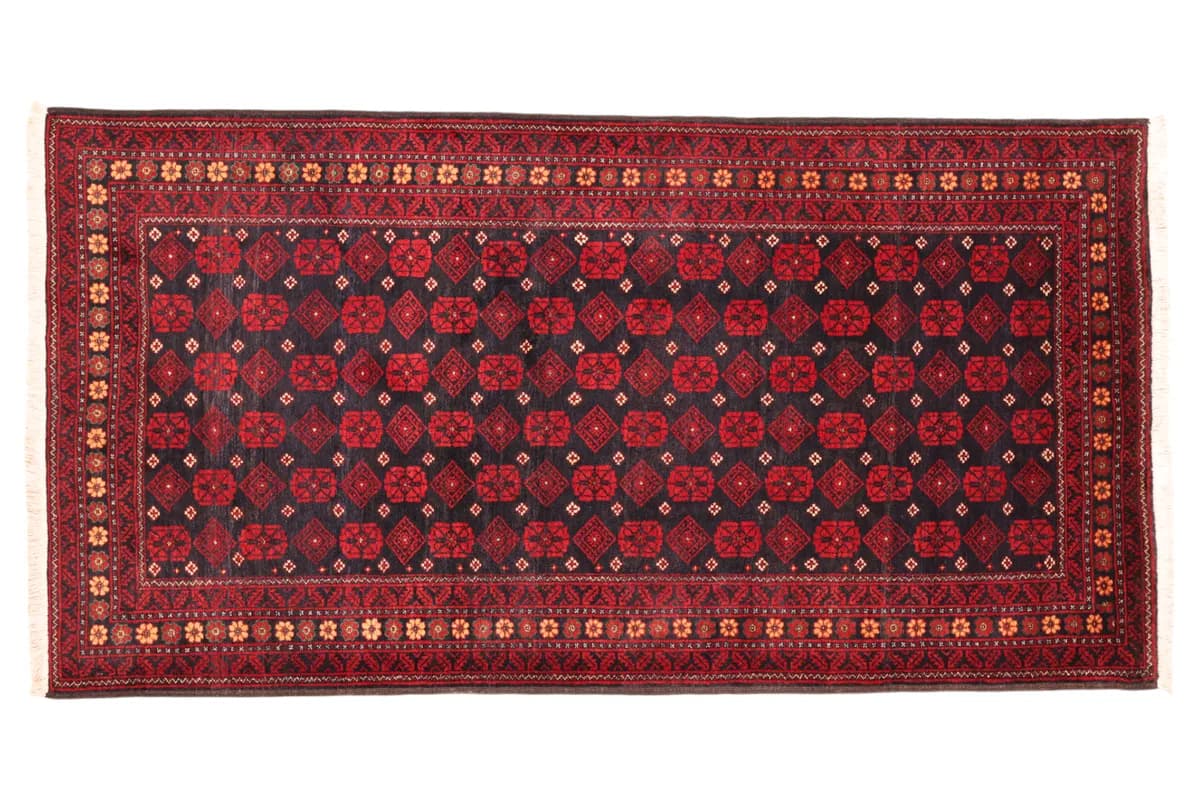
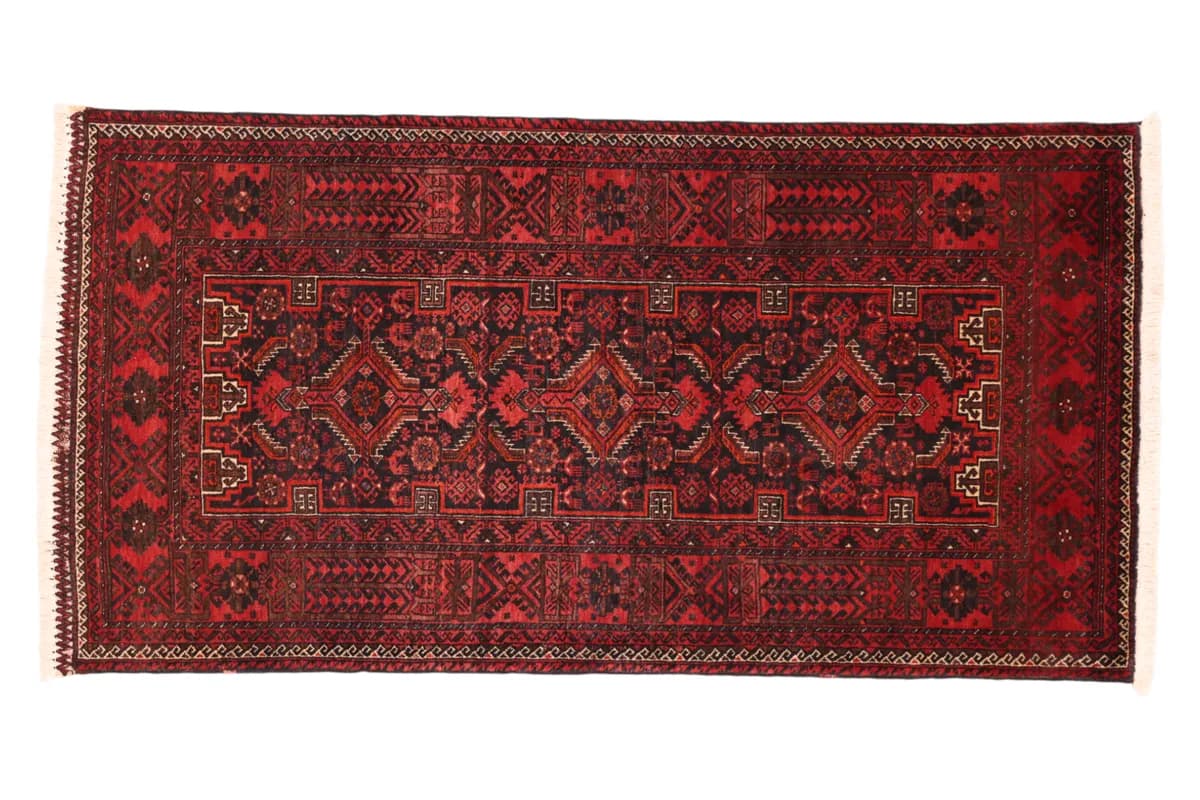
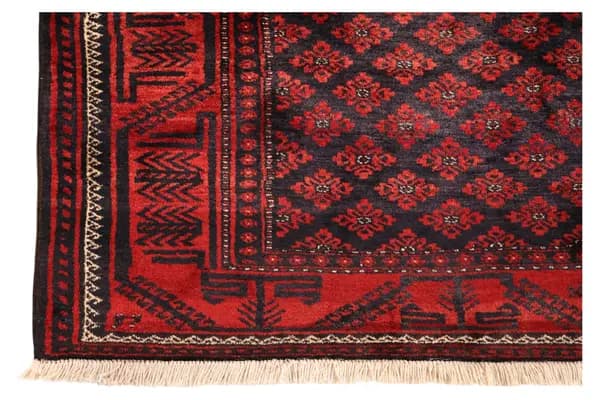
A Baluch, also written Belouch, comes from the tribal borderlands of southeastern Iran, where women knotted from memory rather than from a drawn plan, working deep reds and indigo into bold, angular geometry passed down through generations. This example measures 200 x 106 cm (6'7" x 3'6"), a size suited to a narrower space rather than a great open floor. Where the type is often loud and flatly repeated, this field does something quieter: it drifts.
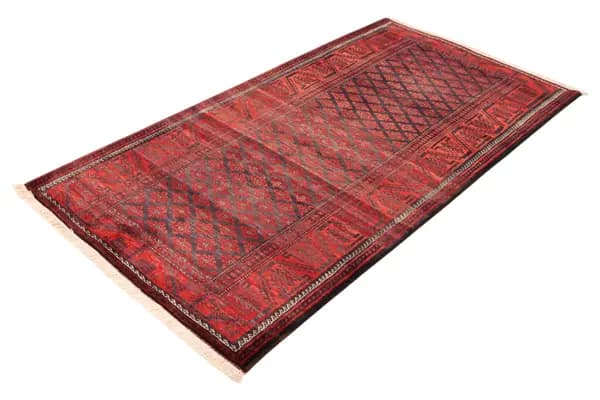
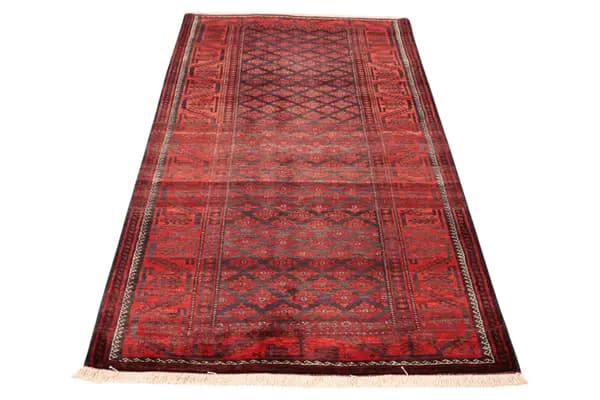
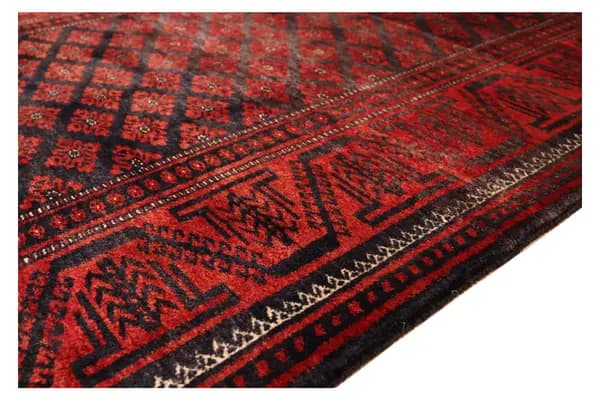
The ground is a deep brick red, overlaid with a dense lattice of dark navy-charcoal diamonds, each holding a small rosette in cream or pink. There is no medallion, no centre to rest the eye on — the pattern simply continues, diamond after diamond, edge to edge. What catches attention instead is the colour beneath it: on the left the lattice sits in a deep navy-red, and moving across the field it pales, by the right-hand end, into a washed, almost dusty rose. A broad border of stacked zigzag bands in red and charcoal frames the field, closed off by a thin ivory guard stripe.
That drift is not a flaw in the dyeing but a mark of how the rug was made. Knotted at 128,000 to 160,000 knots per square metre on a cotton warp, with a pile of hand-spun wool, it was worked over months on a portable loom, and hand-spun wool never dyes with perfect uniformity from batch to batch. A workshop piece would correct for this. A nomadic weaver did not need to.
At this width, the rug suits a hallway, a landing, or the floor beside a bed rather than a large seating group, and its reds hold their warmth even where daylight is thin. The pile is tight and firm underfoot, six millimetres deep, dense enough for a well-used corner of the house rather than one kept for best. Seen across its length, morning and evening light will catch the two ends differently, and that quiet shift is the thing you keep noticing.
More on Baluch rugs: origin, making and how to recognise a genuine piece
Traditional weave
At 200 × 106 cm (2.12 m²) this is a small rug. It works beside a bed, in a reading corner, in front of a fireplace or as a mat by a door. It does not furnish a room; it makes a point in one.
Yes, knotted by hand — knot by knot on a loom, not machine-made. The density is 128,000 to 160,000 knots per square metre; across 2.12 m² that is roughly 270,000 to 340,000 individual knots, every one of them tied by hand.
Hand-spun wool still carries its own lanolin, which keeps liquid sitting on the surface for a moment: blot quickly, with clear water and a light cloth, working inwards and without rubbing. Otherwise regular vacuuming along the pile is enough. Turn the rug once or twice a year so light and footfall reach it evenly.
We are in the Hamburg Speicherstadt. Come and see this rug in daylight, or write to us — a person answers.
Certificate included verifying origin, materials, and craftsmanship.
Ref: 801160