Hamadan
159 × 107 cm
930 €
2.475 €
Incl. VAT
In Stock · Ready to Ship
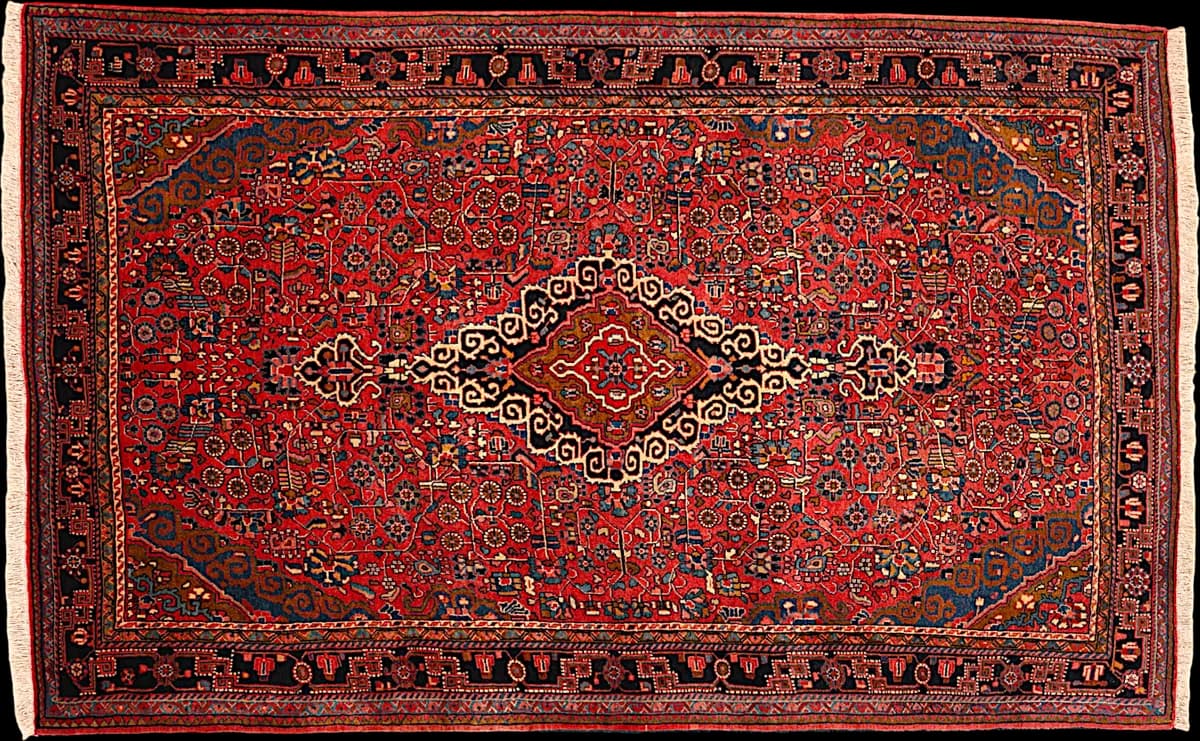
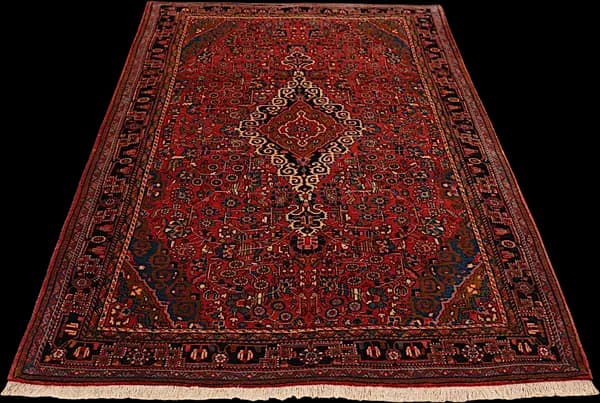
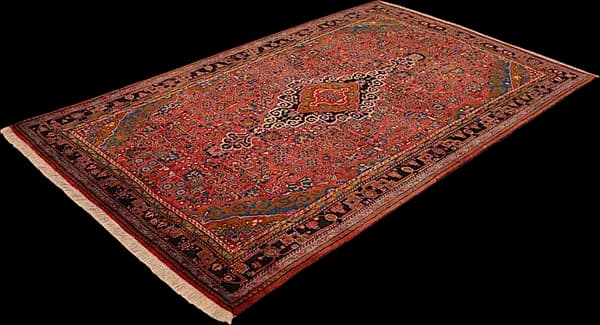
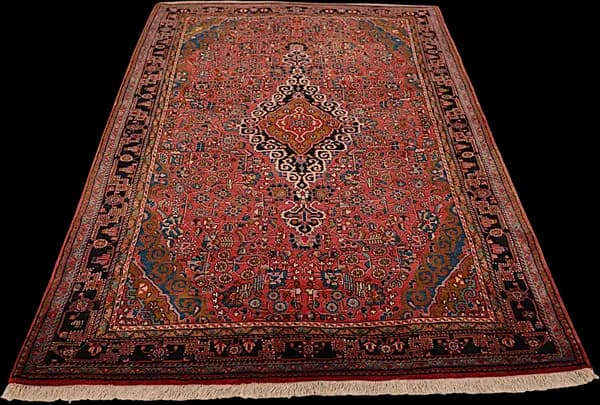
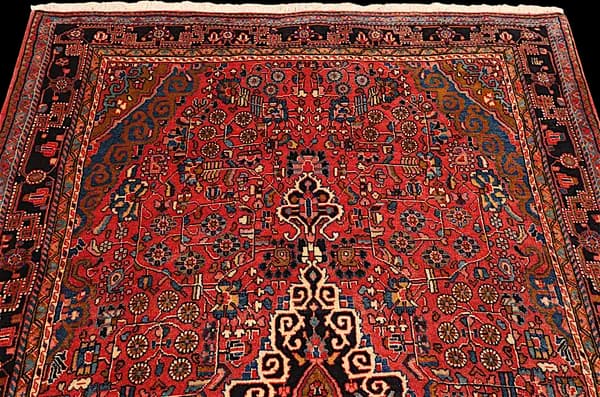
A Djozan rug, a village weaving from the Khorasan region of northeast Iran, 220 x 138 cm (7'3" x 4'6"). Djozan villages have long worked within the wider Khorasan tradition of large medallion compositions and warm colour, producing rugs with an honest, direct character rather than the refined precision of the big city workshops. This piece keeps that village warmth but pushes its colour further than the type usually allows, giving it real graphic force.
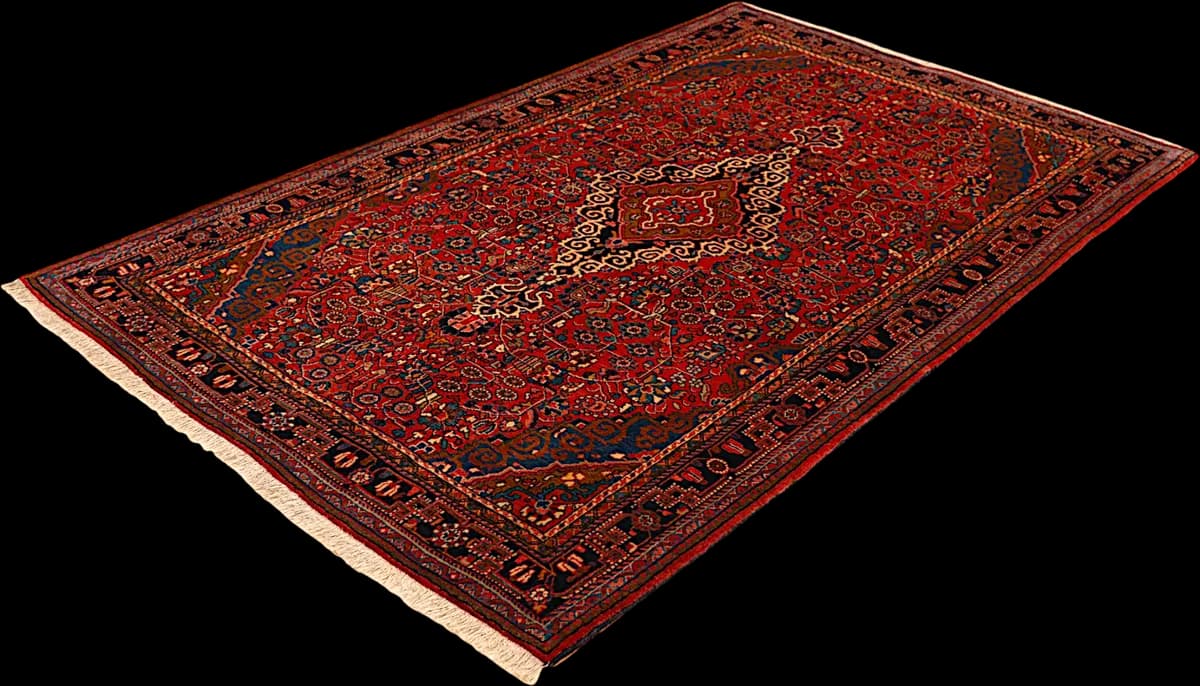
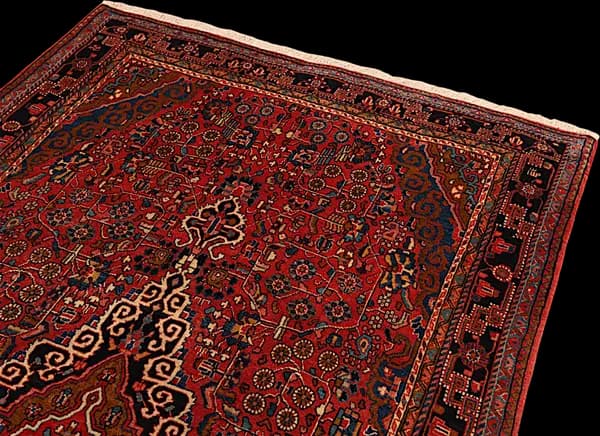
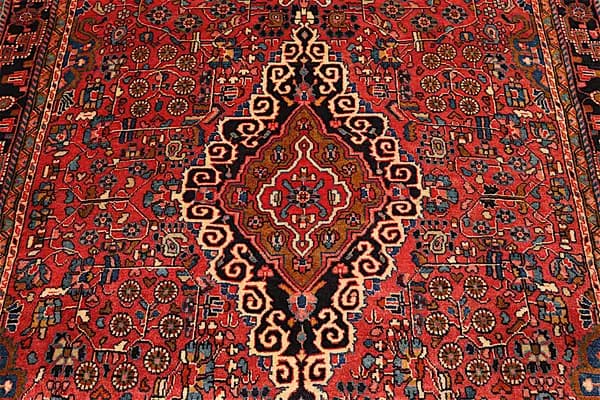
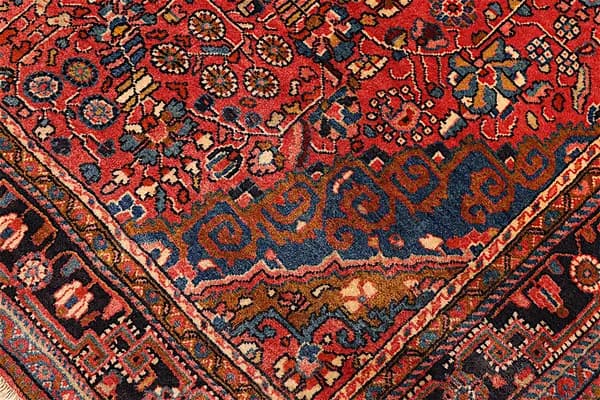
A bold, ivory-outlined medallion floats over a deep, saturated brick red, the field packed close with small rosettes and floral sprays in the Khorasan manner. The medallion is cusped, with pendants above and below, its cream outline drawn with an unusual crispness against a dark core, so it reads sharply even at a distance. Navy cloud-band shapes fill the corners, echoing the border, where camel-brown scrollwork and teal-green accents move through the florals. That border itself is wide and dark, near black in places, carrying cream cartouches and small boteh in a band that takes up close to a fifth of the rug's width and holds the whole design firmly in place.
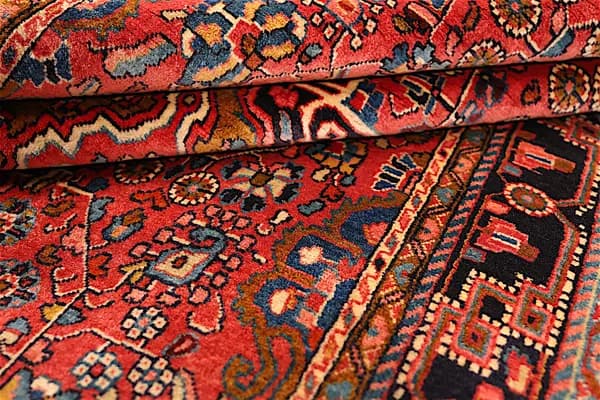
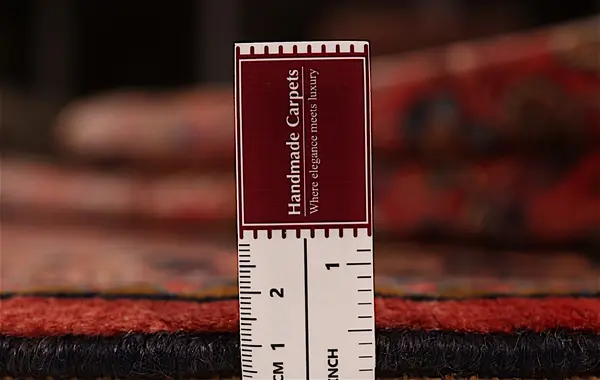
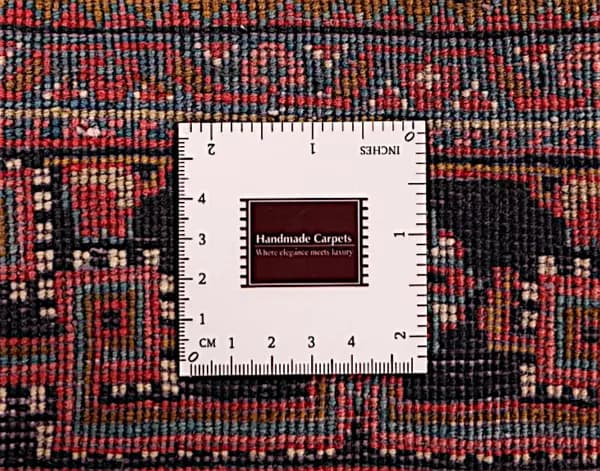
The pile is hand-spun wool on a cotton warp, knotted by hand at a density of 321,000 to 380,000 knots per square metre, respectable for a village production and enough to carry a medallion this detailed without losing its edges. Hand-spun yarn varies slightly in thickness from knot to knot, which is why the surface has a matte, faintly ribbed hand rather than an even sheen, and it is this same slight irregularity, worked at pace rather than to a fixed cartoon, that gives the medallion its confident, almost drawn-freehand sharpness. At 10 mm the pile has enough depth to sit well underfoot, and at twenty to forty years old it has already proved the durability Khorasan wool is known for.
At this size the rug suits a bedroom or a quiet study rather than a large open room, and its saturated red will warm a pale floor while holding its own against dark wood furniture. Underfoot it is dense and firm, a weave built for daily use rather than careful protection. In changing light the camel-brown scrollwork and teal accents catch and recede across the red, giving the room something quietly different to notice through the day.
Hamadan rugs come from the ancient city of Hamadan (the historic Ecbatana) and its surrounding region of over a thousand villages in western Iran. Woven with the symmetrical (Turkish) knot on a cotton foundation, they are distinguished by their single-weft construction, one weft thread between each row of knots, which creates a characteristic ribbed appearance on the reverse.
Geometric medallion-and-corner layouts, Herati patterns, and boteh (paisley) motifs dominate the design language, rendered in a classic palette of deep reds and blues from madder root and indigo. The sturdy highland wool ensures excellent durability for everyday use.
Superior craftsmanship
At 220 × 138 cm (3.04 m²) this is a medium rug. It works in front of a sofa, in front of a bed or in a study. It is too small for a dining table — there you want about 80 cm of clearance so a chair does not tip over the edge when pushed back.
Yes, knotted by hand — knot by knot on a loom, not machine-made. The density is 321,000 to 380,000 knots per square metre; across 3.04 m² that is roughly 1.0 to 1.2 million individual knots, every one of them tied by hand.
Hand-spun wool still carries its own lanolin, which keeps liquid sitting on the surface for a moment: blot quickly, with clear water and a light cloth, working inwards and without rubbing. Otherwise regular vacuuming along the pile is enough. Turn the rug once or twice a year so light and footfall reach it evenly.
We are in the Hamburg Speicherstadt. Come and see this rug in daylight, or write to us — a person answers.
Certificate included verifying origin, materials, and craftsmanship.
Ref: 826835