Senneh
147 × 120 cm
1.035 €







969 €
Incl. VAT
In Stock · Ready to Ship
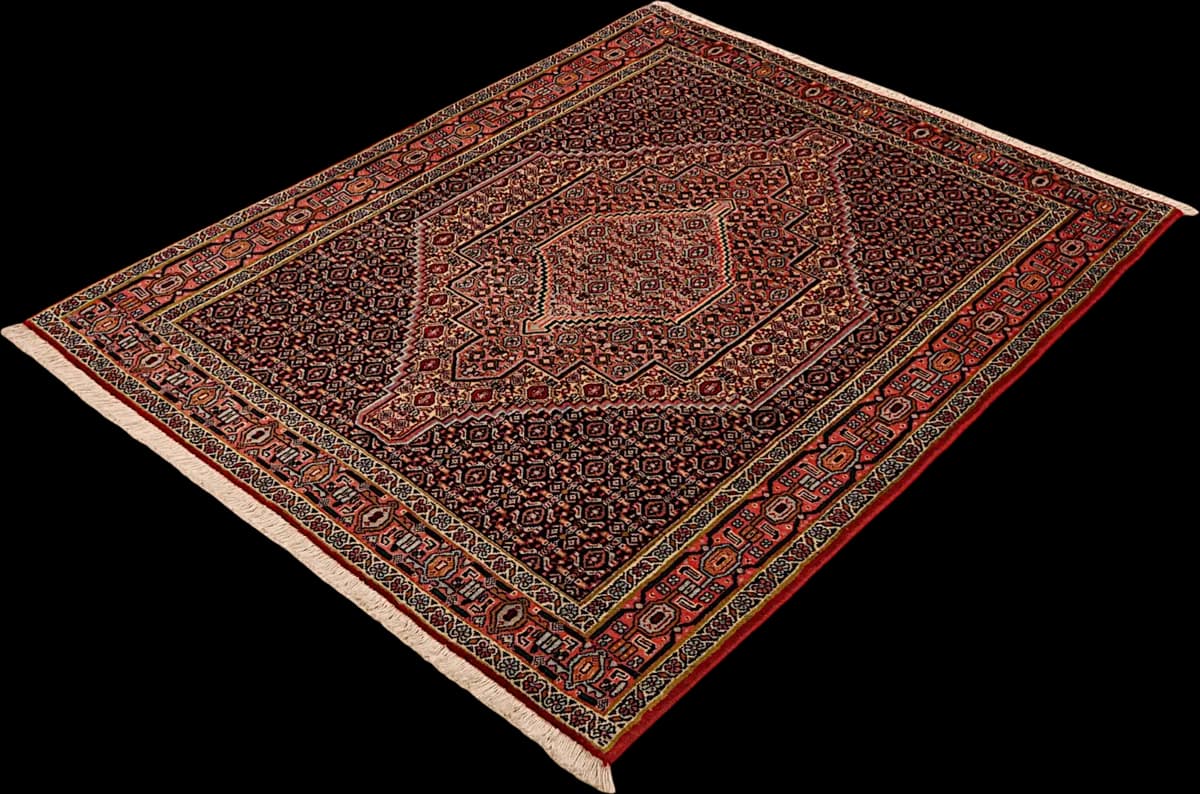
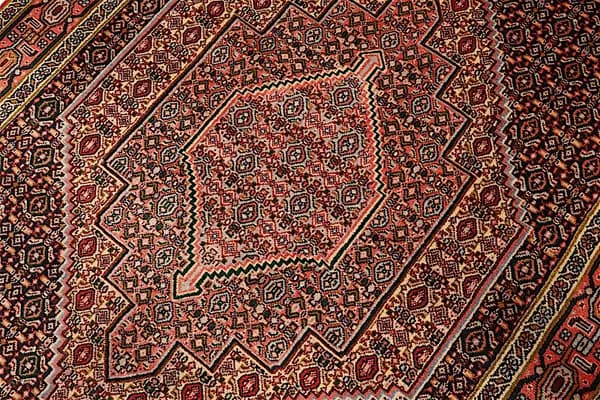
This is a Senneh, also written Senna, a hand-knotted rug from Sanandaj in Kurdish western Iran, 152 x 120 cm (5'0" x 3'11"). Senneh is named first whenever the finest drawing in Persian weaving is discussed, its rugs prized for a precision so exact the pattern can look almost painted rather than knotted.
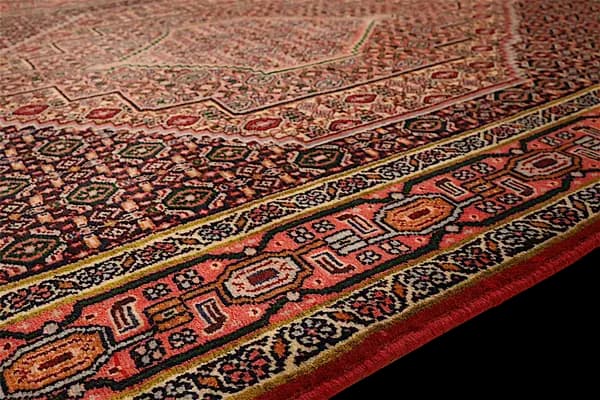
The field is a deep, near-black navy, covered edge to edge with a fine Mahi lattice — the Herati pattern of small leaves and rosettes repeated in miniature. Floating at its centre is a medallion in salmon-pink, the outline stepped and angular rather than curved, a hard shape set against all that soft repetition. A wide salmon-pink border carries its own small geometric medallions, framed by narrow guard stripes in ivory and navy.
That precision is a matter of construction. The warp is cotton, spun fine and tight, which lets the weaver turn a much sharper corner than wool alone would allow — it is why the medallion holds its stepped, angular edge instead of softening into a curve. The pile itself is hand-spun wool with a faint sheen, knotted at 201,000 to 250,000 knots per square metre, a density that took months at the loom, and left a surface fine enough to carry that lattice in full detail.
This is a rug for a smaller room — a study, a reading corner, or beside a bed. Against pale boards the navy grounds the room; against dark furniture it holds its own. The weave is tight and firm underfoot, made for daily use. Watch it in evening light and the stepped medallion catches first, the sage and pale blue in the lattice showing only then.
More on Senneh rugs: origin, making and how to recognise a genuine piece
Fine quality weave
At 152 × 120 cm (1.82 m²) this is a small rug. It works beside a bed, in a reading corner, in front of a fireplace or as a mat by a door. It does not furnish a room; it makes a point in one.
Yes, knotted by hand — knot by knot on a loom, not machine-made. The density is 201,000 to 250,000 knots per square metre; across 1.82 m² that is roughly 370,000 to 460,000 individual knots, every one of them tied by hand.
Hand-spun wool still carries its own lanolin, which keeps liquid sitting on the surface for a moment: blot quickly, with clear water and a light cloth, working inwards and without rubbing. Otherwise regular vacuuming along the pile is enough. Turn the rug once or twice a year so light and footfall reach it evenly.
We are in the Hamburg Speicherstadt. Come and see this rug in daylight, or write to us — a person answers.
Certificate included verifying origin, materials, and craftsmanship.
Ref: 974469