Senneh
145 × 120 cm
975 €





900 €
Incl. VAT
In Stock · Ready to Ship
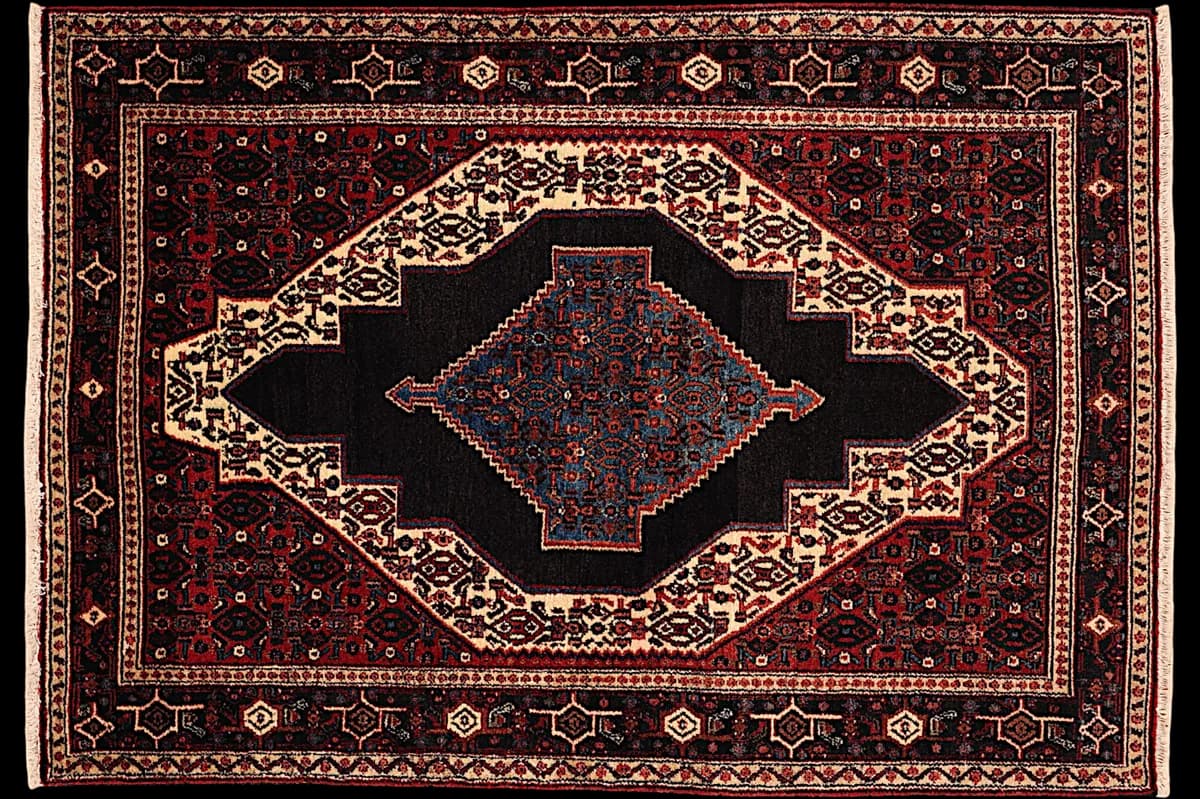
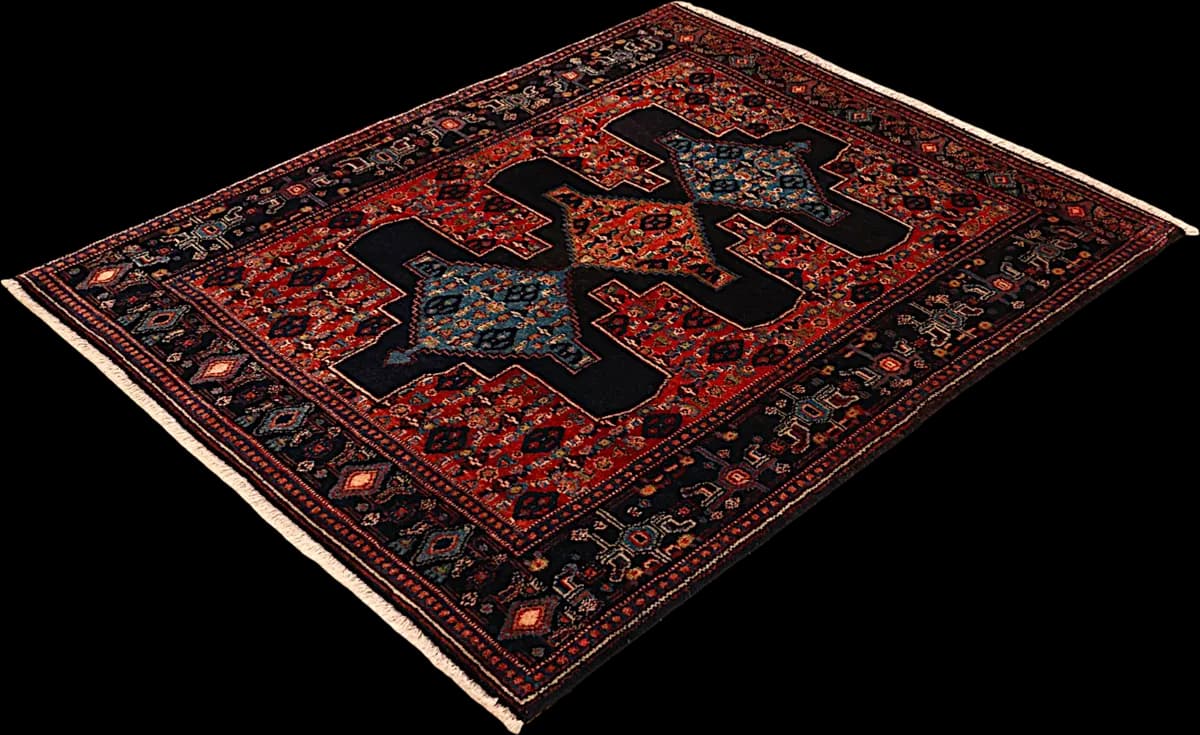
This is a hand-knotted Senneh rug, 153 x 121 cm (5'0" x 3'11"), from Sanandaj in Kurdish western Iran — the town once called Senneh, also spelled Senna, that gave its name to some of Persia's most admired weaving. Senneh is known above all for precision, for patterns drawn with a fineness so exact that the finest pieces read as painted rather than woven.
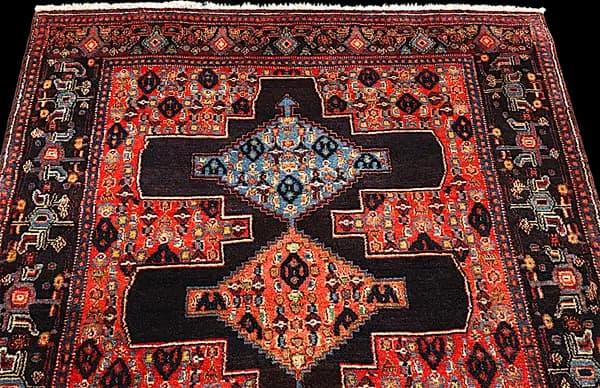
A deep brick red fills the field, and across it march three stepped, hook-edged medallions in the old Seh Torandj arrangement. Each sits against a near-black ground, yet none repeats: the outer two glow ice-blue at the centre, the middle one warms to coral, cream outlining holding each in place. Around them the red is worked densely with small motifs in mustard, sage and dusty pink. A wide navy-black border, filled with angular pendant hooks, closes the design firmly at the edge.
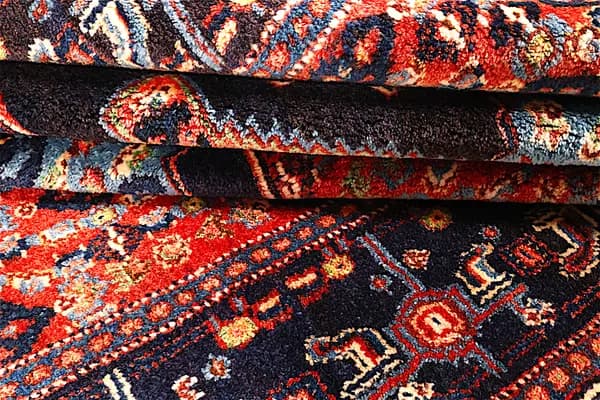
The wool is hand-spun and knotted by hand onto a cotton warp, using the asymmetric knot the trade still calls the Senneh knot, after this town. Hand-spun yarn is never perfectly even, and that slight irregularity gives the medallions their bold, hooked edges rather than the miniature, near-painted precision the town is more famous for. Setting three different centre colours instead of repeating one was a choice made fresh at each medallion — a small decision that gives the whole field its graphic rhythm.
At this size the rug suits a study, a hallway, or a corner beside a favourite chair. The brick red holds its warmth against pale floors and stands its ground beside dark wood. Underfoot it is dense and slightly nubbly, built for daily footsteps rather than display. Through the day the ice-blue and coral centres shift against the red, a small pleasure that never quite settles.
More on Senneh rugs: origin, making and how to recognise a genuine piece
At 153 × 121 cm (1.85 m²) this is a small rug. It works beside a bed, in a reading corner, in front of a fireplace or as a mat by a door. It does not furnish a room; it makes a point in one.
Yes, knotted by hand — knot by knot on a loom, not machine-made.
Hand-spun wool still carries its own lanolin, which keeps liquid sitting on the surface for a moment: blot quickly, with clear water and a light cloth, working inwards and without rubbing. Otherwise regular vacuuming along the pile is enough. Turn the rug once or twice a year so light and footfall reach it evenly.
We are in the Hamburg Speicherstadt. Come and see this rug in daylight, or write to us — a person answers.
Certificate included verifying origin, materials, and craftsmanship.
Ref: 246865