Senneh
150 × 118 cm
945 €





1.095 €
Incl. VAT
In Stock · Ready to Ship
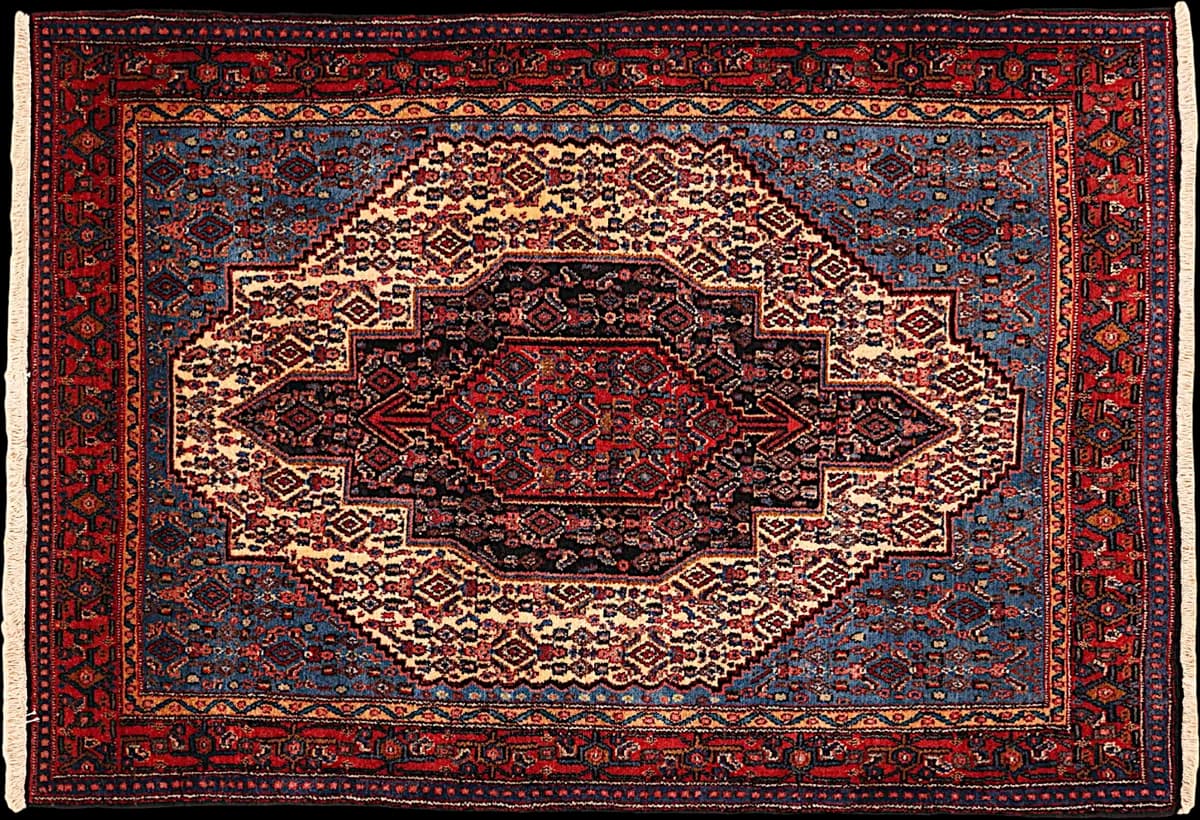
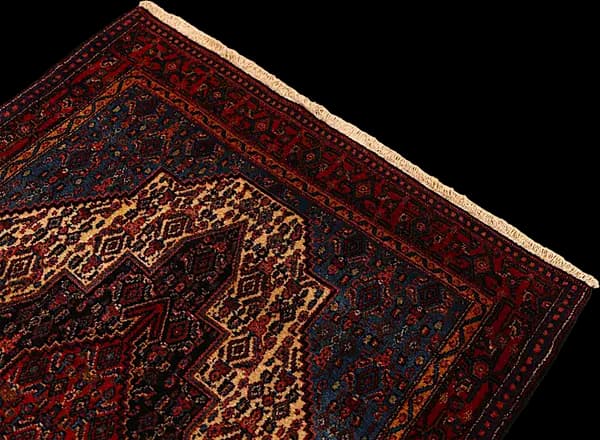
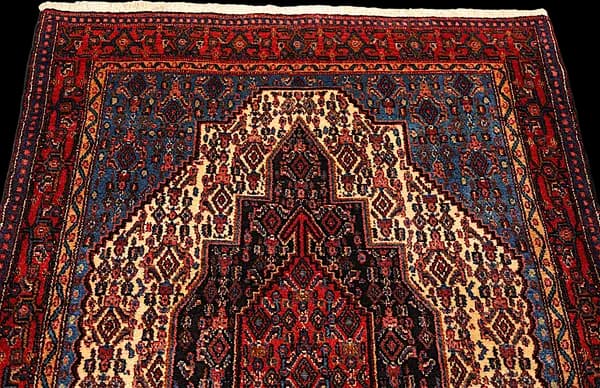
A Senneh rug, hand-knotted, 176 x 123 cm (5'9" x 4'0"), from Sanandaj in Kurdish Iran, the town once called Senneh that gave its name to the most admired flatweaves in Persia. The reputation was built on drawing rather than size: an accuracy of pattern so fine it is often described as painted rather than woven. This knotted piece carries that same precision, though the design it serves is bolder than the miniature florals Senneh is usually known for.
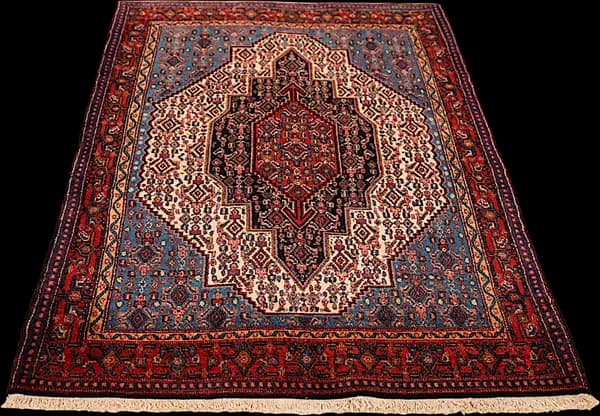
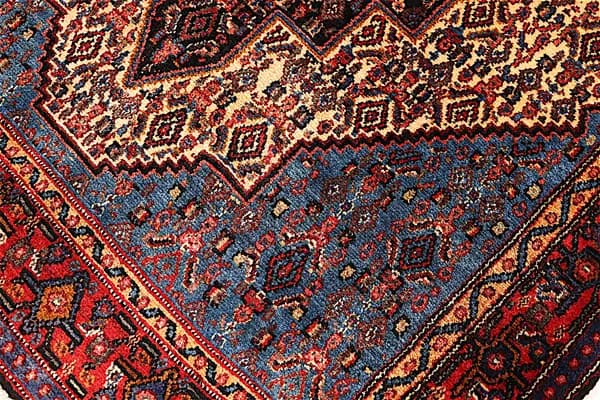
The first impression is a cream stepped medallion with a dark, almost brooding core, set against a field of steel blue. Look closer and the core is not one colour but two, near-black at its centre giving way to deep red, so the medallion reads with real depth rather than sitting flat on the field. Cream spandrels fill the corners, echoing the medallion's tone, and the whole is held by a wide brick-red border carrying a small repeating geometric guard pattern, roughly a fifth of the rug's width and firmly contrasting with the blue.
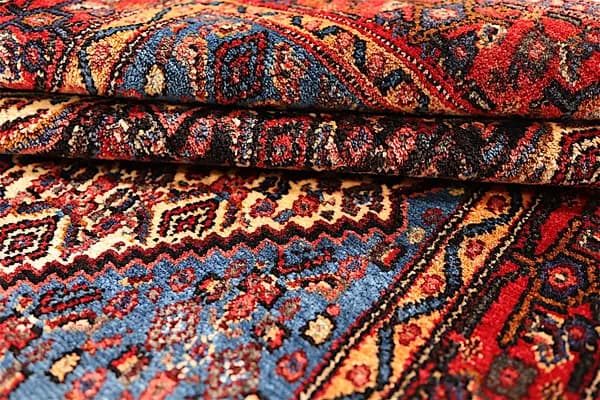
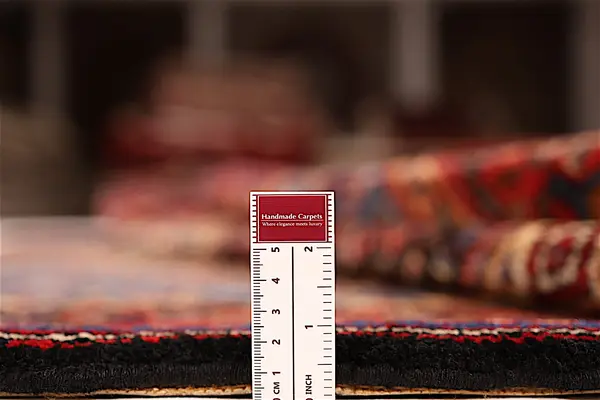
Senneh's fineness is usually spent on covering a field with tiny repeating motifs. Here the same precision has been used instead to draw one large, stepped, nested form cleanly, with edges sharp enough that the shift from black to red inside the medallion reads as intentional shading rather than blur. A knot density of 201,000 to 250,000 per square metre is what allows that; on a cotton warp with hand-spun wool pile, closely clipped, each step of the medallion holds a crisp line rather than a soft one. At twenty to forty years old, the wool has settled into a slightly flattened, matt surface with no sheen gathered in any one place, evenly worn rather than favoured on one side.
At this size the rug suits a bedroom or a quiet reading corner rather than a large open floor, and it works equally well set in a hallway where it is seen close rather than from across a room. The steel blue holds its own against dark furniture and warms considerably next to pale wood, while the red border keeps the whole piece grounded underfoot. The pile is dense and firm rather than plush, hand-spun wool that takes daily use comfortably without needing to be protected from it. Morning light picks out the shift from black to red at the medallion's centre before anything else in the room.
More on Senneh rugs: origin, making and how to recognise a genuine piece
Fine quality weave
At 176 × 123 cm (2.16 m²) this is a small rug. It works beside a bed, in a reading corner, in front of a fireplace or as a mat by a door. It does not furnish a room; it makes a point in one.
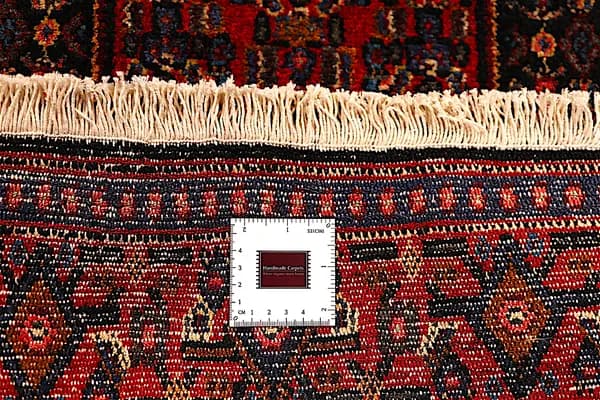
Yes, knotted by hand — knot by knot on a loom, not machine-made. The density is 201,000 to 250,000 knots per square metre; across 2.16 m² that is roughly 440,000 to 540,000 individual knots, every one of them tied by hand.
Hand-spun wool still carries its own lanolin, which keeps liquid sitting on the surface for a moment: blot quickly, with clear water and a light cloth, working inwards and without rubbing. Otherwise regular vacuuming along the pile is enough. Turn the rug once or twice a year so light and footfall reach it evenly.
We are in the Hamburg Speicherstadt. Come and see this rug in daylight, or write to us — a person answers.
Certificate included verifying origin, materials, and craftsmanship.
Ref: 927465