A town between two traditions
North of Malayer lies Hamadan, one of the oldest and most productive village weaving landscapes in Persia — robust, geometric, single-weft. South lie Sarough and Farahan, known for fine floral drawing on a cotton warp.
Malayer sits between them, and it shows in the rugs. You find floral motifs set with the angularity of village work, and geometric frames filled with floral elements. No rug of the town belongs unambiguously to either camp.
For a buyer that is a category of its own rather than a compromise. Anyone who wants the warmth of village work without giving up drawing will find exactly that mixture here — and with around 360,000 knots, a density remarkable for the region.
How to recognise a Malayer
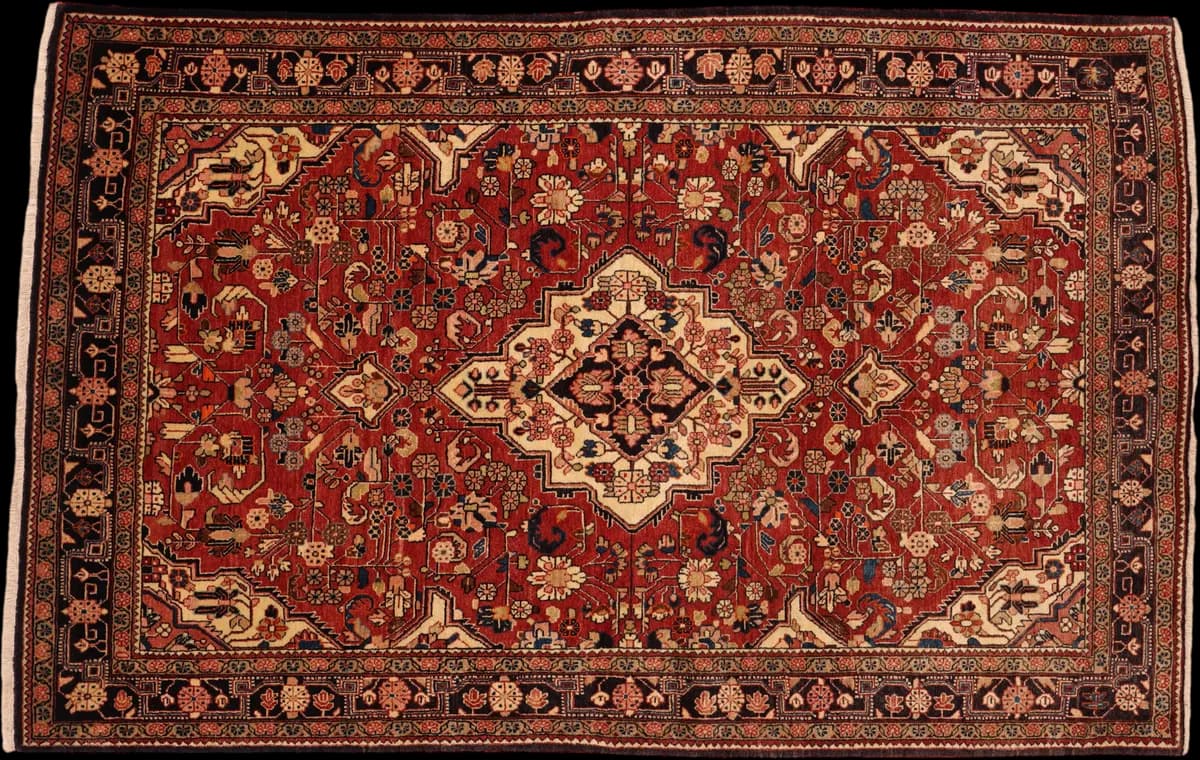
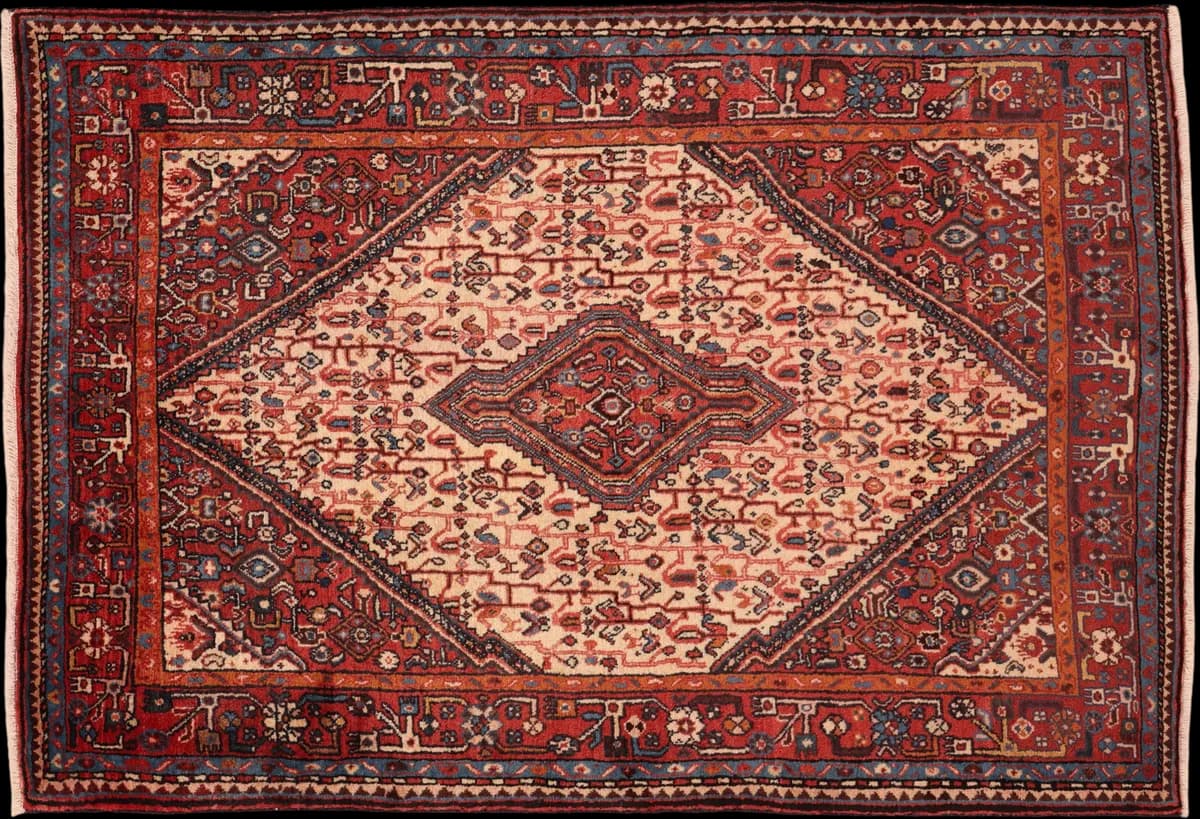
By the contradiction in the drawing. A flower motif whose edges are stepped rather than rounded. A medallion with a floral interior and an angular outline. Where two design languages stand in one field, you are looking at a Malayer.
By the density. Around 360,000 knots per square metre sits well above the neighbouring Hamadan villages at 250,000 and allows the finer motifs the southern neighbourhood contributed.
By the warp. Cotton, as throughout the region, with light smooth fringes — village and town work rather than a nomadic weaving.
- Two design languages in one field — floral in conception, angular in execution.
- Around 360,000 knots — high for the Hamadan region.
- Cotton warp with light, smooth fringes.
- Medallion composition predominates.
- Medium formats for a place rather than a whole room.
Which room a Malayer suits
The medium formats work in front of a sofa, in front of a bed, or in a study.
The hybrid character makes it versatile: strong enough for a room with character, drawn enough for a more formal one.
For a dining table the typical size is usually not enough — there you need around 80 centimetres of clearance beyond the table edge.
Care
Vacuum along the pile, without a rotating brush.
Blot spills at once with clear water and a light cloth, working from the outside in, without rubbing.
Turn it once or twice a year so light and footfall reach it evenly.
Malayer or Sarough?
Malayer lies north of Sarough and takes over its floral drawing without giving up the angularity of the Hamadan neighbourhood.
| Criterion | Malayer | Sarough |
|---|---|---|
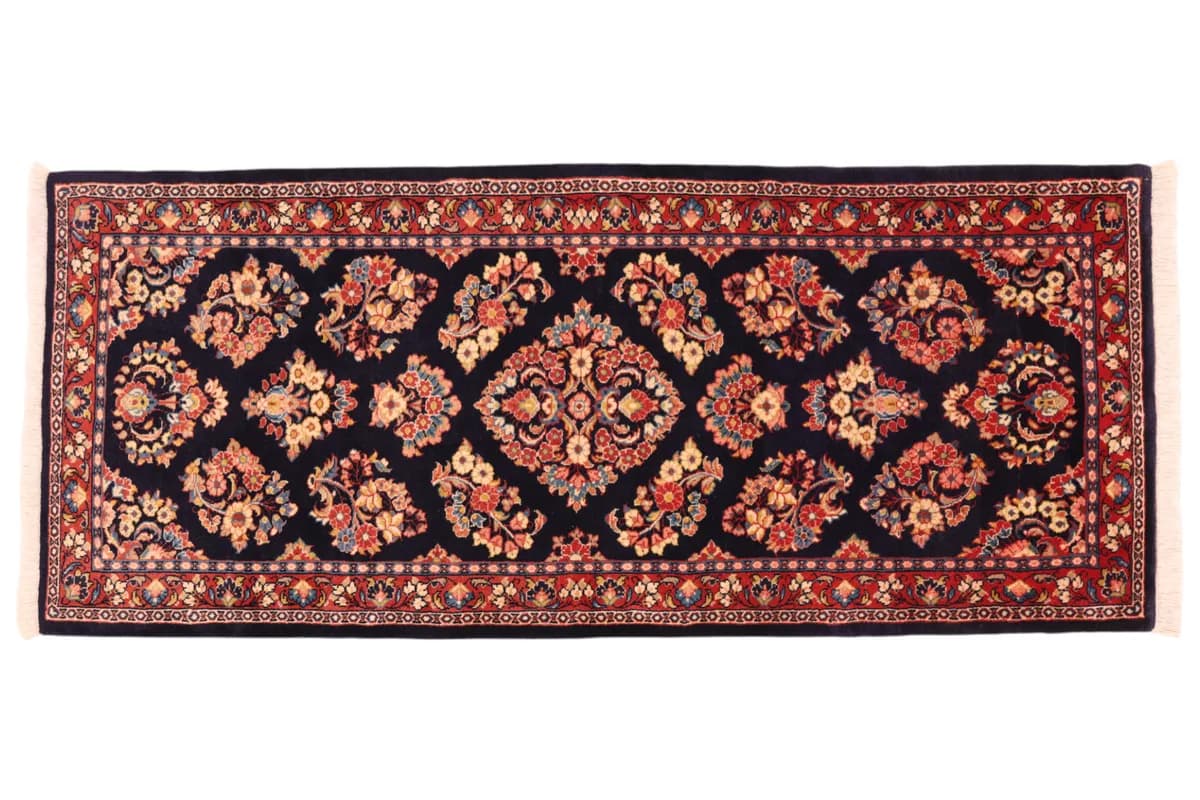
| Drawing | floral, but angularly set | floral and rounded |
| Knot density | around 360,000 / m² | typically 201,000–250,000 / m² |
| Layout | predominantly medallion | predominantly all-over |
| Character | a mixture of two traditions | unambiguously floral |
| Typical size | medium | medium to large |
Common questions
Does Malayer belong to Hamadan or to Sarough?
To both and to neither alone. The town lies between the geometric Hamadan tradition and the floral aesthetic of Sarough and Farahan, and its rugs carry marks of both sides. That is the town’s own hand rather than a compromise.
How do I recognise the hybrid character?
By motifs that are floral in conception and angular in execution: a flower ornament with stepped rather than rounded edges, a medallion with a floral interior and an angular outline. Where two design languages stand in one field, you are looking at a Malayer.
Is a Malayer finer than a Hamadan village rug?
As a rule yes. Around 360,000 knots per square metre sits well above the neighbouring villages at about 250,000, and that density is exactly what allows the finer motifs from the southern neighbourhood.
What room size does it suit?
The typical formats are medium and work in front of a sofa, in front of a bed, or in a study. For a dining table with around 80 centimetres of clearance it is usually not enough.
Is a Malayer a nomadic rug?
No. The warp is cotton, recognisable by light, smooth fringes — the mark of town and village work. A genuine nomadic weaving on a portable loom needs a wool warp.