Belutsch
89 × 65 cm
364 €




438 €
Incl. VAT
In Stock · Ready to Ship
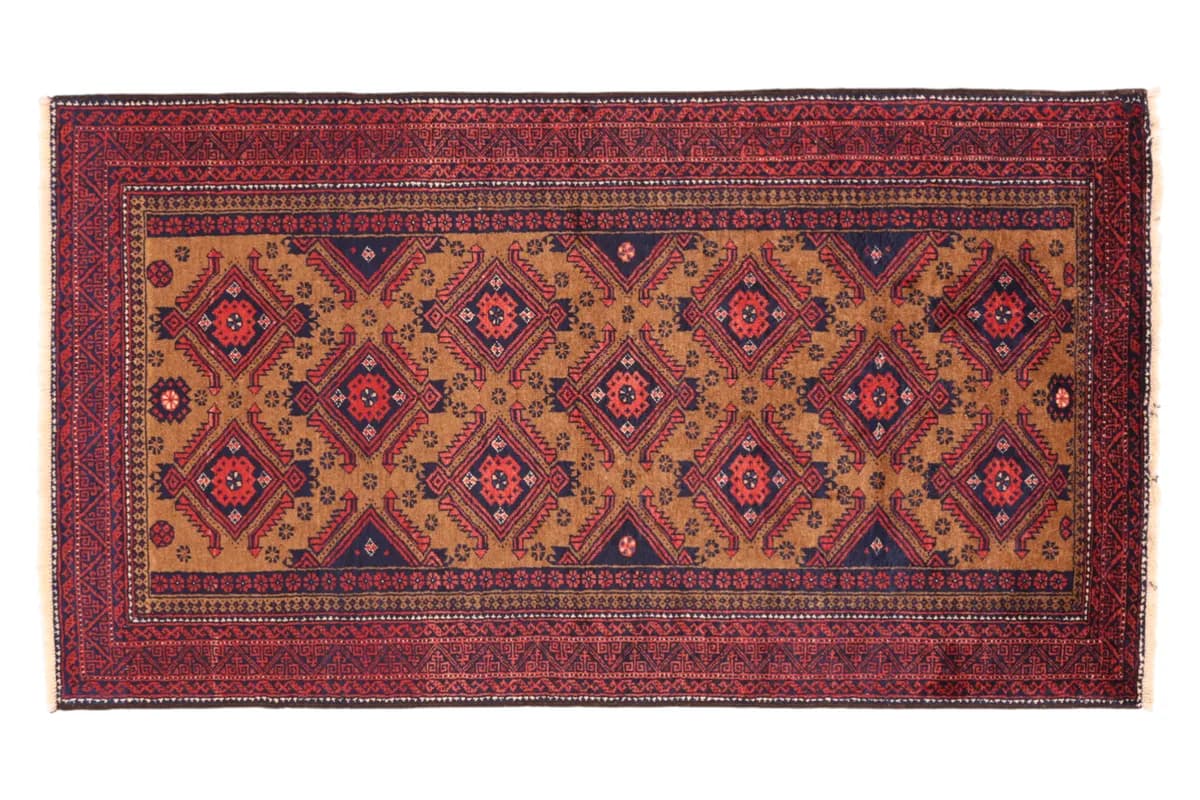
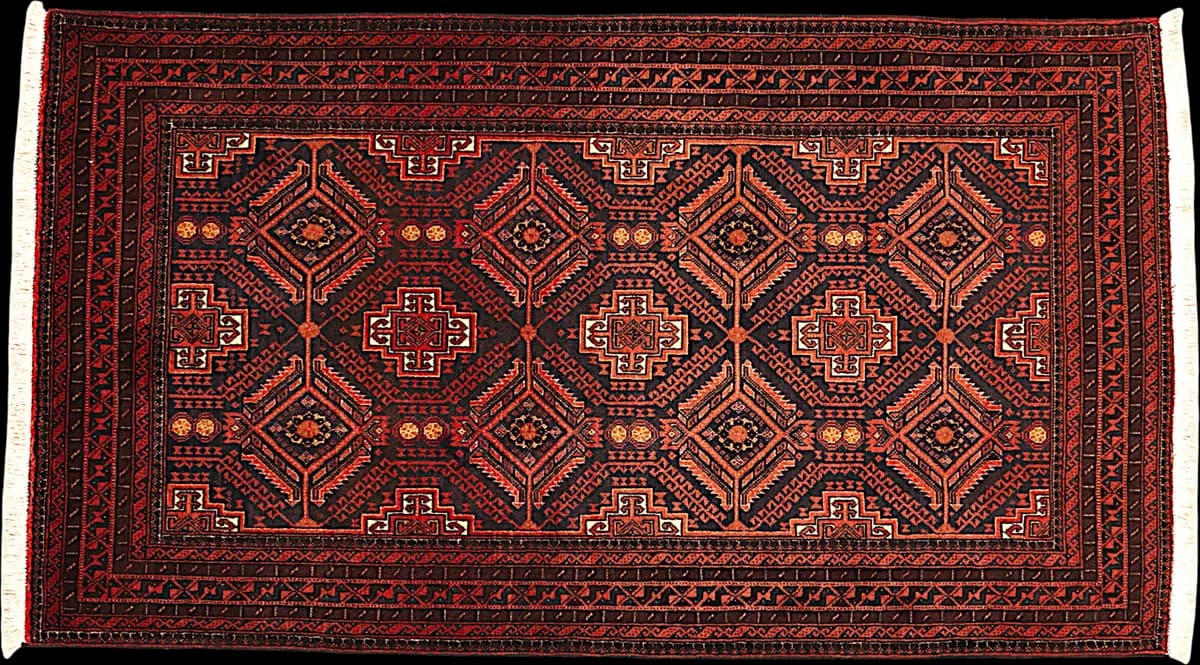
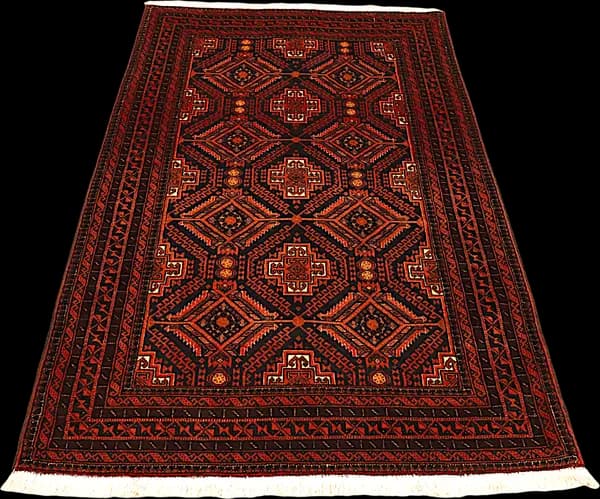
This is a Baluch rug, a tribal weaving from the borderlands of southeastern Iran, measuring 176 x 100 cm (5'9" x 3'3"). Baluch weavers worked from memory rather than a drawn plan, carrying their geometry and their colour sense from one generation to the next rather than from a workshop pattern book. The type is known for deep, earthy colour and bold angular design, and for a certain looseness that comes with knotting entirely by eye. This piece has the colour and the geometry in full, but not the looseness — its diamonds are set out with a discipline you do not often meet in nomadic work.
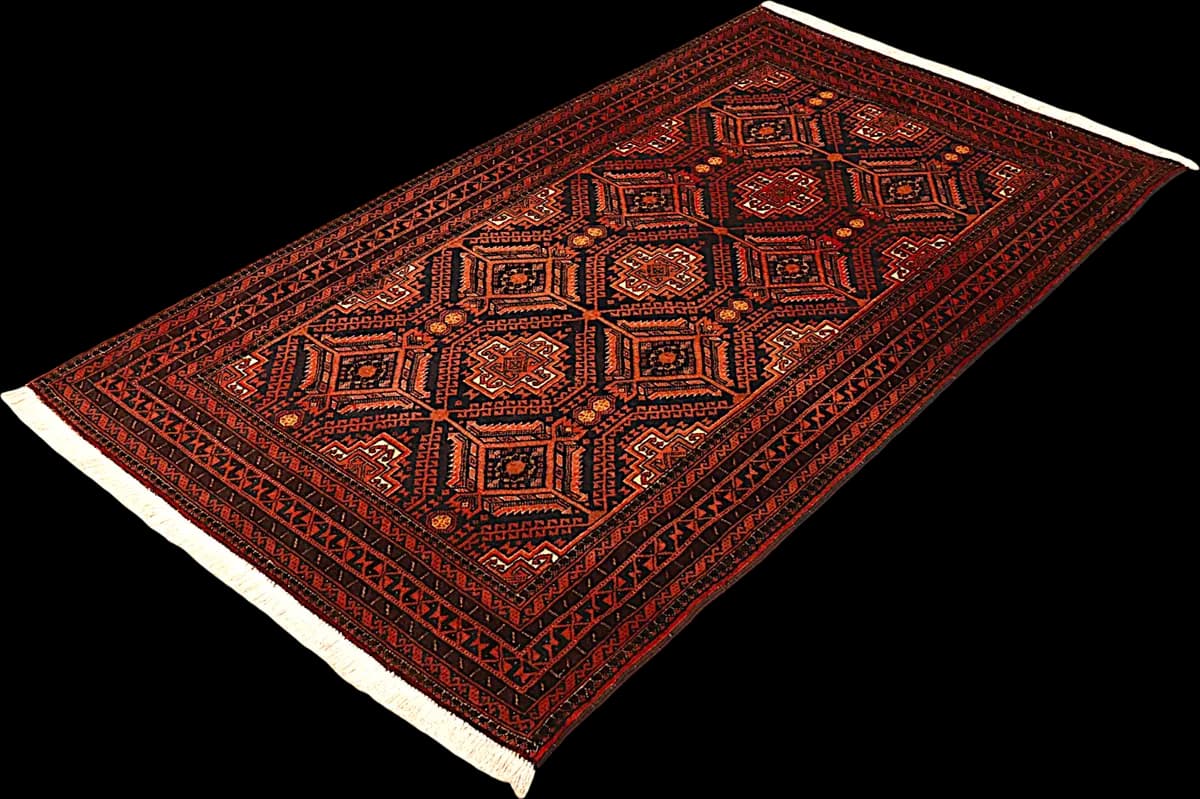
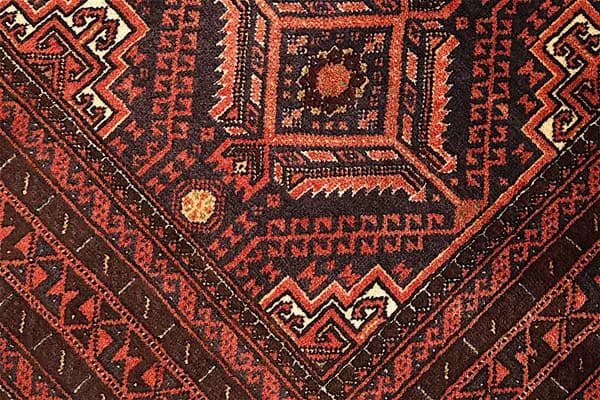
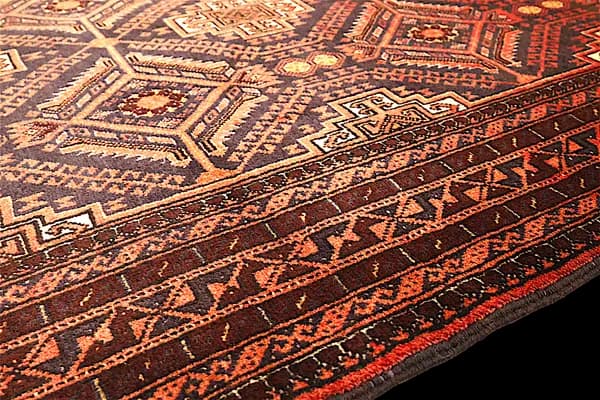
The field is a deep indigo so dark it reads almost as black, and across it marches a grid of stepped diamond medallions in brick red and rust-orange, each one centred on a small rosette. Fine cross-hatch lattice links the diamonds together, and small mustard dots scatter through the gaps between them, warm points of colour against the near-black ground. A wide border in brick red and dark maroon carries stepped diagonals and hook motifs, held in by several narrow ivory-and-red guard stripes that pull the whole design into a sharp, contained frame. The diamonds sit in three rows of four, and every row holds its line — nothing drifts, nothing leans.
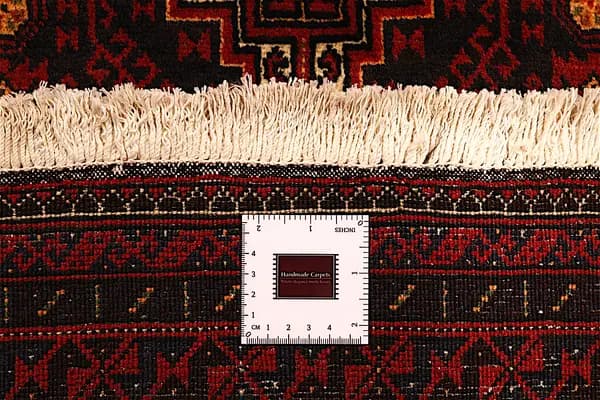
That regularity is the work of a steady hand rather than a loom built for it: this was knotted on a portable frame, the kind a weaver could set up and take down as her group moved. The wool is hand-spun, which gives the pile its faintly ribbed, textured surface rather than the smooth face of machine-spun yarn, and it is knotted at 128,000 to 160,000 knots per square metre onto a cotton warp — a dense, workmanlike count that has held the pile firm at 6 mm for twenty to forty years of use. Keeping a grid this even across that density, entirely from memory, is not the usual story a Baluch tells.
At this size the rug suits a hallway, a landing, or a study floor, somewhere it is seen in passing rather than sat over. The indigo ground will hold its own against dark furniture or floorboards and give a pale hallway a real anchor of colour, while the brick red diamonds keep it from ever looking heavy. The pile is dense and firm underfoot, built for a rug that gets walked on rather than kept for best. Catch it in low light and the mustard rosettes are what you notice first, small warm points scattered through the dark.
More on Baluch rugs: origin, making and how to recognise a genuine piece
Traditional weave
At 176 × 100 cm (1.76 m²) this is a small rug. It works beside a bed, in a reading corner, in front of a fireplace or as a mat by a door. It does not furnish a room; it makes a point in one.
Yes, knotted by hand — knot by knot on a loom, not machine-made. The density is 128,000 to 160,000 knots per square metre; across 1.76 m² that is roughly 230,000 to 280,000 individual knots, every one of them tied by hand.
Hand-spun wool still carries its own lanolin, which keeps liquid sitting on the surface for a moment: blot quickly, with clear water and a light cloth, working inwards and without rubbing. Otherwise regular vacuuming along the pile is enough. Turn the rug once or twice a year so light and footfall reach it evenly.
We are in the Hamburg Speicherstadt. Come and see this rug in daylight, or write to us — a person answers.
Certificate included verifying origin, materials, and craftsmanship.
Ref: 190125