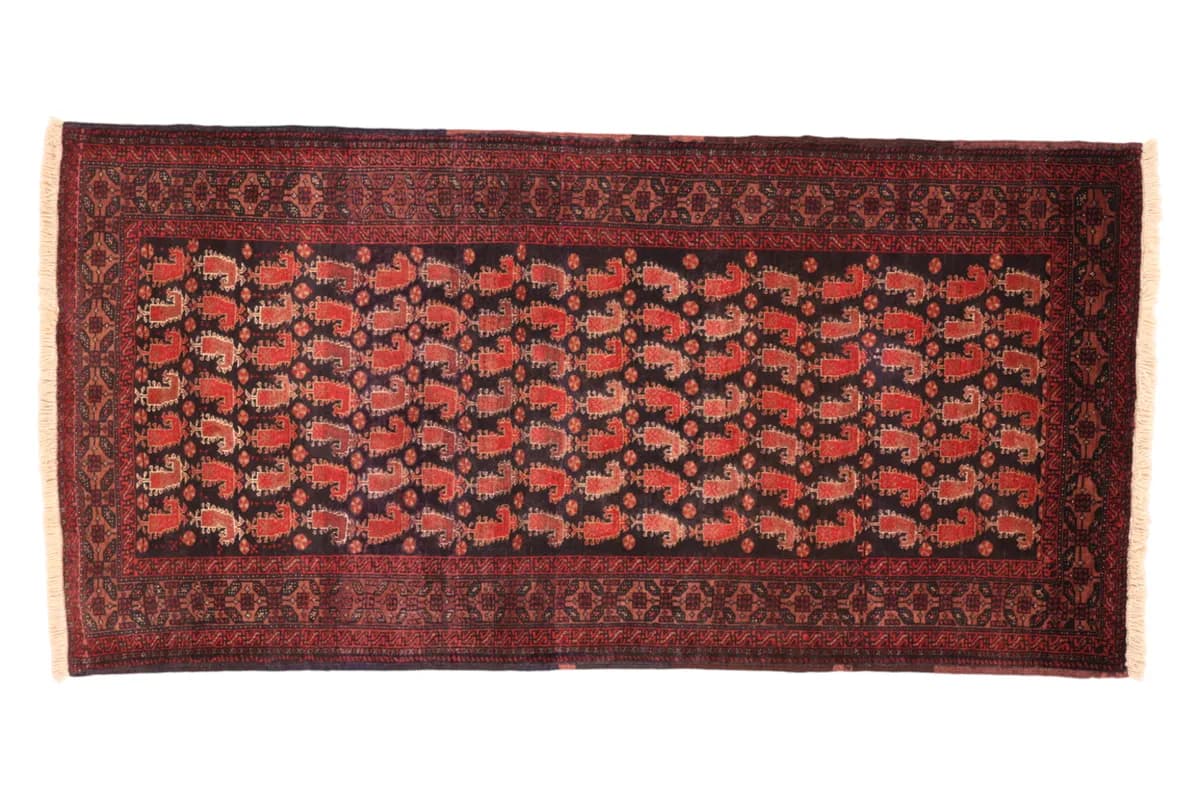
Belutsch
212 × 102 cm
616 €





530 €
Incl. VAT
In Stock · Ready to Ship
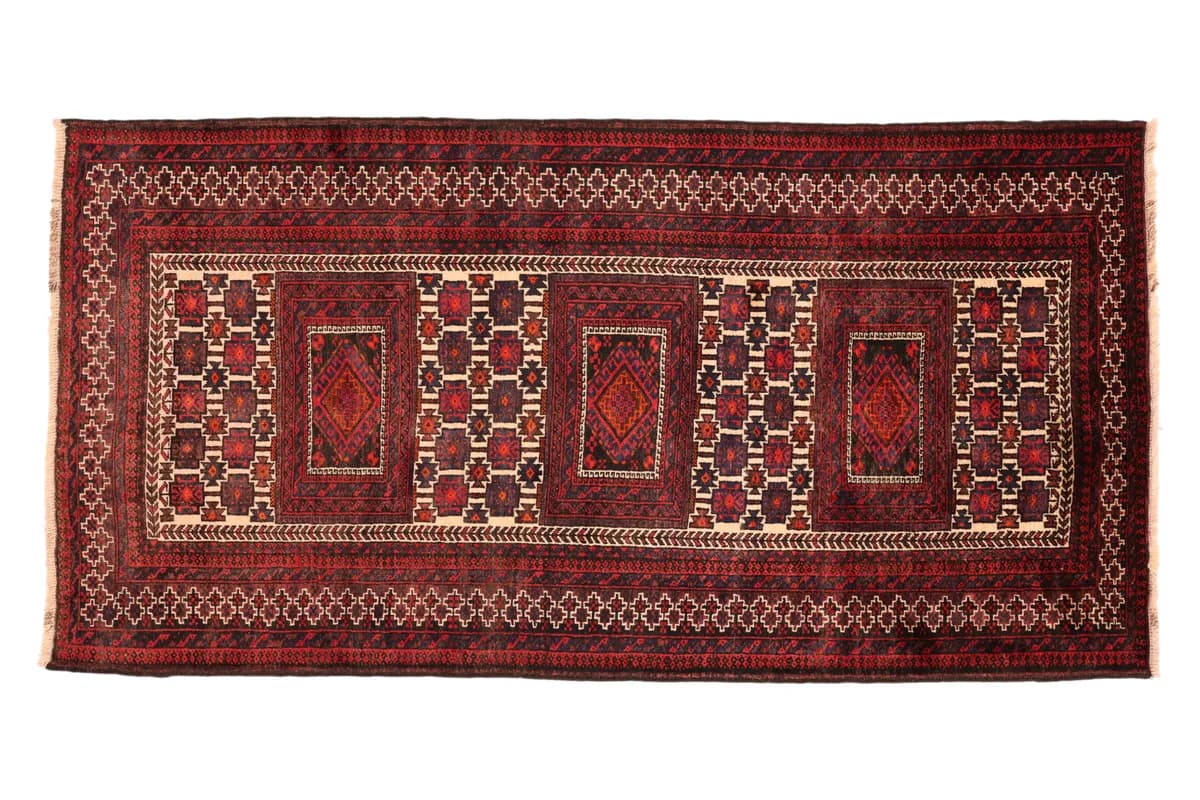
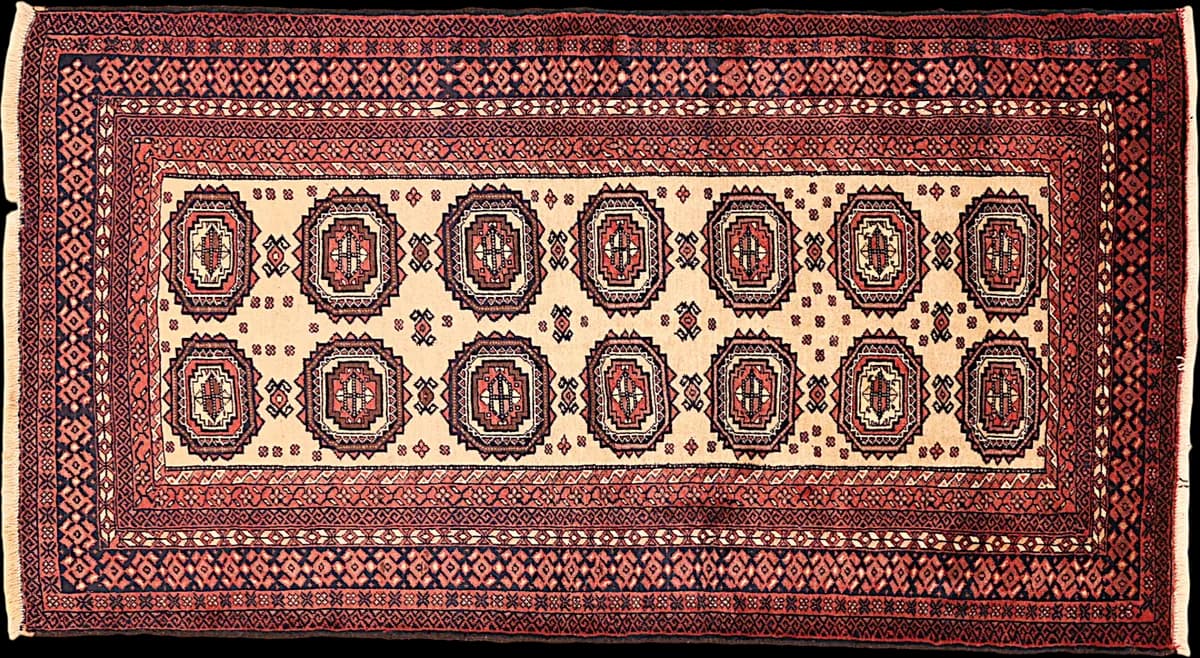
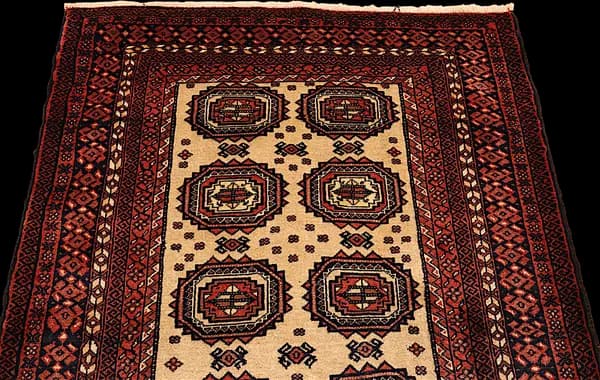
A Baluch rug, hand-knotted in the borderlands of southeastern Iran, 197 x 108 cm (6'6" x 3'7"). Baluch weavings come from tribal and nomadic groups working from memory rather than a drawn plan, and are best known for a deep, earthy palette of reds and indigo, and for the mihrab-shaped prayer designs that recur through generations of the same families. This piece keeps the tribal geometry but sets it against a field far paler than most.
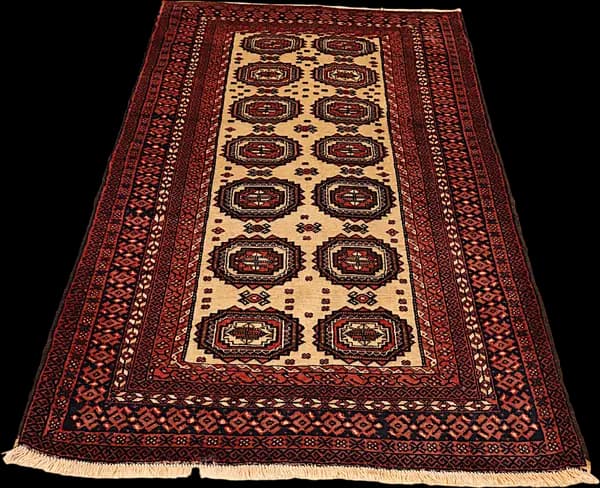
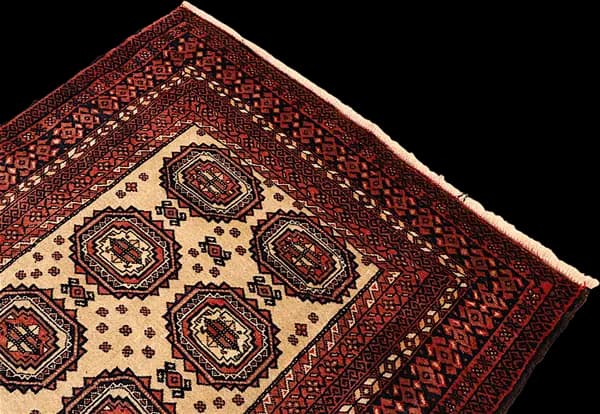
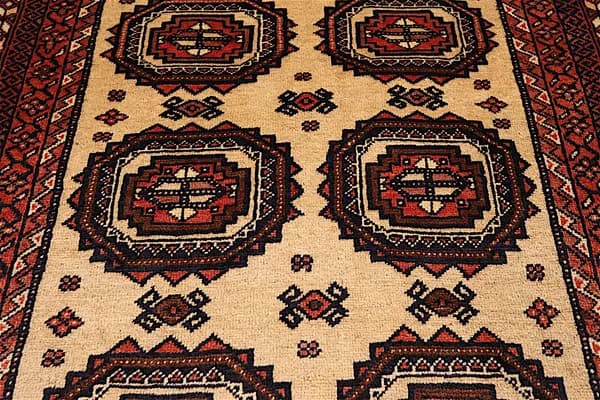
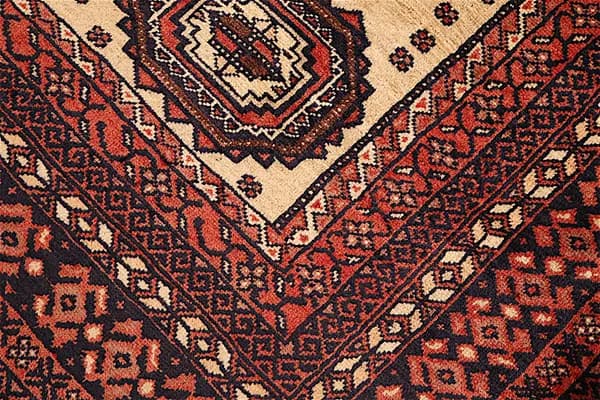
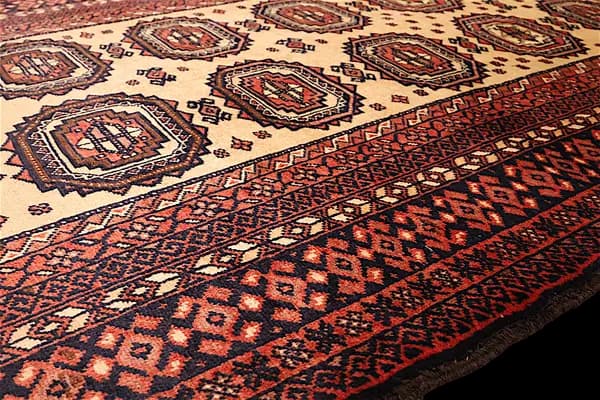
The first impression is of an open, warm ivory ground, not the dense red usually associated with this layout. Across it run two neat columns of small octagonal medallions, each outlined in dark wool, in a Turkmen-style gul arrangement more often knotted crowded and close on a dark field. Here the pale ground gives the octagons room to breathe, and the eye reads them almost as a checkerboard rather than a solid repeating pattern. A wide, multi-band border of red, navy and cream diamonds closes the composition, taking up close to a fifth of the width on each side, and its density is what makes the quiet field in the centre so noticeable by comparison.
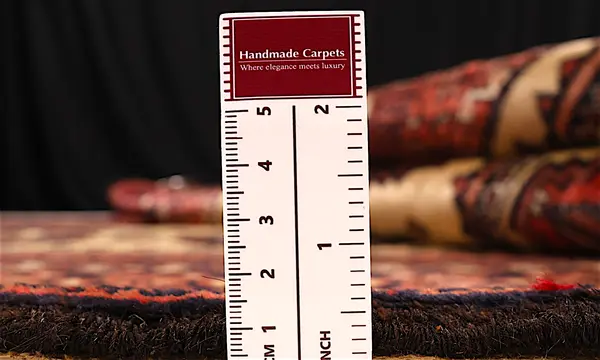
The wool is hand-spun rather than machine-spun, which is why the surface has no sheen banding and a slightly irregular, textured hand rather than a uniform gloss. Spun by eye on a portable loom, the yarn varies just enough from knot to knot to keep the octagon outlines crisp without ever looking mechanical. At 128,000 to 160,000 knots per square metre, the density is enough to hold that geometry sharply defined, while the low, 6mm pile keeps the whole piece flat and close to the floor, letting the pattern rather than the pile do the work.
A rug this size suits a hallway, a landing, or the floor beside a bed, somewhere it is seen close up and often. The ivory field lifts a dim hallway noticeably, and holds its own against dark floorboards or furniture without needing a busy pattern to do it. Underfoot it is firm and flat, made for foot traffic rather than protected from it, and the low pile means it wears in rather than wears out. Morning or lamp light catches the red and navy outlines against the pale ground, and that quiet checkerboard rhythm is the sort of thing you keep noticing on the way past.
More on Baluch rugs: origin, making and how to recognise a genuine piece
Traditional weave
At 197 × 108 cm (2.13 m²) this is a small rug. It works beside a bed, in a reading corner, in front of a fireplace or as a mat by a door. It does not furnish a room; it makes a point in one.
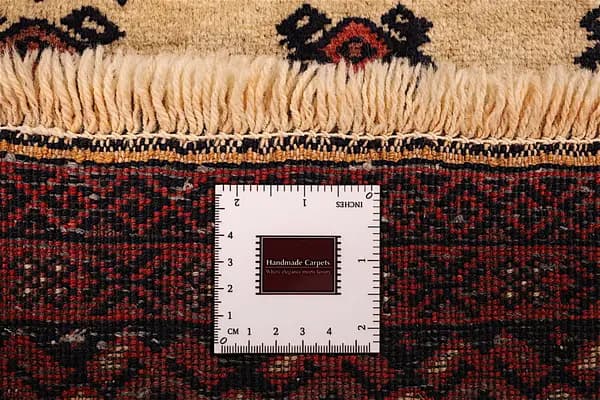
Yes, knotted by hand — knot by knot on a loom, not machine-made. The density is 128,000 to 160,000 knots per square metre; across 2.13 m² that is roughly 270,000 to 340,000 individual knots, every one of them tied by hand.
Hand-spun wool still carries its own lanolin, which keeps liquid sitting on the surface for a moment: blot quickly, with clear water and a light cloth, working inwards and without rubbing. Otherwise regular vacuuming along the pile is enough. Turn the rug once or twice a year so light and footfall reach it evenly.
We are in the Hamburg Speicherstadt. Come and see this rug in daylight, or write to us — a person answers.
Certificate included verifying origin, materials, and craftsmanship.
Ref: 431851