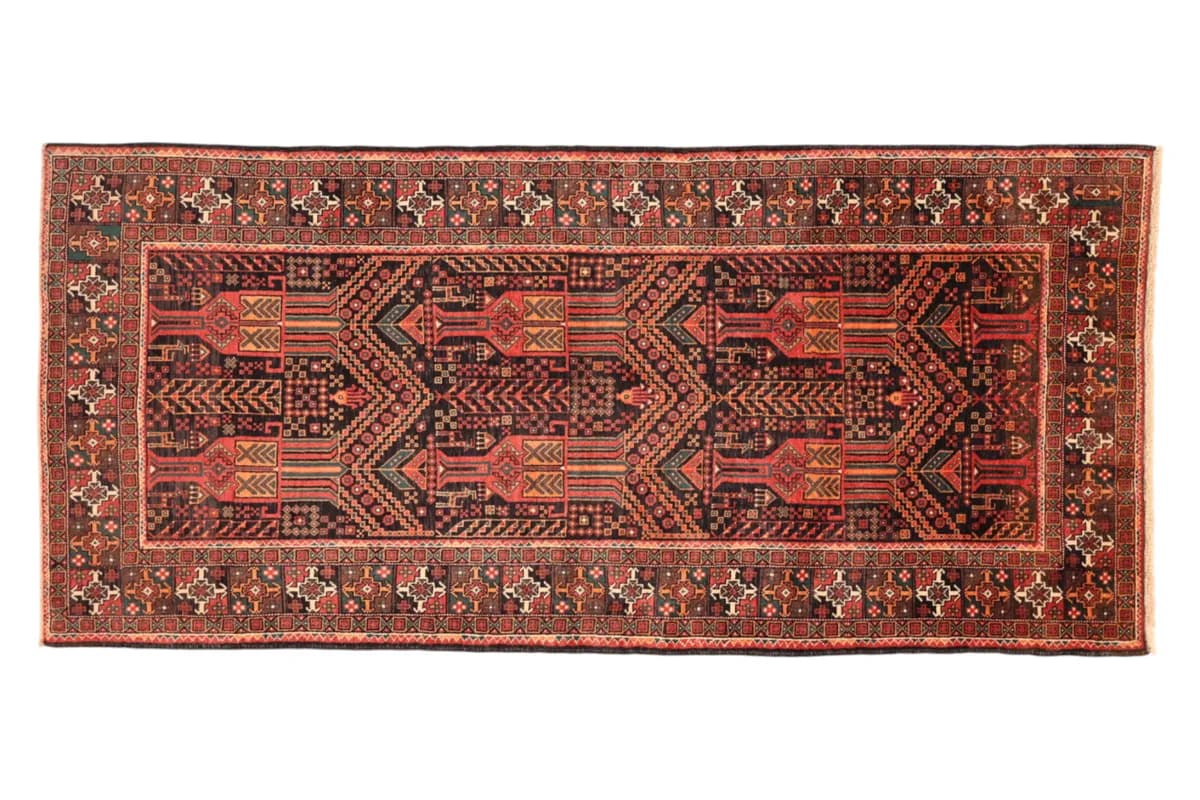
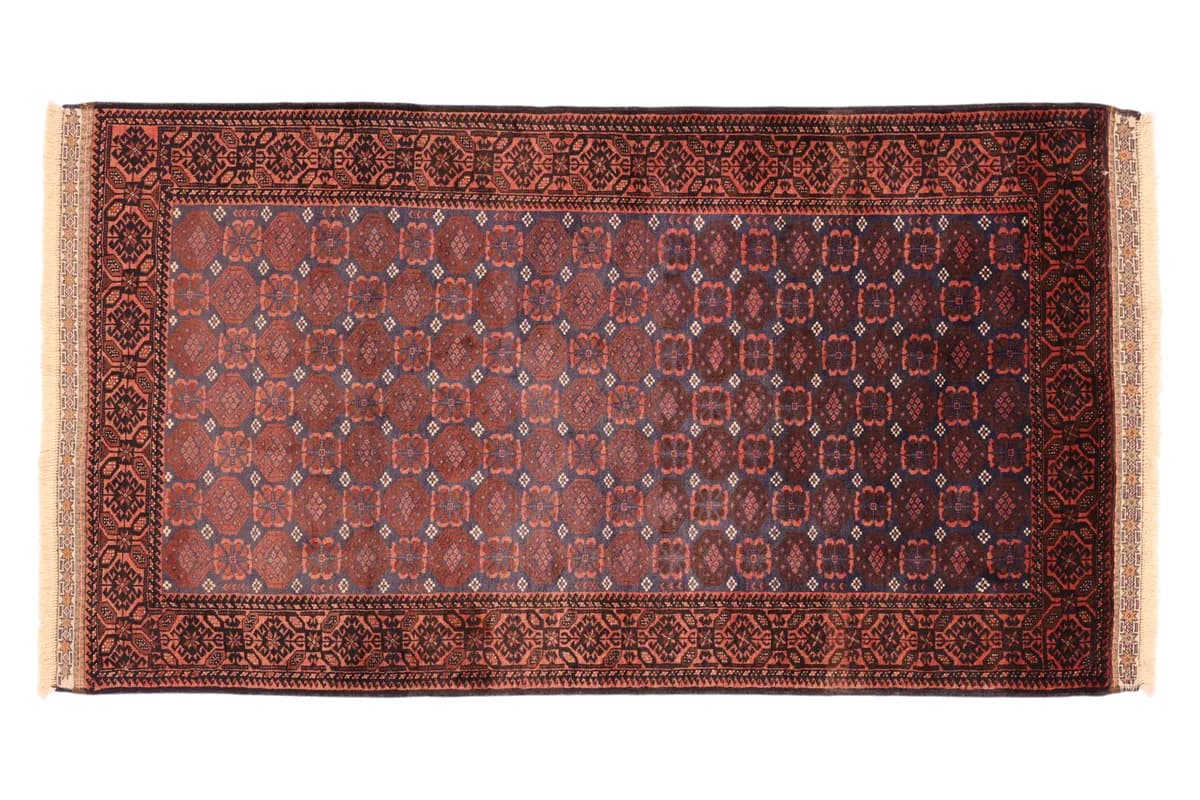
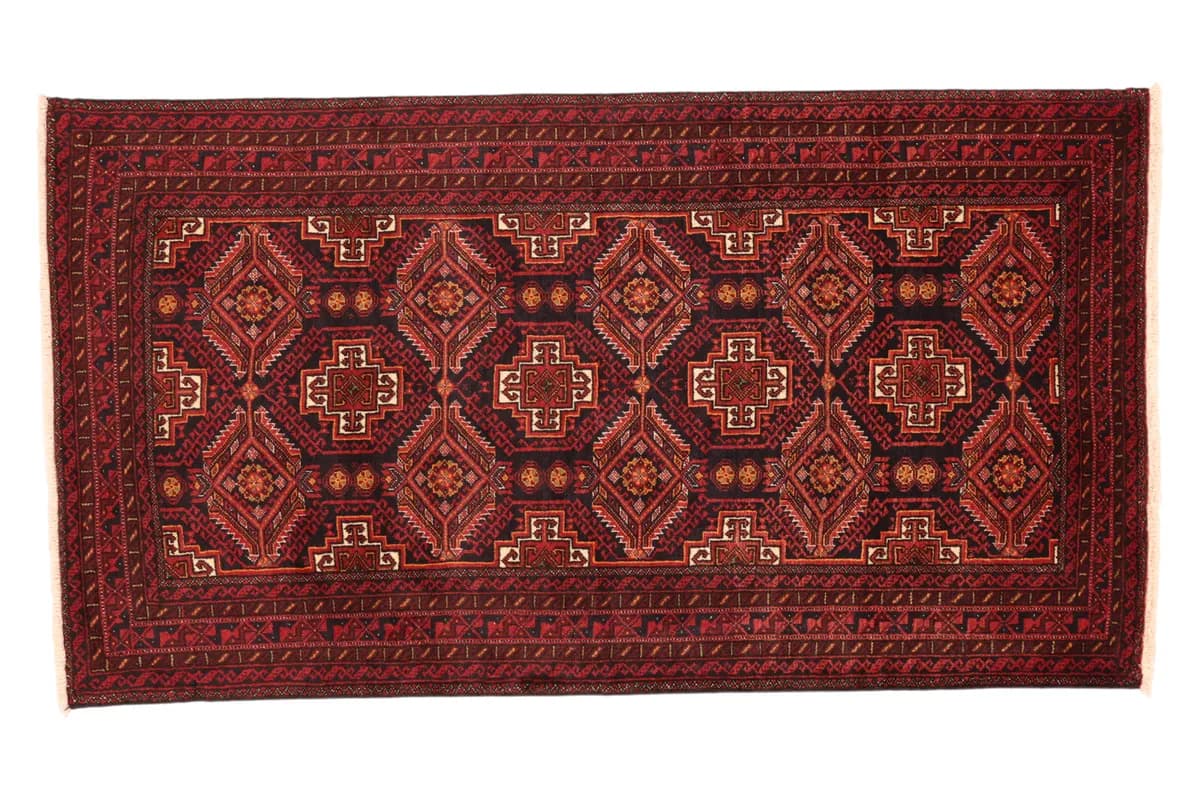
Belutsch
230 × 120 cm
952 €





598 €
Incl. VAT
In Stock · Ready to Ship
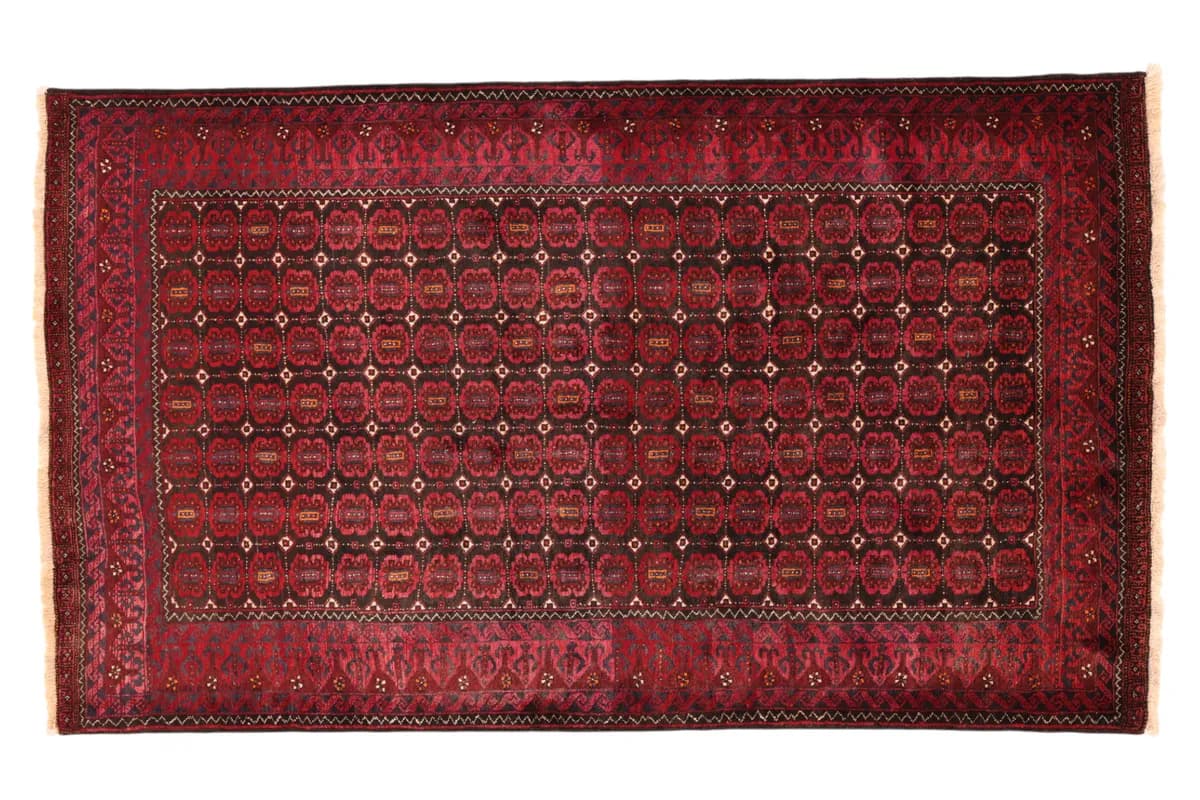
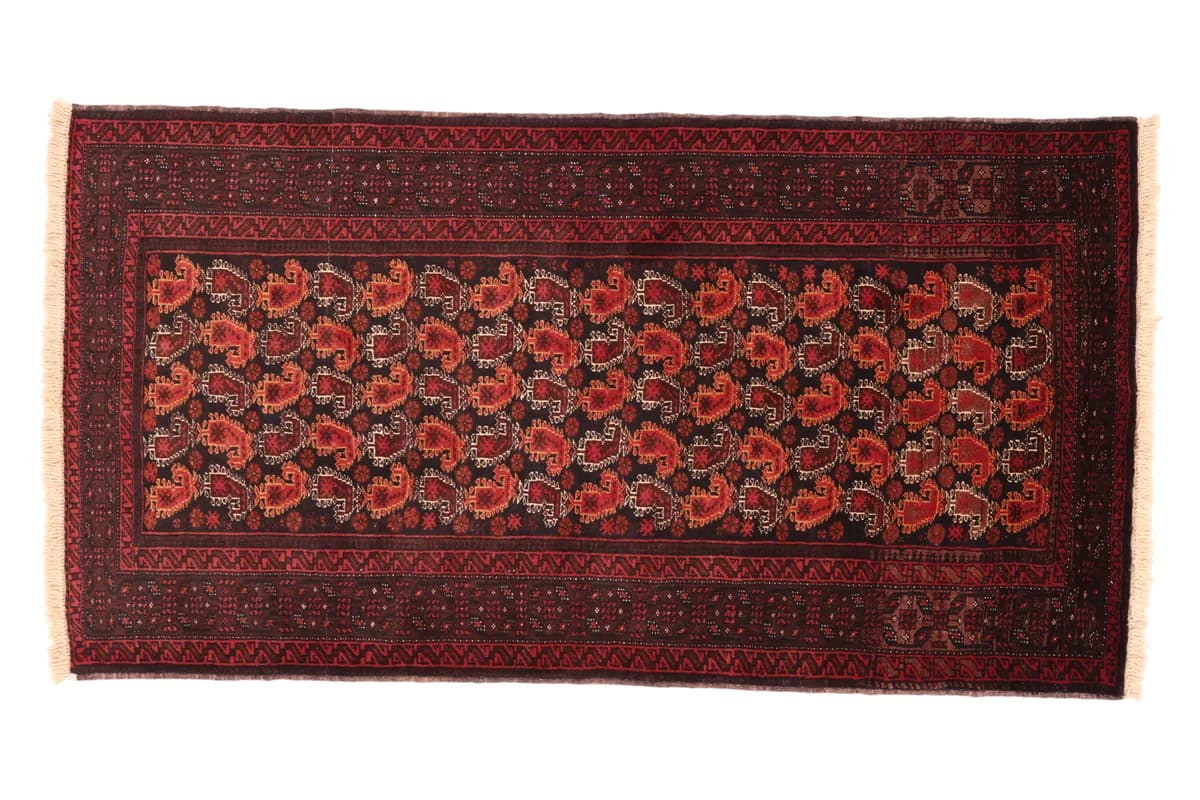
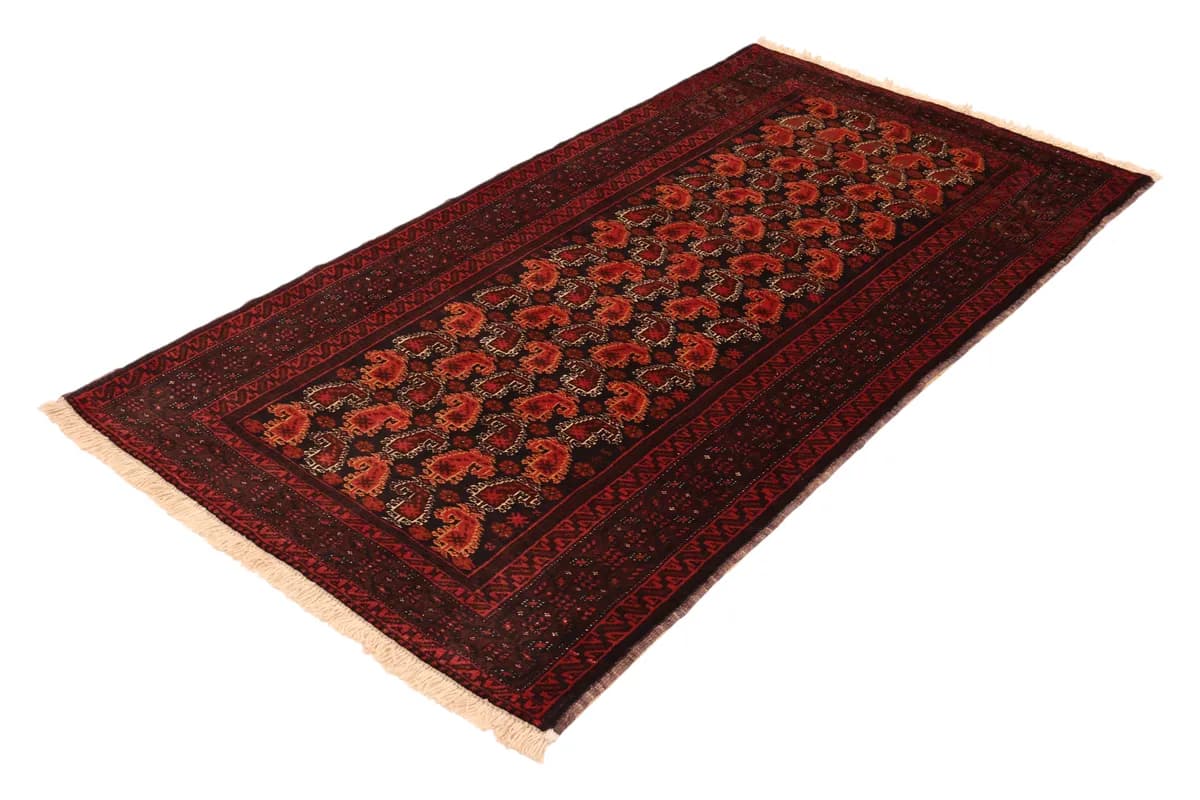
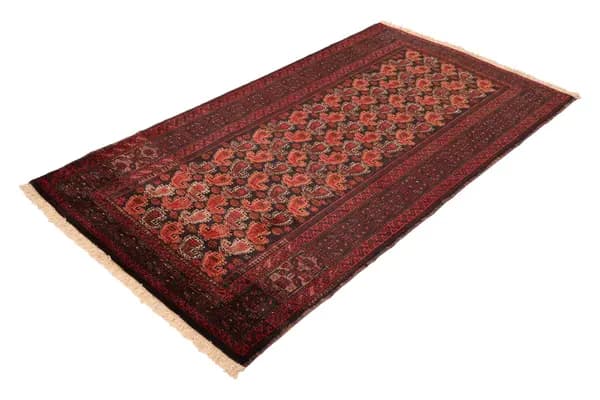
A Baluch, also written Belouch, is a tribal weaving from the borderlands of south-eastern Iran, made by weavers working from memory rather than a drawn plan. This one measures 194 x 103 cm (6'4" x 3'4"), a size built for a narrow room rather than a great hall, and it carries the geometric boteh pattern the type is best known for, set out here without a medallion, as a plain, continuous field.
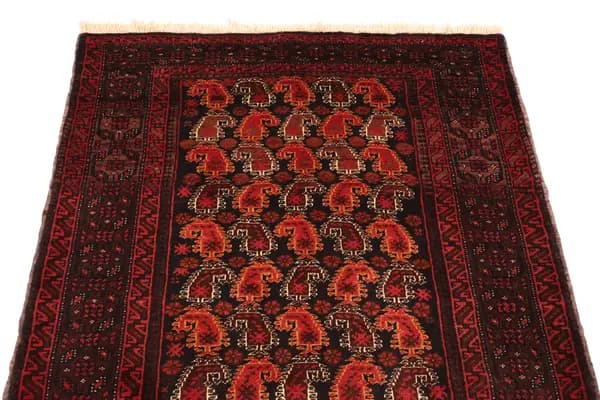
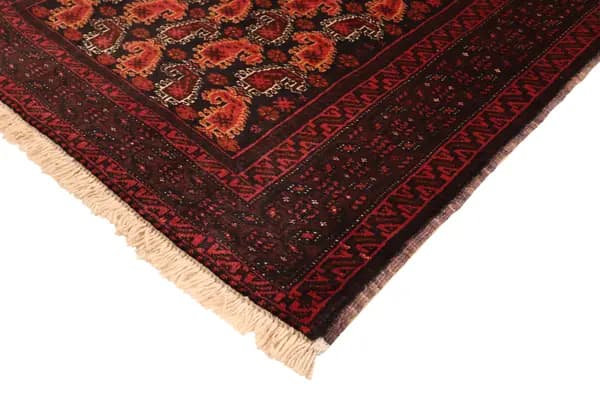
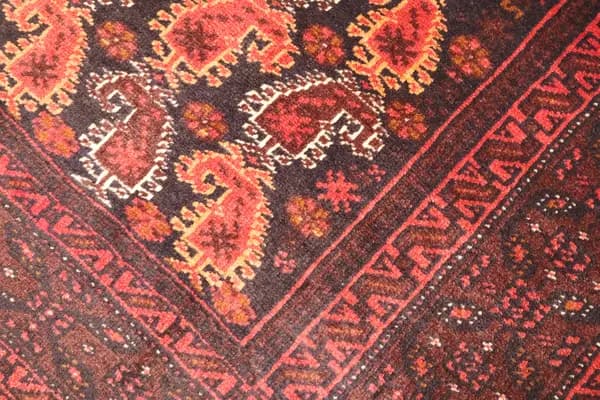
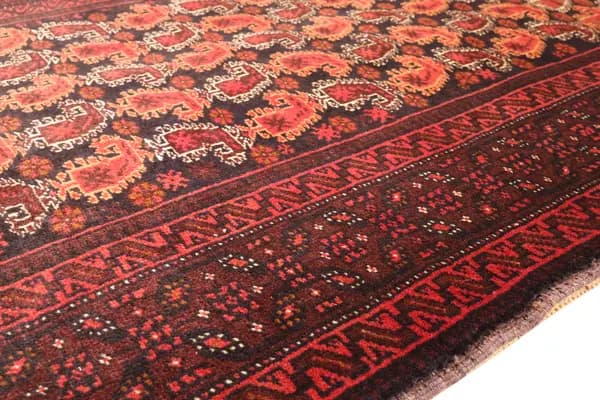
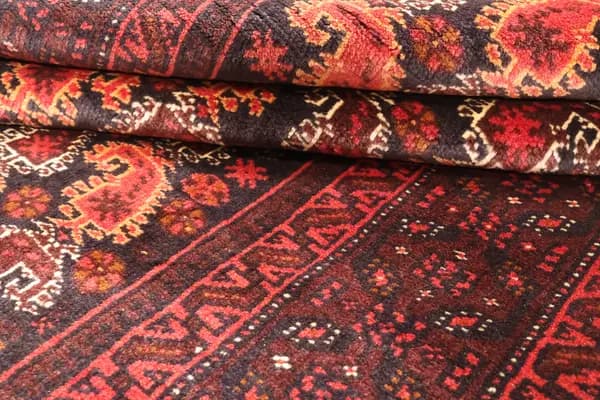
The ground is a deep, almost black brown, and across it march tight vertical rows of hooked boteh in glowing rust-red and brick, each shape lit by small touches of ivory. There is no centre to the design and no medallion to rest the eye on; it simply repeats, column after column, to the edge. Look along the rows and the colour is not constant: on the left the boteh burn warm orange, and by the right edge they have cooled to a greyer maroon, a slow drift running through an otherwise strict pattern. Around it all sit several narrow bands, a red zigzag guard stripe and a darker band strung with small ivory-dotted rosettes, holding the field on every side.
That drift is the mark of the hand behind the loom rather than a flaw in it. The wool here is hand-spun, and hand-spun yarn takes dye a little differently from one batch to the next, so a colour mixed and re-mixed over the weeks of work will never sit perfectly even across a piece this size. Knotted at 128,000 to 160,000 knots per square metre on a cotton warp, without a cartoon to follow, the repeat was carried entirely in the weaver's memory, row by row, which is exactly why the pattern holds its rhythm while never quite repeating twice.
A rug this size earns its keep in a hallway, at the foot of a bed, or tucked into a small study, where the dark ground will hold its own against wood floors and furniture rather than disappearing beneath them. Underfoot the pile is flat, tightly clipped and firm, matte rather than lustrous, and made for a floor that gets walked on rather than one that is kept for best. Walk past it through the day and the drift shows itself differently in each light, the same rows reading warmer in the morning and cooler by evening, so the pattern never quite looks the same twice.
More on Baluch rugs: origin, making and how to recognise a genuine piece
Traditional weave
At 194 × 103 cm (2.00 m²) this is a small rug. It works beside a bed, in a reading corner, in front of a fireplace or as a mat by a door. It does not furnish a room; it makes a point in one.
Yes, knotted by hand — knot by knot on a loom, not machine-made. The density is 128,000 to 160,000 knots per square metre; across 2.00 m² that is roughly 260,000 to 320,000 individual knots, every one of them tied by hand.
Hand-spun wool still carries its own lanolin, which keeps liquid sitting on the surface for a moment: blot quickly, with clear water and a light cloth, working inwards and without rubbing. Otherwise regular vacuuming along the pile is enough. Turn the rug once or twice a year so light and footfall reach it evenly.
We are in the Hamburg Speicherstadt. Come and see this rug in daylight, or write to us — a person answers.
Certificate included verifying origin, materials, and craftsmanship.
Ref: 481771