Belutsch
195 × 100 cm
486 €







952 €
Incl. VAT
In Stock · Ready to Ship
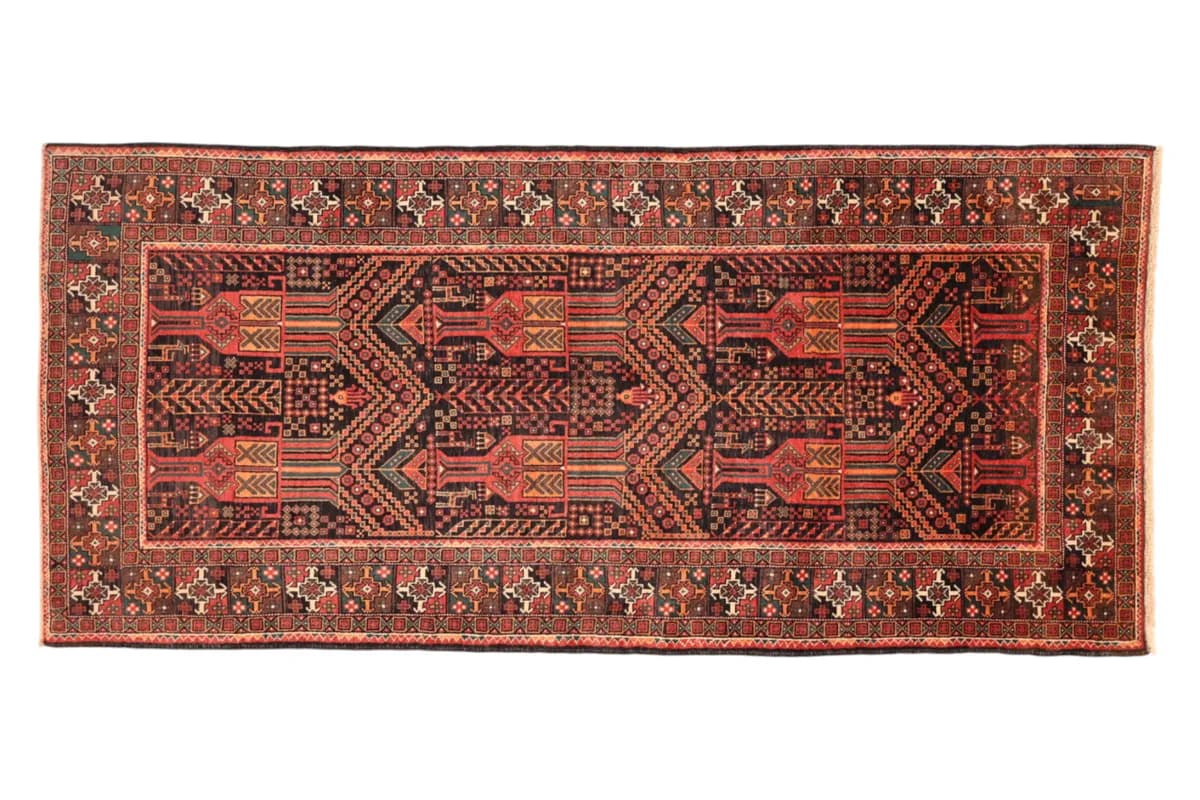
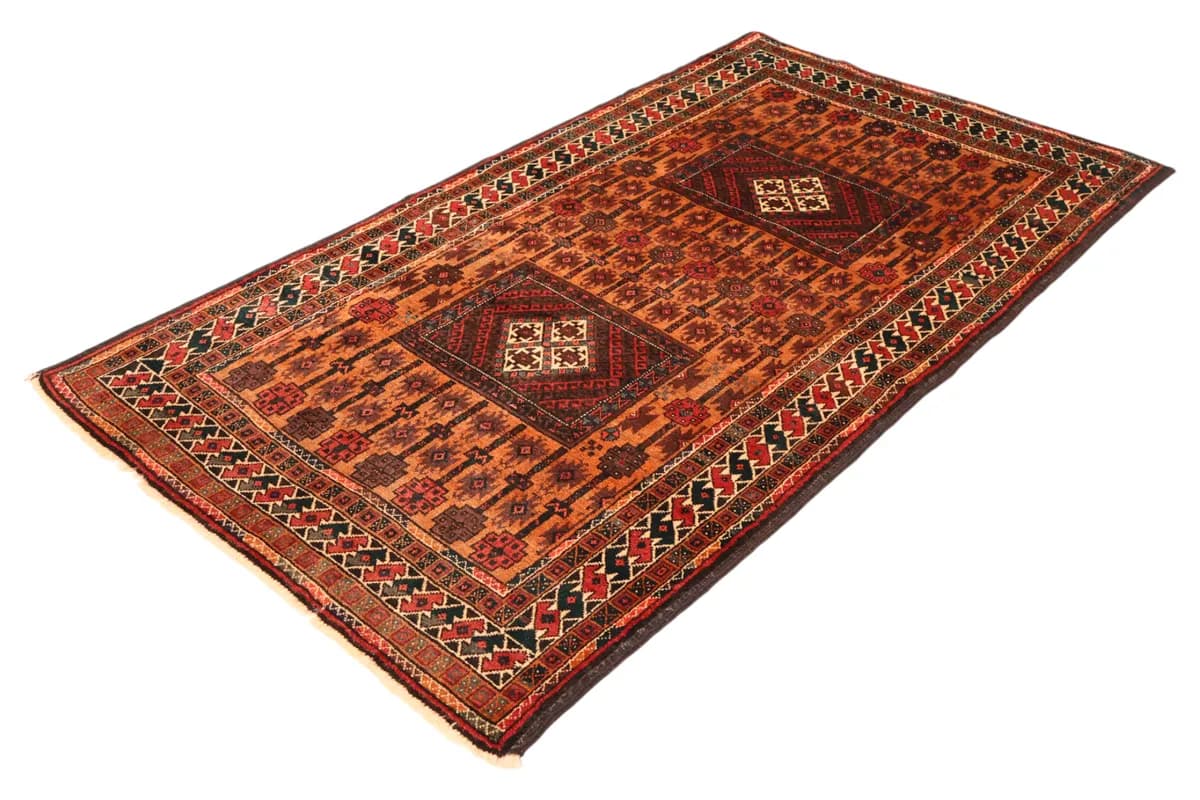
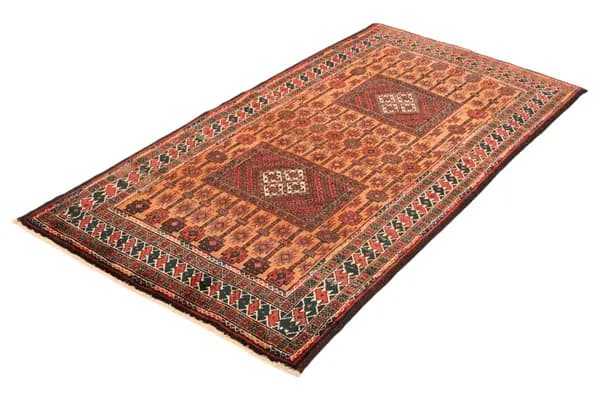
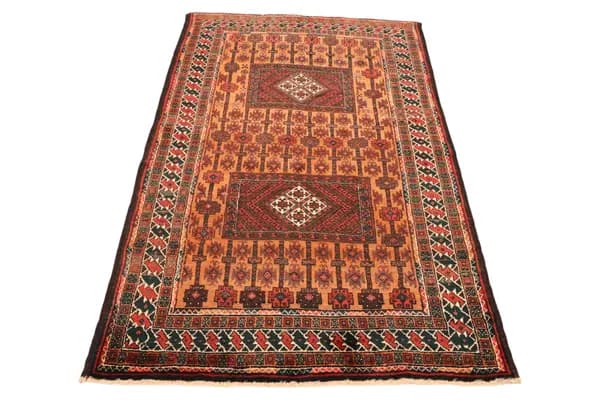
A Baluch rug, also written Belouch, in 230 x 120 cm (7'7" x 3'11"), from the tribal weaving grounds of southeastern Iran and the borderlands beyond. Baluch work is known for bold, angular geometry and a deep, earthy palette, knotted by nomadic weavers who carried their patterns in memory rather than on paper. What sets this piece apart is its composition: rather than the single centred medallion the type usually favours, it carries two, set off-centre and plainly unequal in size.
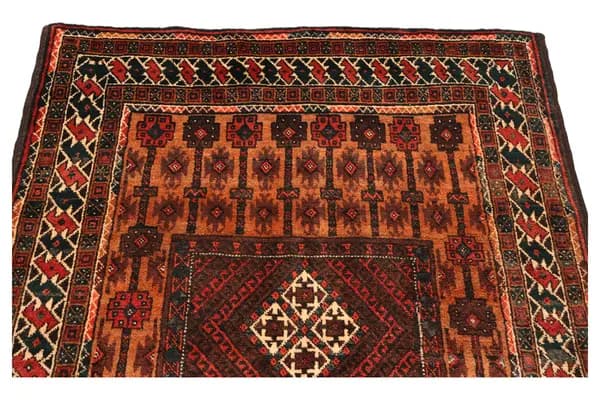
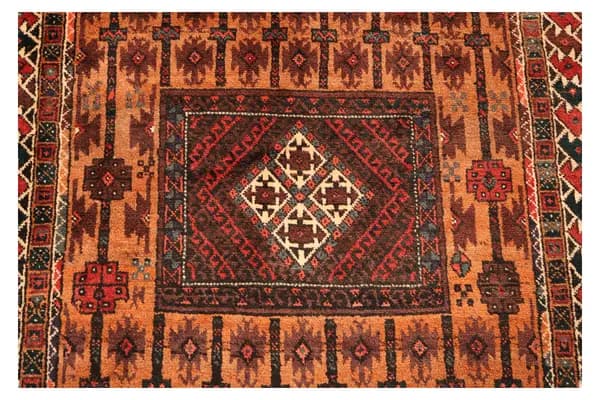
The field is a warm rust-orange, closer to camel in places, and it is this ground that lets the two dark, almost black medallions read so clearly against it. Each holds a stepped diamond centre in ivory and brick-red, and the two sit at different points and different scales, an arrangement that never quite settles into symmetry. Around them the open field carries small floral sprays and rosettes in red-mauve and slate-grey, scattered rather than ranked. A wide border, close to a fifth of the rug's width, closes the composition in dark brown, ivory and red, its zigzag band running like a current around the calmer field.
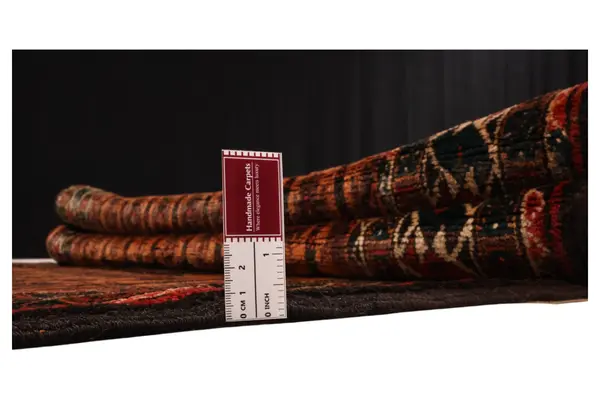
That asymmetry is not a flaw to be explained away; it is what happens when a design is carried in the head rather than drawn on paper. The weaver set down the first medallion, then the second, judging the second against the first by eye alone, and the difference in size is the honest record of that judgement rather than a plan. The wool is hand-spun before it is hand-knotted, at a density of 128,000 to 160,000 knots per square metre over a cotton warp, and hand-spinning leaves the yarn slightly uneven in thickness, which is why the surface has visible tuft and no sheen. At 6 mm the pile sits dense and substantial underfoot rather than fine.
A rug this size and shape earns its keep in a hallway or landing, or beside a bed where its width is felt rather than crossed daily. The rust-orange field warms pale floorboards and holds its own against dark furniture without needing a large room to do it in. Underfoot it is dense, matte and firm, built for the kind of daily use a passage sees rather than a room to be admired from the doorway. Morning light picks out the ivory in the medallions and border first, and it is the small shift between the two, never quite matching, that keeps catching the eye.
More on Baluch rugs: origin, making and how to recognise a genuine piece
Traditional weave
At 230 × 120 cm (2.76 m²) this is a medium rug. It works in front of a sofa, in front of a bed or in a study. It is too small for a dining table — there you want about 80 cm of clearance so a chair does not tip over the edge when pushed back.
Yes, knotted by hand — knot by knot on a loom, not machine-made. The density is 128,000 to 160,000 knots per square metre; across 2.76 m² that is roughly 350,000 to 440,000 individual knots, every one of them tied by hand.
Hand-spun wool still carries its own lanolin, which keeps liquid sitting on the surface for a moment: blot quickly, with clear water and a light cloth, working inwards and without rubbing. Otherwise regular vacuuming along the pile is enough. Turn the rug once or twice a year so light and footfall reach it evenly.
We are in the Hamburg Speicherstadt. Come and see this rug in daylight, or write to us — a person answers.
Certificate included verifying origin, materials, and craftsmanship.
Ref: 493579