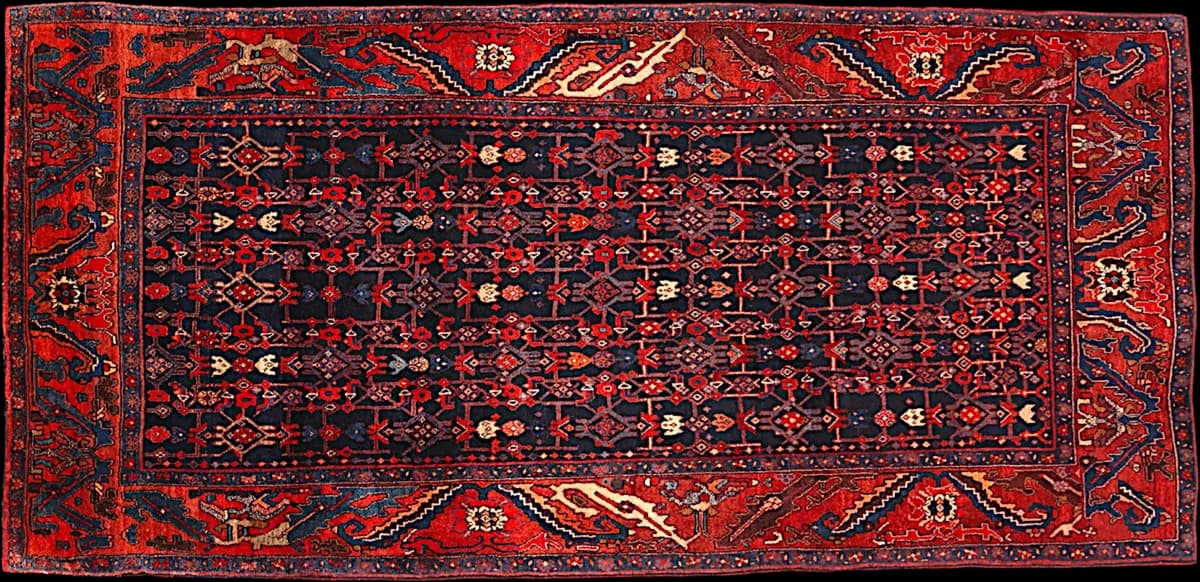
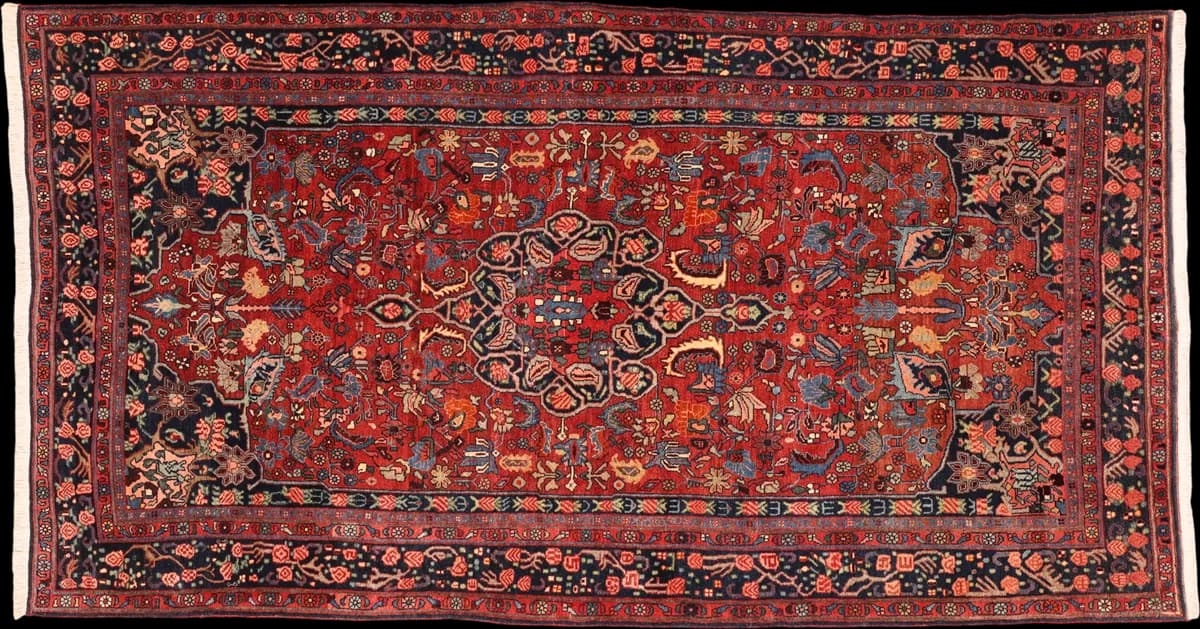
Koliai
336 × 168 cm
1.620 €





6.289 €
Incl. VAT
In Stock · Ready to Ship
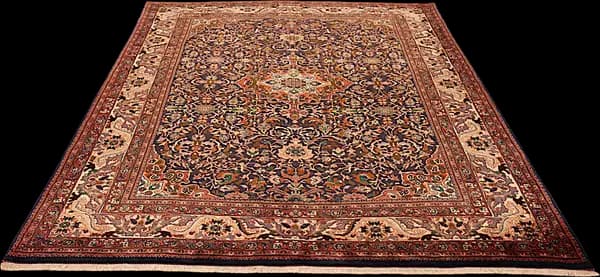
The type is called Garrous, after the old name for the Bijar region of Iranian Kurdistan, and this piece measures 296 x 218 cm (9'9" x 7'2"). It was knotted by Kurdish tribal weavers in the high country around Bijar, an area whose rugs are known above all for a density so firm it is often described as iron-like — a rug built to be walked on for generations rather than kept from foot traffic. Woven from memory rather than a workshop plan, it still carries a clarity that this weaving tradition is respected for.
The first impression is a bold ivory-and-red star medallion suspended on a deep indigo field. Look again and smaller diamond pendants appear above and below it, echoing the star's points and drawing a clear line down the centre of the rug. Around this axis runs a dense floral vine, palmettes and serrated leaves filling the ground in rust, camel, olive and muted teal-grey against the indigo. A wide ivory border, taking up close to a fifth of the width, carries the same vine in a warmer red-brown, and it is this border that pulls the eye back out from the medallion to the edge of the piece.
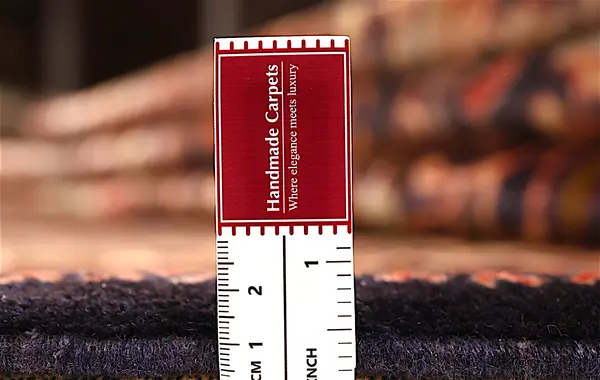
Cotton forms the warp, wool the pile, and the wool itself was hand-spun rather than machine-spun, which means the thickness of each thread varies very slightly along its length. That variation is what gives the surface its light sheen and its faint ribbed texture, and it is also what lets a knot density of 201,000 to 250,000 per square metre read as crisply as it does here, each petal and serration holding its shape rather than blurring into the next. At this density, tied entirely by hand, the rug represents months of steady work at the loom, and it is that same tight, low-pile construction, at 15 mm, that gives Garrous weaving its legendary firmness underfoot.
At close to three metres by just over two, this is a rug for a dining room or a living room seating group, sized to sit under a table or hold a sofa arrangement without being overwhelmed by either. The indigo field will stand up to dark wood furniture rather than disappear beside it, while the ivory medallion and border keep the whole composition from ever feeling heavy. Underfoot it is dense and firm, built for a room that gets daily use rather than one kept for best. As daylight moves across it through the day, the slight sheen in the wool catches along the vine border first, then the medallion, so the pattern never sits quite still.
More on Garrous rugs: origin, making and how to recognise a genuine piece
Fine quality weave
At 296 × 218 cm (6.45 m²) this is a large rug. It sits under a seating group with the front legs of sofa and chairs on it, or under a dining table for four. A table for six wants about 80 cm of clearance all round, and needs more.
Yes, knotted by hand — knot by knot on a loom, not machine-made. The density is 201,000 to 250,000 knots per square metre; across 6.45 m² that is roughly 1.3 to 1.6 million individual knots, every one of them tied by hand.
Hand-spun wool still carries its own lanolin, which keeps liquid sitting on the surface for a moment: blot quickly, with clear water and a light cloth, working inwards and without rubbing. Otherwise regular vacuuming along the pile is enough. Turn the rug once or twice a year so light and footfall reach it evenly.
We are in the Hamburg Speicherstadt. Come and see this rug in daylight, or write to us — a person answers.
Certificate included verifying origin, materials, and craftsmanship.
Ref: 602759