Exclusive
Bidjar | Exclusive
283 × 136 cm
3.300 €







2.158 €
Incl. VAT
In Stock · Ready to Ship
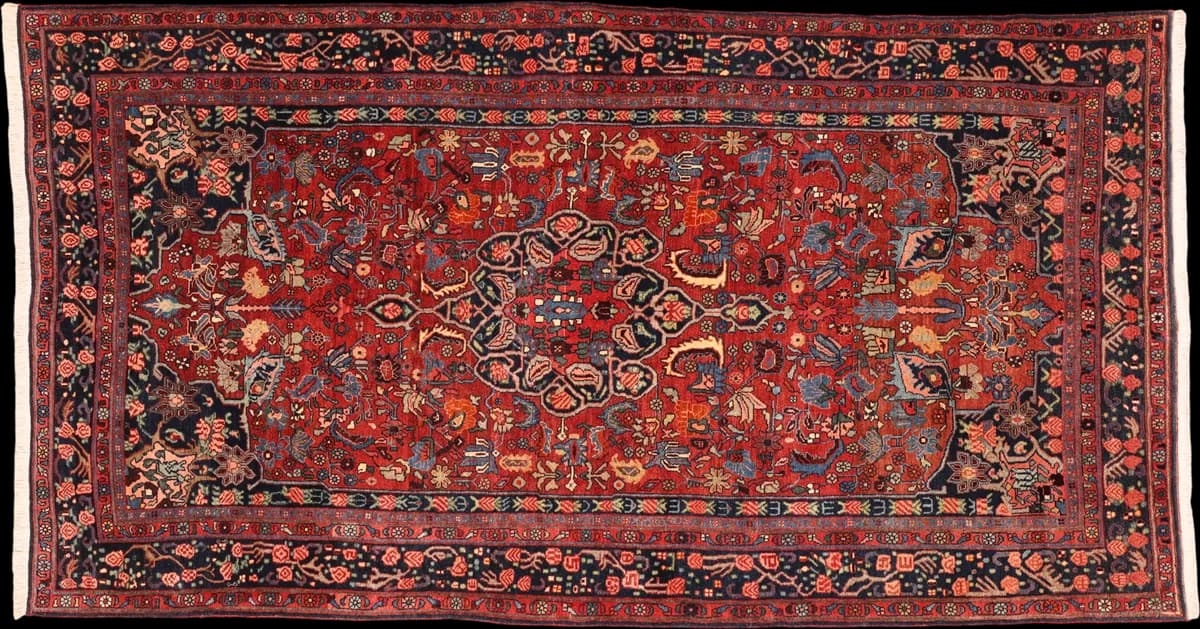
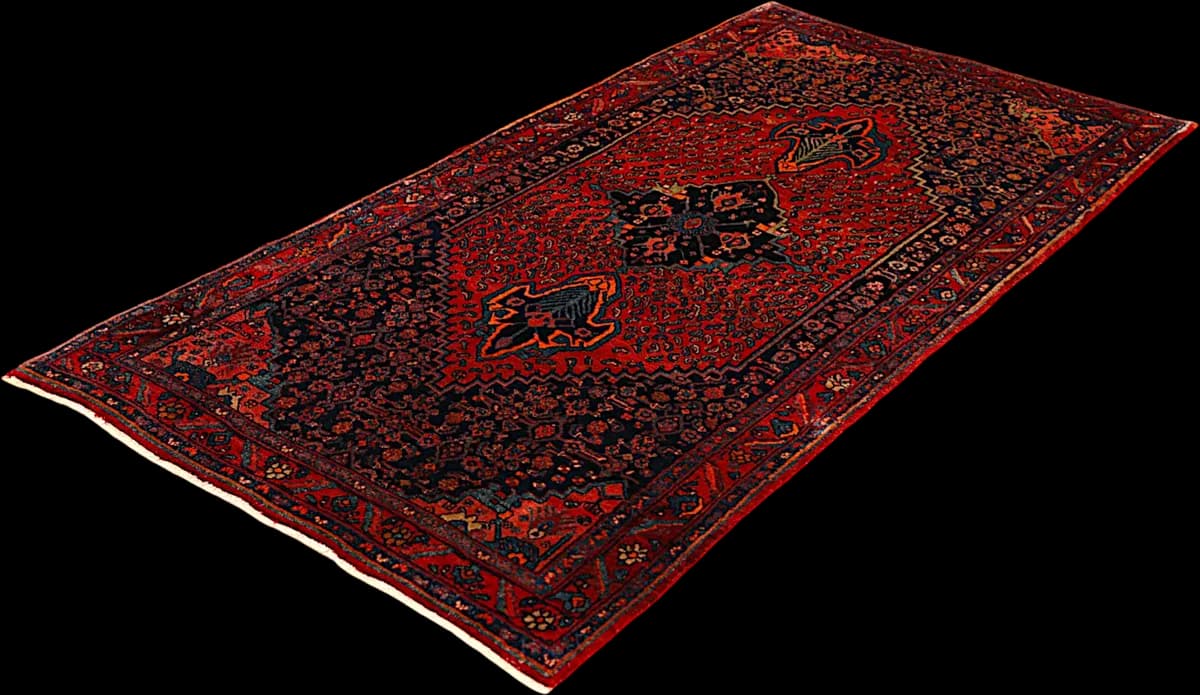
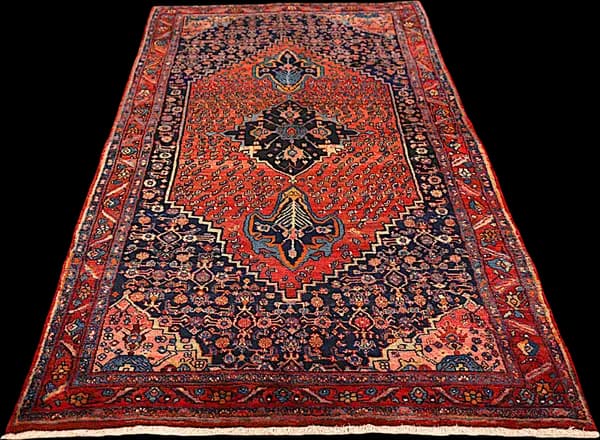
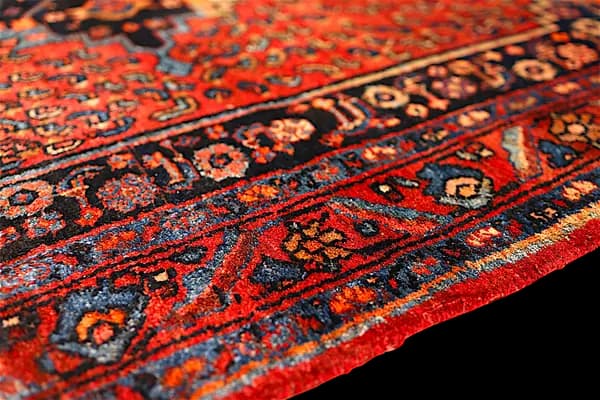
This is a Garrous, a Kurdish rug from the Bijar region of Iranian Kurdistan, knotted by tribal weavers from memory rather than from a workshop plan. Garrous rugs are famous above all for their density, a weave so tight it is said to outlast nearly everything else in a house. This piece measures 272 x 146 cm (8'11" x 4'9"), and while it carries that reputation for toughness, its medallions do something a little more ornamental than the type usually allows.
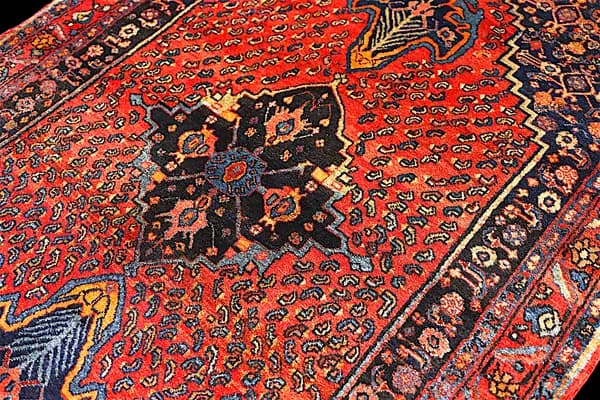
The field is a warm brick red, scattered throughout with small botehs, and against it stand three deep navy medallions strung one above the other along the centre line. The two outer medallions do not simply repeat: each grows an orange-outlined pendant at its tip, the lines curving out into shapes that read almost like feathers or wings. Around this a lattice border in navy, drawn in the mahi fish pattern, holds the field in place, and beyond it runs a wide red border of floral vine, closed off with fine guard stripes. The whole arrangement is more heraldic than a plain medallion chain, three emblems on a red ground rather than one motif repeated.
The pile is handspun wool, knotted onto a cotton warp at a density of 128,000 to 160,000 knots per square metre, and it is this density that is behind the Garrous name — enough knots per hand's width to hold the small botehs and the fine lattice crisply, rather than letting them blur into the field. Handspun wool also takes natural dye a little unevenly, which is why the red has depth rather than flatness, and why the surface has a matte, slightly irregular hand rather than any sheen. At 12 mm the pile is kept low, so that density rather than depth carries the pattern, and forty to sixty years of use have only settled it further.
At this size the rug suits a bedroom, laid beside or partly under the bed, or a smaller seating corner where it can be seen whole rather than crossed daily. The red holds its own against dark wood and warms a pale floor without needing anything else in the room to match it. Underfoot it is dense and firm rather than soft, a weave built for standing and walking rather than for admiring from a distance, and in low light the two pendant finials are the first thing the eye returns to, again and again.
More on Garrous rugs: origin, making and how to recognise a genuine piece
Traditional weave
At 272 × 146 cm (3.97 m²) this is a medium rug. It works in front of a sofa, in front of a bed or in a study. It is too small for a dining table — there you want about 80 cm of clearance so a chair does not tip over the edge when pushed back.
Yes, knotted by hand — knot by knot on a loom, not machine-made. The density is 128,000 to 160,000 knots per square metre; across 3.97 m² that is roughly 510,000 to 640,000 individual knots, every one of them tied by hand.
Hand-spun wool still carries its own lanolin, which keeps liquid sitting on the surface for a moment: blot quickly, with clear water and a light cloth, working inwards and without rubbing. Otherwise regular vacuuming along the pile is enough. Turn the rug once or twice a year so light and footfall reach it evenly.
We are in the Hamburg Speicherstadt. Come and see this rug in daylight, or write to us — a person answers.
Certificate included verifying origin, materials, and craftsmanship.
Ref: 737208