Exclusive
Bidjar | Exclusive
276 × 168 cm
11.700 €






1.368 €
Incl. VAT
In Stock · Ready to Ship
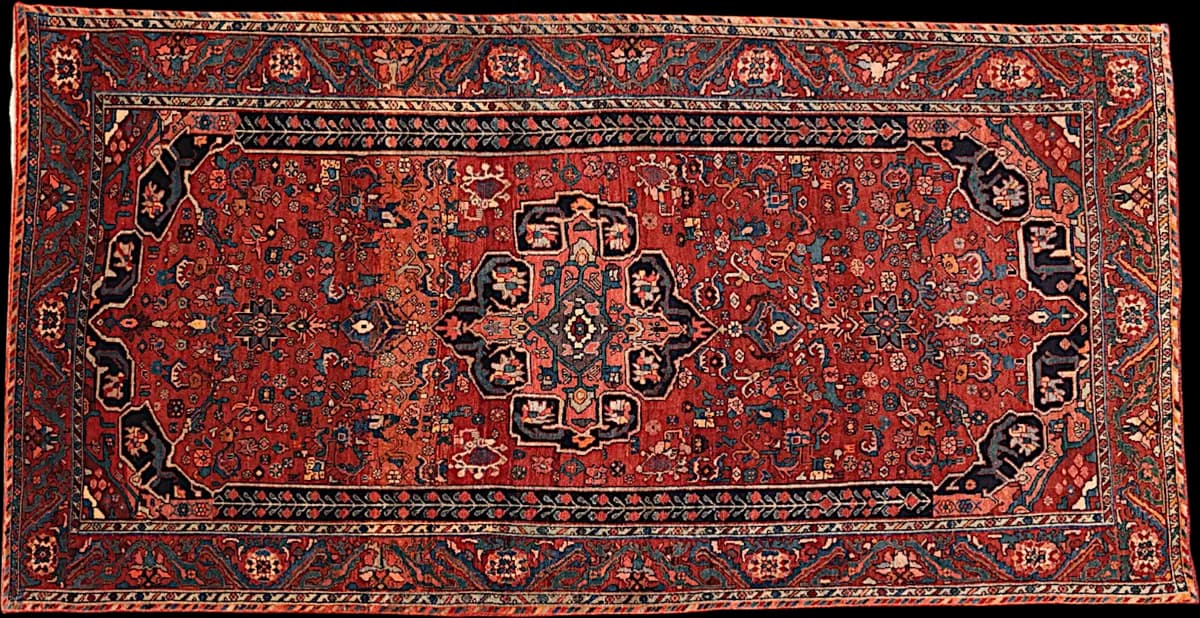
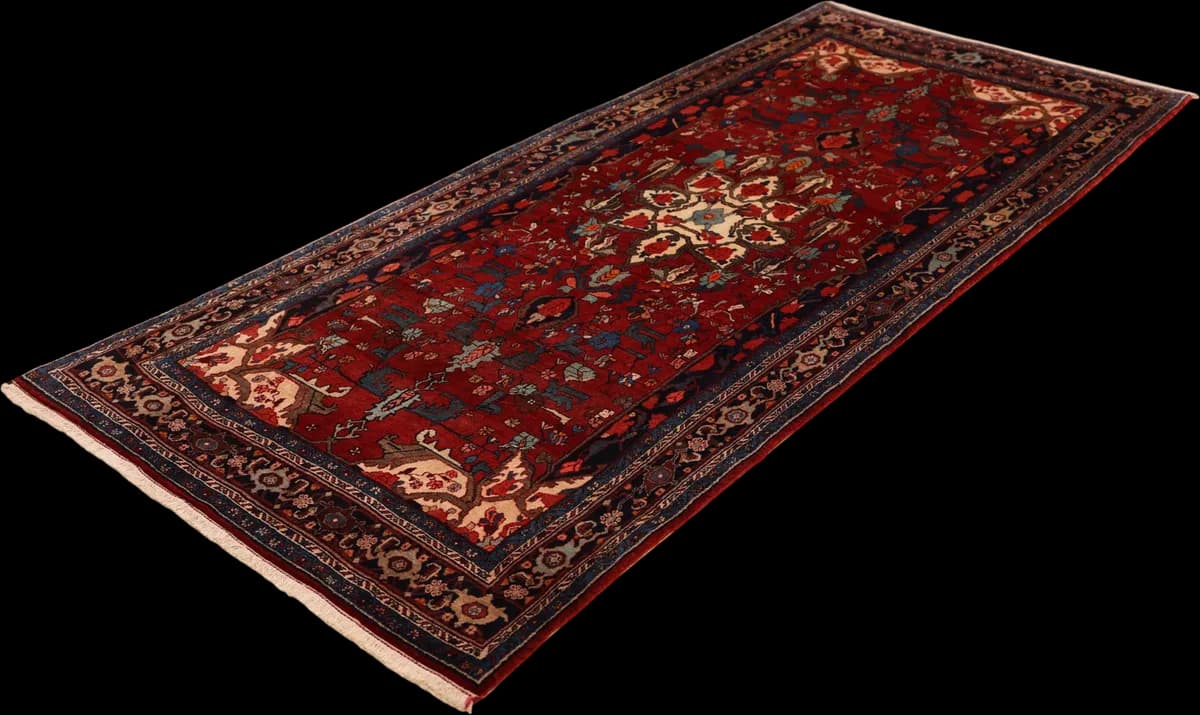
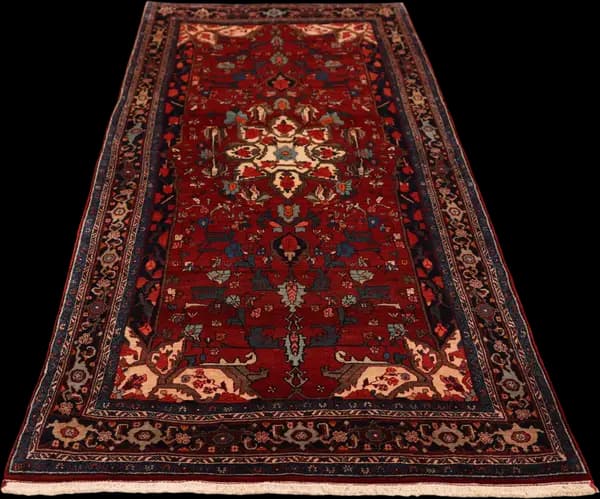
This is a Garrous runner, also written Garrus, 331 x 145 cm (10'10" x 4'9"), from the Kurdish highlands around Bijar in western Iran. Garrous rugs share the legendary density that made Bijar famous, woven by Kurdish tribal weavers whose work is known for outlasting almost everything else in a house.
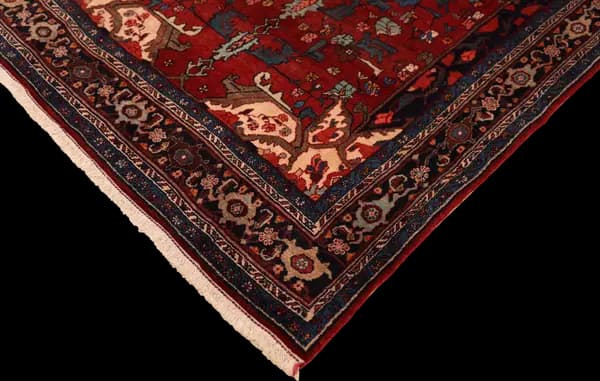
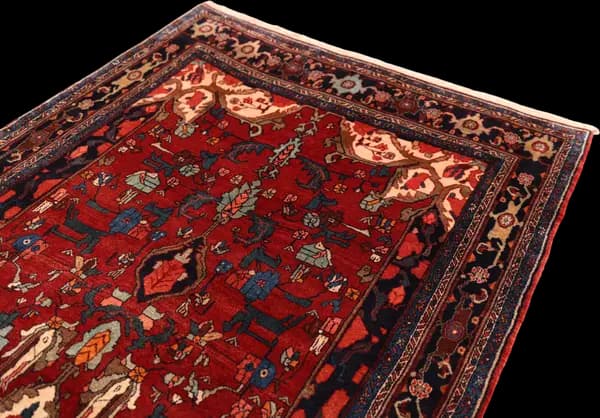
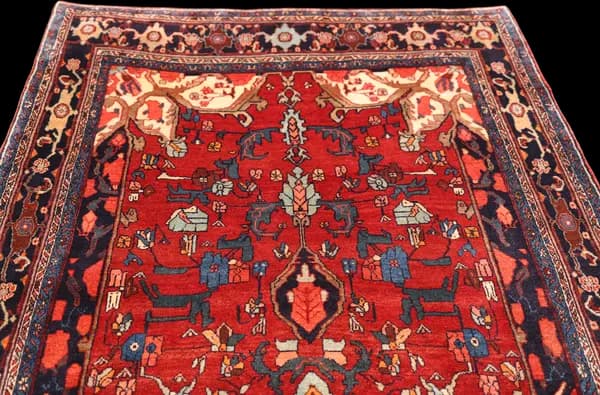
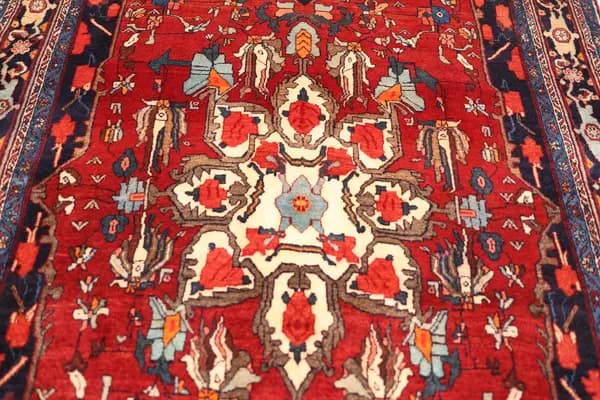
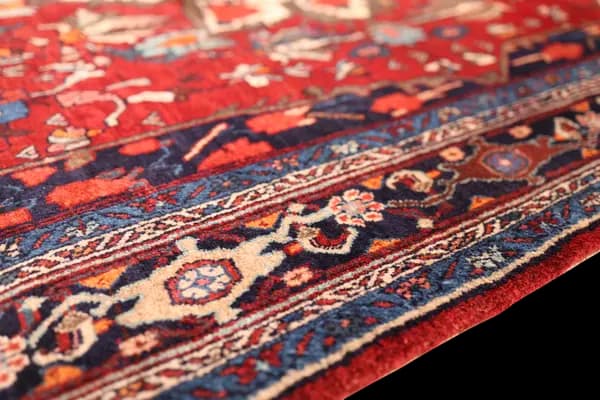
The field is a deep brick red, scattered thickly with small stylised flowers and leaves. At its centre sits a medallion drawn as an elongated star rather than the round form Garrous medallions usually take, its ivory body stretching the length of the field with sharp, anchor-like points reaching up and down into the red. Cream cartouche spandrels with floral sprays mark the corners, and a wide navy border, patterned with cream, rust, pink and turquoise vines, closes the design.
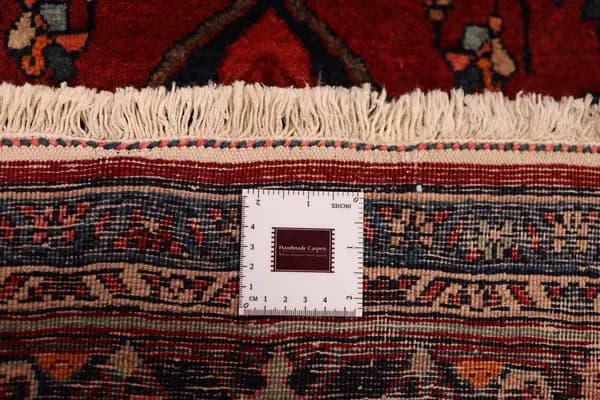
The elongated medallion is no accident of drawing: on a runner this narrow, a round medallion would sit lost in the red, so the weaver stretched it to fill the length, anchoring the whole design. That density is what Bijar country is known for: wool hand-knotted tightly onto a cotton warp, at up to 250,000 knots per square metre, giving a rug this age the surface tension of new wool. Woven from memory rather than a paper plan, the pattern still keeps its sharpness.
A runner this size suits a hallway or landing, and this one earns its keep. The brick red holds its own with no daylight, warming a stone or pale wood floor, while the navy border keeps the eye moving along its length. Underfoot it is dense and firm, built to be walked on, and the ivory medallion catches whatever light reaches it along the hall.
More on Garrous rugs: origin, making and how to recognise a genuine piece
Fine quality weave
At 331 × 145 cm (4.80 m²) this is a runner. It belongs in a hallway, an entrance, on a landing or lengthways beside a bed. It is too narrow for the middle of a room.
Yes, knotted by hand — knot by knot on a loom, not machine-made. The density is 201,000 to 250,000 knots per square metre; across 4.80 m² that is roughly 1.0 to 1.2 million individual knots, every one of them tied by hand.
Hand-spun wool still carries its own lanolin, which keeps liquid sitting on the surface for a moment: blot quickly, with clear water and a light cloth, working inwards and without rubbing. Otherwise regular vacuuming along the pile is enough. Turn the rug once or twice a year so light and footfall reach it evenly.
We are in the Hamburg Speicherstadt. Come and see this rug in daylight, or write to us — a person answers.
Certificate included verifying origin, materials, and craftsmanship.
Ref: 986361