Bidjar Garus
324 × 148 cm
936 €





10.500 €
Incl. VAT
In Stock · Ready to Ship
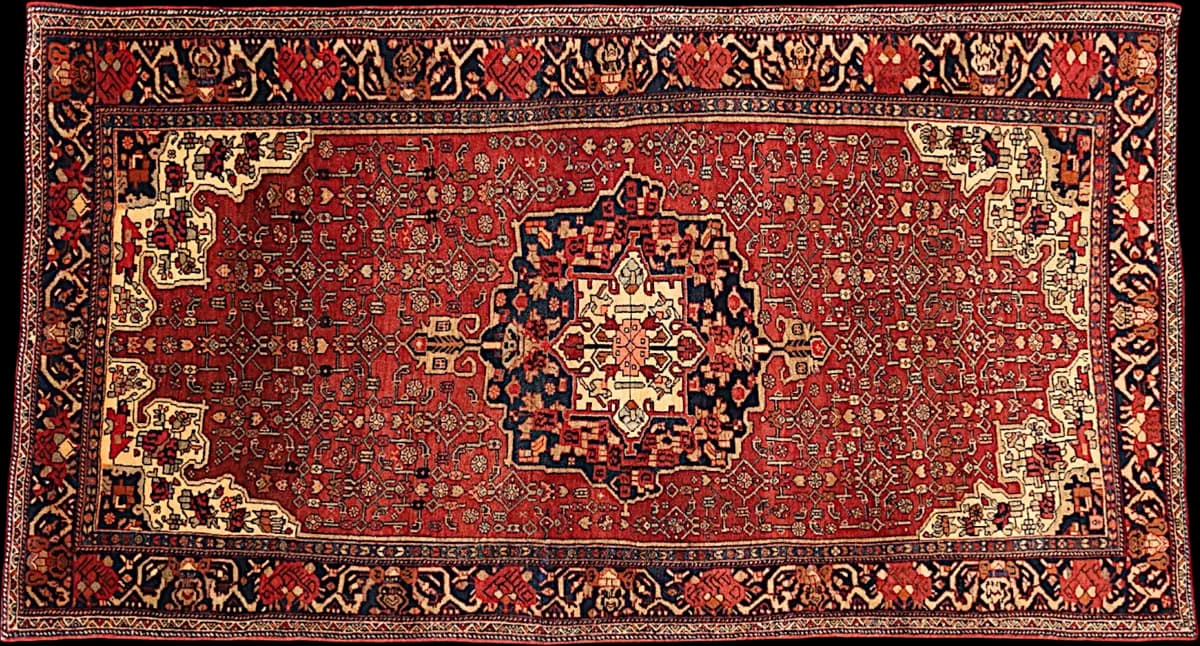
Garrous is the tribal name for the rugs woven by Kurdish highlanders around Bijar, in Iranian Kurdistan, and it stands for one thing above all: density so firm that Bijar weaving is nicknamed the iron rug of Persia. This piece measures 291 x 152 cm (9'7" x 5'0"), knotted by hand, and it carries that reputation with a clarity of drawing that is unusual even for the type — a Garrous, also written Garrus, that reads as much for its graphic sharpness as for its famous strength.
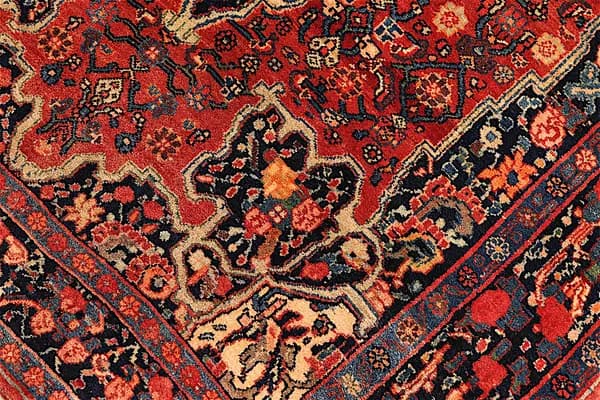
The first impression is a deep brick red field, densely scattered with small floral sprays, out of which an oversized ivory star medallion glows with unusual crispness. Rather than sitting alone, it is flanked by two smaller navy medallions, so the eye follows a line of three rather than settling on one centre. Navy corner spandrels, filled with the same florals as the field, hold the composition square, and a wide navy border carries a red-and-cream palmette vine, framed by several narrow guard stripes that keep the red field contained rather than letting it bleed to the edge.
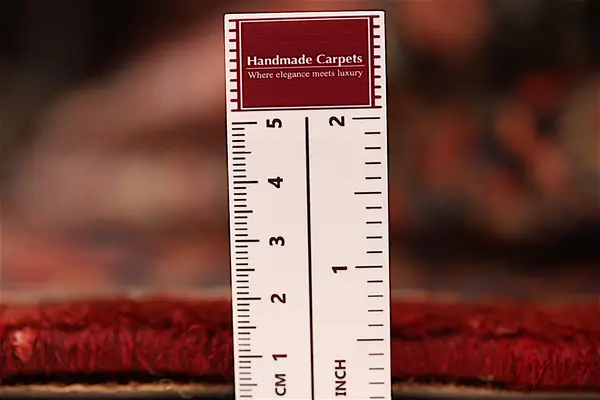
That contained clarity comes directly out of how the rug was built. The pile is hand-spun wool, knotted at 128,000 to 160,000 knots per square metre onto a cotton warp — a density well above what most tribal weavings attempt, and one that lets a Kurdish weaver working freehand, from memory, still draw an outline as clean as the ivory star here. The wool's uneven, hand-spun thickness is what gives the surface its soft matte face rather than any sheen, and at 15 mm the pile sits low enough to keep the drawing sharp underfoot rather than blurred. Sixty to eighty years of settling have only made that iron-like density more apparent.
A rug this size sits well in a living room, anchoring a sofa and a pair of chairs where the medallion can be read as a whole rather than crossed in passing. The red holds its own against dark wood or leather and warms a pale floor without needing help from anything else in the room. Underfoot it is dense and firm, built for a room that gets used rather than one that is kept for best, and the low, even pile will take that use for decades yet. As daylight moves across it through the day, the hand-spun wool catches the light unevenly, and the ivory star seems to lift slightly off the red each time.
More on Garrous rugs: origin, making and how to recognise a genuine piece
Traditional weave
At 291 × 152 cm (4.42 m²) this is a medium rug. It works in front of a sofa, in front of a bed or in a study. It is too small for a dining table — there you want about 80 cm of clearance so a chair does not tip over the edge when pushed back.
Yes, knotted by hand — knot by knot on a loom, not machine-made. The density is 128,000 to 160,000 knots per square metre; across 4.42 m² that is roughly 570,000 to 710,000 individual knots, every one of them tied by hand.
Hand-spun wool still carries its own lanolin, which keeps liquid sitting on the surface for a moment: blot quickly, with clear water and a light cloth, working inwards and without rubbing. Otherwise regular vacuuming along the pile is enough. Turn the rug once or twice a year so light and footfall reach it evenly.
We are in the Hamburg Speicherstadt. Come and see this rug in daylight, or write to us — a person answers.
Certificate included verifying origin, materials, and craftsmanship.
Ref: 823588