Belutsch
176 × 98 cm
428 €





536 €
Incl. VAT
In Stock · Ready to Ship
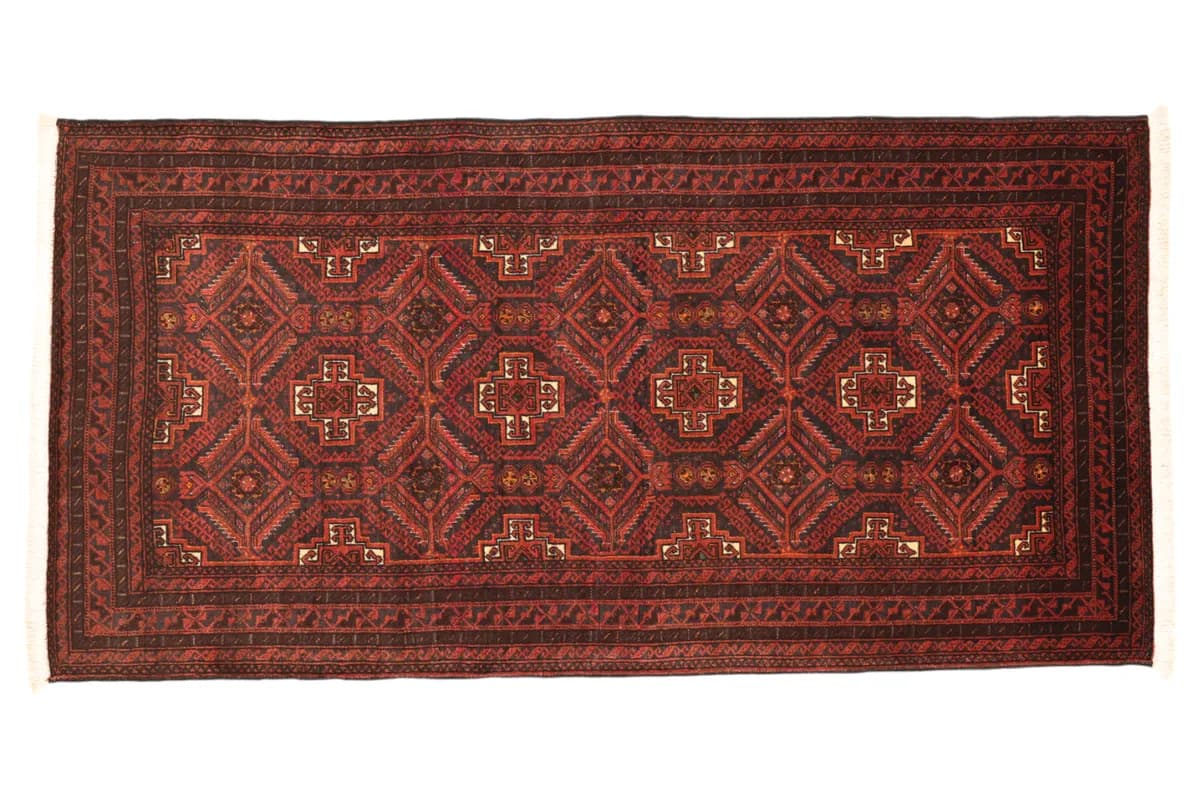
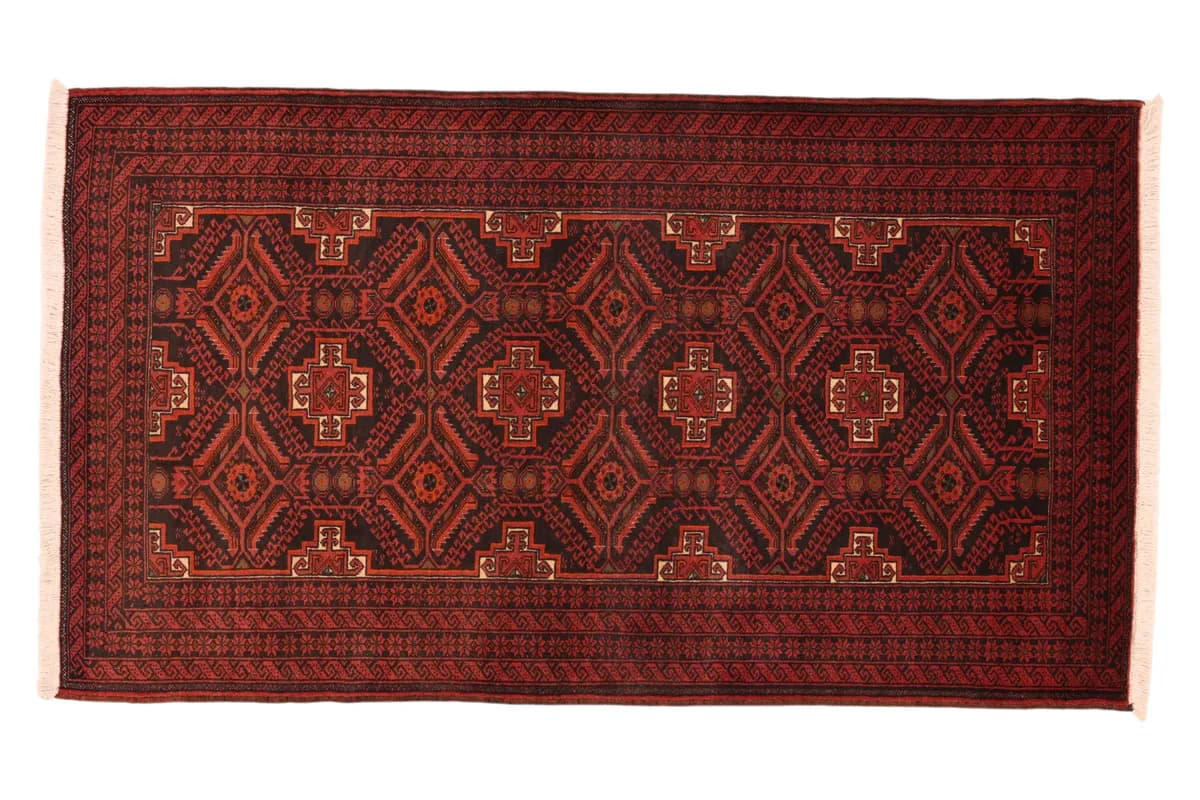
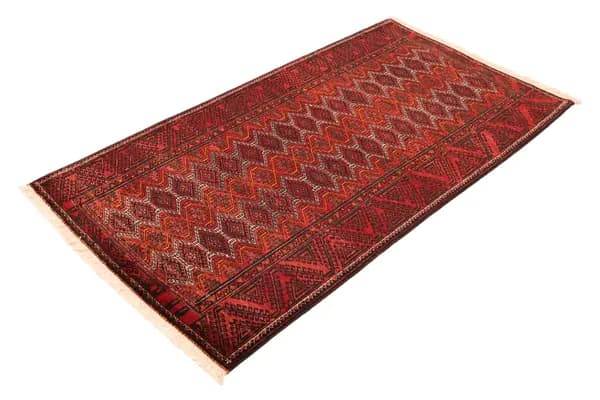
A Baluch, also written Belouch, a tribal weaving from the borderlands of south-eastern Iran, 180 x 97 cm (5'11" x 3'2"). These are nomadic rugs, knotted from memory on portable looms rather than drawn to a plan, and they are known above all for bold, angular geometry set against deep, earthy colour. This piece carries no prayer-niche design, the layout some Baluch rugs are known for. Instead the whole field is given over to one dense, continuous pattern, and it is the density that sets it apart.
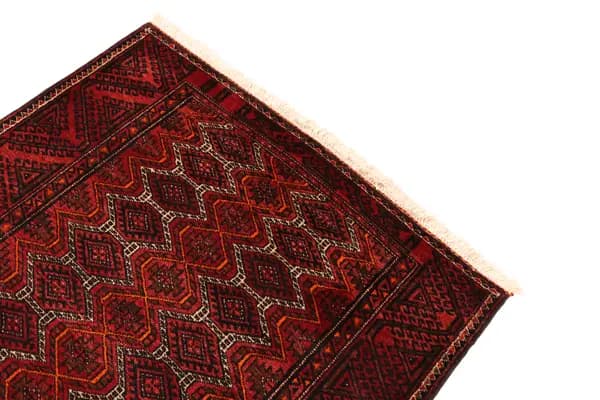
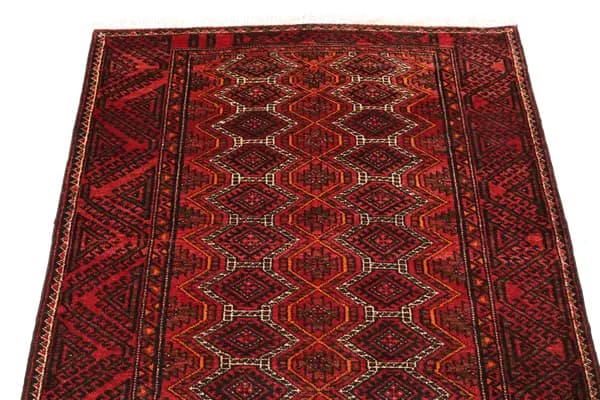
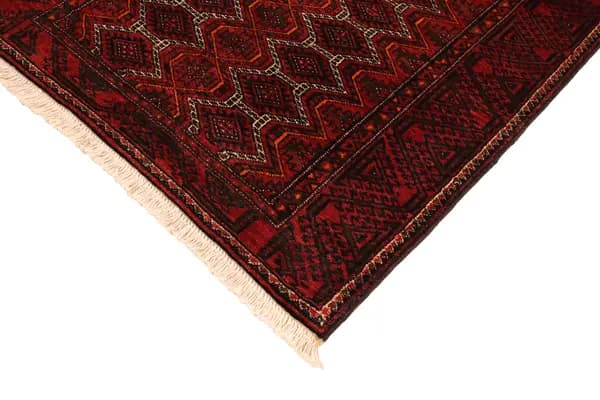
A deep brick red ground carries a tight lattice of ivory diamonds, their edges jagged rather than smooth, repeating across the entire field without a medallion to interrupt it. Look closely and the red shifts gently in tone from one area to the next, the kind of change that comes from wool dyed in small batches rather than one uniform vat. Several narrow zigzag borders in dark chocolate brown and red frame the field, with the occasional line of orange running through them, and together they form a band close to a fifth of the rug's width. What holds the eye is how evenly the lattice is spaced and how cleanly each diamond is drawn, more disciplined than the somewhat looser hand this type of weaving usually shows.
That discipline comes from the knotting itself. At 128,000 to 160,000 knots per square metre, hand-tied one by one from hand-spun wool on a cotton warp, the weaver had enough resolution in the grid to keep every diamond the same size and every zigzag point sharp, even working from memory rather than a cartoon. The pile sits at six millimetres, short enough to keep the pattern crisp rather than soft-edged, and the wool's own texture is still visible on the surface rather than smoothed away, which is why the piece reads as matte and grounded rather than glossy. Twenty to forty years of settling have given the colours their depth without dulling the contrast between red and ivory.
At this size the rug belongs somewhere lived-in but not central, a hallway, beside a bed, or in a study by the door, and the red will hold its warmth even where daylight is limited. Underfoot it is dense and firm, a weave built for a floor that gets walked on rather than one that asks to be spared. Morning light picks out the ivory lattice first, then settles into the red as the day goes on, and it is a pattern you keep noticing rather than one you stop seeing after the first week.
More on Baluch rugs: origin, making and how to recognise a genuine piece
Traditional weave
At 180 × 97 cm (1.75 m²) this is a small rug. It works beside a bed, in a reading corner, in front of a fireplace or as a mat by a door. It does not furnish a room; it makes a point in one.
Yes, knotted by hand — knot by knot on a loom, not machine-made. The density is 128,000 to 160,000 knots per square metre; across 1.75 m² that is roughly 220,000 to 280,000 individual knots, every one of them tied by hand.
Hand-spun wool still carries its own lanolin, which keeps liquid sitting on the surface for a moment: blot quickly, with clear water and a light cloth, working inwards and without rubbing. Otherwise regular vacuuming along the pile is enough. Turn the rug once or twice a year so light and footfall reach it evenly.
We are in the Hamburg Speicherstadt. Come and see this rug in daylight, or write to us — a person answers.
Certificate included verifying origin, materials, and craftsmanship.
Ref: 711913