Belutsch
180 × 100 cm
621 €








520 €
Incl. VAT
In Stock · Ready to Ship
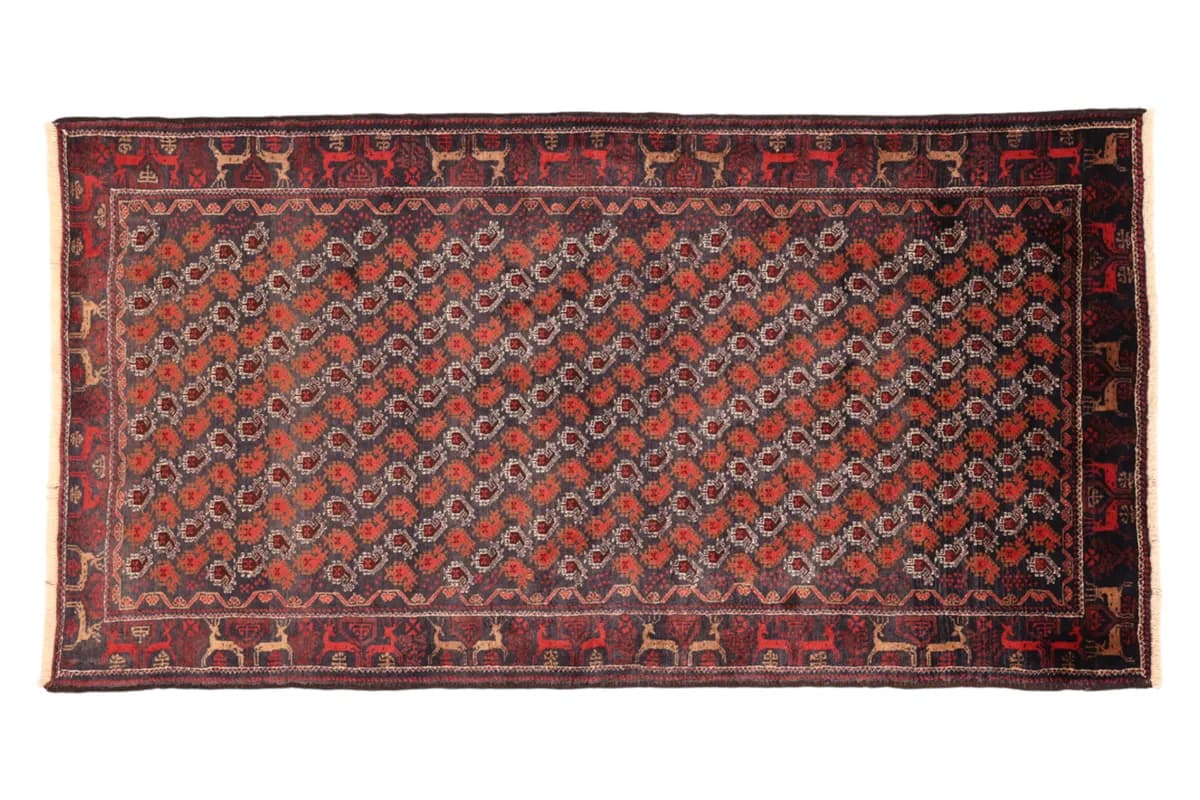
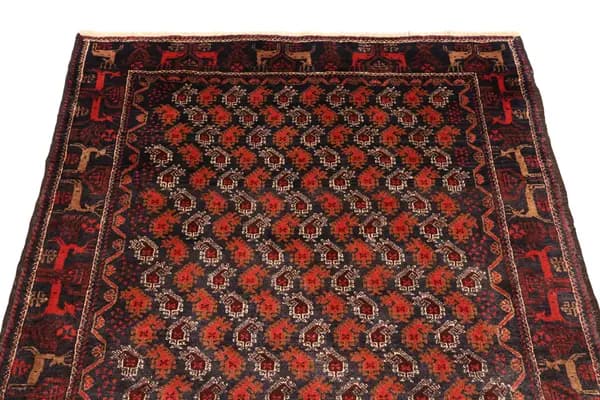
Baluch weavings come from the tribal borderlands of southeastern Iran, made by women on portable looms, knotted from memory rather than from any drawn plan. The type is known for deep, earthy colour and bold angular geometry, and for the prayer-niche layouts that turn up often in classic pieces. This one measures 210 x 110 cm (6'11" x 3'7") and takes a different route: instead of a mihrab, it carries a dense all-over field, and its real subject is the border.
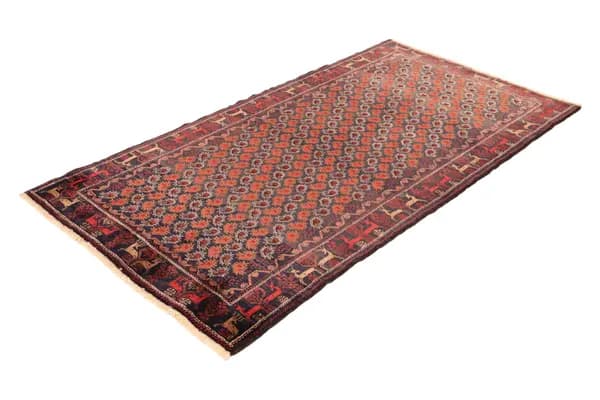
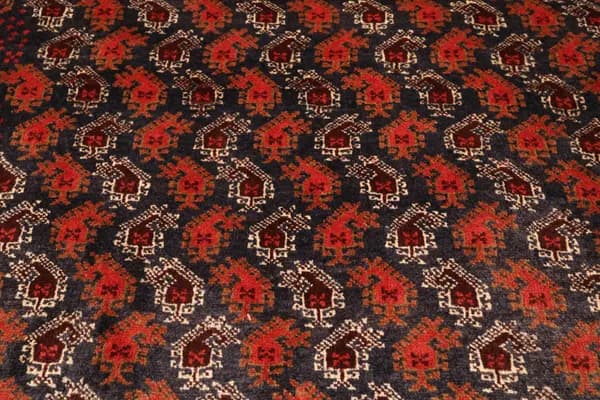
The field reads first, a dark slate blue-violet ground packed edge to edge with small paisley shapes in brick red and rust, set on the diagonal so the pattern seems to march rather than sit still. It is a disciplined field, small-scale and repetitive, the kind that recedes rather than announces itself. The border does the opposite. Wide, roughly a sixth of the rug's width, in dark navy, it carries a repeating row of stylised deer with antlers in red, cream and camel, clear enough to be read as animals rather than as another floral turn. Against the quiet field, the deer feel almost like a procession framing the piece.
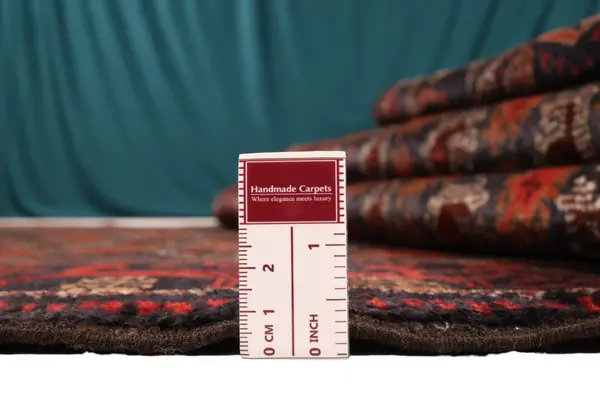
Hand-spun wool, knotted onto a cotton warp, gives the surface its particular character: the fibre varies slightly in thickness along its length, so the pile sits matte and slightly uneven rather than flat and glassy, and the deer in the border take on the soft, hand-drawn edge that comes from a weaver working from memory rather than a cartoon. At a density of 128,000 to 160,000 knots per square metre and a 6 mm pile, the weave is firm and close-packed without being fine in the workshop sense, which is exactly what lets a bold figurative motif like this read clearly rather than dissolve into detail.
At this size, the rug suits a study, a spot beside a bed, or a small hallway where it will be seen up close rather than across a room. The slate blue-violet ground holds its own against dark wood and quietens a pale floor, while the red and camel of the deer keep working even in low light. Underfoot it is dense and firm, hand-spun wool built for daily use rather than display, and worth revisiting each time the eye finds the deer again, still walking the border.
More on Baluch rugs: origin, making and how to recognise a genuine piece
Traditional weave
At 210 × 110 cm (2.31 m²) this is a small rug. It works beside a bed, in a reading corner, in front of a fireplace or as a mat by a door. It does not furnish a room; it makes a point in one.
Yes, knotted by hand — knot by knot on a loom, not machine-made. The density is 128,000 to 160,000 knots per square metre; across 2.31 m² that is roughly 300,000 to 370,000 individual knots, every one of them tied by hand.
Hand-spun wool still carries its own lanolin, which keeps liquid sitting on the surface for a moment: blot quickly, with clear water and a light cloth, working inwards and without rubbing. Otherwise regular vacuuming along the pile is enough. Turn the rug once or twice a year so light and footfall reach it evenly.
We are in the Hamburg Speicherstadt. Come and see this rug in daylight, or write to us — a person answers.
Certificate included verifying origin, materials, and craftsmanship.
Ref: 736326