Belutsch
175 × 96 cm
479 €






621 €
Incl. VAT
In Stock · Ready to Ship
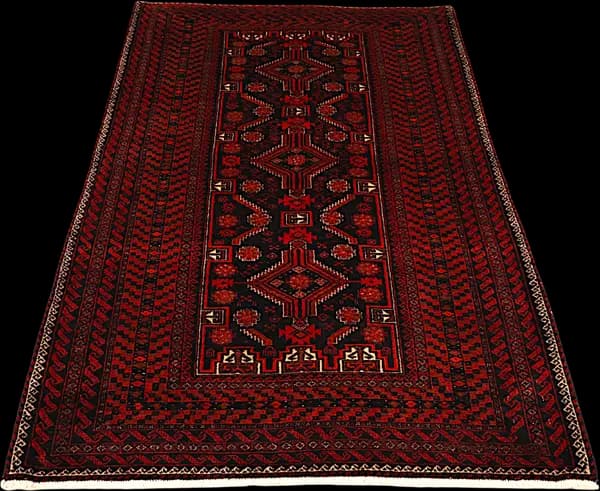
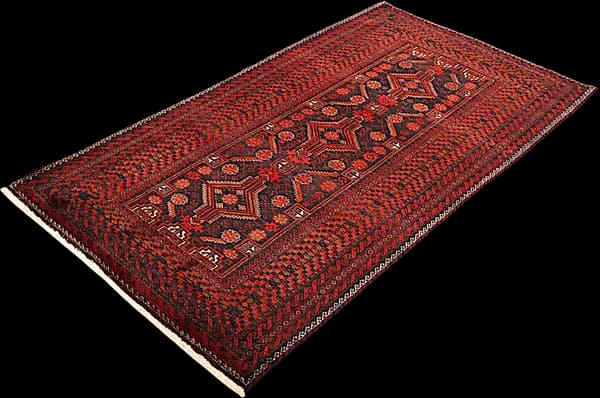
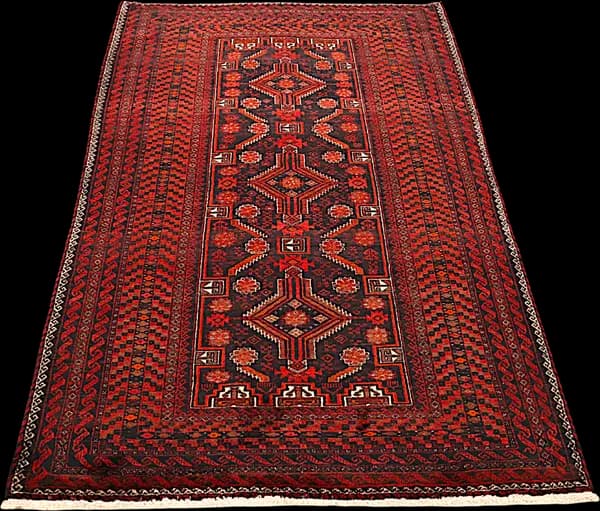
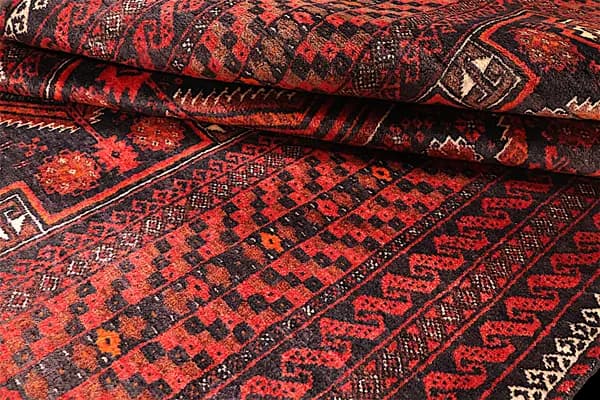
This is a Baluch runner, also written Belouch, a tribal weaving from the borderlands of southeastern Iran, 180 x 100 cm (5'11" x 3'3"). Baluch weavers are known for a bold, angular vocabulary of geometric medallions worked from memory rather than a drawn plan, and for a palette built on deep red and indigo against dark grounds. Here the weaver has chosen the Seh Torandj arrangement, three medallions in a column, a classic Baluch composition rather than the prayer-niche form the type is equally known for.
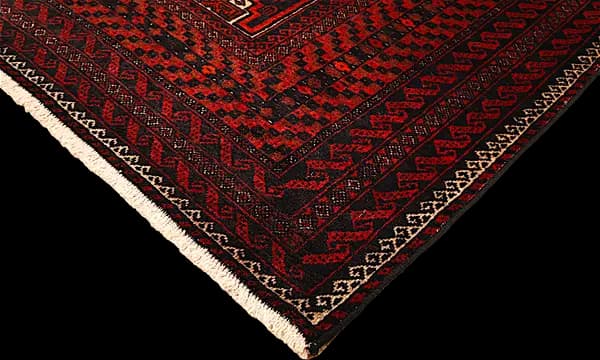
The field reads as a near-black ground, into which three large serrated diamond medallions are set one above the other, each surrounded by small scattered rosettes. Hooked leaf forms flank the medallions on either side, and small hooked shapes sit at the corners of each panel, a device that turns up often in Baluch weaving. All of this is held inside a wide stack of narrow borders, in red, ivory and dark grounds, patterned with zigzags and diamonds, taking up close to a fifth of the rug's width and pulling the eye outward from the dark centre.
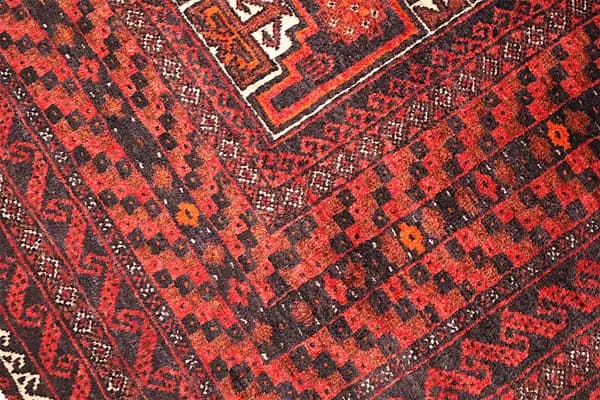
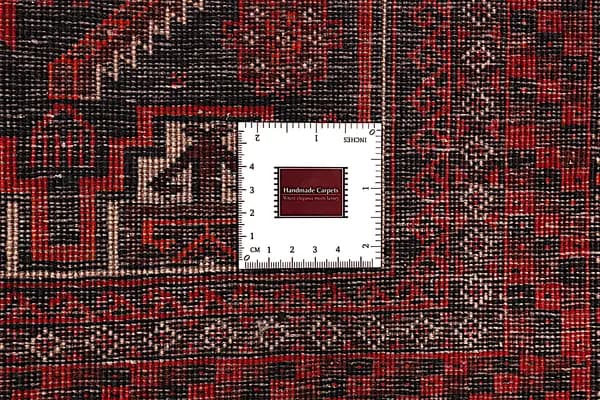
The wool here is hand-spun rather than machine-spun, so the strands vary slightly in thickness along their length, and that is what gives the surface its faint ribbed texture rather than a flat, even one. At a density of 128,000 to 160,000 knots per square metre, tied by hand over a cotton warp, the piece sits at a weight that favours a firm, close pile rather than a fine one, with the wool left at a generous 6 mm. Knotted without a cartoon, from memory, the column of medallions holds its order but not a machine's precision, which is exactly the character the design is prized for.
At this width, the rug belongs in a hallway or along a landing, or beside a bed where a runner is read end to end rather than taken in as a square. Against a pale floor the near-black field holds firm and grounds the space, while the brick red and ivory borders catch the eye down a corridor that gets little daylight. Underfoot it is dense and firm, a wool built to be walked on rather than kept for best, well suited to a passage that sees daily use. Morning light along its length brings up the rust and cream in the guard stripes before it reaches the medallions at all.
More on Baluch rugs: origin, making and how to recognise a genuine piece
Traditional weave
At 180 × 100 cm (1.80 m²) this is a small rug. It works beside a bed, in a reading corner, in front of a fireplace or as a mat by a door. It does not furnish a room; it makes a point in one.
Yes, knotted by hand — knot by knot on a loom, not machine-made. The density is 128,000 to 160,000 knots per square metre; across 1.80 m² that is roughly 230,000 to 290,000 individual knots, every one of them tied by hand.
Hand-spun wool still carries its own lanolin, which keeps liquid sitting on the surface for a moment: blot quickly, with clear water and a light cloth, working inwards and without rubbing. Otherwise regular vacuuming along the pile is enough. Turn the rug once or twice a year so light and footfall reach it evenly.
We are in the Hamburg Speicherstadt. Come and see this rug in daylight, or write to us — a person answers.
Certificate included verifying origin, materials, and craftsmanship.
Ref: 741175