Belutsch
210 × 110 cm
520 €





443 €
Incl. VAT
In Stock · Ready to Ship
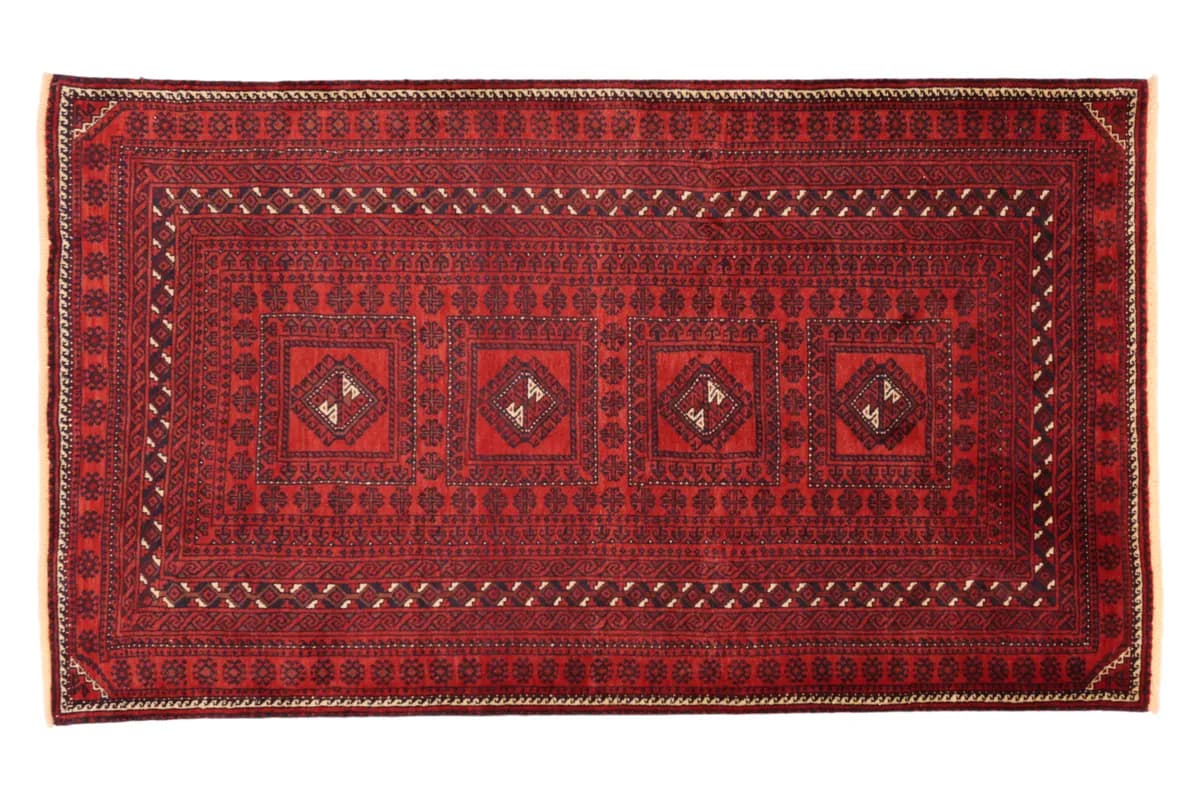
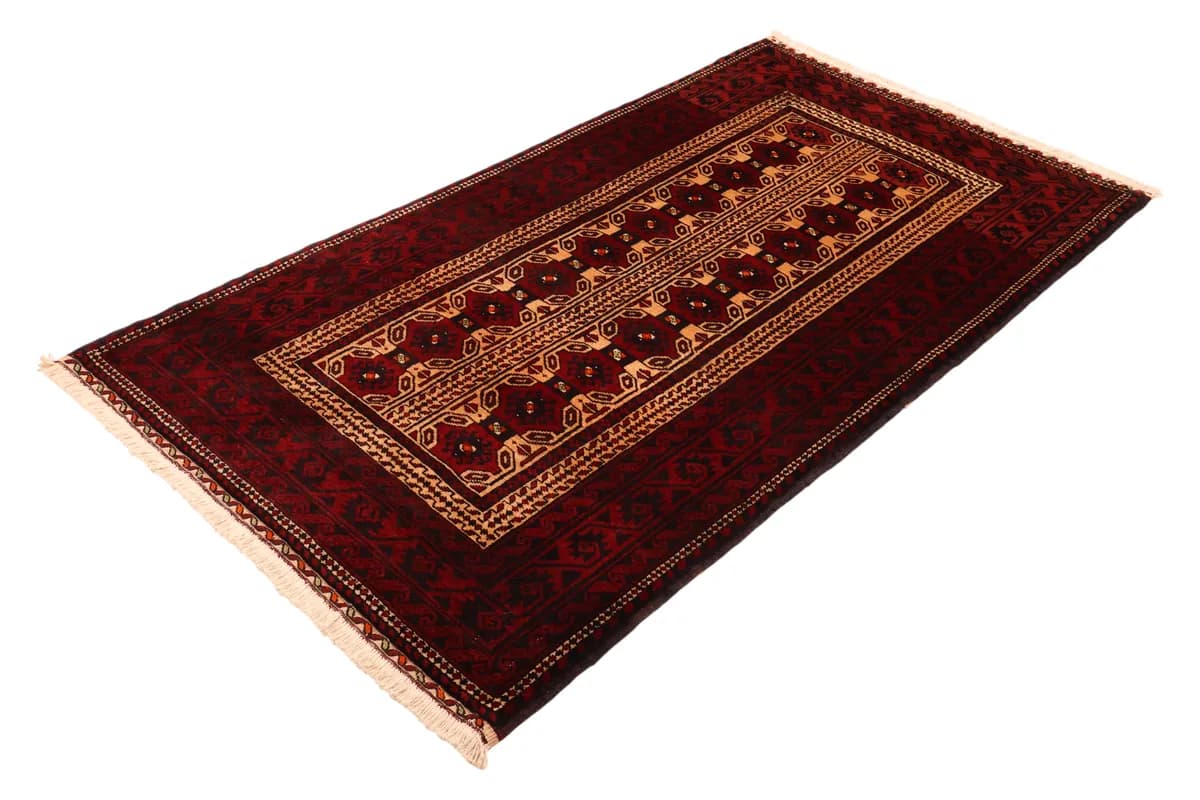
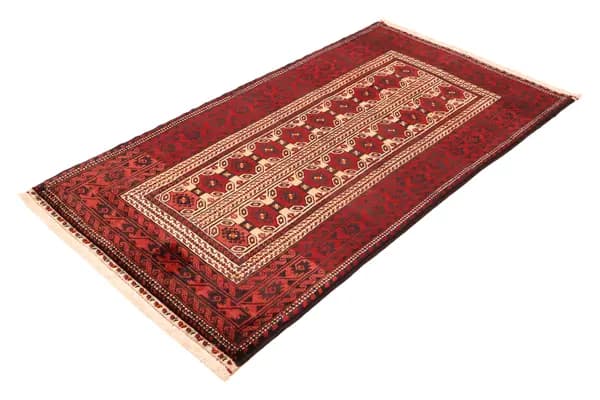
This is a Baluch, also written Baluchi, a tribal weaving from the borderlands of southeastern Iran, measuring 182 x 98 cm (6'0" x 3'3"). Rugs of this kind are known chiefly for bold, angular geometry and a rich earthy palette of deep red and indigo, most often arranged around a prayer-niche mihrab handed down through generations of weavers. Here the weaver has chosen a different order: not one niche but two mirrored rows of medallions, set out with the same geometric confidence.
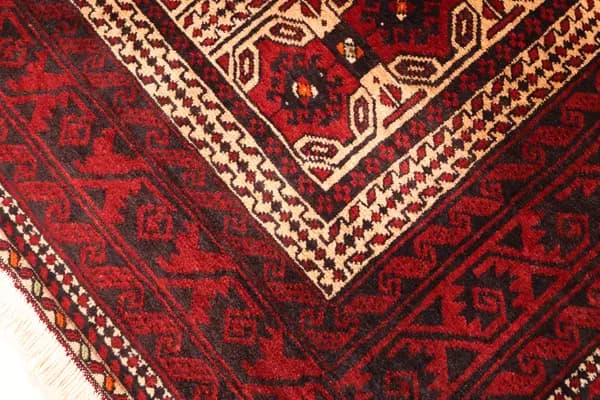
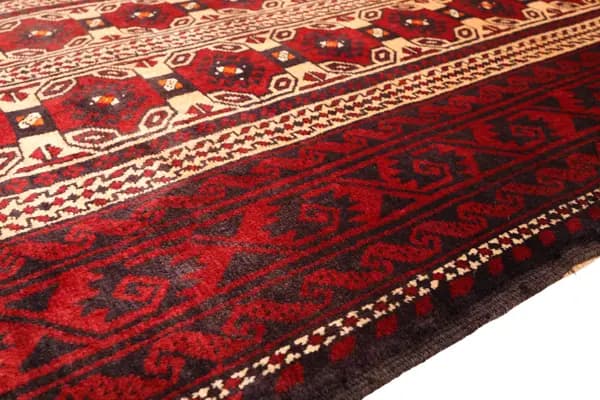
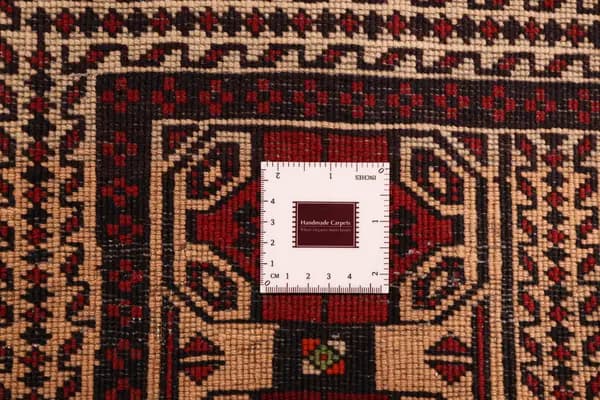
The first impression is of a grid, dark octagonal medallions marching in two disciplined rows across a warm ivory band, held deep inside a heavy border of red and near-black. Each medallion carries small internal accents of terracotta orange, sage green and dusty blue, the only departures from an otherwise strict red-cream-black scheme. The border itself runs in several bands of deep red and near-black, broken by a fine ivory hooked-diamond guard stripe that keeps the eye moving along its length before it settles.
The wool of the pile was spun by hand, which gives the surface its slightly uneven, matte character rather than the even sheen of a mill-spun yarn, and it sits on a cotton warp that shows as a light ribbing along the selvedge. At a density of around 128,000 to 160,000 knots per square metre, the weave is firm enough to hold the medallions in their crisp, repeating rows, even though the whole design was carried in the weaver's memory rather than drawn on paper. That combination, a fine order kept by hand rather than by cartoon, is what gives this piece its particular rhythm.
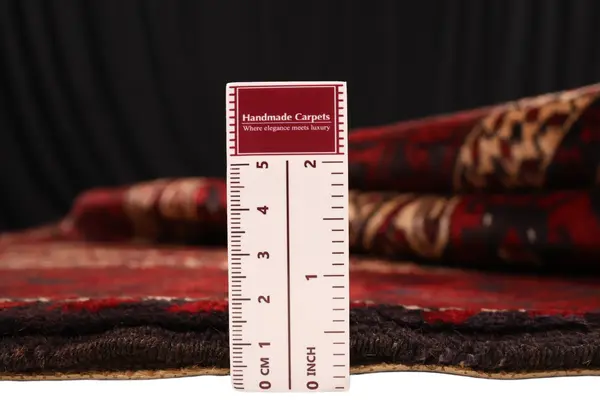
At just under a metre wide, it suits a hallway, a landing or the floor beside a bed rather than a large open room, and its deep red and near-black tones will hold their own against dark furniture while warming a pale floor underneath. The pile is dense and flat underfoot, six millimetres deep, firm rather than plush, and it is a rug made to be walked on daily rather than kept for best. As the light moves across it through the day, the small orange, sage and dusty blue flecks inside the medallions catch and let go in turn, the one warm surprise in a design built otherwise from red, cream and black.
More on Baluch rugs: origin, making and how to recognise a genuine piece
Traditional weave
At 182 × 98 cm (1.78 m²) this is a small rug. It works beside a bed, in a reading corner, in front of a fireplace or as a mat by a door. It does not furnish a room; it makes a point in one.
Yes, knotted by hand — knot by knot on a loom, not machine-made. The density is 128,000 to 160,000 knots per square metre; across 1.78 m² that is roughly 230,000 to 290,000 individual knots, every one of them tied by hand.
Hand-spun wool still carries its own lanolin, which keeps liquid sitting on the surface for a moment: blot quickly, with clear water and a light cloth, working inwards and without rubbing. Otherwise regular vacuuming along the pile is enough. Turn the rug once or twice a year so light and footfall reach it evenly.
We are in the Hamburg Speicherstadt. Come and see this rug in daylight, or write to us — a person answers.
Certificate included verifying origin, materials, and craftsmanship.
Ref: 729129