Kerman Ravar
259 × 183 cm
4.050 €



765 €
Incl. VAT
In Stock · Ready to Ship
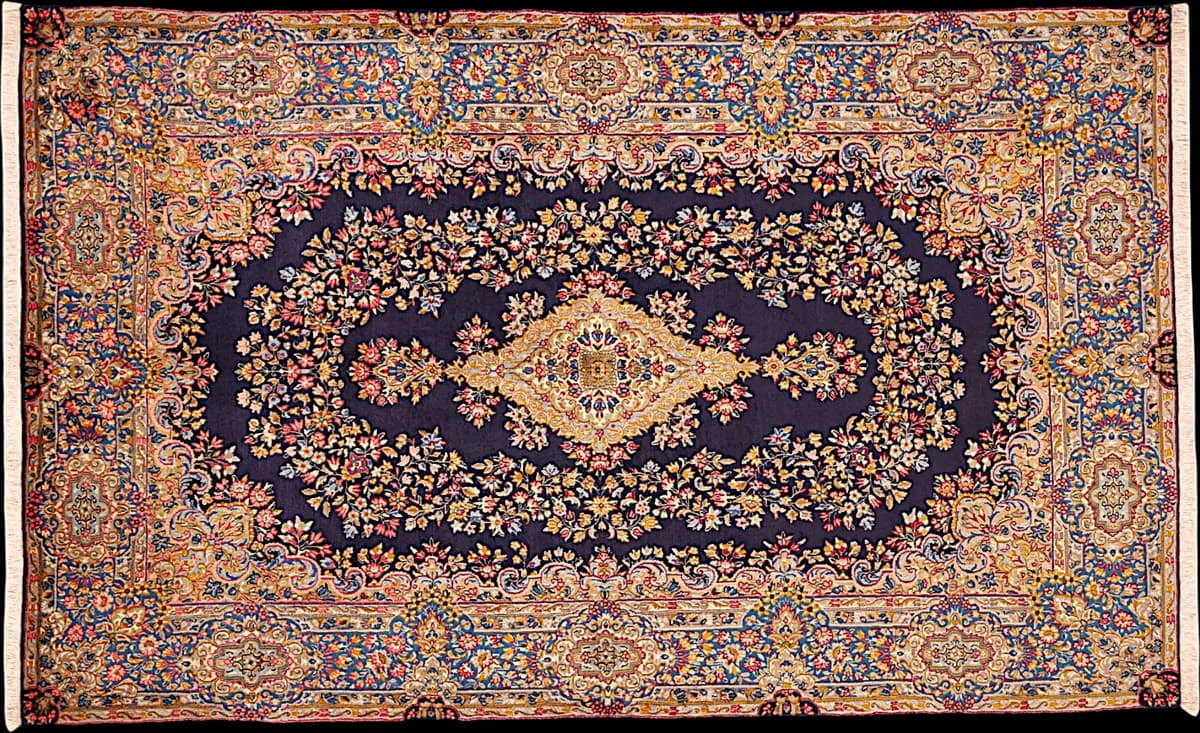
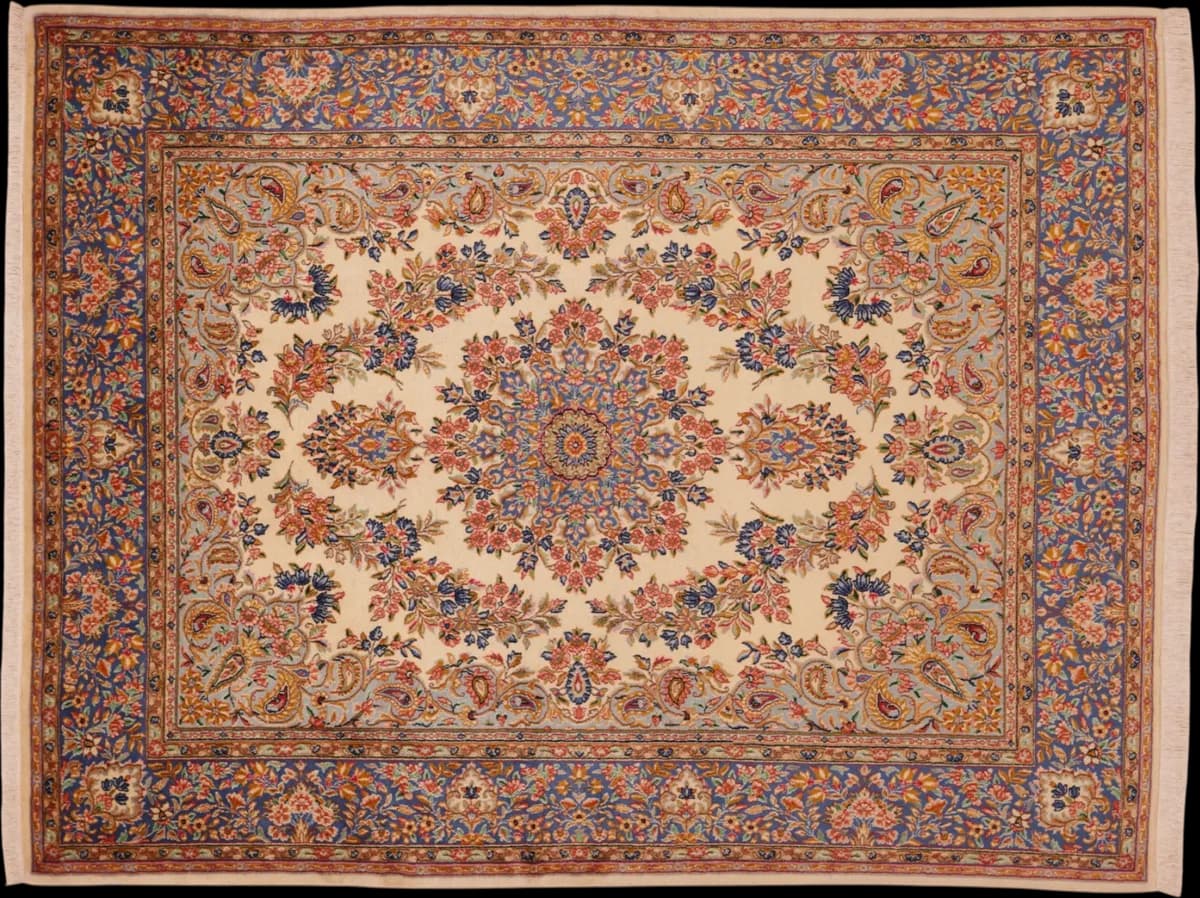
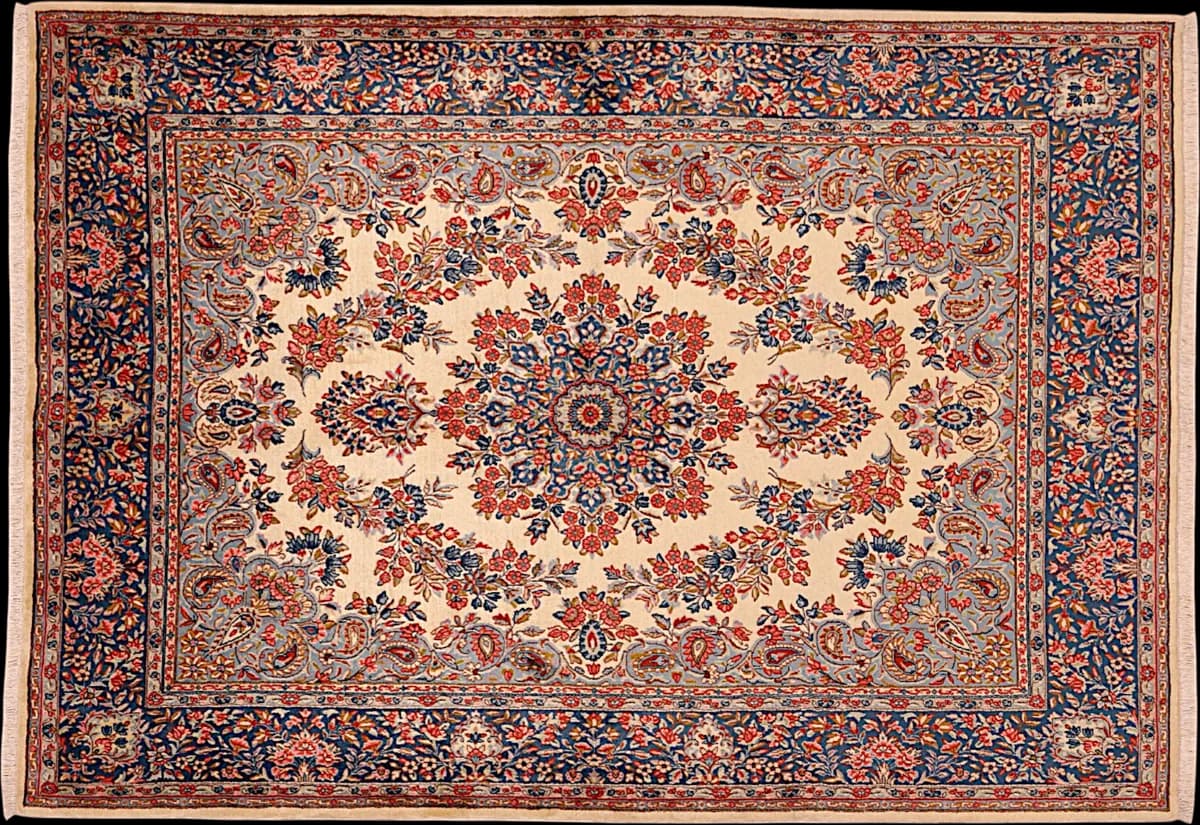
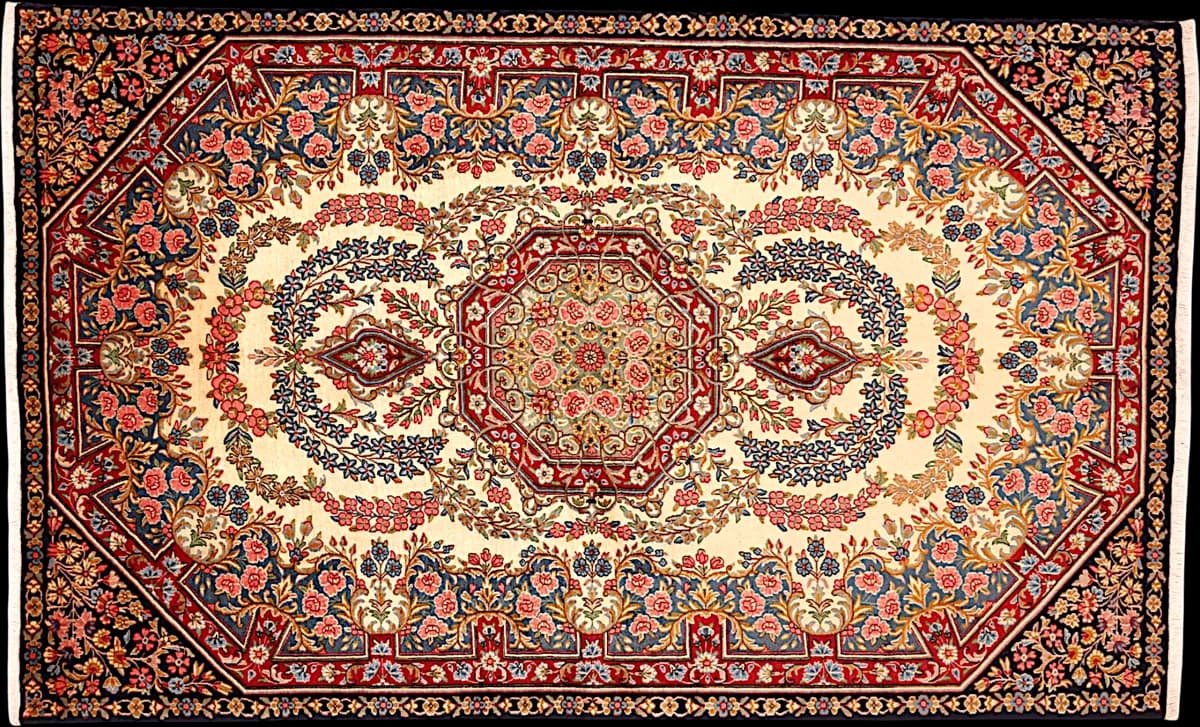
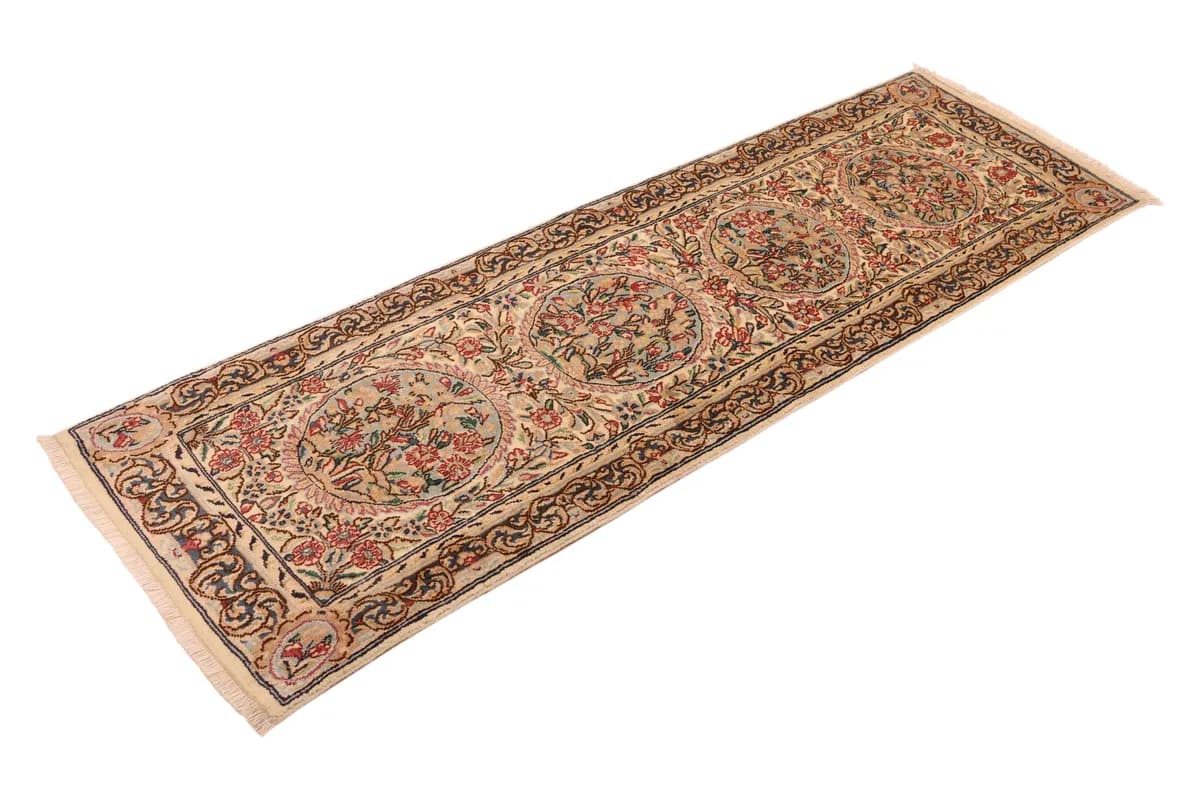
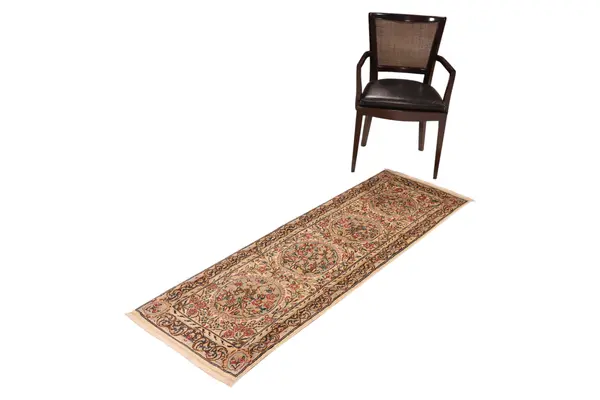
This is a Ravar rug, from the district of Kerman in south-eastern Iran, known in the trade as Lavar Kerman for the exceptional refinement its weavers reached from the Qajar era onward. Ravar pieces stand above ordinary Kerman work for their fine drawing and their traceable signatures, often the weaver's own worked quietly into the field. This one comes as a runner, 187 x 59 cm (6'2" x 1'11").
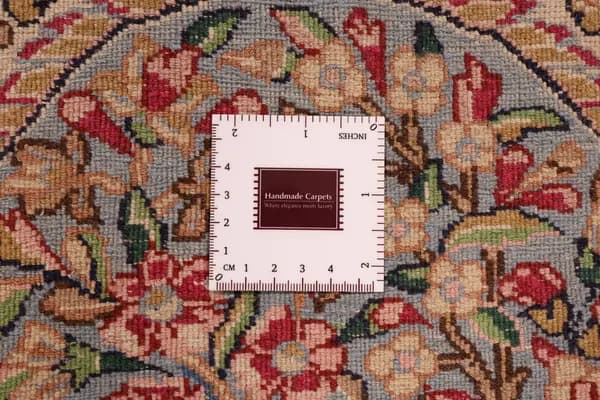
The field is a soft cream, dense with small floral sprays in dusty rose and brick red among sage-green leaves, so that from any distance the ground reads as a continuous garden rather than a plain backdrop. Down its length run four medallions in a single row rather than the one central roundel a Kerman usually carries, each interior a pale blue-grey shifting subtly from the last. A wide navy border closes the runner, its scrollwork in tan and rose standing firmly against the ivory field, with small cartouches marking the corners.
The pile is hand-spun wool, hand-knotted onto a cotton warp at 321,000 to 380,000 knots per square metre, fine enough to keep the roundels and the scrolling border crisp rather than blurred into the field. Clipped to a low 12 mm, the wool carries a light sheen rather than a deep lustre, the soft, faintly reflective finish typical of well-finished Kerman weaving. At this density, four medallions strung across a dense floral ground mean months of steady work at the loom.
A runner this narrow belongs in a hallway or along a landing, and this one earns its place: the cream field lifts a dark corridor, while the navy border holds firm against dark skirting or timber floors. Underfoot the fine, tightly clipped wool is dense and even, built for daily footsteps rather than careful preservation. Walk its length and the four medallions catch the light one after another, each pale roundel its own quiet variation on the one before.
More on Ravar rugs: origin, making and how to recognise a genuine piece
Superior craftsmanship
At 187 × 59 cm (1.10 m²) this is a runner. It belongs in a hallway, an entrance, on a landing or lengthways beside a bed. It is too narrow for the middle of a room.
Yes, knotted by hand — knot by knot on a loom, not machine-made. The density is 321,000 to 380,000 knots per square metre; across 1.10 m² that is roughly 350,000 to 420,000 individual knots, every one of them tied by hand.
Hand-spun wool still carries its own lanolin, which keeps liquid sitting on the surface for a moment: blot quickly, with clear water and a light cloth, working inwards and without rubbing. Otherwise regular vacuuming along the pile is enough. Turn the rug once or twice a year so light and footfall reach it evenly.
We are in the Hamburg Speicherstadt. Come and see this rug in daylight, or write to us — a person answers.
Certificate included verifying origin, materials, and craftsmanship.
Ref: 716074